

K
Khách
Hãy nhập câu hỏi của bạn vào đây, nếu là tài khoản VIP, bạn sẽ được ưu tiên trả lời.
Các câu hỏi dưới đây có thể giống với câu hỏi trên
HK
4
1 tháng 6 2017
Nguyên tắc thêm đuôi ing 1: Động từ tận cùng bằng e, ta bỏ e rồi mới thêm ing
Ví dụ:
drive => driving
Nhưng không bỏ e khi động từ tận cùng bằng ee.
Ví dụ:
agree => agreeing
Nguyên tắc thêm ing 2: Động từ tận cùng bằng ie, ta biến ie thành ying.
Ví dụ:
lie => lying
Nhưng động từ tận cùng bằng y vẫn giữ nguyên y khi thêm ing.
Ví dụ:
Nguyên tắc thêm ing 3: Ta nhân đôi phụ âm cuối trước khi thêm -ing khi động từ một âm tiết tận cùng bằng “1 nguyên âm + 1 phụ âm”.
Ví dụ:
put => putting
4.Nguyên tắc thêm ing 4: Trong trường hợp động từ có từ hai âm tiết trở lên, ta chỉ nhân đôi phụ âm khi dấu nhấn âm rơi vào âm tiết cuối cùng.
Ví dụ:
preˈfer => preˈferring
Nhưng không nhân đôi phụ âm khi dấu nhấn âm không rơi vào âm tiết cuối.
Ví dụ:
open => opening
enter => entering
VY
2 tháng 6 2017
1.
- Khi động từ tận cùng bằng một –e, ta phải bỏ -e trước khi thêm –ing
Ex: love --> loving, write --> writing, etc.
Nhưng nếu động từ tận cùng bằng –ee, ta vẫn giữ nguyên chúng:
Ex: free --> freeing, see --> seeing, knee --> kneeing
2.
- Khi động từ một vần tận cùng bằng một phụ âm (trừ h, w, x, y), đi trước là một nguyên âm, ta gấp đôi phụ âm trước khi thêm –ing.
Ex: stop--> stopping, run--> running, etc.
- Nhưng:
Fix--> fixing, play--> playing (vì có x, y) ở cuối từ.
Greet--> greeting (đi trước bằng 2 nguyên âm)
Work--> working (đi trước bằng 2 phụ âm)
- Quy luật này cũng áp dụng cho động từ 2 vần, miễn là dấu nhấn trọng âm nằm trên vần cuối cùng:
Be’gin --> beginning, pre’fer --> preferring
Nhưng ‘suffer --> suffering (vì dấu nhấn nằm ở vần đầu)
- Các động từ tận cùng bằng “l” thường được gấp đôi (Mĩ: không gấp đôi)
3.
- Một vài trường hợp cần phải thuộc lòng:
Die--> dying, lie --> lying, tie --> tying (hoặc tieing).
9 tháng 10 2023
1. sing 2. draw 3. cut 4. read 5. dance 6. get 7. act | singing drawing cutting reading dancing getting acting | hát vẽ cắt đọc khiêu vũ nhận/ trở nên diễn xuất |
25 tháng 9 2018
1.Change the following verbs into V-ing forms ( chuyển những động từ sau sang V ing).
1.arriving 7.copying
2.loading 8.riding
3.lying 9.watching
4.going 10.sitting
5.writing 11.having
6.getting 12.listening
HN
25 tháng 9 2018
1.Change the following verbs into V-ing forms ( chuyển những động từ sau sang V ing).
1.arrive->arriving
7.copy->copying
2.load->loading
8.ride->riding
3.lie->lieing
9.watch->watching
4.go->going
10.sit->sitting
5.write->writing
11.have->having
6.get->getting
12.listen->listening
DT
24 tháng 7 2021
1 isn't riding
2 am not playing
3 aren't sitting
4 am not eating
5 isn't doing
6 isn't brushing
7 isn't talking
8 isn't sleeping
9 isn't doing
10 isn't watching
11 aren't going
24 tháng 7 2021
1.Miss.Nhung(not ride)...isn't riding.............her bike to work.
2.I(not play).....am not playing.......video game now.
3.We (not sit)...are not sitting..............in the living room.
4.I (not eat).....am not eating.......my breakfast at a food store.
5.My sister(not do) is not doing her homework
6.She (not brush).....isn't brushing.........her teeth now.
7.Mark (not talk)..isn't talking...........to a friend at the momemt.
8.The cat (not sleep).....isn't sleeping............under the table at the momemt.
9.Lan(not do).....isn't doing.....her homework.
10.My sister(not watch) ...ian't watching...............television.
11.They(notgo) ....aren't going.........to school now.
15 tháng 12 2018
Minh chon la (2) vi day la ban thich chu ban ko lam gi ca ban
nhe
15 tháng 12 2018
cho mik hỏi khi đặt câu với (to) thì thêm đuôi ing vào V ( động từ)
VD: i playing football
Vậy khi đặt câu hỏi nghi vấn với ' ' thì có thêm đuôi ing vào cuối động từ không?
=====> Có nhé
Hãy chọn cho mik nhé!
(1) do you playing football? ===>đúng
(2) do you play football
những động từ theo sau VIng, to V hay V dù là khẳng đinh ,phủ định hay nghi vấn thì vẫn cộng bình thường
vd: +)you eating rice
-)you don't eating rice
? )DO you eating rice?
( + Ving hoặc to V )
Hay
+)You would to eat rice.
-)You would not to eat rice.
?)would you to eat rice.?
(would + to V )
T
11 tháng 11 2019
khẳng định
- S + V(s/es) + ……
I, You, We, They + V (nguyên thể)
He, She, It + V (s/es)
phủ định
- S + do/ does + not + V (nguyên thể)
do not = don’t
does not = doesn’t
nghi vấn
- Yes – No question (Câu hỏi ngắn)
Q: Do/ Does (not) + S + V(ng.thể)..?
A: Yes, S + do/ does.
No, S + don’t/ doesn’t.
- Wh- questions (Câu hỏi có từ để hỏi)
Wh- + do/ does (not) + S + V(nguyên thể)….?
11 tháng 11 2019
https://www.voca.vn/blog/thi-hien-tai-don-trong-tieng-anh-488
DT
24 tháng 7 2021
1 is riding
2 am playing - is watching
3 are sitting
4 am eating
5 is doing
6 is brushing
7 is talking
8 is sleeping
9 is doing
10 is watching
11 are going
12 are playing
13 is sitting
14 are eating
15 is having
LT
24 tháng 7 2021
Chia động từ ở thì HTTD với thể khẳng định.
S+Am/is/are+V-ing+......
1.Miss.Nhung(ride)...are riding......her bike to work
2.I(play).....am playing....video games and my sister(watch).......is watching.......TV.
3.We(sit)....are sitting...in the living room.
4.I(eat)....am eating.....my breakfast at a food store.
5.My sister(do)...is doing.... her homework.
6.She (brush).....is brushing......... her teeth now.
7.Mark(talk)...........is talking......to a friend at the momemt.
8.The cat (sleep)......is sleeping..........under the table at the momemt.
9.Lan (do)...is doing.......her homework.
10.My sister (watch).....is watching........television.
11.They(go)...are going.........to school now.
12.Dung and I(play).....are playing....soccer.
13.This boy (sit)..........is sitting........on the bench.
14.We (eat) are eating a big breakfast at the momemt.
15.He (have)......is having...dinner with her.
T
10 tháng 11 2019
thể khẳng định :
- S + V(s/es) + ……
I, You, We, They + V (nguyên thể)
He, She, It + V (s/es)
thể phủ định:
- S + do/ does + not + V (nguyên thể)
do not = don’t
does not = doesn’t
Thể Nghi vấn :
- Yes – No question (Câu hỏi ngắn)
Q: Do/ Does (not) + S + V(ng.thể)..?
A: Yes, S + do/ does.
No, S + don’t/ doesn’t.
- Wh- questions (Câu hỏi có từ để hỏi)
Wh- + do/ does (not) + S + V(nguyên thể)….?
10 tháng 11 2019
Cách chia V-s hoặc V-es
– Bỏ y và thêm ies vào sau các động từ kết thúc bởi một phụ âm + y:study-studies;…
~Thêm es vào các động từ kết thúc bằng ch, sh, x, s: watch-watches;miss-misses; wash-washes; fix-fixes;…
– Thêm s vào đằng sau hầu hết các động từ: want-wants; work-works;…
– Động từ bất quy tắc: Go-goes; do-does; have-has.
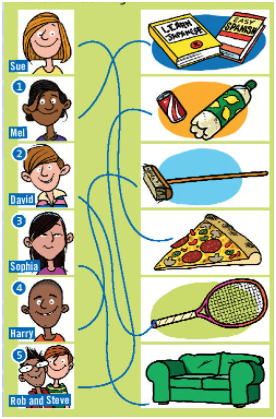
12 tháng 10 2023
Sue likes eating pizza. (Sue thích ăn bánh pizza.)
1. Mel enjoys reading books.
2. David doesn't like playing tennis.
3. Sophia really likes sitting on the sofa.
4. Harry doesn't mind doing housework.
5. Rob and Steve love drinking fizzy drinks.
appear (hình như, có vẻ)
believe (tin)
belong (thuộc về)
have (có)
hear (nghe)
know (biết)
like (thích)
look (có vẻ)
love (yêu, thích)
mean (có nghĩa)
need (cần)
own (có, là chủ của)
prefer (thích hơn)
remember (nhớ lại)
see (thấy)
seem (dường như)
smell (có mùi)
sound (nghe có vẻ)
taste (nếm)
think (nghĩ)
understand (hiểu)
want (muốn)
wish (ước)
không chia Ving thì là chia TO V và chia Vnt nha,mk cho bn 1 số từ thông dụng nha
+to V:
refuse :từ chối remember(khi mang nghĩa nhớ để làm)
forget(giống vs remember) promise:hứa
need:cần seem:có vẻ
try:cố gắng làm j(còn thử làm gj mới là Ving)
manage:xoay xở want:muốn
would like:thích j prefer:thích hơn
offer:yêu cầu
+V nt
must,should,had better,would,would rather,have to...........
SAU các từ để hỏi thì + to V nha bạn :who,what,how,which...
CHÚC BẠN HỌC TỐT!
a. Khi những động từ này ở bất kì thì tiếp diễn nào, ta không thể dùng ‘V-ing’
e.g : I’m beginning to learn French .
I was starting to leave home for school .
b. Với những động từ chỉ suy nghĩ, hiểu biết à phải dùng ‘to-V’ (think, understand, remember, forget, realize, recognize, appreciate, comprehend, know, ….etc . )
e.g : I begin to understand him .
I start to forget all about this event .
c. Với những từ chỉ tình cảm, cảm xúc ta không dùng ‘ V-ing’
( love, hate, miss, admire, respect, adore,…etc )
e.g: I stop to miss him .
d. Động từ chỉ cảm giác ( feel, hear, see, smell, taste…etc ) à ta không dùng ‘Ving’
e.g : I begin to feel hot .
This soup starts to taste sour .
e. Động từ sở hữu ( have, posess, own, belong to) ta không dùng hình thức ‘V-ing’
e.g: This house begins to belong to you today .
A. Động từ luôn được theo sau bởi to infinitive:
1 . to ask e.g : He asked me to see you.
2. to afford e.g : I can’t afford to buy the farm.
B. Động từ luôn được theo sau bởi V-ing :
1. to enjoy e.g : I enjoy reading novels .
2. to appreciate e.g : She appreciates being given that chance .
C. động từ được theo sau bởi “ to-infinitive” và “ V-ing”
1. ‘ begin, start, continue, commence, cease’
_ Dùng ‘ V-ing’ hay ‘ to-V’ nghĩa không đổi
e.g : He started to learn ( learning ) English 6 years ago .
_ Với hành động kéo dài, ta thường dùng ‘ V-ing’ ; với hành động ngắn ta nên dùng ‘to-V’
e.g : I began teaching English 19 years old .
She began to feel worried and anxious .
a. Khi những động từ này ở bất kì thì tiếp diễn nào, ta không thể dùng ‘V-ing’
e.g : I’m beginning to learn French .
I was starting to leave home for school .
b. Với những động từ chỉ suy nghĩ, hiểu biết à phải dùng ‘to-V’ (think, understand, remember, forget, realize, recognize, appreciate, comprehend, know, ….etc . )
e.g : I begin to understand him .
I start to forget all about this event .
c. Với những từ chỉ tình cảm, cảm xúc ta không dùng ‘ V-ing’
( love, hate, miss, admire, respect, adore,…etc )
e.g: I stop to miss him .
d. Động từ chỉ cảm giác ( feel, hear, see, smell, taste…etc ) à ta không dùng ‘Ving’
e.g : I begin to feel hot .
This soup starts to taste sour .
e. Động từ sở hữu ( have, posess, own, belong to) ta không dùng hình thức ‘V-ing’
e.g: This house begins to belong to you today .
2. ‘ Can’t / couldn’t bear’
_Dùng được ở ‘V-ing’ lẫn ‘to-V’ ( ‘V-ing’ phổ biến hơn )
e.g : I can’t bear talking / to talk to him . He is rude .
_ ‘ Can’t stand / couldn’t stand’ + V-ing
e.g : She can’t stand answering the phone all day .
_ ‘ Endure / withstand ‘ + V-ing (chịu đựng )
e.g : How can you endure living with such a jealous husband ?
3. Intend (có ý định )
_ Dùng với ‘V-ing’ và ‘to-V’ ( ‘to-V’ phổ biến hơn )
e.g : I don’t intend to leave / leaving my present job .
_ Khi có túc từ, ta phải dùng ‘ to-V’
e.g : He intends his wife to open a fashion shop .
_ ‘ Have an ( no) intention of ‘ + V-ing .
e.g : ihave an intention of leaving my present job
4. ‘ allow, permit, advise, recommend ‘
_ Nếu có túc từ, ta phải dùng ‘ to-V’ . Ngược lại dùng V-ing
e.g : He advised housewives to buy big tins as it is more economical .
He advised buying big tins as it is more economical .
_ ‘allow, permit’ + V-ing à khi không có túc từ e.g : They allow parking here .
5. ‘Need, want, require ‘
_Dùng với ‘V-ing’ hoặc ‘to-V’ ở bị động
e.g: This car needs washing = This car needs to be washed .
_ Ta dùng ‘ to-V’ nếu nghĩa của nó không phải bị động
e.g : I want to go home now .
6. ‘Remember, forget, stop, go on, regret’
a. ‘ Remember’
_ ‘ Remember’ + V-ing : nhớ đã làm cái gì rồi
e.g : I remember clocking the door .
_ ‘ Remember’ + to-V : nhớ phải / sẽ làm gì .
e.g : Remember to clock the door carefuully before going home .
b. ‘Stop’
_ ‘Stop’ + V-ing : dừng việc đã đang làm
e.g : I want to stop smoking .
_ ‘Stop’ + to-V : dừng một hành động để làm cái khác .
e.g : I stopped to buy some petrol .
c. ‘go on’
_ ‘go on’ + V-ing : tiếp tục những việc đang / đã đang làm .
e.g : I went on typing .
_ ‘go on’ + to-V : đổi việc này sang việc khác .
e.g: He was sleeping and he woke up when the teacher called him but he went on to
talk to the girl beside him .
d. ‘regret’
_ ‘Regret’ + V-ing : tiếc về việc đã làm
e.g : I regret spending too much money last week .
_ ‘ regret’ + to-V : xin lỗi trước khi thông báo tin xấu .
e.g : I regret to tell you that you can’t meet our requirements .
e. ‘ Try’
_ ‘Try ‘ + V-ing : làm gì để đi đến kết quả . (thử )
_ ‘Try’ + to-V : nổ lực làm điều gì, thường là khó khăn
e.g : The booking office often was crowded but I tired to buy a ticket .
Try outting on this hat to see if it suits you .
8. ‘Interest’
_ ‘Interest’ + V-ing : đề cập đến điều gì xảy ra .
e.g : I’m interested in buying a computer .
_ ‘Interest’ + to-V : đề cập đến điều gì đã xảy ra .
e.g: I’m interest to meet you today .
9. ‘Sorry’
a. ‘ Sorry’ + for + V-ing : xin lỗi về điều đã làm
e.g : I’m sorry to ringing too late last night .
b. ‘ Sorry’ + to-V : xin lỗi điều gì dự định làm .
e.g : Sorry to interrupt you, but I have a question to ask you .
c. ‘Sorry’ + that + clause :
* Thông báo tin xấu :
e.g : I’m sorry that you have failed in your driving test .
* Từ chối lời đề nghị :
e.g : We’re sorry that we cannot lend you the money .
d. ‘Sorry’ + for + noun e.g : I’m sorry for the accident .
e. ‘Sorry’ + about + noun : thông cảm điều gì đó
e.g : I’m sorry about that .
10. ‘Afraid’
a. ‘ Afraid’ + of + V-ing : những gì mà ta không kiểm soát, chọn lựa, quyết định .
b. ‘ Afraid’ + to-V : những gì mà ta kiểm soát, chọn lựa, quyết định .
e.g : I’m afraid to touch to the contact as I’m afraid of dying .
c. ‘Afraid’ + of + noun / pronoun
e.g : I’m afraid of ghost .
d. ‘Afraid’ + that + clause
* Đưa tin xấu : e.g : I’m afraid that you cannot meet our requirements .
* Từ chối lời yêu cầu : e.g : We’re afraid that we can’t lend you the money .
11. ‘Like ‘ : có thể dùng ‘V-ing’ ( vui khi làm… ) hoặc ‘to-V’ (cần thiết phải làm )
e.g : She likes to read (reading) English novels .
‘ Would like’ + to-V : diễn tả một lời cho phép, một sở thích cụ thể .
e.g : I would like to ask you a question .
I would like to go out with my friends .
12. ‘Agree’
a. ‘Agree to do sth’
e.g : He agreed to go .
b. ‘Agree to sb doing sth’
e.g : He agreed to me using his office .
c. ‘Agree with sb about sth’
e.g : He agreed with her about her wage .
d. ‘Agree to ( on, upon ) sth’
e.g : He agreed to on a 2% discount .
e. ‘Agree to (with ) a plan / suggestion / a proposal
e.g : I agree to my plan .
f. ‘Agree with sb’
e.g : This colour of the shirt agrees with your complexion .
g. ‘ In agreement with sth’
e.g : What I’m doing is in agreement with the law .
h. ‘ Agreeable to V-ing ‘
e.g : He is agreeable to going .
13. ‘Chance and opportunity’
a. ‘Chance’ + of + V-ing
e.g : He has very chance of passing the exam .
b. ‘Chance’ + to-V
e.g : We haven’t goy any chance to talk though we are in the same class .
c. ‘Opportunity’ + to-V ( of + V-ing )
e.g: Last year, I had an opportunity to go the States .
14. ‘Mean’
a. ‘Mean’ + V-ing : có nghĩa là
e.g : Being beautiful means having less time for study .
b. ‘Mean’ + to-V : want, intend
e.g : Because I want (mean) to go home before 9:00 to watch a live football game on
Đây là những động từ không thể dùng V-ing ở các thì: hiện tại tiếp diễn, quá khứ tiếp diễn, tương lai tiếp diễn và hiện tại hoàn thành tiếp diễn.
=> Mental and Emotional States (về tinh thần và những trạng thái cảm xúc)
believe, dislike, doubt, imagine, know, like, love, hate, prefer, realize, recognize, remember, suppose, understand, want, wish
Examples:
She dislikes that boy. NOT She is disliking that boy.
Trang prefers going out for dinner tonight. NOT Trang is preferring going out for dinner tonight.
I recognize you! NOT I'm recognizing you!
=> Sense (giác quan)
appear, hear, see, seem, smell, sound, taste
Examples
I saw him when the train arrived. NOT I was seeing him when the train arrived.
It tastes strange. NOT It is tasting strange.
Did you hear that? NOT Were you hearing that?
=> Communication (truyền đạt, thông báo)
agree, astonish, deny, disagree, impress, mean, please, promise, satisfy, surprise
Examples:
I saw him when the train arrived. NOT I was seeing him when the train arrived.
It tastes strange. NOT It is tasting strange.
Did you hear that? NOT Were you hearing that?
=> Other States (những tình huống khác)
be, belong, concern, consist, contain, cost, depend, deserve
fit, include, involve, lack, matter, need, owe, own, possess
Examples
It depends on how much it costs. NOT It is depending on how much it is costing.
She said it involved a lot of work. NOT She said it was involving a lot of work.
It doesn't matter. NOT It isn't mattering.