

K
Khách
Hãy nhập câu hỏi của bạn vào đây, nếu là tài khoản VIP, bạn sẽ được ưu tiên trả lời.
Các câu hỏi dưới đây có thể giống với câu hỏi trên
27 tháng 7 2021
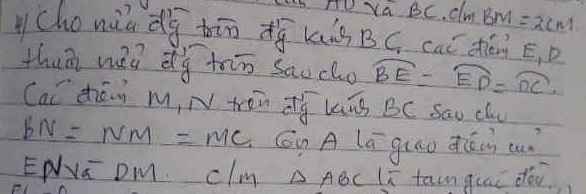
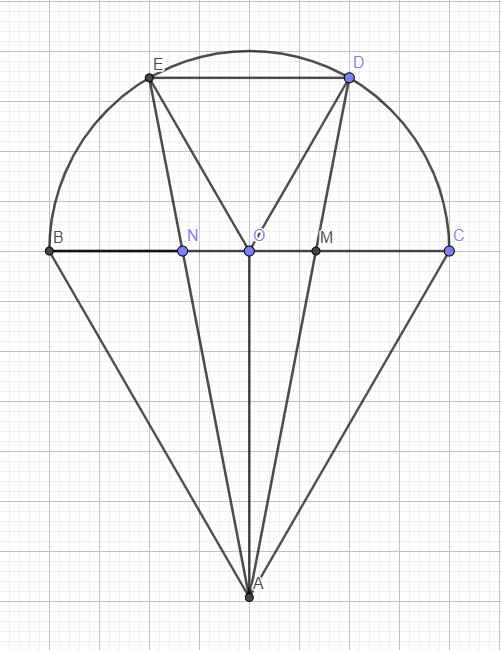
Gọi O là tâm đường tròn \(\Rightarrow\) O là trung điểm BC
\(\stackrel\frown{BE}=\stackrel\frown{ED}=\stackrel\frown{DC}\Rightarrow\widehat{BOE}=\widehat{EOD}=\widehat{DOC}=\dfrac{180^0}{3}=60^0\)
Mà \(OD=OE=R\Rightarrow\Delta ODE\) đều
\(\Rightarrow ED=R\)
\(BN=NM=MC=\dfrac{2R}{3}\Rightarrow\dfrac{NM}{ED}=\dfrac{2}{3}\)
\(\stackrel\frown{BE}=\stackrel\frown{DC}\Rightarrow ED||BC\)
Áp dụng định lý talet:
\(\dfrac{AN}{AE}=\dfrac{MN}{ED}=\dfrac{2}{3}\Rightarrow\dfrac{EN}{AN}=\dfrac{1}{2}\)
\(\dfrac{ON}{BN}=\dfrac{OB-BN}{BN}=\dfrac{R-\dfrac{2R}{3}}{\dfrac{2R}{3}}=\dfrac{1}{2}\)
\(\Rightarrow\dfrac{EN}{AN}=\dfrac{ON}{BN}=\dfrac{1}{2}\) và \(\widehat{ENO}=\widehat{ANB}\) (đối đỉnh)
\(\Rightarrow\Delta ENO\sim ANB\left(c.g.c\right)\)
\(\Rightarrow\widehat{NBA}=\widehat{NOE}=60^0\)
Hoàn toàn tương tự, ta có \(\Delta MDO\sim\Delta MAC\Rightarrow\widehat{MCA}=\widehat{MOD}=60^0\)
\(\Rightarrow\Delta ABC\) đều


DD
Đoàn Đức Hà
Giáo viên
7 tháng 11 2021
Bài 1:
Kẻ \(OM\perp AB\), \(OM\)cắt \(CD\)tại \(N\).
Khi đó \(MN=8cm\).
TH1: \(AB,CD\)nằm cùng phía đối với \(O\).
\(R^2=OC^2=ON^2+CN^2=h^2+\left(\frac{25}{2}\right)^2\)(\(h=CN\)) (1)
\(R^2=OA^2=OM^2+AM^2=\left(h+8\right)^2+\left(\frac{15}{2}\right)^2\)(2)
Từ (1) và (2) suy ra \(R=\frac{\sqrt{2581}}{4},h=\frac{9}{4}\).
TH2: \(AB,CD\)nằm khác phía với \(O\).
\(R^2=OC^2=ON^2+CN^2=h^2+\left(\frac{25}{2}\right)^2\)(\(h=CN\)) (3)
\(R^2=OA^2=OM^2+AM^2=\left(8-h\right)^2+\left(\frac{15}{2}\right)^2\)(4)
Từ (3) và (4) suy ra \(R=\frac{\sqrt{2581}}{4},h=\frac{-9}{4}\)(loại).
DD
Đoàn Đức Hà
Giáo viên
7 tháng 11 2021
Bài 3:
Lấy \(A'\)đối xứng với \(A\)qua \(Ox\), khi đó \(A'\)có tọa độ là \(\left(1,-2\right)\).
\(MA+MB=MA'+MB\ge A'B\)
Dấu \(=\)xảy ra khi \(M\)là giao điểm của \(A'B\)với trục \(Ox\).
Suy ra \(M\left(\frac{5}{3},0\right)\).


VT

1
NQ

1
30 tháng 7 2021
Ta có : \(\frac{A}{B}\ge\frac{x}{4}+5\Leftrightarrow\sqrt{x}+4\ge\frac{x}{4}+5\)
\(\Leftrightarrow\frac{4\sqrt{x}+16}{4}-\frac{x}{4}-\frac{20}{4}\ge0\Leftrightarrow\frac{4\sqrt{x}-x-4}{4}\ge0\)
\(\Rightarrow-x+4\sqrt{x}-4\ge0\Leftrightarrow x-4\sqrt{x}+4\le0\)vì 4 > 0
\(\Leftrightarrow\left(\sqrt{x}-2\right)^2\le0\Leftrightarrow x\le4\)
Kết hợp với đk vậy \(0\le x\le4;x\ne1\)
KS

0
NQ

1
TT

1
LV
31 tháng 10 2021
a, đặt t = căn x suy ra t lớn hơn bằng 0
quy đồng nhân từ (t-1) ( t+3) ta đc P = ((t^2 +16 ))/ t +3
các câu sau tự làm nha

10 tháng 7 2017
Áp dụng BĐT \(\dfrac{1}{x}+\dfrac{1}{y}\ge\dfrac{4}{x+y}\)(Tự chứng minh BĐT này )
\(B\ge\dfrac{4}{\left(a+b\right)^2+1}\)
10 tháng 7 2017
 cảm ơn Định đã trả lời giúp mk . Nhưng bn làm sai rồi vì nếu làm như vậy sẽ ko tìm ra a, b
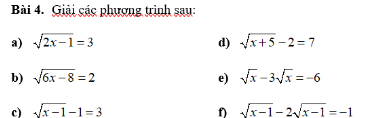
a) ĐKXĐ: x >= 1/2
Pt <=> 2x - 1 = 9
<=> x = 5 (thỏa ĐKXĐ)
b) ĐKXĐ: x>=4/3
Pt <=> 6x - 8 = 4
<=> 6x = 12 <=> x = 2 (thỏa ĐKXĐ)
c) ĐKXĐ: x >= 1
Pt <=> sqrt(x-1)=4
<=> x - 1 = 16 <=> x = 17 (thỏa ĐKXĐ)
Bn dùng \(\sum\) đi nhé
d) ĐKXĐ: x >= -5
Pt <=> sqrt(x+5)=9
<=> x + 5 = 81
<=> x = 76 (thỏa ĐKXĐ)
e) ĐKXĐ: x >= 0
Pt <=> -2sqrt(x) = -6
<=> sqrt(x)=3
<=> x = 9 (thỏa ĐKXĐ)
f) ĐKXĐ: x >= 1
Pt <=> -sqrt(x-1)=-1
<=> sqrt(x-1)=1
<=> x - 1 = 1 <=> x = 2(thỏa ĐKXĐ)
@hưng phúc: Mk chưa học LaTeX :))
a) \(đk:x\ge\dfrac{1}{2}\)
\(\Leftrightarrow2x-1=9\Leftrightarrow2x=10\Leftrightarrow x=5\left(tm\right)\)
b) \(đk:x\ge\dfrac{4}{3}\)
\(pt\Leftrightarrow6x-8=4\Leftrightarrow6x=12\Leftrightarrow x=2\left(tm\right)\)
c) \(đk:x\ge1\)
\(pt\Leftrightarrow\sqrt{x-1}=4\Leftrightarrow x-1=16\Leftrightarrow x=17\left(tm\right)\)
d) \(đk:x\ge-5\)
\(pt\Leftrightarrow\sqrt{x+5}=9\Leftrightarrow x+5=81\Leftrightarrow x=76\left(tm\right)\)
e) \(đk:x\ge0\)
\(pt\Leftrightarrow2\sqrt{x}=6\Leftrightarrow\sqrt{x}=3\Leftrightarrow x=9\left(tm\right)\)
f) \(đk:x\ge1\)
\(pt\Leftrightarrow\left(\sqrt{x-1}-1\right)^2=0\)
\(\Leftrightarrow\sqrt{x-1}-1=0\Leftrightarrow\sqrt{x-1}=1\)
\(\Leftrightarrow x-1=1\Leftrightarrow x=2\left(tm\right)\)
d) \(\sqrt{x+5}-2=7\)
\(\sqrt{x+5}=9\) Điều kiện: \(x>-5\)
\(\left(\sqrt{x+5}\right)^2=81\)
\(x+5=81\)
\(x=76\)
a: Ta có: \(\sqrt{2x-1}=3\)
\(\Leftrightarrow2x-1=9\)
hay x=5
b: ta có: \(\sqrt{6x-8}=2\)
\(\Leftrightarrow6x-8=4\)
hay x=2
Cái đấy là trợ lí Latex dùng đơn giản lắm