
Hãy nhập câu hỏi của bạn vào đây, nếu là tài khoản VIP, bạn sẽ được ưu tiên trả lời.

Tổng số học sinh hai lớp là 60 em nên ta có phương trình:
$$x + y = 60$$Nếu chuyển 15 học sinh từ chuyên Tin sang chuyên Toán, thì:
Số học sinh lớp chuyên Toán lúc sau là: $x + 15$
Số học sinh lớp chuyên Tin lúc sau là: $y - 15$Vì lúc đó số học sinh chuyên Toán gấp đôi số học sinh chuyên Tin nên ta có phương trình:
$$x + 15 = 2(y - 15)$$$$x + 15 = 2y - 30$$$$x - 2y = -45$$Ta có hệ phương trình:
$$\begin{cases} x + y = 60 \\ x - 2y = -45 \end{cases}$$Trừ vế với vế của hai phương trình cho nhau:
$$3y = 105$$$$y = 35$$Thay $y = 35$ vào phương trình tổng:
$$x + 35 = 60 \implies x = 25$$Vậy số học sinh ban đầu của lớp chuyên Toán là 25 học sinh và chuyên Tin là 35 học sinh.
Gọi số học sinh của lớp chuyên toán là x và số học sinh của lớp chuyên tin là y (x;y>0)
Do tổng 2 lớp có 60 học sinh nên: \(x+y=60\)
Chuyển 15 học sinh từ lớp tin sang lớp toán thì số học sinh lớp tin là \(y-15\) và số học sinh lớp toán là \(x+15\)
Do khi đó số học sinh lớp toán gấp 2 lần lớp tin nên: \(x+15=2\left(y-15\right)\Rightarrow x-2y=-45\)
Ta được hệ: \(\left\{{}\begin{matrix}x+y=60\\x-2y=-45\end{matrix}\right.\) \(\Rightarrow\left\{{}\begin{matrix}x=25\\y=35\end{matrix}\right.\)

Câu 4b:
Ta có \(a-\sqrt{a}=\sqrt{b}-b\Leftrightarrow a+b=\sqrt{a}+\sqrt{b}\). (1)
Áp dụng bất đẳng thức Cauchy - Schwarz ta có:
\(a^2+b^2\ge\dfrac{\left(a+b\right)^2}{2};\sqrt{a}+\sqrt{b}\le\sqrt{2\left(a+b\right)}\).
Kết hợp với (1) ta có:
\(a+b\le\sqrt{2\left(a+b\right)}\Leftrightarrow0\le a+b\le2\).
Ta có: \(P\ge\dfrac{\left(a+b\right)^2}{2}+\dfrac{2020}{\left(\sqrt{a}+\sqrt{b}\right)^2}\) (Do \(a^2+b^2\ge\dfrac{\left(a+b\right)^2}{2}\))
\(=\dfrac{\left(a+b\right)^2}{2}+\dfrac{2020}{\left(a+b\right)^2}\) (Theo (1))
\(\Rightarrow P\ge\dfrac{\left(a+b\right)^2}{2}+\dfrac{2020}{\left(a+b\right)^2}\).
Áp dụng bất đẳng thức AM - GM cho hai số thực dương và kết hợp với \(a+b\le2\) ta có:
\(\dfrac{\left(a+b\right)^2}{2}+\dfrac{2020}{\left(a+b\right)^2}=\left[\dfrac{\left(a+b\right)^2}{2}+\dfrac{8}{\left(a+b\right)^2}\right]+\dfrac{2012}{\left(a+b\right)^2}\ge2\sqrt{\dfrac{\left(a+b\right)^2}{2}.\dfrac{8}{\left(a+b\right)^2}}+\dfrac{2012}{2^2}=4+503=507\)
\(\Rightarrow P\ge507\).
Đẳng thức xảy ra khi a = b = 1.
Vậy Min P = 507 khi a = b = 1.
Giải nốt câu 4a:
ĐKXĐ: \(x\geq\frac{-1}{2}\).
Phương trình đã cho tương đương:
\(x^2+2x+1=2x+1+2\sqrt{2x+1}+1\)
\(\Leftrightarrow\left(x+1\right)^2=\left(\sqrt{2x+1}+1\right)^2\)
\(\Leftrightarrow\left(x+1\right)^2-\left(\sqrt{2x+1}+1\right)^2=0\)
\(\Leftrightarrow\left(x+1-\sqrt{2x+1}-1\right)\left(x+1+\sqrt{2x+1}+1\right)=0\)
\(\Leftrightarrow\left(x-\sqrt{2x+1}\right)\left(x+\sqrt{2x+1}+2\right)=0\)
\(\Leftrightarrow\left[{}\begin{matrix}x-\sqrt{2x+1}=0\left(1\right)\\x+\sqrt{2x+1}+2=0\left(2\right)\end{matrix}\right.\).
Ta thấy \(x+\sqrt{2x+1}+2>0\forall x\ge-\dfrac{1}{2}\).
Do đó phương trình (2) vô nghiệm.
Xét phương trình (1) \(\Leftrightarrow x=\sqrt{2x+1}\)
\(\Leftrightarrow\left\{{}\begin{matrix}x\ge0\\x^2=2x+1\end{matrix}\right.\)
\(\Leftrightarrow\left\{{}\begin{matrix}x\ge0\\\left(x-1\right)^2=2\end{matrix}\right.\)
\(\Leftrightarrow\left\{{}\begin{matrix}x\ge0\\\left[{}\begin{matrix}x-1=\sqrt{2}\\x-1=-\sqrt{2}\end{matrix}\right.\end{matrix}\right.\)
\(\Leftrightarrow\left\{{}\begin{matrix}x\ge0\\\left[{}\begin{matrix}x=\sqrt{2}+1>0>-\dfrac{1}{2}\left(TM\right)\\x=-\sqrt{2}+1< 0\left(\text{loại}\right)\end{matrix}\right.\end{matrix}\right.\).
Vậy nghiệm của phương trình là \(x=\sqrt{2}+1\).
a) Ta có : \(x=\sqrt[3]{a+\frac{a+1}{3}\sqrt{\frac{8a-1}{3}}}+\sqrt[3]{a-\frac{a+1}{3}\sqrt{\frac{8a-1}{3}}}\)
\(\Rightarrow x^3=2a+3.\sqrt[3]{a^2-\left(\frac{a+1}{3}\right)^2\left(\frac{8a-1}{3}\right)}.x\)
\(=2a+3\sqrt[3]{a^2-\frac{\left(a^2+2a+1\right)\left(8a-1\right)}{27}}.x\)
\(=2a+3\sqrt[3]{\frac{27a^2-\left(8a^3+15a^2+6a-1\right)}{27}}.x\)
\(=2a+3\sqrt[3]{\frac{-8a^3+12a^2-6a+1}{27}}.x\)
\(=2a+3x.\sqrt[3]{\frac{\left(1-2a\right)^3}{3^3}}=2a+3x.\frac{1-2a}{3}=2a+x\left(1-2a\right)\)
\(\Rightarrow x^2-2a+x\left(2a-1\right)=0\)\(\Leftrightarrow x^3-2a+2ax-x=0\Leftrightarrow x\left(x-1\right)\left(x+1\right)+2a\left(x-1\right)=0\)
\(\Leftrightarrow\left(x-1\right)\left(x^2+x+2a\right)=0\Leftrightarrow\orbr{\begin{cases}x-1=0\\x^2+x+2a=0\end{cases}}\)
Vì \(a>\frac{1}{8}\) nên \(x^2+x+2a>0\Rightarrow\)vô nghiệm.
Vậy x - 1 = 0 => x = 1 thoả mãn x là số nguyên dương.
b) \(\sqrt[3]{x+24}+\sqrt{12-x}=6\) (ĐKXĐ : \(x\le12\))
\(\Leftrightarrow\sqrt[3]{x+24}=6-\sqrt{12-x}\Leftrightarrow x+24=\left(6-\sqrt{12-x}\right)^3\)
\(\Leftrightarrow x+24=6^3-3.6^2.\sqrt{12-x}+3.6.\left(12-x\right)-\left(\sqrt{12-x}\right)^3\)
\(\Leftrightarrow x+24=216-108\sqrt{12-x}+216-18x-\sqrt{12-x}^3\)
\(\Leftrightarrow-19\left(12-x\right)+108\sqrt{12-x}+\sqrt{12-x}^3-180=0\)
Đặt \(y=\sqrt{12-x},y\ge0\) . Phương trình trên tương đương với :
\(-19y^2+108y+y^3-180=0\Leftrightarrow\left(y-10\right)\left(y-6\right)\left(y-3\right)=0\)
=> y = 10 (TM) hoặc y = 6 (TM) hoặc y = 3 (TM)
- Với y = 10 , ta có x = -88 (TM)
- Với y = 6 , ta có x = -24 (TM)
- Với y = 3 , ta có x = 3 (TM)
Vậy tập nghiệm của phương trình : \(S=\left\{-88;-24;3\right\}\)
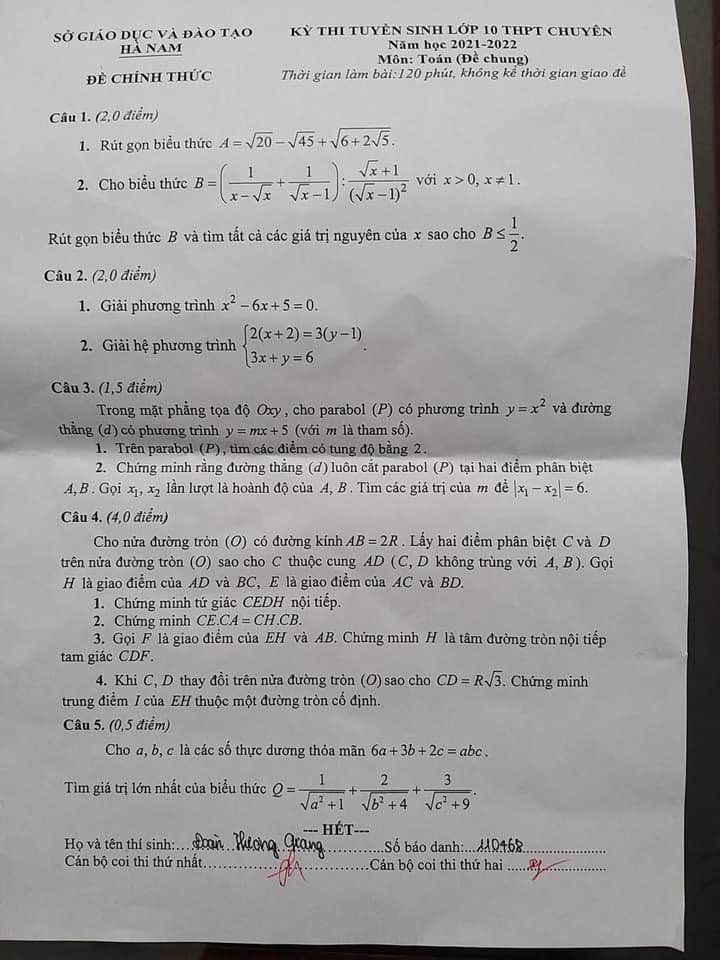
Câu 1
1) \(A=\sqrt{20}-\sqrt{45}+\sqrt{6+2\sqrt{5}}\)
\(=2\sqrt{5}-3\sqrt{5}+\sqrt{\left(\sqrt{5}\right)^2+2\sqrt{5}+1}\)
\(=-\sqrt{5}+\sqrt{\left(\sqrt{5}+1\right)^2}\)
\(=-\sqrt{5}+\sqrt{5}+1\)
\(=1\)
2) ĐKXĐ: \(x>0;x\ne1\)
\(B=\left(\dfrac{1}{x-\sqrt{x}}+\dfrac{1}{\sqrt{x}-1}\right):\dfrac{\sqrt{x}+1}{\left(\sqrt{x}-1\right)^2}\)
\(=\left(\dfrac{1}{\sqrt{x}\left(\sqrt{x}-1\right)}+\dfrac{1}{\sqrt{x}-1}\right).\dfrac{\left(\sqrt{x}-1\right)^2}{\sqrt{x}+1}\)
\(=\dfrac{1+\sqrt{x}}{\sqrt{x}\left(\sqrt{x}-1\right)}.\dfrac{\left(\sqrt{x}-1\right)^2}{\sqrt{x}+1}\)
\(=\dfrac{\sqrt{x}-1}{\sqrt{x}}\)
\(\Rightarrow B=\dfrac{\sqrt{x}-1}{\sqrt{x}}=\dfrac{1}{2}\)
\(\Leftrightarrow2\left(\sqrt{x}-1\right)=\sqrt{x}\)
\(\Leftrightarrow2\sqrt{x}-2=\sqrt{x}\)
\(\Leftrightarrow2\sqrt{x}-\sqrt{x}=2\)
\(\Leftrightarrow\sqrt{x}=2\)
\(\Rightarrow x=4\left(tmđk\right)\)
Câu 2
1) Phương trình \(x^2-6x+5=0\) có:
\(a+b+c=1-6+5=0\)
\(\Rightarrow\) Phương trình có hai nghiệm phân biệt \(x_1=1\) và \(x_2=\dfrac{c}{a}=5\)
2) \(\left\{{}\begin{matrix}2\left(x+2\right)=3\left(y-1\right)\\3x+y=6\end{matrix}\right.\Leftrightarrow\left\{{}\begin{matrix}2x+4=3y-3\\3x+y=6\end{matrix}\right.\)
\(\Leftrightarrow\left\{{}\begin{matrix}2x-3y=-7\\3x+y=6\end{matrix}\right.\)
\(\Leftrightarrow\left\{{}\begin{matrix}2x-3y=-7\\9x+3y=18\end{matrix}\right.\)
\(\Leftrightarrow\left\{{}\begin{matrix}11x=11\\3x+y=6\end{matrix}\right.\)
\(\Leftrightarrow\left\{{}\begin{matrix}x=1\\3+y=6\end{matrix}\right.\)
\(\Leftrightarrow\left\{{}\begin{matrix}x=1\\y=3\end{matrix}\right.\)


