
Hãy nhập câu hỏi của bạn vào đây, nếu là tài khoản VIP, bạn sẽ được ưu tiên trả lời.

A: This is the crawling mop.
(Đây là cây lau nhà biết bò.)
B: What is a crawling mop?
(Cây lau nhà bò là gì?)
A: It's a type of clothes the babies wear and clean the floor when they crawl around the house.
(Đó là loại quần áo em bé mặc và lau sàn nhà khi chúng bò quanh nhà.)
A: Who is it for?
(Nó dành cho ai?)
B: It's for people who want to keep their houses clean with the helping of their babies.
(Nó dành cho những người muốn giữ cho ngôi nhà của họ sạch sẽ với sự giúp đỡ của em bé.)
- Do you like doing karate? (Bạn có thích tập karate không?)
- Yes, I really like doing karate. (Đúng vậy, tôi rất thích tập karate.
If tourists are on an ecotour to Eco-Park, a tourist attraction in my local area, I will suggest them doing several things. Firstly, tourists should prepare food with less packaging and shouldn’t litter to the park. This will protect the environment. The second thing I suggest tourists should do is travelling by electric cars or bicycles as it will help protect the green environment. I believe that it will be better for the environment if tourists follow these suggestions. Our local area will reduce carbon footprint, and I can help introduce green ways to relax in the park.
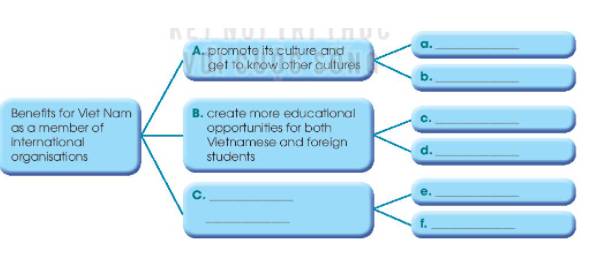
Benefits for Viet Nam as a member of international organisations
(Lợi ích đối với Việt Nam với tư cách là thành viên của các tổ chức quốc tế)
A. promote its culture and get to know other cultures
(quảng bá văn hóa của mình và tìm hiểu các nền văn hóa khác)
a. Various cultural exchanges help visitors know more about our country.
(Giao lưu văn hóa đa dạng giúp du khách biết thêm về đất nước chúng ta.)
b. Vietnamese people have a better chance of experiencing different cultures.
(Người Việt Nam có cơ hội trải nghiệm nhiều hơn các nền văn hóa khác nhau.)
B. create more educational opportunities for both Vietnamese and foreign students
(tạo nhiều cơ hội giáo dục hơn cho cả sinh viên Việt Nam và sinh viên nước ngoài)
c. Greater educational opportunities abroad are now open to Vietnamese students.
(Các cơ hội giáo dục lớn hơn ở nước ngoài đang mở ra cho sinh viên Việt Nam.)
d. Viet Nam’s colleges and universities can also accept international students.
(Các trường cao đẳng và đại học của Việt Nam cũng có thể tiếp nhận sinh viên quốc tế.)
C. increase both local and international tours
(tăng cả các tour du lịch trong nước và quốc tế)
e. Our country has become one of the most popular destinations for foreign tourists in the region.
(Đất nước chúng ta đã trở thành một trong những điểm đến được ưa chuộng nhất đối với khách du lịch nước ngoài trong khu vực.)
f. It is also easier for Vietnamese people to travel abroad.
(Người Việt Nam đi du lịch nước ngoài cũng dễ dàng hơn.)
- I bought 10 ice-cream cones for my classmates. There was one cone that I sprinkled some salt on it.
(Mình mua 10 cây kem ốc quế cho bạn cùng lớp. Đã có một cây kem mình rắc muối lên đó.)
- Luckily, the person I hated chose the cone that had salt in it. She was really upset about the salty cream.
(May mắn là người mình ghét bốc trúng cây kem có muối. Cô ấy có vẻ rất cáu vì vị kem mặn.)
- I was so excited and no one know about the fact. She just thought that it was a mistake from the store.
(Mình rất phấn khích khi không ai biết sự thật. Cô ấy chỉ nghĩ đấy là lỗi của cửa hàng.)
- I didn’t feel bad now. I enjoyed it as a revenge. (Mình không thấy tệ. Mình tận hưởng nó như một sự trả thù.)
1. I dropped my phone and it broke. (Tôi đã đánh rớt điện thoại và nó bể.)
How annoying! (Thật khó chịu làm sao!)
2. My dad danced at my birthday party. (Bố mình đã nhảy múa ở bữa tiệc sinh nhật của mình.)
How amazing! (Thật kinh ngạc làm sao!)
3. My favourite football team lost a match last weekend. (Đội bóng ưa thích của mình đã thua một trận đấu vào tuần trước.)
How sad! (Thật đáng buồn làm sao!)
1. Somebody's knocking at the door. → I’ll answer it.
(Ai đó đang gõ cửa. → Tôi sẽ trả lời nó.)
2. Would you like the blue T-shirt or the red one? → I’ll choose the blue one.
(Bạn thích áo phông xanh hay áo đỏ? → Tôi sẽ chọn cái màu xanh.)
3. There's chicken or fish for lunch. → I’ll have chicken.
(Có gà hoặc cá cho bữa trưa. → Tôi sẽ ăn gà.)
4. It looks freezing outside. → I’ll wear warm clothes.
(Bên ngoài có vẻ lạnh cóng. → Tôi sẽ mặc quần áo ấm.)
5. The next bus into town is in an hour. → I’ll hurry up.
(Chuyến xe buýt tiếp theo vào thị trấn sẽ mất một giờ nữa. → Tôi sẽ nhanh chóng.)
6. What would you like to drink? → I’ll have orange juice.
(Bạn muốn uống gì? → Tôi sẽ uống nước cam.)

- What will happen if we use public transportation?
(Chuyện gì sẽ xảy ra nếu chúng ta sử dụng giao thông công cộng?)
- If we use public transportation, we will help reduce air pollution.
(Nếu chúng ta sử dụng phương tiện công cộng, chúng ta sẽ giúp giảm ô nhiễm không khí.)