
Hãy nhập câu hỏi của bạn vào đây, nếu là tài khoản VIP, bạn sẽ được ưu tiên trả lời.

a)
\(A=\dfrac{2x^2-16x+41}{x^2-8x+22}=\dfrac{2\left(x^2-8x+22\right)-3}{x^2-8x+22}\)
\(A-2=-\dfrac{3}{x^2-8x+22}=-\dfrac{3}{\left(x-4\right)^2+6}\ge-\dfrac{3}{6}=-\dfrac{1}{2}\)
\(A\ge\dfrac{3}{2}\) khi x =4
a.
\(\dfrac{x+3}{x-2}+\dfrac{4+x}{2-x}\\ =\dfrac{x+3}{x-2}-\dfrac{4+x}{x-2}\\ =\dfrac{x+3-4-x}{x-2}\\ =-\dfrac{1}{x-2}\)
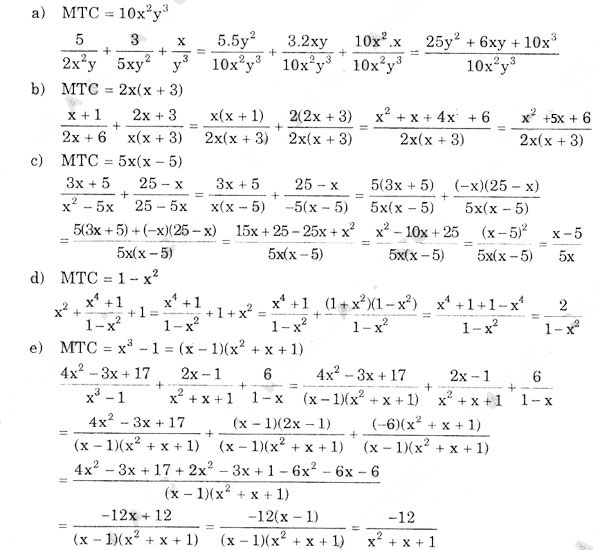
b. \(\dfrac{x+1}{2x+6}+\dfrac{2x+3}{x^2+3x}\)
\(=\dfrac{x+1}{2\left(x+3\right)}+\dfrac{2x+3}{x\left(x+3\right)}\)
\(=\dfrac{x^2+x}{2x\left(x+3\right)}+\dfrac{4x+6}{2x\left(x+3\right)}=\dfrac{x^2+x+4x+6}{2x\left(x+3\right)}\)
\(=\dfrac{x^2+5x+6}{2x\left(x+3\right)}=\dfrac{x^2+3x+2x+6}{2x\left(x+3\right)}\)
\(=\dfrac{x\left(x+3\right)+2\left(x+3\right)}{2x\left(x+3\right)}=\dfrac{\left(x+2\right)\left(x+3\right)}{2x\left(x+3\right)}\)
\(=\dfrac{x+2}{2x}\)
c. \(\dfrac{3}{2x+6}-\dfrac{x-6}{2x^2+6x}\)
\(=\dfrac{3}{2\left(x+3\right)}-\dfrac{x-6}{2x\left(x+3\right)}\)
\(=\dfrac{3x}{2x\left(x+3\right)}-\dfrac{x-6}{2x\left(x+3\right)}\)
\(=\dfrac{3x-x+6}{2x\left(x+3\right)}=\dfrac{2x+6}{2x\left(x+3\right)}=\dfrac{2\left(x+3\right)}{2x\left(x+3\right)}\)
\(=\dfrac{1}{x}\)
d. \(\dfrac{2x+6}{3x^2-x}:\dfrac{x^2+3x}{1-3x}\)
\(=\dfrac{2\left(x+3\right)}{x\left(3x-1\right)}:\dfrac{-x\left(x+3\right)}{3x-1}\)
\(=\dfrac{2\left(x+3\right)}{x\left(3x-1\right)}.\dfrac{-\left(3x-1\right)}{x\left(x+3\right)}\)
\(=-\dfrac{2}{x^2}\)
Ta có : \(P=2x^2-8x+1=2\left(x^2-4x\right)+1=2\left(x^2-4x+4-4\right)+1=2\left(x-2\right)^2-7\)
Vì \(2\left(x-2\right)^2\ge0\forall x\)
Nên : \(P=2\left(x-2\right)^2-7\ge-7\forall x\in R\)
Vậy \(P_{min}=-7\) khi x = 2
\(b,Q=-5x^2-4x+1\)
\(=-5\left(x^2+\dfrac{4}{5}x+\dfrac{4}{25}\right)+\dfrac{9}{5}\)
\(=-5\left(x+\dfrac{2}{5}\right)^2+\dfrac{9}{5}\)
Với mọi giá trị của x ta có:
\(-5\left(x+\dfrac{2}{5}\right)^2\le0\)
\(\Rightarrow-5\left(x+\dfrac{2}{5}\right)^2+\dfrac{9}{5}\le\dfrac{9}{5}\)
Vậy MaxQ = \(\dfrac{9}{5}\)
Để Q = \(\dfrac{9}{5}\) thì \(x+\dfrac{2}{5}=0\Rightarrow x=-\dfrac{2}{5}\)
\(c,K=x\left(x-3\right)\left(x-4\right)\left(x-7\right)\)
\(=x\left(x-7\right)\left(x-3\right)\left(x-4\right)\)
\(=\left(x^2-7x\right)\left(x^2-7x+12\right)\)
Đặt \(x^2-7x+6=t\) , ta có:
\(K=\left(t-6\right)\left(t+6\right)\)
\(=t^2-36\)
\(=\left(x^2-7x+6\right)^2-36\)
Với mọi giá trị của x ta có:
\(\left(x^2-7x+6\right)^2\ge0\Rightarrow\left(x^2-7x+6\right)^2-36\ge-36\)
Vậy Min K = -36
Để K = - 36 thì \(x^2-7x+6=0\)
\(\Leftrightarrow x^2-x-6x+6=0\)
\(\Leftrightarrow x\left(x-1\right)-6\left(x-1\right)=0\)
\(\Leftrightarrow\left(x-6\right)\left(x-1\right)=0\)
\(\Leftrightarrow\left[{}\begin{matrix}x-6=0\\x-1=0\end{matrix}\right.\Rightarrow\left[{}\begin{matrix}x=6\\x=1\end{matrix}\right.\)
a)\(P=2x^2-8x+1\)
=\(2\left(x^2-4x+4\right)-7\)
=\(2\left(x-2\right)^2-7\)
Với mọi x thì \(2\left(x-2\right)^2>=0\)
=>\(2\left(x-2\right)^2-7>=-7\)
Hay \(P>=-7\) với mọi x
Để \(P=-7\) thì
\(\left(x-2\right)^2=0\)
=>\(x-2=0\)
=>\(x=2\)
Vậy...
Các câu sau tương tự
a/ \(M=\dfrac{x^2-x+1}{x^2+2x+1}=\dfrac{1}{4}+\dfrac{3x^2-6x+3}{x^2+2x+1}=\dfrac{1}{4}+\dfrac{3\left(x-1\right)^2}{x^2+2x+1}\ge\dfrac{1}{4}\)
b/ \(N=\dfrac{3x^2+4x}{x^2+1}=4-\dfrac{x^2-4x+4}{x^2+1}=4-\dfrac{\left(x-2\right)^2}{x^2+1}\le4\)

Bài 2 .
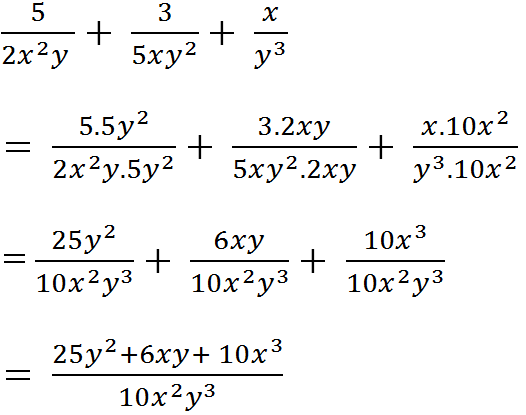
a) \(\dfrac{2x}{x^2+2xy}+\dfrac{y}{xy-2y^2}+\dfrac{4}{x^2-4y^2}\)
\(=\dfrac{2x}{x\left(x+2y\right)}+\dfrac{y}{y\left(x-2y\right)}+\dfrac{4}{\left(x-2y\right)\left(x+2y\right)}\)
\(=\dfrac{2xy\left(x-2y\right)+xy\left(x+2y\right)+4xy}{xy\left(x+2y\right)\left(x-2y\right)}\)
\(=\dfrac{2x^2y-2xy^2+x^2y+2xy^2+4xy}{xy\left(x+2y\right)\left(x-2y\right)}\)
\(=\dfrac{3x^2y+4xy}{xy\left(x+2y\right)\left(x-2y\right)}\)
b) Sai đề hay sao ý
c) \(\dfrac{2x+y}{2x^2-xy}+\dfrac{16x}{y^2-4x^2}+\dfrac{2x-y}{2x^2+xy}\)
\(=\dfrac{2x+y}{x\left(2x-y\right)}+\dfrac{-16x}{\left(2x-y\right)\left(2x+y\right)}+\dfrac{2x-y}{x\left(2x+y\right)}\)
\(=\dfrac{\left(2x+y\right)^2-16x^2+\left(2x-y\right)^2}{x\left(2x-y\right)\left(2x+y\right)}\)
\(=\dfrac{4x^2+4xy+y^2-16x^2+4x^2-4xy+y^2}{x\left(2x-y\right)\left(2x+y\right)}\)
\(=\dfrac{-8x^2}{x\left(2x-y\right)\left(2x+y\right)}\)
d) \(\dfrac{1}{1-x}+\dfrac{1}{1+x}+\dfrac{2}{1+x^2}+\dfrac{4}{1+x^4}+\dfrac{8}{1+x^8}+\dfrac{16}{1+x^{16}}\)
\(=\dfrac{2}{1-x^2}+\dfrac{2}{1+x^2}+\dfrac{4}{1+x^4}+\dfrac{8}{1+x^8}+\dfrac{16}{1+x^{16}}\)
\(=\dfrac{4}{1-x^4}+\dfrac{4}{1+x^4}+\dfrac{8}{1+x^8}+\dfrac{16}{1+x^{16}}\)
.....
\(=\dfrac{16}{1-x^{16}}+\dfrac{16}{1+x^{16}}\)
\(=\dfrac{32}{1-x^{32}}\)
a) \(A = \frac{2x^2 - 16x+43}{x^2-8x+22}\) = \(\frac{2(x^2-8x+22)-1}{x^2-8x+22}\) = \(2 - \frac{1}{x^2-8x+22}\)
Ta có : \(x^2-8x+22 \) = \(x^2-8x+16+6 = ( x-4)^2 +6 \)
Vì \((x-4)^2 \ge 0 \) với \( \forall x\in R\) Nên \(( x-4)^2 +6 \ge 6 \)
\(\Rightarrow \) \(x^2-8x+22 \) \( \ge 6\)\(\Rightarrow \) \(\frac{1}{x^2-8x+22} \) \(\le \frac{1}{6}\) \(\Rightarrow \) - \(\frac{1}{x^2-8x+22} \) \(\ge - \frac{1}{6}\)
\(\Rightarrow \) A = \(2 - \frac{1}{x^2-8x+22}\) \( \ge 2-\frac{1}{6}\) = \(\frac{11}{6}\) Dấu "=" xảy ra khi và chỉ khi x=4
Vậy GTNN của A = \(\frac{11}{6}\) khi và chỉ khi x=4
a. Ta có:\(P\left(x\right)=\dfrac{2x^2-2x+3}{x^2-x+2}=\dfrac{2x^2-2x+4-1}{x^2-x+2}=2-\dfrac{1}{x^2-x+2}\)
Để \(P\left(x\right)\) đạt GTLN thì \(\dfrac{1}{x^2-x+2}\)đạt GTNN
\(\Rightarrow x^2-x+2\) đạt GTNN.
Ta có: \(x^2-x+2=x^2-x+\dfrac{1}{4}+\dfrac{7}{4}=\left(x-\dfrac{1}{2}\right)^2+\dfrac{7}{4}\ge\dfrac{7}{4}\)
\(\Rightarrow P\left(x\right)=2-\dfrac{1}{x^2-x+2}\ge\dfrac{10}{7}\)
Dấu '' = '' xảy ra khi: \(x=\dfrac{1}{2}\)
Vậy: GTNN của \(P\left(x\right)=\dfrac{10}{7}\) tại \(x=\dfrac{1}{2}\).
\(\dfrac{2\left(x^2-x+2\right)-1}{x^2-x+2}=2-\dfrac{1}{x^2-x+2}\)
ta có \(x^2-x+2=\left(x-\dfrac{1}{2}\right)^2+\dfrac{7}{4}\ge\dfrac{7}{4}\) (vì \(\left(x-\dfrac{1}{2}\right)^2\ge0\) )
Do đó \(\dfrac{1}{x^2-x+2}\ge\dfrac{1}{\dfrac{7}{4}}=\dfrac{4}{7}\)
Nên P\(\ge2-\dfrac{4}{7}=\dfrac{10}{7}\)
Vậy Min P(x)=\(\dfrac{10}{7}\)
phan so toi gian hay so thap phan
mk cx ko rõ thày mk chi cho có như thế nhưng nếu có thập phân hay phân số thì mong bạn có thể làm giúp mk cả 2 đc ko
a) 10/7
b) 17/4
hinh nhu la vay
(3x2+12+5)/x2+4=3(x2+4)/x2+4 + 5/x2+4 =3+5/x2+4
Để Q max thì 3 + 5/x2+4 max <=>5/x2+4 max <=>x2+4 min
=>x2+4 min =4 <=>x=0
Vầy Qmax =3 + 5/0+4=3+ 5/4=17/4
Cảm ơn mình nha
Bạn tên j
Phần a mình chưa nghĩ ra
a. Ta có: \(P\left(x\right)=\dfrac{2x^2-2x+3}{x^2-x+2}=\dfrac{2x^2-2x+4-1}{x^2-x+2}=2-\dfrac{1}{x^2-x+2}\)
Để \(P\left(x\right)\) đạt giá trị nhỏ nhất thì \(\dfrac{1}{x^2-x+2}\) phải đạt giá trị lớn nhất.
\(\Rightarrow x^2-x+2\) đạt giá trị nhỏ nhất.
Ta có: \(x^2-x+2=x\times\left(x-1\right)+2\)
Vì: \(x\left(x-1\right)\ge0\)
\(\Rightarrow x\left(x-1\right)+2\ge2\)
\(\Rightarrow\)\(P\left(x\right)=2-\dfrac{1}{x^2-x+2}\ge\dfrac{3}{2}\)
Dấu \("="\) xảy ra khi: \(\left\{\begin{matrix}x=0\\x=1\end{matrix}\right.\)
Vậy: Giá trị nhỏ nhất của \(P\left(x\right)=\dfrac{3}{2}=1,5\) tại \(x\in\left\{0;1\right\}\).
mk ten loan
gtnn cua cau a la 10/7 tai x=1/2
10/7 nho hon 3/2 ma
b. Ta có: \(Q\left(x\right)=\dfrac{3x^2+17}{x^2+4}=\dfrac{3x^2+12+5}{x^2+4}=3+\dfrac{5}{x^2+4}\)
Để \(Q\left(x\right)\) đạt giá trị lớn nhất thì \(\dfrac{5}{x^2+4}\) đạt giá trị lớn nhất.
\(\Rightarrow x^2+4\) đạt giá trị nhỏ nhất.
Ta có: \(x^2+4\ge4\)
\(\Rightarrow Q\left(x\right)=3+\dfrac{5}{x^2+4}\ge\dfrac{17}{4}\)
Dấu '' = '' xảy ra khi: \(x=0\)
Vậy: Giá trị lớn nhất của \(Q\left(x\right)=\dfrac{17}{4}=4,25\) tại \(x=0\).
gtnn cua x2_x+2 la 7/4 tai x=1/2
mình nhầm rồi !!!
làm lại vậy
mk bị nhầm dấu xíu phải là
\(\dfrac{1}{x^2-x+2}\le\dfrac{1}{\dfrac{7}{4}}=\dfrac{4}{7}\)
bạn viết dấu\(\dfrac{>}{ }\)phải thành \(\dfrac{< }{ }\) chỗ do đó nhé
mk sửa lại ở phần trên rồi bạn
mk sửa lại ở phần trên rồi bạn