K
Khách

Hãy nhập câu hỏi của bạn vào đây, nếu là tài khoản VIP, bạn sẽ được ưu tiên trả lời.

11 tháng 9 2023

1. Did Harry know the person who fell into the water? (Harry có biết ai là người bị ngã xuống nước không?)

Maybe that was a friend of Harry. (Có lẽ là một người bạn của Harry.)

2. Did they fight or help each other? (Họ đánh nhau hay giúp đỡ nhau?)

They were fighting. (Họ đang đánh nhau.)

3. What happened to the boat? (Chuyện gì đã xảy ra với con thuyền?)

The boat stopped moving. (Con thuyền ngừng di chuyển.)

4. Did Harry return to the shore or get on the boat? (Harry quay vào bờ hay lên thuyền?)

He got on the boat. (Anh ta lên thuyền.)

5. What happened next? (Chuyện gì xảy ra tiếp theo?)

Harry saved the person who fell into the water. (Harry đã cứu người bị rớt xuống nước.)

2. Read the text and circle the correct meanings of the highlighted words.(Đọc văn bản và khoanh tròn nghĩa đúng của các từ được đánh dấu.)Since UNICEF set up an office in 1975 in Viet Nam, it has run projects in various fields to provide the highest possible support for children in our country. The organisation particularly aims to create opportunities for all children in Viet Nam to attend school, learn and succeed. The following programmes help achieve the UNICEF's...
Đọc tiếp

2. Read the text and circle the correct meanings of the highlighted words.

(Đọc văn bản và khoanh tròn nghĩa đúng của các từ được đánh dấu.)

Since UNICEF set up an office in 1975 in Viet Nam, it has run projects in various fields to provide the highest possible support for children in our country. The organisation particularly aims to create opportunities for all children in Viet Nam to attend school, learn and succeed. The following programmes help achieve the UNICEF's education aims for Viet Nam.

Education for Disadvantaged Young People

UNICEF helps disadvantaged teenagers continue their education by offering them job training and career advice. They are also taught essential skills for the job market.

Providing Education Opportunities for Children with Disabilities

This programme gives children with disabilities a chance to get access to and benefit from a quality education. It also helps promote equal participation in society and a culture in which people respect each other.

Improving Learning Achievements

This is another practical programme supported by UNICEF. The aim is to better prepare children for the challenges in the future. UNICEF helps Viet Nam in joining regional educational programmes to improve children's learning achievements. When they leave school, they should have the necessary skills and knowledge to work in a fast-changing world.

1. create

a. make something happen 

b. increase something

c. refuse something

2. essential

a. usual

b. necessary

c. successful

3. respect

a. have a good opinion of somebody

b. look down on somebody

c. get on well with somebody

4. practical

a. connected with organisations

b. connected with ideas

c. connected with real situations

2
14 tháng 8 2023

1. a

2. b

3. a

4. c

10 tháng 9 2023

1. a

2. b

3. a

4. c

1. create (v): tạo ra

a. make something happen

(làm cho một cái gì đó xảy ra)

b. increase something

(tăng cái gì đó)

c. refuse something

(từ chối điều gì đó)

2. essential (adj): cần thiết

a. usual

(thường)

b. necessary

(cần thiết)

c. successful

(thành công)

3. respect (v): tôn trọng

a. have a good opinion of somebody

(có quan điểm tốt về ai đó)

b. look down on somebody

(khinh thường ai đó)

c. get on well with somebody

(có mối quan hệ tốt với người nào đó)

4. practical (adj): thực tiễn

a. connected with organisations

(kết nối với các tổ chức)

b. connected with ideas

(kết nối với các ý tưởng)

c. connected with real situations

(kết nối với các tình huống thực tế)

11 tháng 9 2023

 1. injure

 2. trip

 3. break

 4. blood

 5. a bruise

 6. a burn

 7. an injury

11 tháng 9 2023

Accidents and injuries (Tai nạn và thương tích)

Verbs

burn/ cut/ hurt/ (1) injure yourself/ your hand, etc. (làm phỏng/ cắt/ làm bị thương bản thân/ tay của bạn, v.v)

fall/ (2) trip / slip over (ngã/ trật chân/ trượt té)

(3) break your arm/ finger, etc. (gãy tay/ ngón tay)

bleed (chảy máu)sprain your ankle/ wrist (bong mắt cá chân/ gân cổ tay)

hurt (e.g. my leg hurts) (làm đau. Vd: chân tôi đau)

Noun and phrases

(4) blood (máu)a broken arm/ finger, etc. (một ngón tay/ cánh tay bị gãy)(5) a bruise (vết bầm)

(6) a burn (vết phỏng)a cut (vết cắt)(7) an injury (vết thương)a sprain (vết bong gân)

pain (cơn đau)
10 tháng 9 2023
 

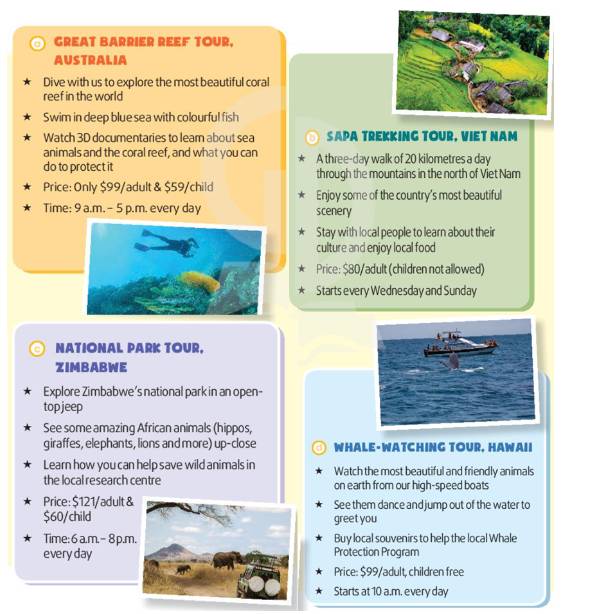
UNICEF Programme

UNDP Project

What / name?

Vaccines for Children

(Vắc xin cho Trẻ em.)

Poverty Reduction

(Giảm nghèo)

What / focus on?

protecting children with life-saving vaccines

(bảo vệ trẻ em bằng vắc-xin cứu mạng)

reducing poverty and developing economy in disadvantaged areas

(xóa đói giảm nghèo và phát triển kinh tế ở những vùng khó khăn)

What / activities?

- educating people about the benefits of vaccines

(giáo dục bảo vệ trẻ em bằng vắc-xin cứu mạng)

- vaccinating as many children as possible

(tiêm chủng cho càng nhiều trẻ em càng tốt)

- providing technical support

(cung cấp hỗ trợ kỹ thuật)

- helping develop solutions to local issues

(giúp phát triển các giải pháp cho các vấn đề địa phương)

A: What is the name of the UNDP Project?

(Tên của dự án UNDP là gì)

B: It’s Poverty Reduction.

(Đó là Giảm nghèo.)

A: What does the project focus on?

(Dự án tập trung vào cái gì?)

B: It focuses on reducing poverty and developing economy in disadvantaged areas.

(Nó tập trung vào việc xóa đói giảm nghèo và phát triển kinh tế ở những vùng khó khăn.)

A: What are the activities of this project?

(Các hoạt động của dự án này là gì?)

B: It provides technical support and helps develop solutions to local issues. What about UNICEF Programme? What is the name of the programme?

(Nó cung cấp hỗ trợ kỹ thuật và giúp phát triển các giải pháp cho các vấn đề địa phương. Chương trình UNICEF thì sao? Tên của chương trình là gì?)

A: It’s Vaccines for Children.

(Đó là Vắc xin cho Trẻ em.)

B: What does the program focus on?

(Chương trình tập trung vào cái gì?)

A: It focuses on protecting children with life-saving vaccines.

(Nó tập trung vào việc bảo vệ trẻ em bằng vắc-xin cứu mạng.)

B: What are the activities of this programme?

(Các hoạt động của chương trình này là gì?)

A: It educates protecting children with life-saving vaccines and vaccinates as many children as possible.

(Nó giáo dục bảo vệ trẻ em bằng vắc-xin cứu mạng và tiêm chủng cho càng nhiều trẻ em càng tốt.)
2. Read the Reading Strategy. Then read the text quickly to get a general idea of the meaning. Were your ideas in exercise 1 correct?(Đọc “Chiến thuật đọc hiểu”. Sau đó đọc bài khóa thật nhanh để lấy ý chính về bài đọc. Ý tưởng của bạn trong bài 1 có đúng không?)Reading Strategy (Chiến thuật đọc hiểu)When you do a matching task, follow these steps:(Khi làm dạng bài nối, làm theo các bước sau:) 1. Read the text to get a...
Đọc tiếp

2. Read the Reading Strategy. Then read the text quickly to get a general idea of the meaning. Were your ideas in exercise 1 correct?

(Đọc “Chiến thuật đọc hiểu”. Sau đó đọc bài khóa thật nhanh để lấy ý chính về bài đọc. Ý tưởng của bạn trong bài 1 có đúng không?)

Reading Strategy (Chiến thuật đọc hiểu)

When you do a matching task, follow these steps:

(Khi làm dạng bài nối, làm theo các bước sau:) 

1. Read the text to get a general idea of the meaning. Do not worry if you do not understand every word.

(1. Đọc bài khóa để lấy ý chính. Đừng lo lắng nếu bạn không hiểu tất cả các từ trong bài đọc.)

2. Read the task and all the options carefully.

(2. Cẩn thận đọc đề bài và các lựa chọn.)

3. Read the paragraphs of the text carefully one by one and match them to the correct option.

(3. Cẩn thận đọc từng đoạn văn một và nối chúng với lựa chọn chính xác.)

4. Check that the extra options do not match with any of the paragraphs.

(4. Kiểm tra các lựa chọn thừa không hợp với bất cứ đoạn văn nào.)

1
11 tháng 9 2023

The text is about a girl who can’t feel pain. (Bài đọc nói về một cô gái không thể cảm nhận cơn đau.)

11 tháng 9 2023

1. I finally finished my science project. (Cuối cùng mình đã hoàn thành dự án khoa học.)

What a cool thing to do! (Thật ngầu khi làm điều đó!)

2. I learnt to play a new song on the guitar. (Mình đã học chơi một bài hát mới trên cây đàn ghi-ta.)

That's amazing! (Thật kinh ngạc!)

3. I broke a bone in my foot. (Mình đã gãy một cái chân ở xương.)

How awful! (Thật tệ làm sao!)

4. I dropped my dad's laptop. (Mình đã làm vỡ máy tính xách tay của bố.)

(Ôi không! Thật đáng xấu hổ!) 

2. Rewrite these sentences about Hoi An villages. Use the expressions below to help you.(Viết lại những câu này về các làng quê Hội An. Sử dụng các cấu trúc diễn đạt dưới đây để giúp bạn.)1. Hoi An villages are famous for their beautiful vegetable and herb gardens.=> __________________ well-known ________________________.2. Tourists can work on a local farm in the morning.=> _____________________ spend________________________.3. Tourists should buy...
Đọc tiếp

2. Rewrite these sentences about Hoi An villages. Use the expressions below to help you.

(Viết lại những câu này về các làng quê Hội An. Sử dụng các cấu trúc diễn đạt dưới đây để giúp bạn.)

1. Hoi An villages are famous for their beautiful vegetable and herb gardens.

=> __________________ well-known ________________________.

2. Tourists can work on a local farm in the morning.

=> _____________________ spend________________________.

3. Tourists should buy handmade products to help local businesses.

=> __________________ recommended ________________________.

Useful expressions:

What is special about the place? 

(Điều gì đặc biệt về nơi này?)

- … is / are famous for sth. 

(... nổi tiếng về...)

- … is / are well-known for sth. 

(... nổi tiếng về...)

What can tourists do / explore there?

(Du khách có thể làm gì ở đây?)

- ... can enjoy doing sth.

(... có thể thích...)

- … can spend time doing sth.

(...có thể dành thời gian...)

- Favourite leisure activities are / include doing sth.

(Những hoạt động giải trí yêu thích là...)

What can tourists do to make their trip more eco-friendly?

(Du khách có thể làm gì để chuyến đi của họ thân thiện với môi trường hơn?)

- ... ought (not) to / should (not) do sth…

(... nên (không nên)...)

- … are encouraged / recommended (nor) to do sth. 

(... được khuyến khích/ đề xuất...)

2
6 tháng 2 2023

1. Hoi An villages are well - known  for their beautiful vegetable and herb gardens.

2. Tourists can spend the morning on a local farm

3. Tourists recommended to buy handmade products to help local businesses.

6 tháng 2 2023

Hoi An villages are well-known for their beautiful vegetable and herb gardens

Tourists can spend the morning working on a local farm

Tourists are recommended to buy handmade products to help local businesses