K
Khách

Hãy nhập câu hỏi của bạn vào đây, nếu là tài khoản VIP, bạn sẽ được ưu tiên trả lời.

7 tháng 2 2023

A:1,4

B: 3

C: 2

D: 3;4

E: 1

F: 1;3;4

11 tháng 9 2023

Speaker 1. I love the UK. I just love the atmosphere, the culture, the art, the history. There is also beautiful scenery in places like Cornwall and Scotland. The people here are kind and friendly. The only things I don't like about the UK are the weather and the food. I had some really bad fish and chips recently!

Speaker 2. British people don't care about their work like we do. They aren't very hard-working really - they spend all day waiting to finish work and go home! And when they leave work, they forget about it. I have my own café here in Cardiff and for me, my work is my life.

Speaker 3. I find British people very friendly and I love an English breakfast and fish and chips. But I don't like it when I finish work at 11 p.m. or midnight, and young people are causing trouble in the street. It's not always nice and they make a lot of noise. I don't worry for me but I'm anxious for my wife at night over here. Overall though I like living in Britain. It's much better than back home.

Speaker 4. OK, the weather definitely is not great but I love the freedom of living in the UK. It's so friendly and welcoming. It was difficult for me when I first arrived at the age of sixteen. I was used to rules. My family came first and I always obeyed my parents. I never answered back. But British teenagers have so much more freedom. They don't have many rules, and that's not always a good thing. They often behave badly.

2. Read the text. Are these sentences about the people who took part in the survey true or false? Write T or F.(Đọc văn bản. Những câu này về những người đã tham gia khảo sát là đúng hay sai? Viết T (đúng) hoặc F (sai).)a. Most have a positive view of the British overall. _____b. More than half have a better opinion of the British now that they live in the country. _____How foreigners see the BritishWhat is a typical British person like? People who come to Britain...
Đọc tiếp

2. Read the text. Are these sentences about the people who took part in the survey true or false? Write T or F.

(Đọc văn bản. Những câu này về những người đã tham gia khảo sát là đúng hay sai? Viết T (đúng) hoặc F (sai).)

a. Most have a positive view of the British overall. _____

b. More than half have a better opinion of the British now that they live in the country. _____

How foreigners see the British

What is a typical British person like? People who come to Britain from other countries probably have a few expectations: British people are polite, rather reserved, and enjoy drinking tea and standing in queues! But how accurate is this stereotype? In an online survey of 1402 foreign nationals living in the UK, just over half said that the British matched their expectations.

The survey also asked which aspects of the British character the foreign nationals liked and disliked. British people's good manners were popular with 49% and 40% liked the ability to queue. Many agreed that the British are reserved and for 32% this was a good quality but for 19% it was negative. Other negative aspects were the British sense of humour (31%) and British culture in general (28%). However, 77% said they liked British people in general and 61% said that their opinion of the British got better as a result of living in the UK. 

A spokesman for the researchers said: People probably come to Britain with a stereotype of what to expect. It’s good to see that, for the majority, the reality is better than the stereotype.'

2
7 tháng 2 2023

a. Most have a positive view of the British overall. _T____

b. More than half have a better opinion of the British now that they live in the country. __T___

11 tháng 9 2023

1. T

Most have a positive view of the British overall.

(Nhìn chung thì đa số mọi người có cái nhìn tích cực về người Anh?)

Thông tin: However, 77% said they liked British people in general…

(Tuy nhiên, 77% số người cho rằng về cơ bản họ thích người Anh…)

2. T

More than half have a better opinion of the British now that they live in the country.

(Hơn một nửa số người đã có những suy nghĩ tốt hơn về người anh khi giờ họ sống ở đây.)

Thông tin: 61% said that their opinion of the British got better as a result of living in the UK.

(61% người nói rằng suy nghĩ của họ về người Anh đã tốt hơn nhờ việc sống ở Anh.)

10 tháng 9 2023

A: What is the name of the programme?

(Tên của chương trình là gì)

B: (1) It is Education for Disadvantaged Young People.

(Đó là Giáo dục cho Thanh thiếu niên có hoàn cảnh khó khăn.)

A: What does the program focus on?

(Chương trình tập trung vào cái gì?)

B: (2) It focuses on helping disadvantaged teenagers continue their education.

(Nó tập trung vào việc giúp đỡ những thanh thiếu niên có hoàn cảnh khó khăn tiếp tục đi học.)

A: What are the activities of this programme?

(Các hoạt động của chương trình này là gì?)

B: (3) It offers young people job training and career advice. It also teaches them essential skills for the job market.

(Nó cung cấp đào tạo việc làm và lời khuyên nghề nghiệp cho những người trẻ tuổi. Nó cũng dạy họ những kỹ năng cần thiết cho thị trường việc làm.)

2. Read the text and circle the correct meanings of the highlighted words.(Đọc văn bản và khoanh tròn nghĩa đúng của các từ được đánh dấu.)Since UNICEF set up an office in 1975 in Viet Nam, it has run projects in various fields to provide the highest possible support for children in our country. The organisation particularly aims to create opportunities for all children in Viet Nam to attend school, learn and succeed. The following programmes help achieve the UNICEF's...
Đọc tiếp

2. Read the text and circle the correct meanings of the highlighted words.

(Đọc văn bản và khoanh tròn nghĩa đúng của các từ được đánh dấu.)

Since UNICEF set up an office in 1975 in Viet Nam, it has run projects in various fields to provide the highest possible support for children in our country. The organisation particularly aims to create opportunities for all children in Viet Nam to attend school, learn and succeed. The following programmes help achieve the UNICEF's education aims for Viet Nam.

Education for Disadvantaged Young People

UNICEF helps disadvantaged teenagers continue their education by offering them job training and career advice. They are also taught essential skills for the job market.

Providing Education Opportunities for Children with Disabilities

This programme gives children with disabilities a chance to get access to and benefit from a quality education. It also helps promote equal participation in society and a culture in which people respect each other.

Improving Learning Achievements

This is another practical programme supported by UNICEF. The aim is to better prepare children for the challenges in the future. UNICEF helps Viet Nam in joining regional educational programmes to improve children's learning achievements. When they leave school, they should have the necessary skills and knowledge to work in a fast-changing world.

1. create

a. make something happen 

b. increase something

c. refuse something

2. essential

a. usual

b. necessary

c. successful

3. respect

a. have a good opinion of somebody

b. look down on somebody

c. get on well with somebody

4. practical

a. connected with organisations

b. connected with ideas

c. connected with real situations

2
14 tháng 8 2023

1. a

2. b

3. a

4. c

10 tháng 9 2023

1. a

2. b

3. a

4. c

1. create (v): tạo ra

a. make something happen

(làm cho một cái gì đó xảy ra)

b. increase something

(tăng cái gì đó)

c. refuse something

(từ chối điều gì đó)

2. essential (adj): cần thiết

a. usual

(thường)

b. necessary

(cần thiết)

c. successful

(thành công)

3. respect (v): tôn trọng

a. have a good opinion of somebody

(có quan điểm tốt về ai đó)

b. look down on somebody

(khinh thường ai đó)

c. get on well with somebody

(có mối quan hệ tốt với người nào đó)

4. practical (adj): thực tiễn

a. connected with organisations

(kết nối với các tổ chức)

b. connected with ideas

(kết nối với các ý tưởng)

c. connected with real situations

(kết nối với các tình huống thực tế)
6 tháng 2 2023

1A

2B

3C

1. Read the text below and fill in each gap in the table below with ONE of the highlighted words from the text.(Đọc văn bản dưới đây và điền vào mỗi khoảng trống trong bảng bên dưới bằng MỘT trong các từ được đánh dấu từ văn bản.)Environmental Impact of TourismAlthough tourism is often called 'the smokeless industry', or an environmentally-friendly industry, it can actually damage nature. However, different kinds of tourism may have different...
Đọc tiếp

1. Read the text below and fill in each gap in the table below with ONE of the highlighted words from the text.

(Đọc văn bản dưới đây và điền vào mỗi khoảng trống trong bảng bên dưới bằng MỘT trong các từ được đánh dấu từ văn bản.)

Environmental Impact of Tourism

Although tourism is often called 'the smokeless industry', or an environmentally-friendly industry, it can actually damage nature. However, different kinds of tourism may have different effects on the environment.

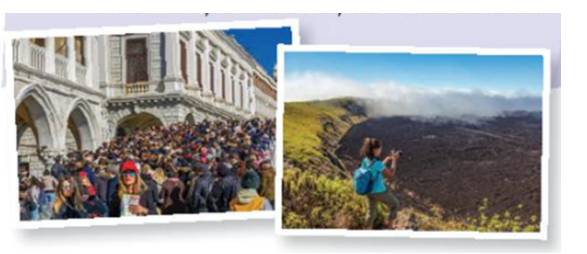
• Mass tourism is a kind of tourism which involves tens of thousands of people crowding the same places at the same time of year. It often has a lot of negative impact on the local area, such as litter from tourists and pollution from traffic.

• Ecotourism provides tourists with opportunities to explore nature, and at the same time helps protect the environment and educates travellers on local environmental issues. It also promotes tourists' respect for local communities.

• Sustainable tourism involves not only environmental protection and cultural respect, but also efforts to keep profits local. It often refers to actions of the tourist industry as a whole.

• Responsible tourism encourages tourists to be more than visitors. Responsible tourists should not only be aware of their role, but also take part in protecting the environment, culture and improving the profits for local people. Responsible tourism often relates to specific actions of individuals, businesses, and communities.

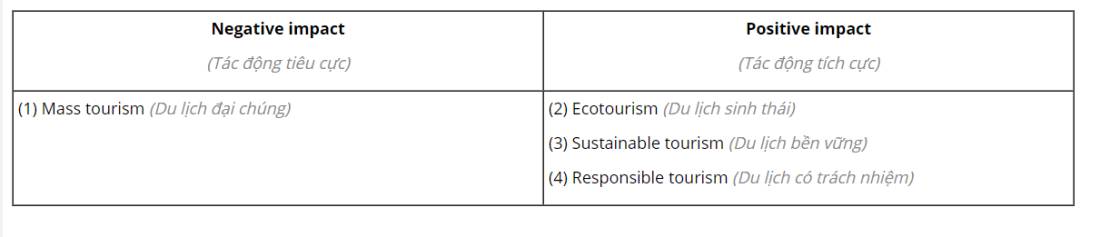
Negative impact

Positive impact

(1) __________

(2) __________

(3) __________

(4) __________

2
11 tháng 9 2023

Tác động đến môi trường của du lịch

Mặc dù du lịch thường được gọi là 'ngành công nghiệp không khói', hoặc một ngành công nghiệp thân thiện với môi trường, nó thực sự có thể gây hại cho thiên nhiên. Tuy nhiên, các loại hình du lịch khác nhau có thể có những tác động khác nhau đến môi trường.

• Du lịch đại chúng là loại hình du lịch bao gồm hàng chục nghìn người tập trung ở cùng một địa điểm vào cùng một thời điểm trong năm. Nó thường có nhiều tác động tiêu cực đến khu vực địa phương, chẳng hạn như xả rác từ khách du lịch và ô nhiễm giao thông.

• Du lịch sinh thái cung cấp cho khách du lịch cơ hội khám phá thiên nhiên, đồng thời giúp bảo vệ môi trường và giáo dục du khách về các vấn đề môi trường tại địa phương. Nó cũng thúc đẩy sự tôn trọng của khách du lịch đối với cộng đồng địa phương.

• Du lịch bền vững không chỉ liên quan đến việc bảo vệ môi trường và tôn trọng văn hóa mà còn phải nỗ lực giữ lợi nhuận cho địa phương. Nó thường đề cập đến các hành động của ngành du lịch nói chung.

• Du lịch có trách nhiệm khuyến khích khách du lịch nhiều hơn là khách vãng lai. Khách du lịch có trách nhiệm không chỉ nhận thức được vai trò của mình mà còn phải tham gia vào việc bảo vệ môi trường, văn hóa và nâng cao lợi nhuận cho người dân địa phương. Du lịch có trách nhiệm thường liên quan đến các hành động cụ thể của cá nhân, doanh nghiệp và cộng đồng.

6 tháng 2 2023

1: popular

2: cultural

3: open to

4: easier

5: international

6: experiencing

11 tháng 9 2023

1. What was the mother doing? - She was sitting on a bench and talking to the boy.

(Người mẹ đang làm gì? – Cô ấy đang ngồi trên băng ghế và nói chuyện với cậu bé.)

2. What was the boy doing? - He was sitting on a bench and was not looking at his mother.

(Cậu bé đang làm gì? – Cậu bé đang ngồi trên băng ghế và không nhìn vào mẹ cậu ấy.)

3. What was the girl doing? - She was singing quietly and playing with a toy.

(Cô bé đang làm gì? – Cô bé đang hát thầm và chơi đồ chơi.)

4. What were the other travellers doing? - They were shouting greetings, waving goodbye, carrying heavy bags or running to catch trains.

(Những du khách khác đang làm gì? -  (Họ đang chào nhau, vẫy tay tạm biết, mang những túi nặng hoặc chạy để bắt kịp tàu.)

5. What was the tall man doing? - He was standing near the exit and looking straight at the narrator.

(Người đàn ông cao lớn đang làm gì? – Anh ta đang đứng gần lối thoát hiểm và nhìn thẳng vào )

6. What were the cafe owners doing? - They were carrying tables outside.

(Các chủ quán ăn đang làm gì – Họ đang mang bàn ra ngoài.)

7. What was the dog doing? - He was lying on the pavement nearby.

(Con chó đang làm gì? – Nó đang nằm trên vỉa hè gần đó.)

8. What were teenage girls doing? - They were sitting on a bench and sharing headphones.

(Các cô gái teen đang làm gì? – Họ đang ngồi trên một băng ghế và chia sẻ tai nghe.)

2. Read the text and circle the correct meanings of the highlighted words and phrases.(Đọc văn bản và khoanh tròn nghĩa đúng của các từ và cụm từ được đánh dấu.)Gender equality has been greatly promoted around the world. However, there are still many challenges that women face.First of all, there are still girls who are forced to get married before the age of 18. In many places, parents may see child marriage as a way to protect daughters from violence. However,...
Đọc tiếp

2. Read the text and circle the correct meanings of the highlighted words and phrases.

(Đọc văn bản và khoanh tròn nghĩa đúng của các từ và cụm từ được đánh dấu.)

Gender equality has been greatly promoted around the world. However, there are still many challenges that women face.

First of all, there are still girls who are forced to get married before the age of 18. In many places, parents may see child marriage as a way to protect daughters from violence. However, many of these young girls become victims of domestic violence. Child marriage also carries serious health risks as young girls are not physically developed to give birth.

Secondly, more than half of the world's uneducated people are women. This means fewer girls than boys go to school or stay long at school. Girls who receive an education are less likely to marry young. They can also have better job skills and can earn higher salaries. Education gives girls the opportunity to have a better life and give back to their communities.

Thirdly, women are often paid less than men. In other words, women have to work longer than men to earn the same amount of money. Differences in career choices might be one reason. Women tend to become nurses, secretaries, or shop assistants, which are low-paying jobs, while men choose high-paying careers as surgeons, airline pilots, or engineers.

Women are still not equal to men in today's society, and governments, organisations and individuals must work together to achieve gender equality.

1. be forced

a. be made to do something unwanted

b. be made to do something necessary

2. domestic violence

a. action taken to please someone

b. behaviour intended to hurt someone you live with

3. uneducated

a. having little or no formal education at school

b. not having many jobs opportunities

4. low-paying

a. giving money to a person

b. providing very little money

1
14 tháng 8 2023

1. a

2. b

3. a

4. b