K
Khách

Hãy nhập câu hỏi của bạn vào đây, nếu là tài khoản VIP, bạn sẽ được ưu tiên trả lời.

11 tháng 9 2023

A. Dave felts amused when he played prank on his sister and felt guilty after seeing his sister get over from it. (Dave cảm thấy thích thú khi chơi khăm chị của cậu ấy và hối hận sau khi thấy chị ấy khó khăn vượt qua nó.)

B. Dave’s big sister felt angry when she knew his prank and frightened when she saw the fake spider.

(Chị cả của Dave cảm thấy tức giận khi biết trò khăm của cậu ta và thấy kinh hãi khi thấy con nhện giả.)

C. Kate felt anxious when she gave his brother the card and felt pleased when his brother’s crush agreed to go out with him.

(Kate cảm thấy lo lắng khi cô ấy đưa anh trai tấm thiệp và cảm thấy vui mừng khi người anh trai thích đồng ý đi chơi với cậu ấy.)

D. Kate's brother felt angry when he found out the girl didn’t send him the card and felt pleased when she agreed to go out with him.

(Anh trai của Kate đã tức giận khi tìm ra cô gái đó không gửi anh tấm thiếp và cảm thấy vui mừng khi cô ấy đồng ý đi chơi với anh.)

6 tháng 2 2023

1: peacekeeping

2: harm

3: expert

4: investors

1. Read the text. Match the highlighted words with their meanings.(Đọc văn bản. Nối các từ được làm nổi bật với nghĩa của chúng.)The more people travel, the bigger impact they may have on the environment. How can we reduce it while travelling? Here are some advice.Reduce your carbon footprint while travelling. Since flying produces more carbon footprint than any other means of transport, you should only fly when the trip is long. During the trip, you should walk, cycle...
Đọc tiếp

1. Read the text. Match the highlighted words with their meanings.

(Đọc văn bản. Nối các từ được làm nổi bật với nghĩa của chúng.)

The more people travel, the bigger impact they may have on the environment. How can we reduce it while travelling? Here are some advice.

Reduce your carbon footprint while travelling. Since flying produces more carbon footprint than any other means of transport, you should only fly when the trip is long. During the trip, you should walk, cycle or use public transport as much as you can. This not only helps to keep the environment clean, but also allows you to enjoy the beauty of nature and interact with local people. 

Choose eco-friendly activities that benefit animals and the ecosystem. Avoid activities that allow you to touch or ride animals because they disturb their natural patterns and attract many people. Instead, visit wildlife parks or organic farms. These will help you understand and respect the nature more and stop doing things that harm the environment.

Words

Meanings

1. interact 

a. to be good for someone or something 

2. benefit 

b. to talk or do things with other people 

3. disturb 

c. to interrupt what people are doing and make them angry 

3
6 tháng 2 2023

1B

2A

3C

6 tháng 2 2023

1. Read the text. Match the highlighted words with their meanings.

(Đọc văn bản. Nối các từ được làm nổi bật với nghĩa của chúng.)

The more people travel, the bigger impact they may have on the environment. How can we reduce it while travelling? Here are some advice.

Reduce your carbon footprint while travelling. Since flying produces more carbon footprint than any other means of transport, you should only fly when the trip is long. During the trip, you should walk, cycle or use public transport as much as you can. This not only helps to keep the environment clean, but also allows you to enjoy the beauty of nature and interact with local people. 

Choose eco-friendly activities that benefit animals and the ecosystem. Avoid activities that allow you to touch or ride animals because they disturb their natural patterns and attract many people. Instead, visit wildlife parks or organic farms. These will help you understand and respect the nature more and stop doing things that harm the environment.
 

Answer:

1. interact ->b: to talk or do things with other people.
2. benefit ->a: to be good for someone or something.

3. disturb ->c: to interrupt what people are doing and make them angry.

2. Read the Reading Strategy. Then read the text quickly to get a general idea of the meaning. Were your ideas in exercise 1 correct?(Đọc “Chiến thuật đọc hiểu”. Sau đó đọc bài khóa thật nhanh để lấy ý chính về bài đọc. Ý tưởng của bạn trong bài 1 có đúng không?)Reading Strategy (Chiến thuật đọc hiểu)When you do a matching task, follow these steps:(Khi làm dạng bài nối, làm theo các bước sau:) 1. Read the text to get a...
Đọc tiếp

2. Read the Reading Strategy. Then read the text quickly to get a general idea of the meaning. Were your ideas in exercise 1 correct?

(Đọc “Chiến thuật đọc hiểu”. Sau đó đọc bài khóa thật nhanh để lấy ý chính về bài đọc. Ý tưởng của bạn trong bài 1 có đúng không?)

Reading Strategy (Chiến thuật đọc hiểu)

When you do a matching task, follow these steps:

(Khi làm dạng bài nối, làm theo các bước sau:) 

1. Read the text to get a general idea of the meaning. Do not worry if you do not understand every word.

(1. Đọc bài khóa để lấy ý chính. Đừng lo lắng nếu bạn không hiểu tất cả các từ trong bài đọc.)

2. Read the task and all the options carefully.

(2. Cẩn thận đọc đề bài và các lựa chọn.)

3. Read the paragraphs of the text carefully one by one and match them to the correct option.

(3. Cẩn thận đọc từng đoạn văn một và nối chúng với lựa chọn chính xác.)

4. Check that the extra options do not match with any of the paragraphs.

(4. Kiểm tra các lựa chọn thừa không hợp với bất cứ đoạn văn nào.)

1
11 tháng 9 2023

The text is about a girl who can’t feel pain. (Bài đọc nói về một cô gái không thể cảm nhận cơn đau.)

6 tháng 2 2023

1C

2D

3A

4E

5B

11 tháng 9 2023

1. What was the mother doing? - She was sitting on a bench and talking to the boy.

(Người mẹ đang làm gì? – Cô ấy đang ngồi trên băng ghế và nói chuyện với cậu bé.)

2. What was the boy doing? - He was sitting on a bench and was not looking at his mother.

(Cậu bé đang làm gì? – Cậu bé đang ngồi trên băng ghế và không nhìn vào mẹ cậu ấy.)

3. What was the girl doing? - She was singing quietly and playing with a toy.

(Cô bé đang làm gì? – Cô bé đang hát thầm và chơi đồ chơi.)

4. What were the other travellers doing? - They were shouting greetings, waving goodbye, carrying heavy bags or running to catch trains.

(Những du khách khác đang làm gì? -  (Họ đang chào nhau, vẫy tay tạm biết, mang những túi nặng hoặc chạy để bắt kịp tàu.)

5. What was the tall man doing? - He was standing near the exit and looking straight at the narrator.

(Người đàn ông cao lớn đang làm gì? – Anh ta đang đứng gần lối thoát hiểm và nhìn thẳng vào )

6. What were the cafe owners doing? - They were carrying tables outside.

(Các chủ quán ăn đang làm gì – Họ đang mang bàn ra ngoài.)

7. What was the dog doing? - He was lying on the pavement nearby.

(Con chó đang làm gì? – Nó đang nằm trên vỉa hè gần đó.)

8. What were teenage girls doing? - They were sitting on a bench and sharing headphones.

(Các cô gái teen đang làm gì? – Họ đang ngồi trên một băng ghế và chia sẻ tai nghe.)

2. Read the text and circle the correct meanings of the highlighted words.(Đọc văn bản và khoanh tròn nghĩa đúng của các từ được đánh dấu.)Since UNICEF set up an office in 1975 in Viet Nam, it has run projects in various fields to provide the highest possible support for children in our country. The organisation particularly aims to create opportunities for all children in Viet Nam to attend school, learn and succeed. The following programmes help achieve the UNICEF's...
Đọc tiếp

2. Read the text and circle the correct meanings of the highlighted words.

(Đọc văn bản và khoanh tròn nghĩa đúng của các từ được đánh dấu.)

Since UNICEF set up an office in 1975 in Viet Nam, it has run projects in various fields to provide the highest possible support for children in our country. The organisation particularly aims to create opportunities for all children in Viet Nam to attend school, learn and succeed. The following programmes help achieve the UNICEF's education aims for Viet Nam.

Education for Disadvantaged Young People

UNICEF helps disadvantaged teenagers continue their education by offering them job training and career advice. They are also taught essential skills for the job market.

Providing Education Opportunities for Children with Disabilities

This programme gives children with disabilities a chance to get access to and benefit from a quality education. It also helps promote equal participation in society and a culture in which people respect each other.

Improving Learning Achievements

This is another practical programme supported by UNICEF. The aim is to better prepare children for the challenges in the future. UNICEF helps Viet Nam in joining regional educational programmes to improve children's learning achievements. When they leave school, they should have the necessary skills and knowledge to work in a fast-changing world.

1. create

a. make something happen 

b. increase something

c. refuse something

2. essential

a. usual

b. necessary

c. successful

3. respect

a. have a good opinion of somebody

b. look down on somebody

c. get on well with somebody

4. practical

a. connected with organisations

b. connected with ideas

c. connected with real situations

2
14 tháng 8 2023

1. a

2. b

3. a

4. c

10 tháng 9 2023

1. a

2. b

3. a

4. c

1. create (v): tạo ra

a. make something happen

(làm cho một cái gì đó xảy ra)

b. increase something

(tăng cái gì đó)

c. refuse something

(từ chối điều gì đó)

2. essential (adj): cần thiết

a. usual

(thường)

b. necessary

(cần thiết)

c. successful

(thành công)

3. respect (v): tôn trọng

a. have a good opinion of somebody

(có quan điểm tốt về ai đó)

b. look down on somebody

(khinh thường ai đó)

c. get on well with somebody

(có mối quan hệ tốt với người nào đó)

4. practical (adj): thực tiễn

a. connected with organisations

(kết nối với các tổ chức)

b. connected with ideas

(kết nối với các ý tưởng)

c. connected with real situations

(kết nối với các tình huống thực tế)
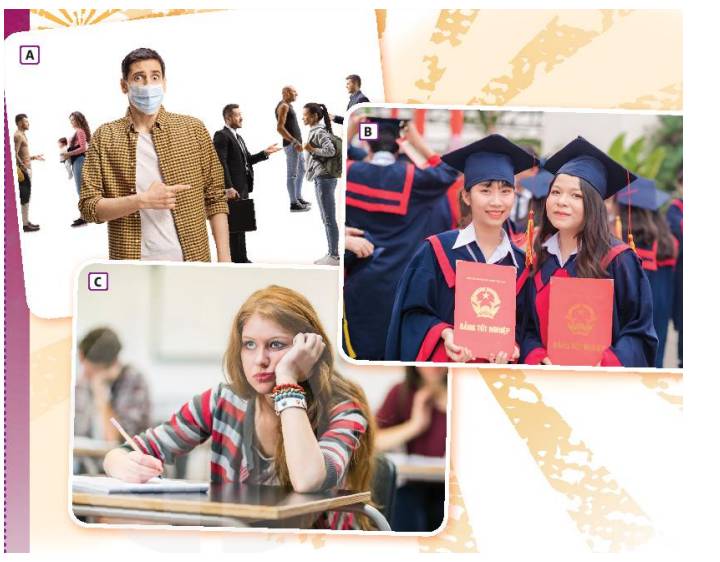
11 tháng 9 2023

1. A. worried (lo lắng), B. happy (vui vẻ), excited (hào hứng).

2. Photo A: The man is worried because the people are standing too close to each other and they are not wearing masks.

(Ảnh A: Người đàn ông lo lắng vì mọi người đứng quá gần nhau và họ không đeo khẩu trang.)

    Photo B: The girls are happy because it is their graduation day.

(Ảnh B: Các cô gái rất vui vì đây là ngày tốt nghiệp của họ.)

   Photo C: The girl's schoolwork is difficult and boring.

(Ảnh C: Bài tập ở trường của cô gái thật khó khăn và nhàm chán.)

6 tháng 2 2023

1C

2D

3A

4E

5B

3. Read the text again. Match the questions below with paragraphs A-E of the text. (Đọc bài khóa một lần nữa. Nối các câu hỏi bên dưới với các đoạn văn (A – E).)In which paragraph does the writer tell us …1. when doctors realised Ashlyn had a medical problem?2. what causes her condition?3. what happened when she burned her hands?4. why some people die from this condition?5. how school life for Ashlyn was unusual?A life without painA. All children hurt...
Đọc tiếp

3. Read the text again. Match the questions below with paragraphs A-E of the text. 

(Đọc bài khóa một lần nữa. Nối các câu hỏi bên dưới với các đoạn văn (A – E).)

In which paragraph does the writer tell us …

1. when doctors realised Ashlyn had a medical problem?

2. what causes her condition?

3. what happened when she burned her hands?

4. why some people die from this condition?

5. how school life for Ashlyn was unusual?

A life without pain

A. All children hurt themselves from time to time. But when thirteen-year-old Ashlyn Blocker gets injured, she doesn't realise it. Once, when she burned herself, she only knew about it when she looked at her skin. 

B. There was always something different about Ashlyn. As a baby, she didn't cry. When she was eight months old, her parents noticed there was some blood in her eye, so they took her to see a doctor. The doctor found a serious cut in her eye and was shocked. Why didn't the baby cry? Tests showed that Ashlyn had a very unusual medical condition: she couldn't feel any pain. 

C. This condition is very rare: many people who have it die of it. Pain is a natural warning that you're ill or injured. People who can't feel pain lust don't realise they're in danger. 

D. The first few years of Ashlyn's life were very difficult. She often tripped and injured herself. Once, she broke her ankle but she didn't stop running. During school breaks, one teacher watched Ashlyn all the time in the playground and they had to search for cuts. bruises or other injuries.

E. When she was five, Ashlyn's story appeared in newspapers and on TV. Scientists studied her condition and found she has a genetic disorder that means pain signals do not reach her brain. Unfortunately, at the moment, there is no hope of a cure. And, as Ashlyn knows, a life without pain is both difficult and dangerous.

3
7 tháng 2 2023

1B

2E

3A

4C

5D

11 tháng 9 2023

In which paragraph does the writer tell us … (Trong đoạn văn nào mà tác giả nói về…)

1. B

when doctors realised Ashlyn had a medical problem? (khi các bác sỹ nhận ra Ashlyn có vấn đề bệnh lý?)

Thông tin: Tests showed that Ashlyn had a very unusual medical condition: she couldn't feel any pain. 

(Các bài kiểm tra đã cho thấy Ashlyn có một tình trạng bệnh lý: cô ấy không thể cảm nhận bất kỳ sự đau đớn nào.)

2. E

what causes her condition? (điều gì gây ra căn bệnh của cô ấy?)

Thông tin: Scientists studied her condition and found she has a genetic disorder that means pain signals do not reach her brain. (Các nhà khoa học nghiên cứu tình trạng của cô ấy và phát hiện ra cô ấy có một loại bệnh di truyền mà những tín hiệu đau đớn không đến được não của cô ấy.)

3. A

what happened when she burned her hands? (điều gì đã xảy ra khi cô ấy làm bỏng tay?)

Thông tin: Once, when she burned herself, she only knew about it when she looked at her skin. (Trong một lần cô ấy làm bỏng chính mình, cô chỉ biết khi cô nhìn vào da của mình.)

4. C

why some people die from this condition? (tại sao có người chết vì tình trạng này?)

Thông tin: People who can't feel pain lust don't realise they're in danger. (Những người không thể nhận ra cơn đau chỉ không nhận ra họ đang gặp nguy hiểm.)

5. D

how school life for Ashlyn was unusual? (cuộc sống trên trường của Ashlyn bất thường như thế nào?)

Thông tin: During school breaks, one teacher watched Ashlyn all the time in the playground and they had to search for cuts. bruises or other injuries. (Những lúc giải lao ở trường, một giáo viên quan sát Ashlyn mọi lúc ở sân chơi và họ phải tìm kiếm những vết cắt, vết bầm hoặc những vết thương khác.)