K
Khách

Hãy nhập câu hỏi của bạn vào đây, nếu là tài khoản VIP, bạn sẽ được ưu tiên trả lời.

11 tháng 9 2023

No. The first post doesn’t mention where Harry is staying.

(Không, blog đầu tiên không đề cập đến Harry ở đâu.)

7 tháng 2 2023

Dear Mai,
Last year, my family went to Phu Quoc Island. It was hot and sunny there though it was winter. We went there by airplane. When we got there, the first thing we do was booked a room in the hotel. After an hour on the plane, we took a nap in the room. In the afternoon, we went swimming in the sea and at the swimming pool. In the evening, we went to the restaurant to had dinner. Next summer, I hope you'll come with us. Bye!
Nguyet

11 tháng 9 2023

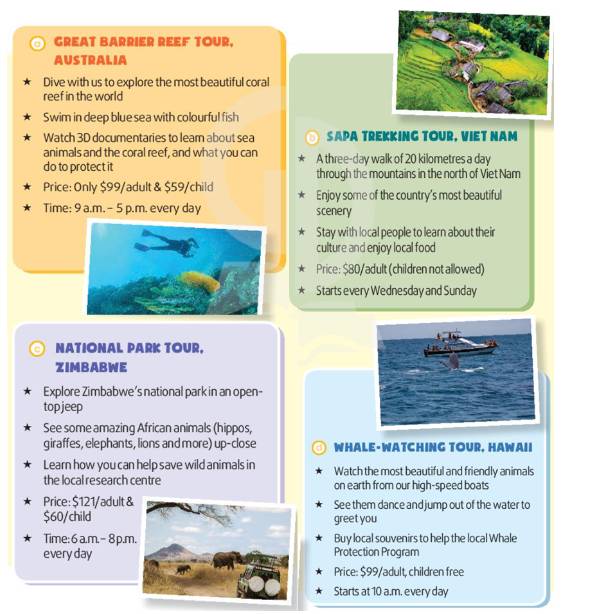
Day trip to discover Nha Trang & Yang Bay Waterfall

(Chuyến đi trong ngày khám phá Nha Trang & Thác Yang Bay)

Time to leave: 6.30 a.m. (Thời gian rời đi: 6:30 sáng)

Trip will take: 5 / ten hours (Chuyến đi sẽ mất: 5 tiếng)

Activities: (Các hoạt động:)

- enjoy stunning views of Yang Bay Waterfall

(thưởng ngoạn tầm nhìn tuyệt đẹp ra Thác Yang Bay)

- have lunch at Memento Country Home

(ăn trưa tại Memento Country Home)

- visit Dien Khanh Citadel and Long Son Pagoda

(thăm Thành cổ Diên Khánh và chùa Long Sơn)

- stop at the Po Nagar Cham Towers and discover the intriguing story of the Chams

(dừng chân tại Tháp Chàm Po Nagar và khám phá câu chuyện hấp dẫn của người Chăm)

- experience local life as you stop at villages and markets

(trải nghiệm cuộc sống địa phương khi bạn dừng chân tại các ngôi làng và chợ)

Do not: (Đừng:)

drop litter or catch fish in the waterfall (xả rác hoặc bắt cá ở thác)

1. Describe the photo. What are the girls doing? How are they feeling? What do you think they are saying?(Mô tả bức ảnh. Các cô gái đang làm gì? Họ đang cảm thấy như thế nào? Bạn nghĩ họ đang nói gì?)1. You borrowed a DVD from your friend but now you can't find it. Do you…(Bạn mượn một cái đĩa DVD từ bạn của bạn nhưng giờ bạn không thể tìm thấy nó nữa. Bạn sẽ…)a. tell your friend the truth as soon as possible? (nói cho...
Đọc tiếp

1. Describe the photo. What are the girls doing? How are they feeling? What do you think they are saying?

(Mô tả bức ảnh. Các cô gái đang làm gì? Họ đang cảm thấy như thế nào? Bạn nghĩ họ đang nói gì?)

1. You borrowed a DVD from your friend but now you can't find it. Do you…

(Bạn mượn một cái đĩa DVD từ bạn của bạn nhưng giờ bạn không thể tìm thấy nó nữa. Bạn sẽ…)

a. tell your friend the truth as soon as possible? 

(nói cho bạn của bạn sự thật sớm nhất có thể?)

b. say nothing and hope your friend forgets about it? 

(không nói gì cả và mong bạn của bạn sẽ quên đi chuyện đó?)

c. secretly buy a new copy of the DVD? 

(bí mật mua một bản sao của đĩa DVD đó?)

d. keep looking for the DVD but say nothing yet? 

(tiếp tục tìm kiếm đĩa DVD nhưng không nói gì cả?)


2. Your friend has stopped speaking to you and you don't know why. Do you…

(Bạn của bạn đã ngừng nói chuyện với bạn và bạn không biết lý do tại sao. Bạn sẽ…)

a. send a message asking what the problem is? 

(gửi tin nhắn để hỏi vấn đề là gì?)

b. ask your other friends about it? 

(hỏi những người bạn khác về chuyện đó?)

c. insist on talking face-to-face with your friend?

(kiên quyết nói chuyện trực tiếp với người bạn đó?)

d. just wait and see if the problem goes away 

(chờ và xem liệu vấn đề có hết không)


3. You’re friendly with a new student at school, but your old friends don't like him/her. Do you… 

(Bạn tỏ ra thân thiện với một học sinh mới ở trường, nhưng mấy người bạn cũ của bạn không thích cậu ấy. Bạn sẽ…)

a. stop spending time with the new student? 

(ngưng dành thời gian với học sinh mới?)

b. tell your old friends they aren't behaving well?

(nói cho mấy đứa bạn cũ rằng họ đang cư xử không đúng?)

c. invite them all to your house so they can get to know one another? 

(mời tất cả đến nhà để họ có thể hiểu nhau hơn?)

d. continue to see them all, but separately?

(tiếp tục gặp tất cả, nhưng riêng biệt?)

1
11 tháng 9 2023

One girl is upset. The other girl is talking to her to make her feel better.

(Một cô gái đang đau. Cô gái còn lại đang nói chuyện để cô ấy cảm thấy tốt hơn.)

2. Rewrite these sentences about Hoi An villages. Use the expressions below to help you.(Viết lại những câu này về các làng quê Hội An. Sử dụng các cấu trúc diễn đạt dưới đây để giúp bạn.)1. Hoi An villages are famous for their beautiful vegetable and herb gardens.=> __________________ well-known ________________________.2. Tourists can work on a local farm in the morning.=> _____________________ spend________________________.3. Tourists should buy...
Đọc tiếp

2. Rewrite these sentences about Hoi An villages. Use the expressions below to help you.

(Viết lại những câu này về các làng quê Hội An. Sử dụng các cấu trúc diễn đạt dưới đây để giúp bạn.)

1. Hoi An villages are famous for their beautiful vegetable and herb gardens.

=> __________________ well-known ________________________.

2. Tourists can work on a local farm in the morning.

=> _____________________ spend________________________.

3. Tourists should buy handmade products to help local businesses.

=> __________________ recommended ________________________.

Useful expressions:

What is special about the place? 

(Điều gì đặc biệt về nơi này?)

- … is / are famous for sth. 

(... nổi tiếng về...)

- … is / are well-known for sth. 

(... nổi tiếng về...)

What can tourists do / explore there?

(Du khách có thể làm gì ở đây?)

- ... can enjoy doing sth.

(... có thể thích...)

- … can spend time doing sth.

(...có thể dành thời gian...)

- Favourite leisure activities are / include doing sth.

(Những hoạt động giải trí yêu thích là...)

What can tourists do to make their trip more eco-friendly?

(Du khách có thể làm gì để chuyến đi của họ thân thiện với môi trường hơn?)

- ... ought (not) to / should (not) do sth…

(... nên (không nên)...)

- … are encouraged / recommended (nor) to do sth. 

(... được khuyến khích/ đề xuất...)

2
6 tháng 2 2023

1. Hoi An villages are well - known  for their beautiful vegetable and herb gardens.

2. Tourists can spend the morning on a local farm

3. Tourists recommended to buy handmade products to help local businesses.

6 tháng 2 2023

Hoi An villages are well-known for their beautiful vegetable and herb gardens

Tourists can spend the morning working on a local farm

Tourists are recommended to buy handmade products to help local businesses

1. Read the text. Match the highlighted words with their meanings.(Đọc văn bản. Nối các từ được làm nổi bật với nghĩa của chúng.)The more people travel, the bigger impact they may have on the environment. How can we reduce it while travelling? Here are some advice.Reduce your carbon footprint while travelling. Since flying produces more carbon footprint than any other means of transport, you should only fly when the trip is long. During the trip, you should walk, cycle...
Đọc tiếp

1. Read the text. Match the highlighted words with their meanings.

(Đọc văn bản. Nối các từ được làm nổi bật với nghĩa của chúng.)

The more people travel, the bigger impact they may have on the environment. How can we reduce it while travelling? Here are some advice.

Reduce your carbon footprint while travelling. Since flying produces more carbon footprint than any other means of transport, you should only fly when the trip is long. During the trip, you should walk, cycle or use public transport as much as you can. This not only helps to keep the environment clean, but also allows you to enjoy the beauty of nature and interact with local people. 

Choose eco-friendly activities that benefit animals and the ecosystem. Avoid activities that allow you to touch or ride animals because they disturb their natural patterns and attract many people. Instead, visit wildlife parks or organic farms. These will help you understand and respect the nature more and stop doing things that harm the environment.

Words

Meanings

1. interact 

a. to be good for someone or something 

2. benefit 

b. to talk or do things with other people 

3. disturb 

c. to interrupt what people are doing and make them angry 

3
6 tháng 2 2023

1B

2A

3C

6 tháng 2 2023

1. Read the text. Match the highlighted words with their meanings.

(Đọc văn bản. Nối các từ được làm nổi bật với nghĩa của chúng.)

The more people travel, the bigger impact they may have on the environment. How can we reduce it while travelling? Here are some advice.

Reduce your carbon footprint while travelling. Since flying produces more carbon footprint than any other means of transport, you should only fly when the trip is long. During the trip, you should walk, cycle or use public transport as much as you can. This not only helps to keep the environment clean, but also allows you to enjoy the beauty of nature and interact with local people. 

Choose eco-friendly activities that benefit animals and the ecosystem. Avoid activities that allow you to touch or ride animals because they disturb their natural patterns and attract many people. Instead, visit wildlife parks or organic farms. These will help you understand and respect the nature more and stop doing things that harm the environment.
 

Answer:

1. interact ->b: to talk or do things with other people.
2. benefit ->a: to be good for someone or something.

3. disturb ->c: to interrupt what people are doing and make them angry.

3. Work in groups. Choose an environmental problem in 1 and make a presentation on the solutions to it. Use the expressions below to help you.(Làm việc nhóm. Chọn một vấn đề môi trường trong bài 1 và trình bày các giải pháp cho vấn đề đó. Sử dụng các cụm từ dưới đây để giúp bạn.)Useful expressionsWelcoming the audience and introducing the topic(Chào khán giả và giới thiệu chủ đề)Hi everyone.(Chào mọi người.)Good morning/...
Đọc tiếp

3. Work in groups. Choose an environmental problem in 1 and make a presentation on the solutions to it. Use the expressions below to help you.

(Làm việc nhóm. Chọn một vấn đề môi trường trong bài 1 và trình bày các giải pháp cho vấn đề đó. Sử dụng các cụm từ dưới đây để giúp bạn.)

Useful expressions

Welcoming the audience and introducing the topic

(Chào khán giả và giới thiệu chủ đề)

Hi everyone.

(Chào mọi người.)

Good morning/ afternoon.

(Chào buổi sáng / buổi chiều.)

I’m here today to talk about/ discuss …

(Hôm nay tôi ở đây để nói về / thảo luận…)

I’d like to talk about …

(Tôi muốn nói về…)

Today, I’d like to share with you …

(Hôm nay, tôi muốn chia sẻ với bạn…)

Introducing the first point/ idea

(Giới thiệu quan điểm/ ý tưởng đầu tiên)

Firstly, the problem can be solved by …

(Thứ nhất, vấn đề có thể được giải quyết bằng…)

The first solution is to …

(Giải pháp đầu tiên là…)

Introducing the second point/ idea

(Giới thiệu quan điểm / ý tưởng thứ hai)

My next point is …

(Điểm tiếp theo của tôi là…)

Another solution is to …

(Một giải pháp khác là…)

Finishing the presentation and thanking the audience

(Kết thúc bài thuyết trình và cảm ơn khán giả)

That concludes our presentation.

(Điều đó kết thúc bài thuyết trình của chúng tôi.)

That’s the end of our presentation today.

(Đó là phần cuối của bài thuyết trình của chúng ta ngày hôm nay.)

Thank you for listening.

(Cám ơn vì đã lắng nghe.)

Thank you for your attention.

(Cảm ơn vì sự quan tâm của bạn.)

1
10 tháng 9 2023

Good morning. Today, I’d like to share with you about the solutions to one of the most significant problems in our city - deforestation. Firstly, the problem can be solved by recycling paper, plastics, and wood products. My next point is introducing strict laws to prevent the cutting of natural forests. Another solution is to educate our friends, family, and community by sharing the deforestation facts, and its causes and effects. That’s the end of our presentation today. Thank you for your attention.

Tạm dịch:

Buổi sáng tốt lành. Hôm nay, tôi muốn chia sẻ với các bạn về giải pháp cho một trong những vấn đề nổi bật nhất ở thành phố của chúng ta - nạn phá rừng. Thứ nhất, vấn đề có thể được giải quyết bằng cách tái chế giấy, nhựa và các sản phẩm từ gỗ. Giải pháp tiếp theo của tôi là đưa ra luật nghiêm khắc để ngăn chặn việc chặt phá rừng tự nhiên. Một giải pháp khác là giáo dục bạn bè, gia đình và cộng đồng của chúng ta bằng cách chia sẻ sự thật về nạn phá rừng, nguyên nhân và hậu quả của nó. Bài thuyết trình hôm nay đến đây là hết. Cảm ơn các bạn vì đã chú ý lắng nghe.

2. Complete the dialogue with the correct affirmative or negative past simple form of the verbs below.(Hoàn thành đoạn hội thoại với thể khẳng định hoặc thể phủ định đúng của thì quá khứ đơn cho các động từ bên dưới.)be   get   learn   leave   love   spend   watchKirstie: Hi, Laurie. How are you? Tell me about your summer holiday!Laurie:  Well, for the first three weeks, I was at a summer camp in Cornwall.Kirstie: Really? That sounds like...
Đọc tiếp

2. Complete the dialogue with the correct affirmative or negative past simple form of the verbs below.

(Hoàn thành đoạn hội thoại với thể khẳng định hoặc thể phủ định đúng của thì quá khứ đơn cho các động từ bên dưới.)

be   get   learn   leave   love   spend   watch

Kirstie: Hi, Laurie. How are you? Tell me about your summer holiday!

Laurie:  Well, for the first three weeks, I was at a summer camp in Cornwall.

Kirstie: Really? That sounds like fun!

Laurie: Yes, it was. I (1) _____ a new sport - bodyboarding.

Kirstie: Wow! That sounds great!

Laurie: Yes. I (2) _____ it. It was really exciting - and a bit frightening too!

Kirstie: I bet! What else did you get up to over the summer?

Laurie: Well, the second half of the holiday (3) _____ so good. I (4) _____ a stomach bug and (5) _____ nearly a week on the sofa.

Kirstie: Oh dear! How awful!

Laurie: I (6) _____ the house for days. I just (7) _____ DVDs. I was so bored!

1
7 tháng 2 2023

1.learnt

2.loved

3.wasn't

4.got

5.spent

6.didn't

7.watched

11 tháng 9 2023

1. Did Harry know the person who fell into the water? (Harry có biết ai là người bị ngã xuống nước không?)

Maybe that was a friend of Harry. (Có lẽ là một người bạn của Harry.)

2. Did they fight or help each other? (Họ đánh nhau hay giúp đỡ nhau?)

They were fighting. (Họ đang đánh nhau.)

3. What happened to the boat? (Chuyện gì đã xảy ra với con thuyền?)

The boat stopped moving. (Con thuyền ngừng di chuyển.)

4. Did Harry return to the shore or get on the boat? (Harry quay vào bờ hay lên thuyền?)

He got on the boat. (Anh ta lên thuyền.)

5. What happened next? (Chuyện gì xảy ra tiếp theo?)

Harry saved the person who fell into the water. (Harry đã cứu người bị rớt xuống nước.)