K
Khách

Hãy nhập câu hỏi của bạn vào đây, nếu là tài khoản VIP, bạn sẽ được ưu tiên trả lời.

3. Read the Learn this! box. Which different noun suffixes can you find in the text in exercise 1? Which nouns do not have a suffix?(Đọc hộp Learn this! Những hậu tố khác nhau của danh từ nào bạn có thể tìm thấy trong bài đọc bài 1? Danh từ nào không có hậu tố?)LEARN THIS! Related verbs and nounsa. Some nouns are formed by adding a suffix (e.g. -(at)ion. -ment, -ure) to a verb. Other spelling changes may be necessary. (Một vài danh từ hình thành...
Đọc tiếp

3. Read the Learn this! box. Which different noun suffixes can you find in the text in exercise 1? Which nouns do not have a suffix?

(Đọc hộp Learn this! Những hậu tố khác nhau của danh từ nào bạn có thể tìm thấy trong bài đọc bài 1? Danh từ nào không có hậu tố?)

LEARN THIS! Related verbs and nouns

a. Some nouns are formed by adding a suffix (e.g. -(at)ion. -ment, -ure) to a verb. Other spelling changes may be necessary. (Một vài danh từ hình thành bằng cách thêm một hậu tố (vd. -(at)ion. -ment, -ure) vào một động từ. Chính tả có thể thay đổi nếu cần.)

argue (v)- argument (n) fail (v)-failure (n)

translate (v)- translation (n)

b. Some nouns and verbs are identical. (Có những danh từ và động từ giống nhau.)

thunder (v) - thunder (n) fall (v) -fall (n)

c. In dictionaries, related nouns and verbs sometimes appear under the same entry. (Trong các cuốn từ điển, những danh từ và động từ có liên quan đến nhau đôi khi xuất hiện trong cùng một mục từ.)

1
11 tháng 9 2023

-tion: exploration

-ure: adventure

Không có hậu tố: attempt, need, experience, dream

2. Read the text and circle the correct meanings of the highlighted words.(Đọc văn bản và khoanh tròn nghĩa đúng của các từ được đánh dấu.)Since UNICEF set up an office in 1975 in Viet Nam, it has run projects in various fields to provide the highest possible support for children in our country. The organisation particularly aims to create opportunities for all children in Viet Nam to attend school, learn and succeed. The following programmes help achieve the UNICEF's...
Đọc tiếp

2. Read the text and circle the correct meanings of the highlighted words.

(Đọc văn bản và khoanh tròn nghĩa đúng của các từ được đánh dấu.)

Since UNICEF set up an office in 1975 in Viet Nam, it has run projects in various fields to provide the highest possible support for children in our country. The organisation particularly aims to create opportunities for all children in Viet Nam to attend school, learn and succeed. The following programmes help achieve the UNICEF's education aims for Viet Nam.

Education for Disadvantaged Young People

UNICEF helps disadvantaged teenagers continue their education by offering them job training and career advice. They are also taught essential skills for the job market.

Providing Education Opportunities for Children with Disabilities

This programme gives children with disabilities a chance to get access to and benefit from a quality education. It also helps promote equal participation in society and a culture in which people respect each other.

Improving Learning Achievements

This is another practical programme supported by UNICEF. The aim is to better prepare children for the challenges in the future. UNICEF helps Viet Nam in joining regional educational programmes to improve children's learning achievements. When they leave school, they should have the necessary skills and knowledge to work in a fast-changing world.

1. create

a. make something happen 

b. increase something

c. refuse something

2. essential

a. usual

b. necessary

c. successful

3. respect

a. have a good opinion of somebody

b. look down on somebody

c. get on well with somebody

4. practical

a. connected with organisations

b. connected with ideas

c. connected with real situations

2
14 tháng 8 2023

1. a

2. b

3. a

4. c

10 tháng 9 2023

1. a

2. b

3. a

4. c

1. create (v): tạo ra

a. make something happen

(làm cho một cái gì đó xảy ra)

b. increase something

(tăng cái gì đó)

c. refuse something

(từ chối điều gì đó)

2. essential (adj): cần thiết

a. usual

(thường)

b. necessary

(cần thiết)

c. successful

(thành công)

3. respect (v): tôn trọng

a. have a good opinion of somebody

(có quan điểm tốt về ai đó)

b. look down on somebody

(khinh thường ai đó)

c. get on well with somebody

(có mối quan hệ tốt với người nào đó)

4. practical (adj): thực tiễn

a. connected with organisations

(kết nối với các tổ chức)

b. connected with ideas

(kết nối với các ý tưởng)

c. connected with real situations

(kết nối với các tình huống thực tế)

6 tháng 2 2023

1.were-would live

2.work-will be

3.allow-will have

4.had-would go

6 tháng 2 2023

Put the verbs in brackets in the correct forms.

(Chia dạng đúng các động từ trong ngoặc.)

1. If I (be) __were____ you, I (live) ___would live___ with a host family so that I can learn more about the local culture.

2. If we (work) __work____ together, we (be) __will be____ able to reduce the negative impact of tourism on the environment.

3. If we (allow) __allow____ more people to crowd the city centre, we (have) __will have____ to deal with environmental pollution in the future.

4. If we (have) __had____ enough money, we (go) ___would go___ on an ecotour to Finland. Instead, were staying in Viet Nam in the summer. 
6 tháng 2 2023

1b

2c

3d

4a

6 tháng 2 2023

1B

2C

3D

4A

3. Read the Learn this! box. Find all the past simple forms in the text in exercise 2. Match them with rules a-d in the Learn this! box.(Đọc hộp Learn this!. Tìm tất cả các thể quá khứ trong bài đọc ở bài 2. Nối chúng với các quy tắc trong hộp.)LEARN THIS! Past simple (affirmative)(Thì quá khứ đơn - dạng khẳng định)a. We form the past simple form of regular verbs by adding -ed to the infinitive. (Ta hình thành thể quá khứ đơn của...
Đọc tiếp

3. Read the Learn this! box. Find all the past simple forms in the text in exercise 2. Match them with rules a-d in the Learn this! box.

(Đọc hộp Learn this!. Tìm tất cả các thể quá khứ trong bài đọc ở bài 2. Nối chúng với các quy tắc trong hộp.)

LEARN THIS! Past simple (affirmative)

(Thì quá khứ đơn - dạng khẳng định)

a. We form the past simple form of regular verbs by adding -ed to the infinitive. 

(Ta hình thành thể quá khứ đơn của động từ thường bằng cách thêm -ed vào động từ nguyên mẫu.)

want – wanted       talk – talked

b. There are some rules about spelling changes. 

(Có một vài quy tắc về việc thay đổi chính tả khi thêm -ed.)

1. drop – dropped; 2. marry – married; 3. move – moved

c. Some verbs have irregular past simple forms. 

(Một số động từ có bất quy tắc ở thể quá khứ đơn.)

go – went; begin – began; leave – left; take – took

d. The past simple of the verb be has two forms, singular and plural. 

(Thể quá khứ đơn của động từ tobe có 2 dạng, số ít và số nhiều.)

be – was/were

1
11 tháng 9 2023

a. returned, looked

b. studied, compared, stopped

c. bought, chose, won, felt, gave, found, spent, had

d. were, was

1. Read the text below and fill in each gap in the table below with ONE of the highlighted words from the text.(Đọc văn bản dưới đây và điền vào mỗi khoảng trống trong bảng bên dưới bằng MỘT trong các từ được đánh dấu từ văn bản.)Environmental Impact of TourismAlthough tourism is often called 'the smokeless industry', or an environmentally-friendly industry, it can actually damage nature. However, different kinds of tourism may have different...
Đọc tiếp

1. Read the text below and fill in each gap in the table below with ONE of the highlighted words from the text.

(Đọc văn bản dưới đây và điền vào mỗi khoảng trống trong bảng bên dưới bằng MỘT trong các từ được đánh dấu từ văn bản.)

Environmental Impact of Tourism

Although tourism is often called 'the smokeless industry', or an environmentally-friendly industry, it can actually damage nature. However, different kinds of tourism may have different effects on the environment.

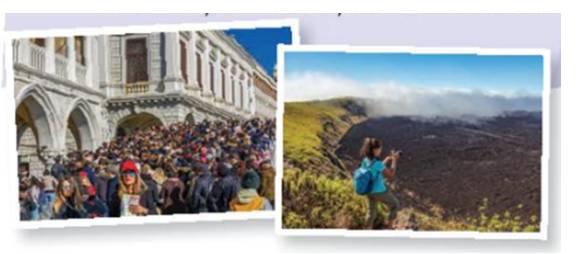
• Mass tourism is a kind of tourism which involves tens of thousands of people crowding the same places at the same time of year. It often has a lot of negative impact on the local area, such as litter from tourists and pollution from traffic.

• Ecotourism provides tourists with opportunities to explore nature, and at the same time helps protect the environment and educates travellers on local environmental issues. It also promotes tourists' respect for local communities.

• Sustainable tourism involves not only environmental protection and cultural respect, but also efforts to keep profits local. It often refers to actions of the tourist industry as a whole.

• Responsible tourism encourages tourists to be more than visitors. Responsible tourists should not only be aware of their role, but also take part in protecting the environment, culture and improving the profits for local people. Responsible tourism often relates to specific actions of individuals, businesses, and communities.

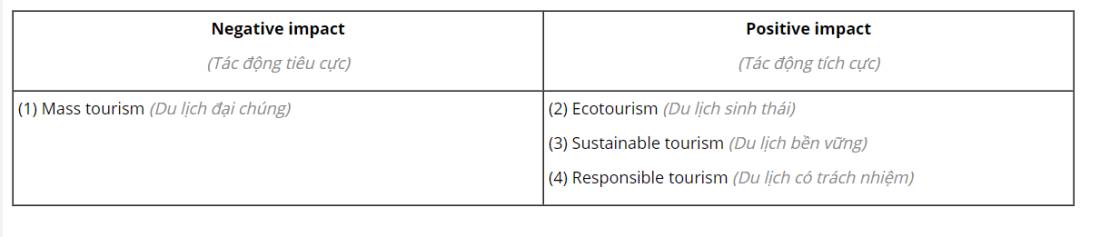
Negative impact

Positive impact

(1) __________

(2) __________

(3) __________

(4) __________

2
11 tháng 9 2023

Tác động đến môi trường của du lịch

Mặc dù du lịch thường được gọi là 'ngành công nghiệp không khói', hoặc một ngành công nghiệp thân thiện với môi trường, nó thực sự có thể gây hại cho thiên nhiên. Tuy nhiên, các loại hình du lịch khác nhau có thể có những tác động khác nhau đến môi trường.

• Du lịch đại chúng là loại hình du lịch bao gồm hàng chục nghìn người tập trung ở cùng một địa điểm vào cùng một thời điểm trong năm. Nó thường có nhiều tác động tiêu cực đến khu vực địa phương, chẳng hạn như xả rác từ khách du lịch và ô nhiễm giao thông.

• Du lịch sinh thái cung cấp cho khách du lịch cơ hội khám phá thiên nhiên, đồng thời giúp bảo vệ môi trường và giáo dục du khách về các vấn đề môi trường tại địa phương. Nó cũng thúc đẩy sự tôn trọng của khách du lịch đối với cộng đồng địa phương.

• Du lịch bền vững không chỉ liên quan đến việc bảo vệ môi trường và tôn trọng văn hóa mà còn phải nỗ lực giữ lợi nhuận cho địa phương. Nó thường đề cập đến các hành động của ngành du lịch nói chung.

• Du lịch có trách nhiệm khuyến khích khách du lịch nhiều hơn là khách vãng lai. Khách du lịch có trách nhiệm không chỉ nhận thức được vai trò của mình mà còn phải tham gia vào việc bảo vệ môi trường, văn hóa và nâng cao lợi nhuận cho người dân địa phương. Du lịch có trách nhiệm thường liên quan đến các hành động cụ thể của cá nhân, doanh nghiệp và cộng đồng.

6 tháng 2 2023

1C

2D

3A

4E

5B

6 tháng 2 2023

1.equally

2.organisation

3.traditionally

4.education

7 tháng 2 2023

1. a. I don't understand this map. It's very _confusing____. (confuse)

b. Can you help me with my maths? I'm _confused____. (confuse)

2. a. I was __embarrassed___ when I fell over. (embarrass)

b. I hate it when my dad dances. It's so __embarrassing___ .(embarrass)

3. a. Are you _interested____ in photography? (interest)

b. Which is the most _interesting____ lesson in this unit? (interest)