K
Khách

Hãy nhập câu hỏi của bạn vào đây, nếu là tài khoản VIP, bạn sẽ được ưu tiên trả lời.

2. Read the Listening Strategy. What are the intentions of the speakers in sentences 1-6? Choose from the verbs below. Match three of these sentences (1-6) with the photos.

(Đọc Chiến lược nghe. Ý đồ của những người nói 1-6 là gì? Chọn các động từ phía dưới. Nối ba trong số các câu 1-6 với các bức ảnh,)

Listening Strategy (Chiến lược Nghe hiểu)

You will sometimes have to identify the intentions of the speaker (e.g. to persuade, to warn, to inform, etc.). Listen for the phrases such as I think you should, Be careful to, I’m going to tell you about… that give you a clue to the speaker’s intentions.

(Thỉnh thoảng bạn sẽ phải xác định được ý đồ của người nói (ví dụ như thuyết phục, cảnh báo, thông báo, …). Lắng nghe các cụm danh từ ví dụ như Tôi nghĩ rằng bạn nên, Hãy cẩn thận, Tôi sẽ kể với bạn về …, những cụm này cho bạn gợi ý về ý đồ của người nói.)

to apolpgise (xin lỗi); to challenge (thách thức); to comfort (an ủi); to complain (phàn nàn); to describe (miêu tả); to encourage (khuyến khích); to enquire (hỏi thăm); to entertain (làm thích thú); to inform (thông báo); to persuade (thuyết phục); to recommend (gợi ý); to tell a story (kể chuyện); to thank (cảm ơn); to warn (cảnh báo); to welcome (chào mừng)

1. “Be careful not to touch the cooker. It’s hot.” 

(“Hãy cẩn thận đừng có chạm vào cái nồi cơm. Nó nóng đấy”)

2. “This is not the phone I ordered. I said I would like one with a memory of 512GB.” 

(“Đây không phải là chiếc điện thoại mà tôi đặt hàng. Tôi đã nói rằng tôi muốn một chiếc điện thoại có bộ nhớ 512GB”)

3. “I’d buy a new refrigerator if I were you. This one is too small.” 

(“Tôi sẽ mua một cái tủ lạnh mới nếu tôi là bạn. Cái này quá nhỏ”)

4. “Hello everyone. I’ll show you our company’s latest gadget: an apple cutter.” 

(“Chào mừng tất cả mọi người. Tôi sẽ cho các bạn xem tiện ích mới nhất của công ty chúng tôi: một cái đồ cắt táo”)

5. “I’d like some information about the new wireless earphones.” 

(“Tôi muốn xin một vài thông tin về chiếc tai nghe không dây mới này”)

6. “Don’t worry. You’ll get used to the new software soon.”

(“Đừng lo. Bạn sẽ sớm dần quen với phần mềm này thôi”)


1
11 tháng 9 2023

1. to warn

 2. to complain (photo A)

 3. to recommend

 4. to welcome (photo C)

 5. to enquire

 6. to comfort (photo B)

2. Read the Reading Strategy. Then read the text quickly to get a general idea of the meaning. Were your ideas in exercise 1 correct?(Đọc “Chiến thuật đọc hiểu”. Sau đó đọc bài khóa thật nhanh để lấy ý chính về bài đọc. Ý tưởng của bạn trong bài 1 có đúng không?)Reading Strategy (Chiến thuật đọc hiểu)When you do a matching task, follow these steps:(Khi làm dạng bài nối, làm theo các bước sau:) 1. Read the text to get a...
Đọc tiếp

2. Read the Reading Strategy. Then read the text quickly to get a general idea of the meaning. Were your ideas in exercise 1 correct?

(Đọc “Chiến thuật đọc hiểu”. Sau đó đọc bài khóa thật nhanh để lấy ý chính về bài đọc. Ý tưởng của bạn trong bài 1 có đúng không?)

Reading Strategy (Chiến thuật đọc hiểu)

When you do a matching task, follow these steps:

(Khi làm dạng bài nối, làm theo các bước sau:) 

1. Read the text to get a general idea of the meaning. Do not worry if you do not understand every word.

(1. Đọc bài khóa để lấy ý chính. Đừng lo lắng nếu bạn không hiểu tất cả các từ trong bài đọc.)

2. Read the task and all the options carefully.

(2. Cẩn thận đọc đề bài và các lựa chọn.)

3. Read the paragraphs of the text carefully one by one and match them to the correct option.

(3. Cẩn thận đọc từng đoạn văn một và nối chúng với lựa chọn chính xác.)

4. Check that the extra options do not match with any of the paragraphs.

(4. Kiểm tra các lựa chọn thừa không hợp với bất cứ đoạn văn nào.)

1
11 tháng 9 2023

The text is about a girl who can’t feel pain. (Bài đọc nói về một cô gái không thể cảm nhận cơn đau.)

1. Read the text. Match the highlighted words with their meanings.(Đọc văn bản. Nối các từ được làm nổi bật với nghĩa của chúng.)The more people travel, the bigger impact they may have on the environment. How can we reduce it while travelling? Here are some advice.Reduce your carbon footprint while travelling. Since flying produces more carbon footprint than any other means of transport, you should only fly when the trip is long. During the trip, you should walk, cycle...
Đọc tiếp

1. Read the text. Match the highlighted words with their meanings.

(Đọc văn bản. Nối các từ được làm nổi bật với nghĩa của chúng.)

The more people travel, the bigger impact they may have on the environment. How can we reduce it while travelling? Here are some advice.

Reduce your carbon footprint while travelling. Since flying produces more carbon footprint than any other means of transport, you should only fly when the trip is long. During the trip, you should walk, cycle or use public transport as much as you can. This not only helps to keep the environment clean, but also allows you to enjoy the beauty of nature and interact with local people. 

Choose eco-friendly activities that benefit animals and the ecosystem. Avoid activities that allow you to touch or ride animals because they disturb their natural patterns and attract many people. Instead, visit wildlife parks or organic farms. These will help you understand and respect the nature more and stop doing things that harm the environment.

Words

Meanings

1. interact 

a. to be good for someone or something 

2. benefit 

b. to talk or do things with other people 

3. disturb 

c. to interrupt what people are doing and make them angry 

3
6 tháng 2 2023

1B

2A

3C

6 tháng 2 2023

1. Read the text. Match the highlighted words with their meanings.

(Đọc văn bản. Nối các từ được làm nổi bật với nghĩa của chúng.)

The more people travel, the bigger impact they may have on the environment. How can we reduce it while travelling? Here are some advice.

Reduce your carbon footprint while travelling. Since flying produces more carbon footprint than any other means of transport, you should only fly when the trip is long. During the trip, you should walk, cycle or use public transport as much as you can. This not only helps to keep the environment clean, but also allows you to enjoy the beauty of nature and interact with local people. 

Choose eco-friendly activities that benefit animals and the ecosystem. Avoid activities that allow you to touch or ride animals because they disturb their natural patterns and attract many people. Instead, visit wildlife parks or organic farms. These will help you understand and respect the nature more and stop doing things that harm the environment.
 

Answer:

1. interact ->b: to talk or do things with other people.
2. benefit ->a: to be good for someone or something.

3. disturb ->c: to interrupt what people are doing and make them angry.

3. Work in groups. Choose an environmental problem in 1 and make a presentation on the solutions to it. Use the expressions below to help you.(Làm việc nhóm. Chọn một vấn đề môi trường trong bài 1 và trình bày các giải pháp cho vấn đề đó. Sử dụng các cụm từ dưới đây để giúp bạn.)Useful expressionsWelcoming the audience and introducing the topic(Chào khán giả và giới thiệu chủ đề)Hi everyone.(Chào mọi người.)Good morning/...
Đọc tiếp

3. Work in groups. Choose an environmental problem in 1 and make a presentation on the solutions to it. Use the expressions below to help you.

(Làm việc nhóm. Chọn một vấn đề môi trường trong bài 1 và trình bày các giải pháp cho vấn đề đó. Sử dụng các cụm từ dưới đây để giúp bạn.)

Useful expressions

Welcoming the audience and introducing the topic

(Chào khán giả và giới thiệu chủ đề)

Hi everyone.

(Chào mọi người.)

Good morning/ afternoon.

(Chào buổi sáng / buổi chiều.)

I’m here today to talk about/ discuss …

(Hôm nay tôi ở đây để nói về / thảo luận…)

I’d like to talk about …

(Tôi muốn nói về…)

Today, I’d like to share with you …

(Hôm nay, tôi muốn chia sẻ với bạn…)

Introducing the first point/ idea

(Giới thiệu quan điểm/ ý tưởng đầu tiên)

Firstly, the problem can be solved by …

(Thứ nhất, vấn đề có thể được giải quyết bằng…)

The first solution is to …

(Giải pháp đầu tiên là…)

Introducing the second point/ idea

(Giới thiệu quan điểm / ý tưởng thứ hai)

My next point is …

(Điểm tiếp theo của tôi là…)

Another solution is to …

(Một giải pháp khác là…)

Finishing the presentation and thanking the audience

(Kết thúc bài thuyết trình và cảm ơn khán giả)

That concludes our presentation.

(Điều đó kết thúc bài thuyết trình của chúng tôi.)

That’s the end of our presentation today.

(Đó là phần cuối của bài thuyết trình của chúng ta ngày hôm nay.)

Thank you for listening.

(Cám ơn vì đã lắng nghe.)

Thank you for your attention.

(Cảm ơn vì sự quan tâm của bạn.)

1
10 tháng 9 2023

Good morning. Today, I’d like to share with you about the solutions to one of the most significant problems in our city - deforestation. Firstly, the problem can be solved by recycling paper, plastics, and wood products. My next point is introducing strict laws to prevent the cutting of natural forests. Another solution is to educate our friends, family, and community by sharing the deforestation facts, and its causes and effects. That’s the end of our presentation today. Thank you for your attention.

Tạm dịch:

Buổi sáng tốt lành. Hôm nay, tôi muốn chia sẻ với các bạn về giải pháp cho một trong những vấn đề nổi bật nhất ở thành phố của chúng ta - nạn phá rừng. Thứ nhất, vấn đề có thể được giải quyết bằng cách tái chế giấy, nhựa và các sản phẩm từ gỗ. Giải pháp tiếp theo của tôi là đưa ra luật nghiêm khắc để ngăn chặn việc chặt phá rừng tự nhiên. Một giải pháp khác là giáo dục bạn bè, gia đình và cộng đồng của chúng ta bằng cách chia sẻ sự thật về nạn phá rừng, nguyên nhân và hậu quả của nó. Bài thuyết trình hôm nay đến đây là hết. Cảm ơn các bạn vì đã chú ý lắng nghe.
3. Read the Listening Strategy. Then listen to six people talking about BASE jumping. Write the synonyms or words with the opposite meaning that they use for the underlined words.(Đọc Chiến thuật nghe. Sau đó nghe sáu người nói về môn nhảy dù mạo hiểm. Viết từ đồng nghĩa hoặc từ có nghĩa trái nghĩa với từ họ dùng cho các từ được gạch chân.)Listening Strategy (Chiến thuật nghe)The information that you need to understand in therecorded...
Đọc tiếp

3. Read the Listening Strategy. Then listen to six people talking about BASE jumping. Write the synonyms or words with the opposite meaning that they use for the underlined words.

(Đọc Chiến thuật nghe. Sau đó nghe sáu người nói về môn nhảy dù mạo hiểm. Viết từ đồng nghĩa hoặc từ có nghĩa trái nghĩa với từ họ dùng cho các từ được gạch chân.)

Listening Strategy (Chiến thuật nghe)

The information that you need to understand in therecorded text may be expressed differently in the task.

(Thông tin bạn cần hiểu trong đoạn băng có thể được thể hiện khác đi trong câu hỏi.)

Listen out for synonyms of key words in the task. Key words are content words such as adjectives, nouns and verbs.

(Nghe rõ từ đồng nghĩa của từ khóa trong câu hỏi. Từ khóa là những từ như tính từ, danh từ và động từ.)

Listen out, too, for ways in which words with the opposite meaning, or negative verbs, correspond with key words in the task.

(Tương tự, nghe ra những từ với có nghĩa trải ngược, hoặc những động từ phủ định, tương ứng với các từ khóa trong câu hỏi.)

It’s rather cold today. >> It isn’t very warm today. (Trời hôm nay khá lạnh. >> Trời hôm nay không được ấm lắm.)

We won the match. >> We didn’t lose the match. (Chúng tôi đã thắng trận đấu. >> Chúng tôi đã không để thua trận đấu.)

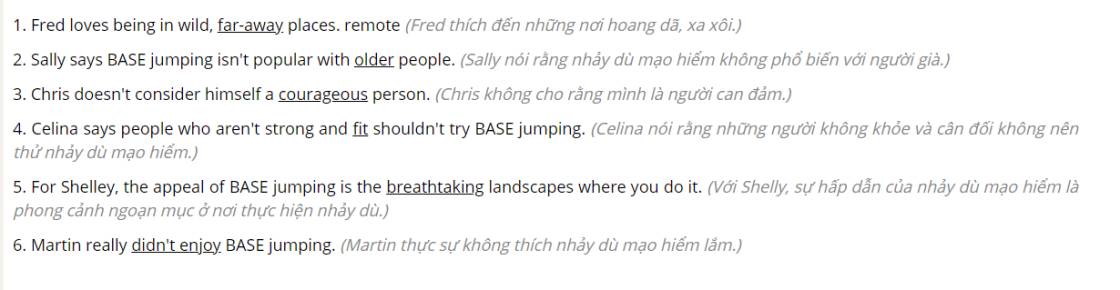
1. Fred loves being in wild, far-away places. remote (Fred thích đến những nơi hoang dã, xa xôi.)

2. Sally says BASE jumping isn't popular with older people. (Sally nói rằng nhảy dù mạo hiểm không phổ biến với người già.)

3. Chris doesn't consider himself a courageous person. (Chris không cho rằng mình là người can đảm.)

4. Celina says people who aren't strong and fit shouldn't try BASE jumping. (Celina nói rằng những người không khỏe và cân đối không nên thử nhảy dù mạo hiểm.)

5. For Shelley, the appeal of BASE jumping is the breathtaking landscapes where you do it. (Với Shelly, sự hấp dẫn của nhảy dù mạo hiểm là phong cảnh ngoạn mục ở nơi thực hiện nhảy dù.) 

6. Martin really didn't enjoy BASE jumping. (Martin thực sự không thích nhảy dù mạo hiểm lắm.)

1
11 tháng 9 2023

 1. accomplishments

 2. employment

 3. preparation

 4. development

 5. dream

6 tháng 2 2023

1.Face to face

2.Online learning

3.Prepare for

4.Strategy

5.Blended learning

10 tháng 9 2023

1. Biodiversity

2. wildlife

3. habitats

4. climate change

5. ecosystem

6 tháng 2 2023

1C

2D

3A

4E

5B

6 tháng 2 2023

1: who

2: which/that

3: which

4: whose

5: that/which

6: who