
K
Khách
Hãy nhập câu hỏi của bạn vào đây, nếu là tài khoản VIP, bạn sẽ được ưu tiên trả lời.
Hãy nhập câu hỏi của bạn vào đây, nếu là tài khoản VIP, bạn sẽ được ưu tiên trả lời.

\(y'=\tan x+\frac{x}{\cos^2x}\)
\(y''=\frac{1}{\cos^2x}+\frac{\cos^2-x.2\cos x.\left(-\sin x\right)}{\cos^4x}=\frac{2\cos^2x+2x.\sin x.\cos x}{\cos^4x}\)
\(VT=\frac{2x^2\left(\cos^2x+x\sin x.\cos x\right)}{\cos^4x}\)
\(VP=2\left(x^2+x^2\tan^2x\right)\left(1+x\tan x\right)\)
\(=\frac{2x^2\left(1+x\tan x\right)}{\cos^2x}=\frac{2x^2\left(\cos^2x+x\sin x.\cos x\right)}{\cos^4x}=VT\)
Ta có y ′ = tan x + x ( 1 + tan 2 x ) y ′ = tan x + x ( 1 + tan 2 x ) ⇒ y ′′ = 1 + tan 2 x + 1 + tan 2 x + 2 x tan x ( 1 + tan 2 x ) = 2 ( 1 + tan 2 x ) ( 1 + x tan x ) ⇒ y ″ = 1 + tan 2 x + 1 + tan 2 x + 2 x tan x ( 1 + tan 2 x ) = 2 ( 1 + tan 2 x ) ( 1 + x tan x ) ⇒ x 2 y ′′ = 2 ( x 2 + x 2 tan 2 x ) ( 1 + x tan x ) = 2 ( x 2 + y 2 ) ( 1 + y ) ⇒ x 2 y ″ = 2 ( x 2 + x 2 tan 2 x ) ( 1 + x tan x ) = 2 ( x 2 + y 2 ) ( 1 + y ) ( đpcm )
y'=(xtanx)' = tanx + x(tanx)' = tanx + x\(\dfrac{1}{\cos^2x}\)
=\(\tan x+x\left(1+\tan^2x\right)\)
y''=\(1+\tan^2x+1+\tan^2x+2x\tan x\left(1+\tan^2x\right)=2\left(1+\tan^2x\right)\left(1+x\tan x\right)\)
\(x^2y''=2\left(x^2+x^2\tan^2x\right)\left(1+x\tan x\right)=2\left(x^2+y^2\right)\left(1+y\right)\)
<br class="Apple-interchange-newline"><div></div>y'=tanx+xcos2x
y''=1cos2x +cos2−x.2cosx.(−sinx)cos4x =2cos2x+2x.sinx.cosxcos4x
VT=2x2(cos2x+xsinx.cosx)cos4x
VP=2(x2+x2tan2x)(1+xtanx)
=2x2(1+xtanx)cos2x =2x2(cos2x+xsinx.cosx)cos4x
Ta có y′=tanx+x(1+tan2x)y′=tanx+x(1+tan2x)
⇒y′′=1+tan2x+1+tan2x+2xtanx(1+tan2x)=2(1+tan2x)(1+xtanx)⇒y″=1+tan2x+1+tan2x+2xtanx(1+tan2x)=2(1+tan2x)(1+xtanx)
⇒x2y′′
Đúng(0)
Ta có y′=tanx+x(1+tan2x)y′=tanx+x(1+tan2x)
⇒y′′=1+tan2x+1+tan2x+2xtanx(1+tan2x)=2(1+tan2x)(1+xtanx)⇒y″=1+tan2x+1+tan2x+2xtanx(1+tan2x)=2(1+tan2x)(1+xtanx)
⇒x2y′′=
Ta có y′=tanx+x(1+tan2x)y′=tanx+x(1+tan2x)
⇒y′′=1+tan2x+1+tan2x+2xtanx(1+tan2x)=2(1+tan2x)(1+xtanx)⇒y″=1+tan2x+1+tan2x+2xtanx(1+tan2x)=2(1+tan2x)(1+xtanx)
⇒x2y′′
Đúng(0)
Ta có y'=tanx+x(1+tan²x)
=>Y mũ n = 1+tan²x+1+tan²x +2x tanx (1+tan²x)=2(1+tan²x) (1+xtanx)
=> X²(y mũ n) =2(x²+x²tan²x )(1+xtanx)=2(x²+y²)(1+y)(đpcm)
ta có y' = tan x +x.( 1+tan 2x)
⇒y'' =1 + tan2x +1 +tan2x +2.x.tan x.(1+tan2x ) 9=) 2+ 2.tan2x +2.x.tan x.(1+tan2x )
(=) 2. (1 +tan2x )+2.x.tan x.(1 +tan2x ) (=) 2.(1 +tan2x ).(1+xtanx)
xét vế trái ta có : x2y'' = x2.2.(1 +tan2x ).(1+xtanx) (=) 2.(1+xtanx).(x2 +x2.tan2x) (1)
theo đề bài ta có y = xtanx
⇒ y2 = x2.tan2x
⇒ (1) (=) : 2.(x
2+y2
).(1+y)
Ta có {y}'=\tan x+x\left( 1+{{\tan }^{2}}x \right)y′=tanx+x(1+tan2x)
\Rightarrow y''=1+{{\tan }^{2}}x+1+{{\tan }^{2}}x+2x\tan x\left( 1+{{\tan }^{2}}x \right)=2\left( 1+{{\tan }^{2}}x \right)\left( 1+x\tan x \right)⇒y′′=1+tan2x+1+tan2x+2xtanx(1+tan2x)=2(1+tan2x)(1+xtanx)
\Rightarrow {{x}^{2}}y''=2\left( {{x}^{2}}+{{x}^{2}}{{\tan }^{2}}x \right)\left( 1+x\tan x \right)=2\left( {{x}^{2}}+{{y}^{2}} \right)\left( 1+y \right)⇒x2y′′=2(x2+x2tan2x)(1+xtanx)=2(x2+y2...
Ta có {y}'=\tan x+x\left( 1+{{\tan }^{2}}x \right)y′=tanx+x(1+tan2x)
\Rightarrow y''=1+{{\tan }^{2}}x+1+{{\tan }^{2}}x+2x\tan x\left( 1+{{\tan }^{2}}x \right)=2\left( 1+{{\tan }^{2}}x \right)\left( 1+x\tan x \right)⇒y′′=1+tan2x+1+tan2x+2xtanx(1+tan2x)=2(1+tan2x)(1+xtanx)
\Rightarrow {{x}^{2}}y''=2\left( {{x}^{2}}+{{x}^{2}}{{\tan }^{2}}x \right)\left( 1+x\tan x \right)=2\left( {{x}^{2}}+{{y}^{2}} \right)\left( 1+y \right)⇒x2y′′=2(x2+x2tan2x)(1+xtanx)=2(x2+y2
Đúng(0)
Ta có y'=tan x+x*[1+(tanx)^2]
⇒ y''=1+(tanx)^2+1+(tanx)^2+2*x*tanx(1+(tanx)^2 =2*(1+(tanx)^2)*( 1+x*tanx)
(x^2)*y''=2*[ x^2+(x^2)*(tanx)^2 ]*(1+x*tan x)=2*(x^2+y^2)*(1+y)( đpcm ).
2Ta có {y}'=\tan x+x\left( 1+{{\tan }^{2}}x \right)y
'=tan x+x (1+tan2
x)
=>y"=1+tan2x+1+tan2x+2x tan x
⇒x2y'' =2(x2+x2tan2x) (1+xtan x) =2(x2+y2) (1+y) ( đpcm)
Ta có y′=tanx+x(1+tan2x)y′=tanx+x(1+tan2x)
⇒y′′=1+tan2x+1+tan2x+2xtanx(1+tan2x)=2(1+tan2x)(1+xtanx)⇒y″=1+tan2x+1+tan2x+2xtanx(1+tan2x)=2(1+tan2x)(1+xtanx)
⇒x2y′′=
Ta có y′=tanx+x(1+tan2x)y′=tanx+x(1+tan2x)
⇒y′′=1+tan2x+1+tan2x+2xtanx(1+tan2x)=2(1+tan2x)(1+xtanx)⇒y″=1+tan2x+1+tan2x+2xtanx(1+tan2x)=2(1+tan2x)(1+xtanx)
⇒x2y′′=
y’=tan x+x(1+tan2x)
=>y’’=1+tan2x+1+tan2x+ 2xtanx(1+tan2x)= 2(1+tan2x)(1+xtanx)
=> x2y’’ = 2(x2 + x2tan2x)(1+xtanx) =2(x2+y2)(1+y) (ĐPCM)
Tìm đạo hàm của các hàm số sau :
a) \(y=\left(9-2x\right)\left(2x^3-9x^2+1\right)\)
b) \(y=\left(6\sqrt{x}-\dfrac{1}{x^2}\right)\left(7x-3\right)\)
c) \(y=\left(x-2\right)\sqrt{x^2+1}\)
d) \(y=\tan^2x-\cot x^2\)
e) \(y=\cos\dfrac{x}{1+x}\)
a) Cách 1: y' = (9 -2x)'(2x3- 9x2 +1) +(9 -2x)(2x3- 9x2 +1)' = -2(2x3- 9x2 +1) +(9 -2x)(6x2 -18x) = -16x3 +108x2 -162x -2.
Cách 2: y = -4x4 +36x3 -81x2 -2x +9, do đó
y' = -16x3 +108x2 -162x -2.
b) y' = .(7x -3) +
 (7x -3)'=
  (7x -3) +7
 .
.
c) y' = (x -2)'√(x2 +1) + (x -2)(√x2 +1)' = √(x2 +1) + (x -2) = √(x2 +1) + (x -2)
 = √(x2 +1) +
  =
=  .
.
d) y' = 2tanx.(tanx)' - (x2)' =
=  .
.
e) y' = sin
sin =
=  sin
sin .
.
Tính đạo hàm của các hàm số sau: (2 điểm)
a. $y={{\sin }^{3}}\left( {{x}^{2}}+2 \right)$;
b. $y={{\left( 2x+1 \right)}^{3}}{{\left( 3-{{x}^{2}} \right)}^{2}}$.
Võ Ngọc Tú Uyên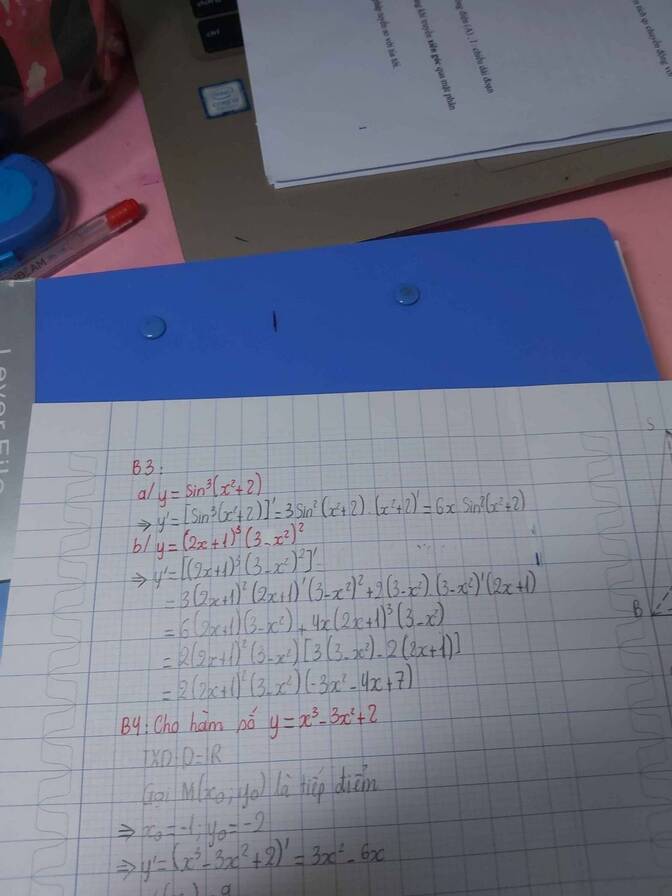
Đạo hàm của hàm số \(y=\left(x^2-\dfrac{2}{x}\right)^3\)là:
A. \(y'=6\left(x+\dfrac{1}{x^2}\right)\left(x^2-\dfrac{2}{x}\right)^2\)
B. \(y'=3\left(x^2-\dfrac{2}{x}\right)^2\)
C. \(y'=6\left(x-\dfrac{1}{x^2}\right)\left(x^2-\dfrac{2}{x}\right)^2\)
D. \(y'=6\left(x-\dfrac{1}{x}\right)\left(x^2-\dfrac{2}{x}\right)^2\)
C
B
Tinh đạo hàm của các hàm số sau:
a) \(y = \tan \left( {{e^x} + 1} \right)\);
b) \(y = \sqrt {\sin 3x} \);
c) \(y = \cot \left( {1 - {2^x}} \right)\).
a: \(y'=\left[tan\left(e^x+1\right)\right]'=\dfrac{\left(e^x+1\right)'}{cos^2\left(e^x+1\right)}=\dfrac{e^x}{cos^2\left(e^x+1\right)}\)
b: \(y'=\left(\sqrt{sin3x}\right)'\)
\(=\dfrac{\left(sin3x\right)'}{2\sqrt{sin3x}}=\dfrac{3\cdot cos3x}{2\sqrt{sin3x}}\)
c: \(y=cot\left(1-2^x\right)\)
=>\(y'=\left[cot\left(1-2^x\right)\right]'\)
\(=\dfrac{-2}{sin^2\left(1-2^x\right)}\cdot\left(-2^x\cdot ln2\right)\)
\(=\dfrac{2^{x+1}\cdot ln2}{sin^2\left(1-2^x\right)}\)
Cho các hàm số \(y = {u^2}\) và \(u = {x^2} + 1.\)
a) Viết công thức của hàm hợp \(y = {\left( {u\left( x \right)} \right)^2}\) theo biến x.
b) Tính và so sánh: \(y'\left( x \right)\) và \(y'\left( u \right).u'\left( x \right)\)
\(a,y=\left(u\left(x\right)\right)^2=\left(x^2+1\right)^2=x^4+2x^2+1\\ b,y'\left(x\right)=4x^3+4x,u'\left(x\right)=2x,y'\left(u\right)=2u\\ \Rightarrow y'\left(u\right)\cdot u'\left(x\right)=2u\cdot2x=4x\left(x^2+1\right)=4x^3+4x\)
Vậy \(y'\left(x\right)=y'\left(u\right)\cdot u'\left(x\right)\)
Hàm số \(y = \frac{{x + 3}}{{x + 2}}\) có đạo hàm là
A. \(y' = \frac{1}{{{{\left( {x + 2} \right)}^2}}}\).
B. \(y' = \frac{5}{{{{\left( {x + 2} \right)}^2}}}\).
C. \(y' = \frac{{ - 1}}{{{{\left( {x + 2} \right)}^2}}}\).
D. \(y' = \frac{{ - 5}}{{{{\left( {x + 2} \right)}^2}}}\).
\(y=\dfrac{x+3}{x+2}\)
=>\(y'=\dfrac{\left(x+3\right)'\left(x+2\right)-\left(x+3\right)\left(x+2\right)'}{\left(x+2\right)^2}=\dfrac{x+2-x-3}{\left(x+2\right)^2}=\dfrac{-1}{\left(x+2\right)^2}\)
=>C
cho các số thực dương x,y,z. chứng minh rằng:
\(\frac{xy^2\left(x+z\right)}{x+y}+\frac{yz^2\left(z+x\right)}{y+z}+\frac{zx^2\left(x+y\right)}{z+x}\ge3xyz\)
HD: áp dụng BĐT Cô-si cho 3 số hạng trên, khi đó trong căn sẽ triệt tiêu các tổng suy ra đpcm
Tìm hàm số có đạo hàm tại x=2
A. \(y=\left|x-2\right|\)
B. \(y=\left|x-2\right|^2\)
C. \(y=\left|4-x^2\right|\)
D. \(y=\left|x^2-3x+2\right|\)
a.
\(y=\left\{{}\begin{matrix}x-2\left(x\ge2\right)\\2-x\left(x\le2\right)\end{matrix}\right.\)
\(\Rightarrow\left\{{}\begin{matrix}y'\left(2^+\right)=1\\y'\left(2^-\right)=-1\end{matrix}\right.\)
\(\Rightarrow y'\left(2^+\right)\ne y'\left(2^-\right)\Rightarrow\) không tồn tại đạo hàm tại \(x=2\)
b.
\(y=\left|x-2\right|^2=x^2-4x+4\Rightarrow y'=2x-4\)
\(\Rightarrow y'\left(2\right)=0\)
c.
\(y=\left\{{}\begin{matrix}4-x^2\left(\text{với }-2< x< 2\right)\\x^2-4\left(\text{với }x\ge2;x\le-2\right)\end{matrix}\right.\)
\(\Rightarrow\left\{{}\begin{matrix}y'\left(2^+\right)=2x=4\\y'\left(2^-\right)=-2x=-4\end{matrix}\right.\)
\(\Rightarrow y'\left(2^+\right)\ne y'\left(2^-\right)\Rightarrow\) ko tồn tại đạo hàm tại \(x=2\)
d. Tương tự a và c
Cho hàm số \(y=f\left(x\right)\) xác định và có đạo hàm trên R thỏa mãn: \(\left[f\left(1+2x\right)\right]^3=8x-\left[f\left(1-x\right)\right]^2\), ∀x∈R. viết phương trình tiếp tuyến của đồ thị hàm số \(y=f\left(x\right)\) tại điểm có hoành độ bằng 1.