
Hãy nhập câu hỏi của bạn vào đây, nếu là tài khoản VIP, bạn sẽ được ưu tiên trả lời.

1. Read the text and choose the correct answer A, B or C for each of the questions.
(Đọc văn bản và chọn câu trả lời đúng A, B hoặc C cho mỗi câu hỏi.)
What will our houses in the future be like?
In the future, the places we live in and the ways we live will change a lot. Our houses will be more eco-friendly. We won't use electricity. We will use wind energy or solar energy instead. We will use our voices to control our houses. It'll make our lives more comfortable. There will be underground cities. There will be cities in the air and on other planets, too. We'll have to build cities there because there will be too many people and not enough land for houses or buildings.
1. Scientists predict where and how we live in the future _________.
A. will change a lot
B. will not change much
C. will change only a intthe
2. According to the text, which of the following is NOT true about future houses?
A. They'll be more eco-friendly.
B. They'll use electricity.
C. They'll use wind energy.
3. We will control our future houses _________.
A. with our voices
B. by clapping our hands
C. with mobile phones
4. There will be cities in the air, on other planets, and underground because _________.
A. we wont have enough land to build houses on
B. living there will be more comfortable
C. life on the Earth will become boring
1 - A. Scientists predict where and how we live in the future will change a lot.
(Các nhà khoa học dự đoán nơi và cách chúng ta sống trong tương lai sẽ thay đổi rất nhiều.)
2 - B. According to the text, which of the following is NOT true about future houses? - They'll use electricity.
(Theo văn bản, điều nào sau đây KHÔNG đúng về ngôi nhà trong tương lai? - Chúng sẽ sử dụng điện.)
3 - A. We will control our future houses with our voices.
(Chúng tôi sẽ kiểm soát ngôi nhà tương lai của mình bằng giọng nói của mình.)
4 - A. There will be cities in the air, on other planets, and underground because we won't have enough land to build houses on.
(Sẽ có những thành phố trên không, trên các hành tinh khác và dưới lòng đất vì chúng ta sẽ không có đủ đất để xây nhà.)
1. Robots can work as guards when we're away.
(Robot có thể làm nhiệm vụ bảo vệ khi chúng ta đi vắng.)
2. We rarely go to restaurants because my father can make delicious meals at home.
(Chúng tôi hiếm khi đi nhà hàng vì bố tôi có thể nấu những bữa ăn ngon ở nhà.)
3. Can you repair my broken clock?
(Bạn có thể sửa chữa đồng hồ bị hỏng của tôi?)
4. Can robots understand our feelings?
(Liệu robot có thể hiểu được cảm xúc của chúng ta?)
5. My father and I water the plants in our garden every morning.
(Cha tôi và tôi tưới cây trong vườn của chúng tôi mỗi sáng.)
1. How much household waste do we recycle every day?
(Chúng ta tái chế bao nhiêu rác thải sinh hoạt mỗi ngày?)
2. My robot sends and receives emails for me.
(Robot của tôi gửi và nhận email cho tôi.)
3. I'm surfing the internet to look for information on Vietnamese music.
(Tôi đang lướt mạng để tìm kiếm thông tin về âm nhạc Việt Nam.)
4. We need to reduce the amount of salt in our diet.
(Chúng ta cần giảm lượng muối trong khẩu phần ăn.)
5. I think we should reuse these envelopes.
(Tôi nghĩ chúng ta nên sử dụng lại những chiếc phong bì này.)
6. Choose the correct option in braciets to complete each sentence.
(Chọn phương án đúng trong bracelets để hoàn thành mỗi câu.)
1. If we (protect/ protected) our forests, we will help our planet.
2. I'm not sure what to do next weekend. I (might/ have to) go to the cinema.
3. I (will/ might) fly to Ho Chi Minh City next Saturday, but I'm not sure yet.
4. If we continue to pollute the air, we will (have/ having) breathing problems.
5. It's very likely that they (will/ might) be here by 10.30 p.m. tomorrow.
1. If we protect our forests, we will help our planet.
(Nếu chúng ta bảo vệ rừng của mình, chúng ta sẽ giúp ích cho hành tinh của chúng ta.)
2. I'm not sure what to do next weekend. I might go to the cinema.
(Tôi không chắc phải làm gì vào cuối tuần tới. Tôi có thể đi xem phim.)
3. I might fly to Ho Chi Minh City next Saturday, but I'm not sure yet.
(Tôi có thể sẽ bay đến Thành phố Hồ Chí Minh vào thứ Bảy tới, nhưng tôi chưa chắc lắm.)
4. If we continue to pollute the air, we will have breathing problems.
(Nếu chúng ta tiếp tục làm ô nhiễm không khí, chúng ta sẽ gặp vấn đề về hô hấp.)
5. It's very likely that they will be here by 10.30 p.m. tomorrow.
(Rất có thể họ sẽ đến đây trước 10h30 tối mai.)
1. go camping
2. go to a disco
3. take photos
4. swim
5. have an ice cream
6. do
7. play games
8. buy souvenirs
EX1:complete the sentences with the words given in the box
| buy souvenirs | go camping | go to a disco | swim |
| have an ice cream | play games | take photos | do |
1.When we ...go camping , ..... we sleep in a tent.
2.Do you want to ...go to a disco... and dance?
3.Can he .....take photos....with his new camera?
4.It's hot! I want to......swim.....in the sea.
5.Would you like to.....have an ice cream....? The chocolate ones are good.
6.You can...do.....a treasurehunt at our summer camp.
7.I sometimes......play games.......like table tennis.
8. You can .....buy sourvernirs.... at the shop in the town.
|
(1) forget
(2) turn
(3) Be
(4) Bring
(5) wait
(6) open
(7) make
(8) Have
2.Complete the sentences with these words.
| celebrate | chase | have fun | march | roll |
- The children have to......roll........to the music in the parade.
- Rover! No, don't ............chase......the cat!
- Music! Dancing! Let's....have fun.........!
- We always.....celebrate...... my grandmother's birthday with a special dinner.
- First you.............march....................the cheese down the hill and hen you run after it!
2. Complete the sentences with these words.
1/ The children have to chase to the music in the parade.
2/ Rover! No, don't march the cat!
3/ Music! Dancing! Let's have fun!
4/ We always celebrate my gandmother's birthday with a specail dinner.
5/ First you roll the cheese down the hill and then you run after it!
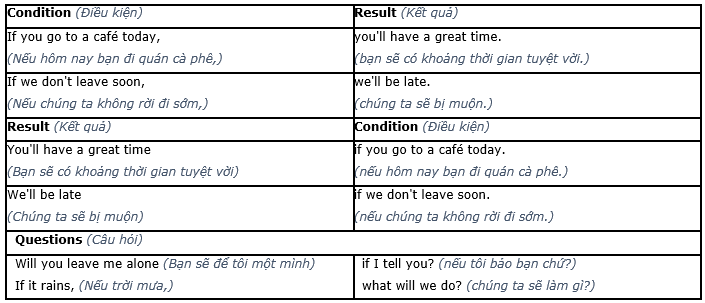
2. condition
3. result
4. condition
RULES (Quy tắc)
1. We use the first conditional to talk about a condition in the future and the result of this condition.
(Chúng ta sử dụng điều kiện loại 1 để nói về một điều kiện trong tương lai và kết quả của điều kiện này.)
2. We describe the condition with if + present simple.
(Chúng ta mô tả điều kiện với if + thì hiện tại đơn.)
3. We describe the result with will + infinitive.
(Chúng ta mô tả kết quả với will + động từ nguyên thể.)
4. The sentence can start with the condition or the result. If it starts with the result, we don't use a comma.
(Câu có thể bắt đầu bằng điều kiện hoặc kết quả. Nếu nó bắt đầu bằng kết quả, chúng ta không sử dụng dấu phẩy.)
5. We never use if + will: If you will go, I'll be happy.
(Chúng ta không bao giờ sử dụng if + will.)