
tính giá trị biểu thức
a, 5 - ( -5/11) +(1/3)\(^2\): 3
b, \(2^3\) + 3 x (1/2)\(^0\) + (-2)\(^2\) : 1/2
c, ( 3/4 )\(^2\) - (1/3)\(^4\) : (1/9)\(^2\) - (3/11)\(^0\) : (-1/5)
Hãy nhập câu hỏi của bạn vào đây, nếu là tài khoản VIP, bạn sẽ được ưu tiên trả lời.

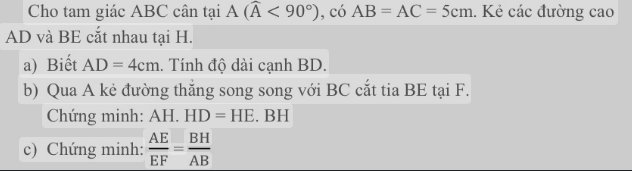
a: ΔABC cân tại A
mà AD là đường cao
nên D là trung điểm của BC
ΔADB vuông tại D
=>\(DA^2+DB^2=AB^2\)
=>\(DB=\sqrt{5^2-4^2}=3\left(cm\right)\)
b: Xét ΔHDB vuông tại D và ΔHEA vuông tại E có
\(\widehat{DHB}=\widehat{EHA}\)(hai góc đối đỉnh)
Do đó: ΔHDB~ΔHEA
=>\(\dfrac{HD}{HE}=\dfrac{HB}{HA}\)
=>\(HD\cdot HA=HB\cdot HE\)
Kẻ đường cao BD của tam giác ABC \(\left(D\in AC\right)\)
Khi đó \(AD=AB.cosA=c.cosA\)
\(BD=AB.sinA=c\sqrt{1-cos^2A}\)
\(CD=AC-AD=b-c.cosA\)
Tam giác BCD vuông tại D
\(\Rightarrow BC^2=CD^2+BD^2\)
\(\Leftrightarrow a^2=\left(b-c.cosA\right)^2+\left(c\sqrt{1-cos^2A}\right)^2\)
\(\Leftrightarrow a^2=b^2-2bc.cosA+c^2.cos^2A+c^2\left(1-cos^2A\right)\)
\(\Leftrightarrow a^2=b^2+c^2-2bc.cosA\)
Ta có đpcm.
11 × 68 + 46 × 33
= 11 × 68 + 46 × 3 × 11
= 11 × 68 + 132 × 11
= 11 × (68 + 132)
= 11 × 200
= 11 × 2 × 100
= 22 × 100
= 2200
11 x 68 + 46 x 33
=748 + 1518
= 2266
ko biết đúng ko nữa
5)
a) \(3x+8y=26\)
\(\Leftrightarrow y=\dfrac{26-3x}{8}\)
Vì \(y\inℤ\) nên \(\dfrac{26-3x}{8}\inℤ\)
\(\Rightarrow26-3x⋮8\)
\(\Leftrightarrow3x\equiv2\left(mod8\right)\)
Vì \(ƯCLN\left(3,8\right)=1\) nên đặt \(x=8q+r\left(0\le r< 8\right)\) thì:
\(3\left(8q+r\right)\equiv2\left(mod8\right)\)
\(\Leftrightarrow24q+3r\equiv2\left(mod8\right)\)
\(\Leftrightarrow3r\equiv2\left(mod8\right)\)
Thử từng trường hợp, ta thấy ngay \(r=6\).
Vậy \(x=8q+6\)
\(\Rightarrow y=\dfrac{26-3x}{8}=\dfrac{26-3\left(8q+6\right)}{8}=\dfrac{8-24q}{8}=1-3q\)
Vậy phương trình đã cho có nghiệm nguyên là \(\left(8q+6,1-3q\right)\) với \(q\inℤ\) bất kì.
b) Cho \(1-3q>0\Leftrightarrow q< \dfrac{1}{3}\)
Cho \(8q+6>0\Leftrightarrow q>-\dfrac{3}{4}\)
Do đó \(-\dfrac{3}{4}< q< \dfrac{1}{3}\). Mà \(q\inℤ\Rightarrow q=0\)
Thế vào \(x,y\), pt sẽ có nghiệm nguyên dương là \(\left(6;1\right)\)
Câu 6 làm tương tự nhé bạn.
It was a long time before we came _____to_____ the truth.
(come to: đạt được, phát hiện ra điều gì đó)
The dog came _____at_____ us with teeth bared.
(come at: tiếp cận với thái độ hung hăng hoặc thù địch)
Come _____on_____ ! We are late for the bus.
(come on: đây là lời thúc giục di chuyển: nhanh lên)
How is your English coming ____along______ ?
(come along: phát triển, tiến đến)
I was picking up the teapot when it came __apart________ in my hands.
(come apart: rơi ra, tách ra, rời rạc)
She has been very ill, but now she is coming ___round_______ fine.
(com round: hồi phục, khôi phục)
We must not let this silly quarrel come ___between_______ us.
(come between: gây cản trở, tạo ra rào cản)
I come _____from_____ Liverpool, but I have spent most of my life in Scotland.
(come from: đến từ)
John has come __into________ the money; he inherited £5,000.
(come into: thừa kế)
The town came _____into_____ sight when we turned the bend.
(come into: xuất hiện)
The hook came ____off______ the wall when I hung up my coat
(come off: bong ra, rời ra)
This tool will come ____in______ very handy for my uncle.
(come in handy: có ích)
Snails come ____out______ as soon as it rains.
(come out: xuất hiện)
When did you first come ____over______ to Europe?
(come over: di chuyển)
Your talk came ______to____ very well.
(come to: kết quả là, dẫn đến)
It has come _____to_____ my attention that he is very short-tempered.
He came ______to____ the conclusion that someone was having an affair with his wife.
He came _______up___ and asked me if I had the time.
(come up: xảy ra, xuất hiện)
Much of the tea consumed in England comes __from________ Sri Lanka.
(come from: đến từ)
He comes ____from______ an interesting family.
How’s your orchard coming _____along_____ ?
Sometimes it’s very difficult to come ___to_______ the truth.
He never lets anything come ______between____ him and his morning paper.
It was a long time before we came ___to_______ the truth.
The dog came _____at_____ us with teeth bared.
Come ____on______ ! We are late for the bus.
How is your English coming ____along______ ?
I was picking up the teapot when it came ______âpart____ in my hands.
She has been very ill, but now she is coming ______round____ fine.
We must not let this silly quarrel come ____between______ us.
I come ______from____ Liverpool, but I have spent most of my life in Scotland.
John has come _____into_____ the money; he inherited £5,000.
The town came ______into____ sight when we turned the bend.
Ta có :
\(12=2^2.3\)
\(15=3.5\)
\(=>BCNN\left(12;15\right)=3.5.2^2=3.5.4=60\)
\(=>60:12=5;60:15=4\)
\(\dfrac{5}{12}=\dfrac{5.5}{12.5}=\dfrac{25}{60}\)
\(\dfrac{8}{15}=\dfrac{8.4}{15.4}=\dfrac{32}{60}\)
Vì \(25< 32\) nên
\(=>\dfrac{25}{60}< \dfrac{32}{60}\)
\(=>\dfrac{5}{12}< \dfrac{8}{15}\)
Vậy \(\dfrac{5}{12}< \dfrac{8}{15}\)
Nếu có gì sai sót thì nhớ bảo mình , mình cảm ơn!

a; 5 - (- \(\dfrac{5}{11}\) ) + (\(\dfrac{1}{3}\))2 : 3
= 5 + \(\dfrac{5}{11}\) + \(\dfrac{1}{9}\) : 3
= \(\dfrac{55}{11}\) + \(\dfrac{5}{11}\) + \(\dfrac{1}{9}\) x \(\dfrac{1}{3}\)
= \(\dfrac{55}{11}\) + \(\dfrac{5}{11}\) + \(\dfrac{1}{27}\)
= \(\dfrac{60}{11}\) + \(\dfrac{1}{27}\)
= \(\dfrac{1620}{297}\) + \(\dfrac{11}{297}\)
= \(\dfrac{1631}{297}\)
b; 23 + 3 x (\(\dfrac{1}{2}\))0 + (- 2)2 : \(\dfrac{1}{2}\)
= 8 + 3 x 1 + 4 : \(\dfrac{1}{2}\)
= 8 + 3 + 4 x \(\dfrac{2}{1}\)
= 8 + 3 + 8
= 11 + 8
= 19