
Tìn x nguyên để P nguyên
P= {x+7sqrt{x}/ x+2sqrt{x}}
Hãy nhập câu hỏi của bạn vào đây, nếu là tài khoản VIP, bạn sẽ được ưu tiên trả lời.

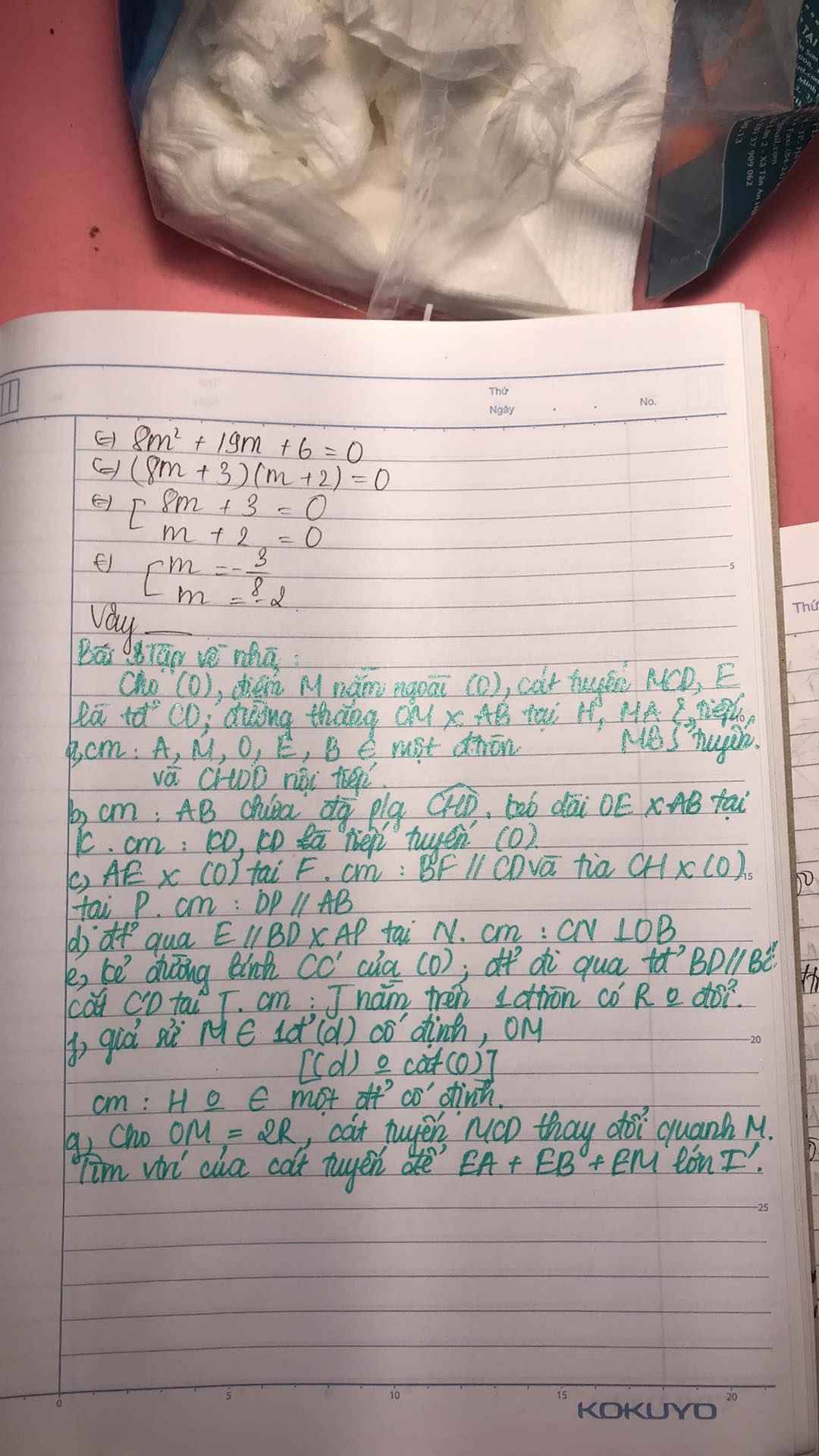
a: ΔOCD cân tại O
mà OE là đường trung tuyến
nên OE⊥CD tại E
ta có: \(\hat{OEM}=\hat{OAM}=\hat{OBM}=90^0\)
=>O,E,M,A,B cùng thuộc đường tròn đường kính OM
Xét (O) có
MA,MB là các tiếp tuyến
Do đó: MA=MB
=>M nằm trên đường trung trực của AB(1)
ta có: OA=OB
=>O nằm trên đường trung trực của AB(2)
Từ (1),(2) suy ra MO là đường trung trực của AB
=>MO⊥AB tại H và H là trung điểm của AB
Xét (O) có
\(\hat{MAC}\) là góc tạo bởi tiếp tuyến AM và dây cung AC
\(\hat{ADC}\) là góc nội tiếp chắn cung AC
Do đó: \(\hat{MAC}=\hat{MDA}\)
Xét ΔMAC và ΔMDA có
\(\hat{MAC}=\hat{MDA}\)
góc AMC chung
Do đó: ΔMAC~ΔMDA
=>\(\frac{MA}{MD}=\frac{MC}{MA}\)
=>\(MC\cdot MD=MA^2\left(3\right)\)
Xét ΔMAO vuông tại A có AH là đường cao
nên \(MH\cdot MO=MA^2\left(4\right)\)
Từ (3),(4) suy ra \(MC\cdot MD=MH\cdot MO\)
=>\(\frac{MC}{MO}=\frac{MH}{MD}\)
Xét ΔMCH và ΔMOD có
\(\frac{MC}{MO}=\frac{MH}{MD}\)
góc CMH chung
Do đó: ΔMCH~ΔMOD
=>\(\hat{MCH}=\hat{MOD}\)
mà \(\hat{MCH}+\hat{DCH}=180^0\) (hai góc kề bù)
nên \(\hat{MOD}+\hat{DCH}=180^0\)
=>CDOH là tứ giác nội tiếp
b: ΔMCH~ΔMOD
=>\(\hat{MHC}=\hat{MDO}\)
mà \(\hat{MDO}=\hat{ODC}=\hat{OCD}=\hat{OHD}\)
nên \(\hat{MHC}=\hat{OHD}\)
Ta có: \(\hat{MHC}+\hat{KHC}=\hat{KHM}=90^0\)
\(\hat{OHD}+\hat{DHK}=\hat{KHO}=90^0\)
mà \(\hat{MHC}=\hat{OHD}\)
nên \(\hat{KHC}=\hat{DHK}\)
=>HK là phân giác của góc CHD
Xét ΔOAM vuông tại A có AH là đường cao
nên \(OH\cdot OM=OA^2=R^2\)
Xét ΔOEM vuông tại E và ΔOHK vuông tại H có
\(\hat{EOM}\) chung
Do đó: ΔOEM~ΔOHK
=>\(\frac{OE}{OH}=\frac{OM}{OK}\)
=>\(OE\cdot OK=OH\cdot OM\)
=>\(OE\cdot OK=R^2=OD^2\)
=>\(\frac{OE}{OD}=\frac{OD}{OK}\)
Xét ΔOED và ΔODK có
\(\frac{OE}{OD}=\frac{OD}{OK}\)
góc EOD chung
Do đó: ΔOED~ΔODK
=>\(\hat{OED}=\hat{ODK}\)
=>\(\hat{ODK}=90^0\)
=>KD là tiếp tuyến của (O)
Ta có: \(OE\cdot OK=R^2\)
R=OC
Do đó: \(OE\cdot OK=OC^2\)
=>\(\frac{OE}{OC}=\frac{OC}{OK}\)
Xét ΔOEC và ΔOCK có
\(\frac{OE}{OC}=\frac{OC}{OK}\)
góc EOC chung
Do đó: ΔOEC~ΔOCK
=>\(\hat{OEC}=\hat{OCK}\)
=>\(\hat{OCK}=90^0\)
=>KC là tiếp tuyến của (O)
\(\left\{{}\begin{matrix}8x-y=6\\x^2-y=-6\end{matrix}\right.\)
=>\(\left\{{}\begin{matrix}8x-y-x^2+y=6+6\\8x-y=6\end{matrix}\right.\)
=>\(\left\{{}\begin{matrix}x^2-8x=-12\\y=8x-6\end{matrix}\right.\)
=>\(\left\{{}\begin{matrix}x^2-8x+12=0\\y=8x-6\end{matrix}\right.\)
=>\(\left\{{}\begin{matrix}\left(x-2\right)\left(x-6\right)=0\\y=8x-6\end{matrix}\right.\)
=>\(\left\{{}\begin{matrix}x\in\left\{2;6\right\}\\y=8x-6\end{matrix}\right.\)
Khi x=2 thì \(y=8\cdot2-6=16-6=10\)
Khi x=6 thì \(y=8\cdot6-6=42\)
Question 1 : We_____to the hospital to visit Mike when he_____to say that he was fine.
A. were driving - was calling B. drove - called
C. were driving - called D. drove - was calling
Question 2 : What_____to you on Sunday night?
A. happen B. happened C. was happening D. would happen
Question 3 : Last night, we_____for you for ages but you never_____up.
A. waited - showed B. would wait - showed
C. were waiting - were showing D. waited - was showing
Question 4 : We_____our quality time when the unexpected guest_____.
A. had - came B. were having - came
C. had been having - came D. have had - would have come
Question 5 : Since they_____us they_____to visit us last Sunday, we_____forward to the day.
A. were telling - came - looked B. would tell - would visit - would look
C. told - would come - were looking D. tell - are coming - will look
Question 6 : I_____out last night but at the last minute I_____that I had a quiz
this morning
A. was going - realized B. went - realized
C. had gone - would realize D. would go — have realized
Question 7 : She hasn't paid as much attention to her children as she_____ since she_____working.
A. does - starts B. did - started
C. was doing - was starting D. has done - would start
Question 8 : My brother_____at the road when he_____into a hole.
A. wasn't looking - was falling B. didn't look - has fallen
C. wasn't looking - fell D. won't look - fall
Question 9 : Magellan_____the first European who_____through the strait.
A. was - was sailing B. was being - was sailing
C. had been - sailed D. was - sailed
Question 10 : The first self-sufficient village in Britain_____the Norman's idea.
They were some strange invaders who_____to change the country in a better way.
A. was - hoped B. is - have hoped
C. have been - were hoping D. was being - had hoped
Thông thường thì hai nghiệm phải có quan hệ với nhau, sao biểu thức trong căn chỉ chứa \(x_1\) vậy em?
Lời giải:
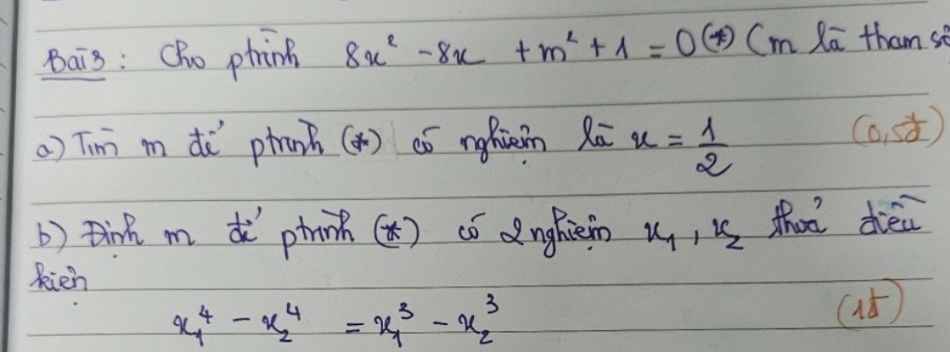
$\Delta' (*) = 4^2-8(m^2+1)=8-8m^2$
Để pt có 2 nghiệm $x_1,x_2$ thì:
$\Delta'(*) = 8-8m^2\geq 0\Leftrightarrow 1-m^2\geq 0$
$\Leftrightarrow -1\leq m\leq 1$
Áp dụng định lý Viet:
$x_1+x_2=1$
$x_1x_2=\frac{m^2+1}{8}$
Khi đó:
$x_1^4-x_2^4=x_1^3-x_2^3$
$\Leftrightarrow (x_1^2-x_2^2)(x_1^2+x_2^2)=(x_1-x_2)(x_1^2+x_1x_2+x_2^2)$
$\Leftrightarrow (x_1-x_2)[(x_1+x_2)(x_1^2+x_2^2)-(x_1^2+x_1x_2+x_2^2)]=0$
$\Leftrightarrow (x_1-x_2)[1(x_1^2+x_2^2)-(x_1^2+x_1x_2+x_2^2)]=0$
$\Leftrightarrow (x_1-x_2)(-x_1x_2)=0$
$\Leftrightarrow (x_1-x_2).\frac{-(m^2+1)}{8}=0$
$\Leftrightarrow x_1-x_2=0$ (do $m^2+1\geq 1>0$ với mọi $m$ nên số này khác 0)
$\Leftrightarrow x_1=x_2$
Kết hợp $x_1+x_2=1$
$\Rightarrow x_1=x_2=\frac{1}{2}$
$\frac{m^2+1}{8}=x_1x_2=\frac{1}{4}$
$\Leftrightarrow m^2+1=2$
$\Leftrightarrow m^2=1\Leftrightarrow m=\pm 1$ (tm)
Lời giải:
$BC=\sqrt{AB^2+AC^2}=\sqrt{18^2+24^2}=30$ (cm) - áp dụng định lý Pitago.
Nửa chu vi tam giác: $p=(AB+BC+AC):2=(18+24+30):2=36$ (cm)
Diện tích: $S=AB.AC:2=18.24:2=216$ (cm2)
Áp dụng công thức:
$S=pr$ với $r$ là bán kính đường tròn nội tiếp tam giác.
$r=\frac{S}{p}=\frac{216}{36}=6$ (cm)
Xét trường hợp cây P thân cao thuần chủng là cây lưỡng bội:
--> P: AA x Aa --> F1: 1AA : 1Aa (100% cây thân cao)
--> Loại.
Vậy khả năng cây P thân cao thuần chủng là cây tứ bội (xảy ra do đột biến nhiễm sắc thể, không phải đột biến gene). Khi đó:
P: AAaa x Aa
--> Giao tử = (1AA:2Aa:1aa) x (1A:1a)
--> P có tỉ lệ cây thân thấp có KG là aaa = 1/4aa * 1/2a = 1/6 --> Phù hợp với trường hợp bài đưa ra (không chắc chắn đúng vì đề bài không nêu rõ tỉ lệ cây thân cao : thân thấp ở đời con, vì vậy trên đây chỉ là một trường hợp có thể xảy ra).
Bài 1:
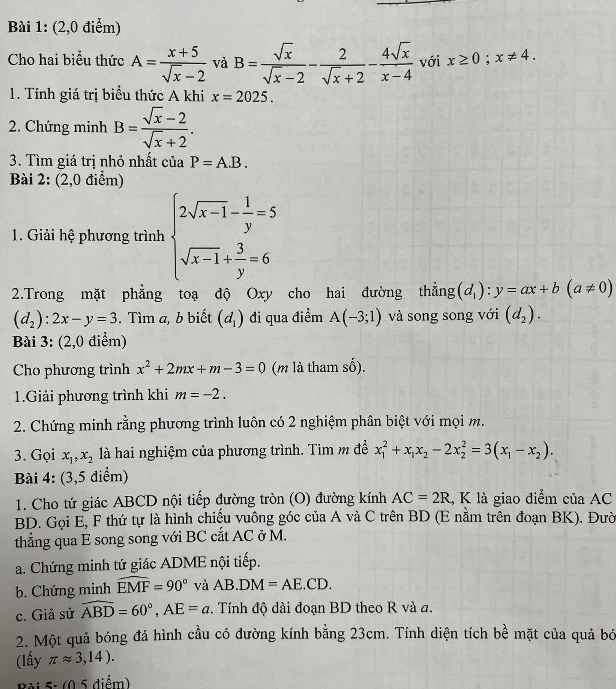
1: Thay x=2025 vào A, ta được:
\(A=\dfrac{2025+5}{\sqrt{2025}-2}=\dfrac{2030}{43}\)
2: \(B=\dfrac{\sqrt{x}}{\sqrt{x}-2}-\dfrac{2}{\sqrt{x}+2}-\dfrac{4\sqrt{x}}{x-4}\)
\(=\dfrac{\sqrt{x}}{\sqrt{x}-2}-\dfrac{2}{\sqrt{x}+2}-\dfrac{4\sqrt{x}}{\left(\sqrt{x}-2\right)\left(\sqrt{x}+2\right)}\)
\(=\dfrac{\sqrt{x}\left(\sqrt{x}+2\right)-2\left(\sqrt{x}-2\right)-4\sqrt{x}}{\left(\sqrt{x}-2\right)\left(\sqrt{x}+2\right)}\)
\(=\dfrac{x+2\sqrt{x}-2\sqrt{x}+4-4\sqrt{x}}{\left(\sqrt{x}-2\right)\left(\sqrt{x}+2\right)}\)
\(=\dfrac{x-4\sqrt{x}+4}{\left(\sqrt{x}-2\right)\left(\sqrt{x}+2\right)}=\dfrac{\sqrt{x}-2}{\sqrt{x}+2}\)
3: \(P=A\cdot B=\dfrac{\sqrt{x}-2}{\sqrt{x}+2}\cdot\dfrac{x+5}{\sqrt{x}-2}=\dfrac{x+5}{\sqrt{x}+2}\)
\(=\dfrac{x-4+9}{\sqrt{x}+2}=\sqrt{x}-2+\dfrac{9}{\sqrt{x}+2}\)
\(=\sqrt{x}+2+\dfrac{9}{\sqrt{x}+2}-4>=2\cdot\sqrt{\left(\sqrt{x}+2\right)\cdot\dfrac{9}{\sqrt{x}+2}}-4=2\)
Dấu '=' xảy ra khi \(\sqrt{x}+2=\sqrt{9}=3\)
=>x=1(nhận)
Bài 3:
1: Khi m=-2 thì phương trình sẽ trở thành:
\(x^2+2\cdot\left(-2\right)\cdot x-2-3=0\)
=>\(x^2-4x-5=0\)
=>(x-5)(x+1)=0
=>\(\left[{}\begin{matrix}x=5\\x=-1\end{matrix}\right.\)
2: \(\text{Δ}=\left(2m\right)^2-4\cdot1\cdot\left(m-3\right)\)
\(=4m^2-4m+12=4m^2-4m+1+11=\left(2m-1\right)^2+11>0\forall m\)
=>Phương trình luôn có 2 nghiệm phân biệt
Theo vi-et, ta có:
\(\left\{{}\begin{matrix}x_1+x_2=-\dfrac{b}{a}=-2m\\x_1x_2=\dfrac{c}{a}=m-3\end{matrix}\right.\)
\(x_1^2+x_1x_2-2x_2^2=3\left(x_1-x_2\right)\)
=>\(x_1^2+2x_1x_2-x_1x_2-2x_2^2=3\left(x_1-x_2\right)\)
=>\(x_1\left(x_1+2x_2\right)-x_2\left(x_1+2x_2\right)-3\left(x_1-x_2\right)=0\)
=>\(\left(x_1-x_2\right)\left(x_1+2x_2-3\right)=0\)
=>\(\left[{}\begin{matrix}x_1=x_2\\x_1+2x_2=3\end{matrix}\right.\)
TH1: \(x_1=x_2\)
mà \(x_1+x_2=-2m\)
nên \(x_1=x_2=-m\)
\(x_1x_2=m-3\)
=>\(\left(-m\right)\cdot\left(-m\right)=m-3\)
=>\(m^2-m+3=0\)
=>\(\left(m-\dfrac{1}{2}\right)^2+\dfrac{11}{4}=0\)(vô lý)
TH2: \(x_1+2x_2=3\)
mà \(x_1+x_2=-2m\)
nên \(x_2=3-\left(-2m\right)=2m+3\)
=>\(x_1=-2m-x_2=-2m-\left(2m+3\right)=-4m-3\)
\(x_1x_2=m-3\)
=>\(\left(2m+3\right)\left(-4m-3\right)=m-3\)
=>\(-8m^2-6m-12m-9=m-3\)
=>\(-8m^2-18m-9-m+3=0\)
=>\(-8m^2-19m-6=0\)
=>\(\left[{}\begin{matrix}m=-\dfrac{3}{8}\\m=-2\end{matrix}\right.\)
Lời giải:
\(P=\frac{x+7\sqrt{x}}{x+2\sqrt{x}}=\frac{x+2\sqrt{x}+5\sqrt{x}}{x+2\sqrt{x}}=1+\frac{5\sqrt{x}}{x+2\sqrt{x}}=1+\frac{5}{\sqrt{x}+2}\)
Với $x$ là số nguyên không âm, để $P$ nguyên thì $\sqrt{x}+2$ là ước của 5.
Mà $\sqrt{x}+2\geq 2$ với mọi $x$ nguyên không âm
$\Rightarrow \sqrt{x}+2=5$
$\Rightarrow \sqrt{x}=3$
$\Rightarrow x=9$ (tm)