
Cho 37, 8 gam Na2SO3 phản ứng với 200 gam dung dịch axit H2SO4 19, 6%. Tính:
1, Thể tích khí sinh ra ở đktc.
2, Nồng độ phần trăm dung dịch thu được sau phản ứng.
Hãy nhập câu hỏi của bạn vào đây, nếu là tài khoản VIP, bạn sẽ được ưu tiên trả lời.

`a)`\(D=\dfrac{x^2-x-1}{3x}+\left(\dfrac{x+2}{3x}+\dfrac{3x+1}{x+1}\right):\dfrac{2-4x}{x+1}\);\(x\ne-1;0\)
\(D=\dfrac{x^2-x-1}{3x}+\left[\dfrac{\left(x+2\right)\left(x+1\right)+3x\left(3x+1\right)}{3x\left(x+1\right)}\right].\dfrac{x+1}{2-4x}\)
\(D=\dfrac{x^2-x-1}{3x}+\dfrac{x^2+3x+2+9x^2+3x}{3x\left(x+1\right)}.\dfrac{x+1}{2-4x}\)
\(D=\dfrac{x^2-x-1}{3x}+\dfrac{10x^2+6x+2}{3x\left(x+1\right)}.\dfrac{x+1}{2-4x}\)
\(D=\dfrac{x^2-x-1}{3x}+\dfrac{10x^2+6x+2}{3x\left(2-4x\right)}\)
\(D=\dfrac{\left(2-4x\right)\left(x^2-x-1\right)+10x^2+6x+2}{3x\left(2-4x\right)}\)
\(D=\dfrac{2x^2-2x-2-4x^3+4x^2+4x+10x^2+6x+2}{3x\left(2-4x\right)}\)
\(D=\dfrac{-4x^3+12x^2+8x}{3x\left(2-4x\right)}\)
\(D=\dfrac{-4x\left(x^2+3x+2\right)}{3x\left(2-4x\right)}\)
\(D=-\dfrac{4\left(x+1\right)\left(x+2\right)}{3\left(2-4x\right)}\)
`b)`\(\left|2x-1\right|=4-x\)
\(\Leftrightarrow\left[{}\begin{matrix}2x-1=4-x;x\ge\dfrac{1}{2}\\1-2x=4-x;x< \dfrac{1}{2}\end{matrix}\right.\) \(\Leftrightarrow\left[{}\begin{matrix}x=\dfrac{5}{3}\left(tm\right)\\x=-3\left(tm\right)\end{matrix}\right.\)
`@`Với `x=5/3` thế vào D, ta được:
\(D=-\dfrac{4\left(\dfrac{5}{3}+1\right)\left(\dfrac{5}{3}+2\right)}{3\left(2-4.\dfrac{5}{3}\right)}=\dfrac{176}{63}\)
`@`Với `x=-3` thế vào D, ta được:
\(D=-\dfrac{4\left(-3+1\right)\left(-3+2\right)}{3\left(2-4.-3\right)}=-\dfrac{4}{21}\)
`c)`\(D=\dfrac{5}{3}\)
`<=>`\(\dfrac{5}{3}=-\dfrac{4\left(x+1\right)\left(x+2\right)}{3\left(2-4x\right)}\)
\(\Leftrightarrow5\left(2-4x\right)=-4\left(x+1\right)\left(x+2\right)\)
\(\Leftrightarrow10-20x=-4x^2-12x-8\)
\(\Leftrightarrow4x^2+8x+2=0\)
\(\Leftrightarrow2x^2+4x+1=0\)
\(\Delta=4^2-4.2=16-8=8>0\)
\(\rightarrow\left[{}\begin{matrix}x=\dfrac{-4+\sqrt{8}}{4}=\dfrac{-2+\sqrt{2}}{2}\left(tm\right)\\x=\dfrac{-4-\sqrt{8}}{4}=\dfrac{-2-\sqrt{2}}{2}\left(tm\right)\end{matrix}\right.\)
`d)`\(D>0\)
`<=>`\(-\dfrac{4\left(x+1\right)\left(x+2\right)}{3\left(2-4x\right)}>0\)
`<=>`\(\dfrac{4\left(x+1\right)\left(x+2\right)}{3\left(2-4x\right)}< 0\)
\(\Leftrightarrow\left\{{}\begin{matrix}4\left(x+1\right)\left(x+2\right)>0\\3\left(2-4x\right)< 0\end{matrix}\right.\) hoặc \(\Leftrightarrow\left\{{}\begin{matrix}4\left(x+1\right)\left(x+2\right)< 0\left(1\right)\\3\left(2-4x\right)>0\left(2\right)\end{matrix}\right.\)
\(\Leftrightarrow\left\{{}\begin{matrix}x>-1\\x>\dfrac{1}{2}\end{matrix}\right.\)\(\rightarrow x>\dfrac{1}{2}\) | \(\left(1\right)\Leftrightarrow\left[{}\begin{matrix}x+1>0\\x+2< 0\end{matrix}\right.\) hoặc \(\left[{}\begin{matrix}x+1< 0\\x+2>0\end{matrix}\right.\)
\(\Leftrightarrow\left[{}\begin{matrix}x>-1\\x< -2\end{matrix}\right.\) hoặc \(\left[{}\begin{matrix}x< -1\\x>-2\end{matrix}\right.\)
\(\left(2\right)\Leftrightarrow2-4x>0\)
\(\Leftrightarrow x< \dfrac{1}{2}\)
Lời giải:
$\sqrt{7+\sqrt{2x}}=3+\sqrt{5}$
$7+\sqrt{2x}=(3+\sqrt{5})^2=14+6\sqrt{5}$
$\sqrt{2x}=7+6\sqrt{5}$
$2x=(7+6\sqrt{5})^2=229+84\sqrt{5}$
$x=114,5+42\sqrt{5}$
a: Bất đẳng thức Cosi là: \(ab\le\frac{\left(a+b\right)^2}{4}\) ; \(a+b\ge2\cdot\sqrt{ab}\)
Gọi chiều rộng hình chữ nhật là a, chiều dài hình chữ nhật là b
Diện tích hình chữ nhật là: \(S=a\cdot b\)
=>\(S\le\frac{\left(a+b\right)^2}{4}\)
=>Dấu '=' xảy ra khi a=b
Khi a=b thì hình chữ nhật trở thành hình vuông
=>Trong các hình chữ nhật có cùng chu vi thì hình vuông là hình có diện tích lớn nhất
b: Gọi chiều rộng của hình chữ nhật là a, chiều dài hình chữ nhật là b
Chu vi hình chữ nhật là;
\(P=2\cdot\left(a+b\right)\)
=>\(P\ge2\cdot2\cdot\sqrt{ab}=4\sqrt{ab}\)
Dấu '=' xảy ra khi a=b
Khi a=b thì hình chữ nhật trở thành hình vuông
=>Trong các hình chữ nhật có cùng diện tích thì hình vuông là hình có diện tích bé nhất
\(\left(2+\sqrt{5}+\sqrt{3}\right)\left(2+\sqrt{5}-\sqrt{3}\right)\)
\(=\left(2+\sqrt{5}\right)^2-\left(\sqrt{3}\right)^2\)
\(=4+4\sqrt{5}+5-3\)
\(=6+4\sqrt{5}\)
tổng kết quả là 14,94
5,96 x 2,5 =14,94
mình ko bt giải thích thế nào cho hiểu bạn thong cảm nhé ( tôi cúng lớp 9 )
a) $n_{Na_2SO_3} = \dfrac{37,8}{126} = 0,3(mol)$
$n_{H_2SO_4} = \dfrac{200.19,6\%}{98} = 0,4(mol)$
$Na_2SO_3 + H_2SO_4 \to Na_2SO_4 + SO_2 + H_2O$
Ta thấy $n_{Na_2SO_3} : 1 < n_{H_2SO_4} :1$ nên $H_2SO_4$ dư
$n_{SO_2} = n_{Na_2SO_3} = 0,3(mol) \Rightarrow V_{SO_2} = 0,3.22,4 = 6,72(lít)$
b) $m_{dd\ sau\ pư} = 37,8 +200 - 0,3.64 = 218,6(gam)$
$n_{Na_2SO_4} = n_{H_2SO_4\ pư} = 0,3(mol) \Rightarrow n_{H_2SO_4\ dư} = 0,4 - 0,3 = 0,1(mol)$
$C\%_{Na_2SO_4} = \dfrac{0,3.142}{218,6}.100\% = 19,49\%$
$C\%_{H_2SO_4} = \dfrac{0,1.98}{218,6}.100\% = 4,48\%$
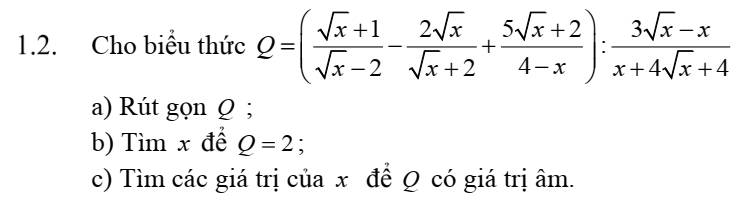
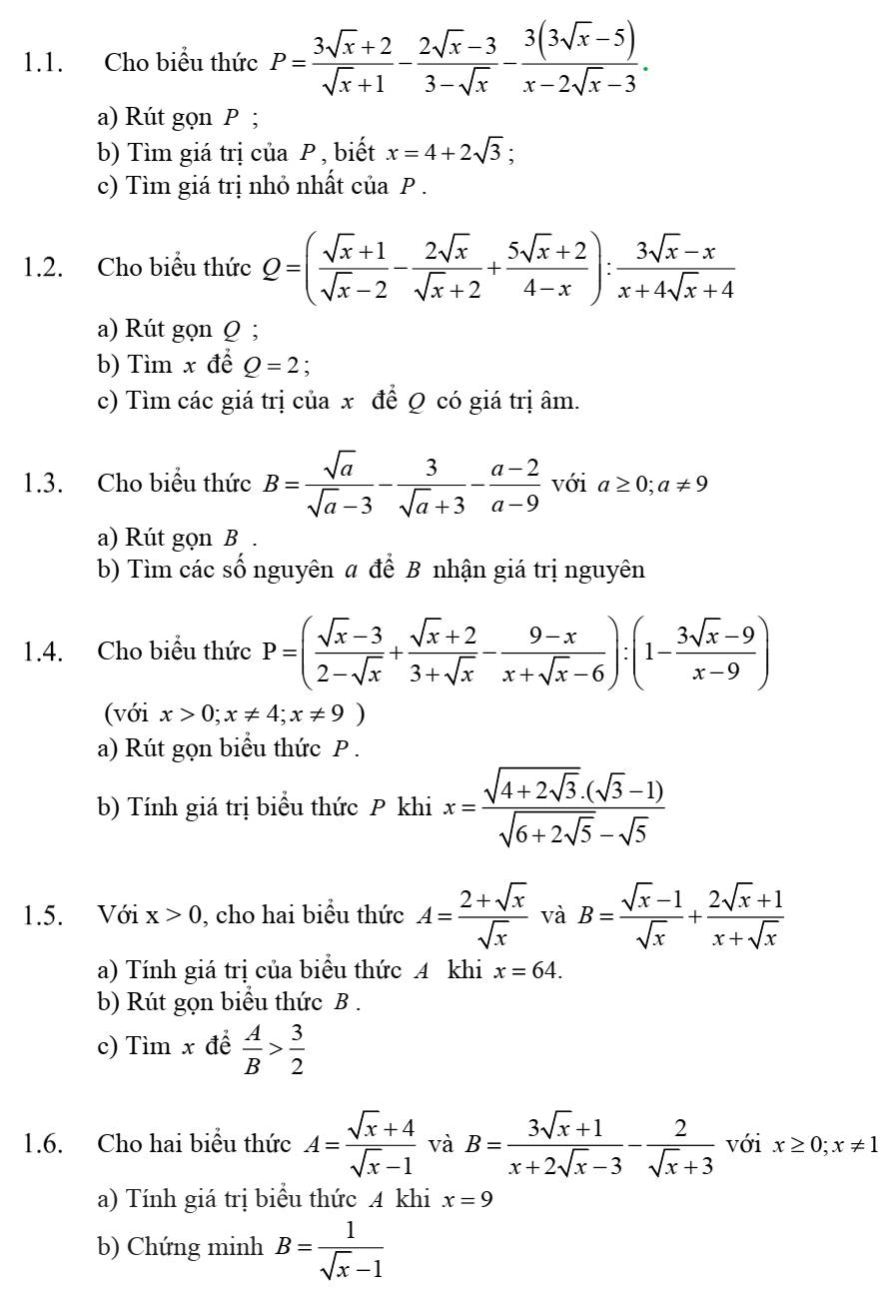
a: ĐKXĐ: x>0; x<>4; x<>9
Ta có: \(Q=\left(\frac{\sqrt{x}+1}{\sqrt{x}-2}-\frac{2\sqrt{x}}{\sqrt{x}+2}+\frac{5\sqrt{x}+2}{4-x}\right):\frac{3\sqrt{x}-x}{x+4\sqrt{x}+4}\)
\(=\left(\frac{\sqrt{x}+1}{\sqrt{x}-2}-\frac{2\sqrt{x}}{\sqrt{x}+2}-\frac{5\sqrt{x}+2}{\left(\sqrt{x}-2\right)\left(\sqrt{x}+2\right)}\right):\frac{-\sqrt{x}\left(\sqrt{x}-3\right)}{\left(\sqrt{x}+2\right)^2}\)
\(=\frac{\left(\sqrt{x}+1\right)\left(\sqrt{x}+2\right)-2\sqrt{x}\left(\sqrt{x}-2\right)-5\sqrt{x}-2}{\left(\sqrt{x}+2\right)\left(\sqrt{x}-2\right)}\cdot\frac{\left(\sqrt{x}+2\right)^2}{-\sqrt{x}\left(\sqrt{x}-3\right)}\)
\(=\frac{x+3\sqrt{x}+2-2x+4\sqrt{x}-5\sqrt{x}-2}{\sqrt{x}-2}\cdot\frac{\sqrt{x}+2}{-\sqrt{x}\left(\sqrt{x}-3\right)}\)
\(=\frac{-x+2\sqrt{x}}{\sqrt{x}-2}\cdot\frac{\sqrt{x}+2}{-\sqrt{x}\left(\sqrt{x}-3\right)}=\frac{-\sqrt{x}\left(\sqrt{x}-2\right)}{-\sqrt{x}\left(\sqrt{x}-2\right)}\cdot\frac{\sqrt{x}+2}{\sqrt{x}-3}=\frac{\sqrt{x}+2}{\sqrt{x}-3}\)
b: Q=2
=>\(\sqrt{x}+2=2\left(\sqrt{x}-3\right)\)
=>\(2\sqrt{x}-6=\sqrt{x}+2\)
=>\(\sqrt{x}=6+2=8\)
=>x=64(nhận)
c: để Q<0 thì \(\frac{\sqrt{x}+2}{\sqrt{x}-3}<0\)
=>\(\sqrt{x}-3<0\)
=>\(\sqrt{x}<3\)
=>0<x<9
Kết hợp ĐKXĐ, ta được: 0<x<9 và x<>4
1,6:
a: Thay x=9 vào A, ta được:
\(A=\frac{3+4}{3-1}=\frac72\)
b: \(B=\frac{3\sqrt{x}+1}{x+2\sqrt{x}-3}-\frac{2}{\sqrt{x}+3}\)
\(=\frac{3\sqrt{x}+1}{\left(\sqrt{x}+3\right)\left(\sqrt{x}-1\right)}-\frac{2}{\sqrt{x}+3}\)
\(=\frac{3\sqrt{x}+1-2\left(\sqrt{x}-1\right)}{\left(\sqrt{x}+3\right)\left(\sqrt{x}-1\right)}=\frac{\sqrt{x}+3}{\left(\sqrt{x}+3\right)\left(\sqrt{x}-1\right)}=\frac{1}{\sqrt{x}-1}\)
1.5:
a: Thay x=64 vào A, ta được:
\(A=\frac{2+8}{8}=\frac{10}{8}=\frac54\)
b: \(B=\frac{\sqrt{x}-1}{\sqrt{x}}+\frac{2\sqrt{x}+1}{x+\sqrt{x}}\)
\(=\frac{\sqrt{x}-1}{\sqrt{x}}+\frac{2\sqrt{x}+1}{\sqrt{x}\left(\sqrt{x}+1\right)}\)
\(=\frac{\left(\sqrt{x}-1\right)\left(\sqrt{x}+1\right)+2\sqrt{x}+1}{\sqrt{x}\left(\sqrt{x}+1\right)}=\frac{x-1+2\sqrt{x}+1}{\sqrt{x}\left(\sqrt{x}+1\right)}\)
\(=\frac{x+2\sqrt{x}}{\sqrt{x}\left(\sqrt{x}+1\right)}=\frac{\sqrt{x}+2}{\sqrt{x}+1}\)
c: Đặt P=A:B
\(=\frac{\sqrt{x}+2}{\sqrt{x}}:\frac{\sqrt{x}+2}{\sqrt{x}+1}=\frac{\sqrt{x}+1}{\sqrt{x}}\)
\(P>\frac32\)
=>\(\frac{\sqrt{x}+1}{\sqrt{x}}>\frac32\)
=>\(\frac{2\left(\sqrt{x}+1\right)-3\sqrt{x}}{2\sqrt{x}}>0\)
=>\(\frac{-\sqrt{x}+2}{2\sqrt{x}}>0\)
=>\(-\sqrt{x}+2>0\)
=>\(-\sqrt{x}>-2\)
=>\(\sqrt{x}<2\)
=>0<x<4
1) $n_{Na_2SO_3} = \dfrac{37,8}{126} = 0,3(mol)$
$n_{H_2SO_4} = \dfrac{200.19,6\%}{98} = 0,4(mol)$
$Na_2SO_3 + H_2SO_4 \to Na_2SO_4 + SO_2 + H_2O$
Ta thấy $n_{Na_2SO_3} : 1 < n_{H_2SO_4} : 1$ nên $H_2SO_4$ dư
$n_{SO_2} = n_{Na_2SO_3} = 0,3(mol)$
$V_{SO_2} = 0,3.22,4 = 6,72(lít)$
2) Sau phản ứng, $m_{dd} = 37,8 + 200 - 0,3.64 = 218,6(gam)$
$n_{H_2SO_4\ pư} = n_{Na_2SO_3} = 0,3(mol) \Rightarrow n_{H_2SO_4\ dư} = 0,4 - 0,3 = 0,1(mol)$
$C\%_{H_2SO_4\ dư} = \dfrac{0,1.98}{218,6}.100\% = 4,48\%$
$C\%_{Na_2SO_4} = \dfrac{0,3.142}{218,6}.100\% = 19,49\%$