
sử dụng cách thử nào để phân biệt hai chất rắn màu trắng CaO;P2O5
K
Khách
Hãy nhập câu hỏi của bạn vào đây, nếu là tài khoản VIP, bạn sẽ được ưu tiên trả lời.

1 tháng 7 2022
Bạn tự kết luận nhé.\(A=x\left(80-2x\right)\left(50-2x\right)=2x\left(40-x\right)\left(50-2x\right)=\dfrac{2}{3}.3x\left(40-x\right)\left(50-2x\right)\le\dfrac{2}{3}.\left[\dfrac{\left(3x\right)+\left(40-x\right)+\left(50-2x\right)}{3}\right]^3=\dfrac{2}{3}.\left(\dfrac{90}{3}\right)^3=18000\)Dấu "=" xảy ra \(\Leftrightarrow3x=40-x=50-2x\Leftrightarrow x=10\)
Vậy \(MaxA=18000\)
DD
Đoàn Đức Hà
Giáo viên
1 tháng 7 2022
Ta sẽ tìm max của \(P=x\left(80-2x\right)\left(50-2x\right)\) với \(0< x< 25\).
Ta có:
\(P=x\left(80-2x\right)\left(50-2x\right)=\dfrac{2}{3}.3x.\left(40-x\right)\left(50-2x\right)\)
\(\le\dfrac{2}{3}\left(\dfrac{3x+40-x+50-2x}{3}\right)^3=\dfrac{2}{3}.\left(\dfrac{90}{3}\right)^3=18000\)
Dấu \(=\) xảy ra khi \(3x=40-x=50-2x\Leftrightarrow x=10\) (thỏa mãn)
DA
1
1 tháng 7 2022
đăng tách ra bạn nhé
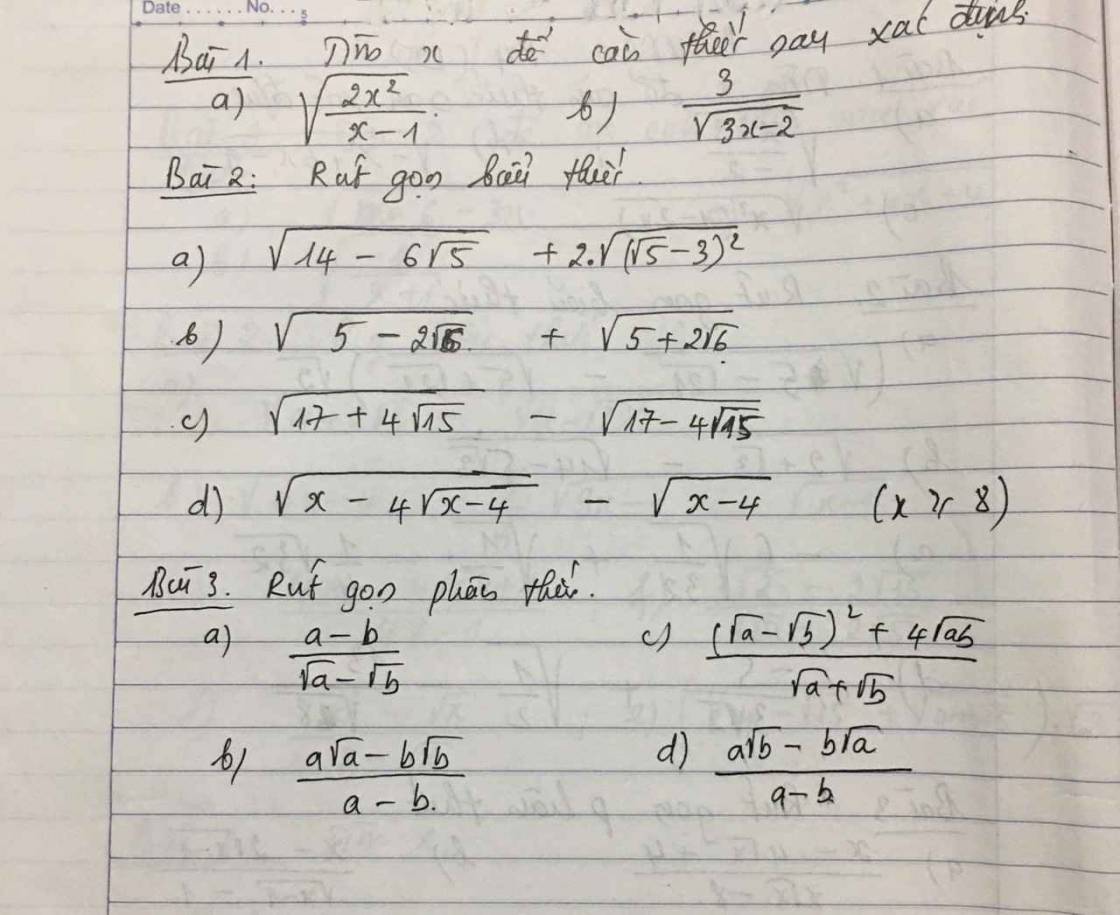
Bài 2 :
a, \(\sqrt{14-2.3\sqrt{5}}+2\sqrt{\left(\sqrt{5}-3\right)^2}=\sqrt{\left(3-\sqrt{5}\right)^2}+2\left|3-\sqrt{5}\right|=3-\sqrt{5}+6-2\sqrt{5}=9-3\sqrt{5}\)
b, \(\sqrt{\left(\sqrt{3}-\sqrt{2}\right)^2}+\sqrt{\left(\sqrt{3}+\sqrt{2}\right)^2}=\sqrt{3}-\sqrt{2}+\sqrt{3}+\sqrt{2}=2\sqrt{3}\)
c, \(\sqrt{17+2.2\sqrt{3}\sqrt{5}}-\sqrt{17-2.2\sqrt{3}\sqrt{5}}\)
\(=\sqrt{\left(2\sqrt{3}-\sqrt{5}\right)^2}-\sqrt{\left(2\sqrt{3}+\sqrt{5}\right)^2}=2\sqrt{3}-\sqrt{5}-2\sqrt{3}-\sqrt{5}=-2\sqrt{5}\)
d, \(\sqrt{x-4-4\sqrt{x-4}+4}-\sqrt{x-4}=\sqrt{\left(\sqrt{x-4}-2\right)^2}-\sqrt{x-4}=\sqrt{x-4}-2-\sqrt{x-4}=-2\)
1 tháng 7 2022
- Vì số A có 3 chữ số nên số A có dạng: \(\overline{abc}\left(0\le b,c\le9;0< a\le9;\right)\)
- Vì chữ số hàng trăm lớn hơn chữ số hàng đơn vị: \(\Rightarrow a>c\).
Cho \(a-c=d\left(0< d\le9\right)\)
- Số có thứ tự các chữ số ngược lại với A: \(\overline{cba}\)
- Hiệu \(D=\overline{abc}-\overline{cba}=100a+10b+c-\left(100c+10b+a\right)=100\left(a-c\right)-\left(a-c\right)=100d-d=\overline{d00}-d\)Do \(0< d\le9\) nên:
\(D=\overline{\left(d-1\right)9\left(10-d\right)}\).
- Số có thứ tự các chữ số ngược lại với D: \(\overline{\left(10-d\right)9\left(d-1\right)}\)
- Tổng \(S=\overline{\left(d-1\right)9\left(10-d\right)}+\overline{\left(10-d\right)9\left(d-1\right)}=100\left(d-1\right)+10.9+\left(10-d\right)+100\left(10-d\right)+10.9+\left(d-1\right)=\left(100d-100\right)+\left(1000-100d\right)+189=1089\)
\(\Rightarrow\)S là 1 hằng số.
Vậy với bất kì số A thỏa mãn yêu cầu đề bài và thực hiện đúng quy trình, ta luôn có S là một hằng số.
1 tháng 7 2022
*Gọi D là giao của BM và EF.
△ABC vuông tại B có: BM là trung tuyến.
\(\Rightarrow BM=CM=\dfrac{BC}{2}\)
\(\Rightarrow\)△BMC cân tại M.
\(\Rightarrow\widehat{MCB}=\widehat{MBC}\)
Tứ giác BEHF có: \(\widehat{EBF}=\widehat{BFH}=\widehat{BEH}=90^0\)
\(\Rightarrow\)BEHF là hình chữ nhật.
\(\Rightarrow\widehat{HBE}=\widehat{DEB}\).
Ta có: \(\widehat{MCB}+\widehat{HBE}=90^0\) (△BHC vuông tại H).
\(\Rightarrow\widehat{MBC}+\widehat{DEB}=90^0\)
\(\Rightarrow180^0-\widehat{BDE}=90^0\)
\(\Rightarrow\widehat{BDE}=90^0\)
\(\Rightarrow\)BM⊥EF tại D.
1 tháng 7 2022
Suppose I is the intersection of BM and EF.
Consider the right triangle ABC, which has \(\widehat{B}=90^o\), has the median BM, so, \(BM=\dfrac{AC}{2}\) (1)
On the other hand, M is the midpoint of AC, therefore, \(AM=\dfrac{AC}{2}\) (2)
From, (1) and (2), we have \(BM=AM\left(=\dfrac{AC}{2}\right)\), which means MAB is an isosceles triangle, and this leads to \(\widehat{A}=\widehat{ABM}\) or \(\widehat{A}=\widehat{FBI}\)
Consider the right triangle ABH (right at H), has the height HF, thus, \(BH^2=BF.BA\)
Similarly, we have \(BH^2=BE.BC\)
From these, we get \(BF.BA=BE.BC\left(=BH^2\right)\) or \(\dfrac{BF}{BC}=\dfrac{BE}{BA}\)
Consider the 2 right triangles (which are both right at B), we have \(\dfrac{BF}{BC}=\dfrac{BE}{BA}\). Therefore, \(\Delta BEF~\Delta BAC\left(s.a.s\right)\), which means \(\widehat{BFE}=\widehat{C}\) or \(\widehat{BFI}=\widehat{C}\)
Also, \(\widehat{A}+\widehat{C}=90^o\) due to the right triangle ABC (right at B). Because \(\widehat{FBI}=\widehat{A};\widehat{BFI}=\widehat{C}\), we have \(\widehat{FBI}+\widehat{BFI}=90^o\). This means FBI is a right triangle (whose right angle is I). Thus, \(BM\perp EF\), and that is what we must prove!
- Hòa tan 2 chất rắn vào nước có pha sẵn quỳ tím:
+ Chất rắn tan, dd có màu đỏ: P2O5
P2O5 + 3H2O --> 2H3PO4
+ Chất rắn tan, dd có màu xanh: CaO
CaO + H2O --> Ca(OH)2
Trích một ít làm mẫu thử.
Hoà tan 2 chất rắn đó vào nước và nhúng quỳ tím:
- Nếu quỳ tím chuyển đỏ thì đó là \(P_2O_5\):
\(P_2O_5+3H_2O\rightarrow2H_3PO_4\)
- Nếu quỳ tím chuyển xanh thì đó là \(CaO\):
\(CaO+H_2O\rightarrow Ca\left(OH\right)_2\)
Dán lại nhãn cho 2 lọ trên.