
Chứng minh x là số vô tỉ nếu:x^3 + 3x^2 − x + 3^n = 0 trong đó n thuộc N*
K
Khách
Hãy nhập câu hỏi của bạn vào đây, nếu là tài khoản VIP, bạn sẽ được ưu tiên trả lời.

NL
Nguyễn Lê Phước Thịnh
CTVHS
29 tháng 6 2024
a: \(\dfrac{1}{4003}>0;0>-\dfrac{75}{106}\)
Do đó: \(\dfrac{1}{4003}>-\dfrac{75}{106}\)
b: \(-19< -17\)
=>\(-\dfrac{19}{31}< -\dfrac{17}{31}\)
c: \(\dfrac{-33}{37}>\dfrac{-34}{37}\)
mà \(-\dfrac{34}{37}>-\dfrac{34}{35}\)
nên \(\dfrac{-33}{37}>-\dfrac{34}{35}\)
d: \(\dfrac{-13}{77}=\dfrac{-13\cdot205}{77\cdot205}=\dfrac{-2665}{77\cdot205}\)
\(\dfrac{-34}{205}=\dfrac{-34\cdot77}{205\cdot77}=\dfrac{-2618}{205\cdot77}\)
mà -2665<-2618
nên \(\dfrac{-13}{77}< \dfrac{-34}{205}\)
e: \(\dfrac{-456}{461}=-1+\dfrac{5}{461};\dfrac{-123}{128}=-1+\dfrac{5}{128}\)
461>128
=>\(\dfrac{5}{461}< \dfrac{5}{128}\)
=>\(\dfrac{5}{461}-1< \dfrac{5}{128}-1\)
=>\(\dfrac{-456}{461}< \dfrac{-123}{128}\)
NL
Nguyễn Lê Phước Thịnh
CTVHS
29 tháng 6 2024
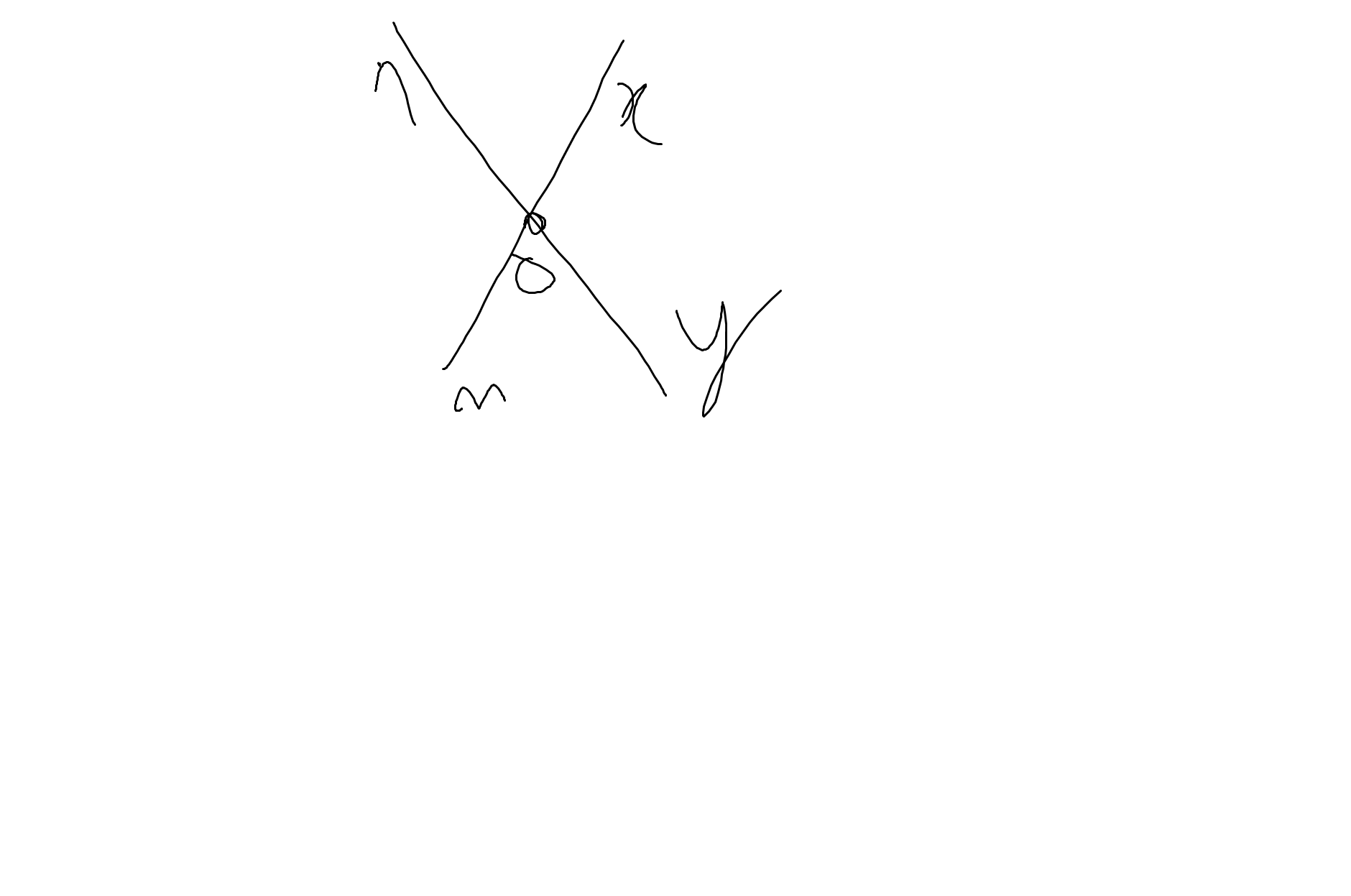
\(\widehat{mOn}=\widehat{xOy}\)(hai góc đối đỉnh)
mà \(\widehat{xOy}=85^0\)
nên \(\widehat{mOn}=85^0\)
Ta có: \(\widehat{nOm}+\widehat{xOn}=180^0\)(hai góc kề bù)
=>\(\widehat{xOn}+85^0=180^0\)
=>\(\widehat{xOn}=180^0-85^0=95^0\)
Ta có: \(\widehat{xOn}=\widehat{yOm}\)(hai góc đối đỉnh)
mà \(\widehat{xOn}=95^0\)
nên \(\widehat{yOm}=95^0\)
TT

1
NL
Nguyễn Lê Phước Thịnh
CTVHS
29 tháng 6 2024
\(1,4\left(51\right)=\dfrac{479}{330};3,1\left(45\right)=\dfrac{173}{55}\)
Tổng các tử số là 479+173=652
=>Chọn C
NK
4
NK
3
P
29 tháng 6 2024
\(\left(\dfrac{-4}{9}\right)^2=\dfrac{16}{81}\Rightarrow x=2\)
\(\left(-\dfrac{1}{3}\right)^3=\dfrac{-1}{27}\Rightarrow x=1\)
\(\left(-\dfrac{1}{3}\right)^4=\dfrac{1}{81}\Rightarrow x=1\)
P
29 tháng 6 2024
\(\left(-\dfrac{4}{9}\right)^x=\dfrac{16}{81}\\ \left(-\dfrac{4}{9}\right)^x=\left(\dfrac{4}{9}\right)^2\\ \left(-\dfrac{4}{9}\right)^x=\left(-\dfrac{4}{9}\right)^2\\ x=2\\ -----------\\ \left(-\dfrac{1}{3}\right)^{2x+1}=-\dfrac{1}{27}\\ \left(-\dfrac{1}{3}\right)^{2x+1}=\left(-\dfrac{1}{3}\right)^3\\ 2x+1=3\\ 2x=3-1=2\\ x=\dfrac{2}{2}=1\\ -----------\\ \left(-\dfrac{1}{3}\right)^{3x+1}=\dfrac{1}{81}\\\left(-\dfrac{1}{3}\right)^{3x+1}=\left(\dfrac{1}{3}\right)^4\\ \left(-\dfrac{1}{3}\right)^{3x+1}=\left(-\dfrac{1}{3}\right)^4\\ 3x+1=4\\ 3x=4-1=3\\ x=\dfrac{3}{3}=1\)
29 tháng 6 2024
\(\left(\dfrac{7}{5}\right)^x=\dfrac{49}{25}\Leftrightarrow\left(\dfrac{7}{5}\right)^x=\left(\dfrac{7}{5}\right)^2\Leftrightarrow x=2\)
NL
Nguyễn Lê Phước Thịnh
CTVHS
29 tháng 6 2024
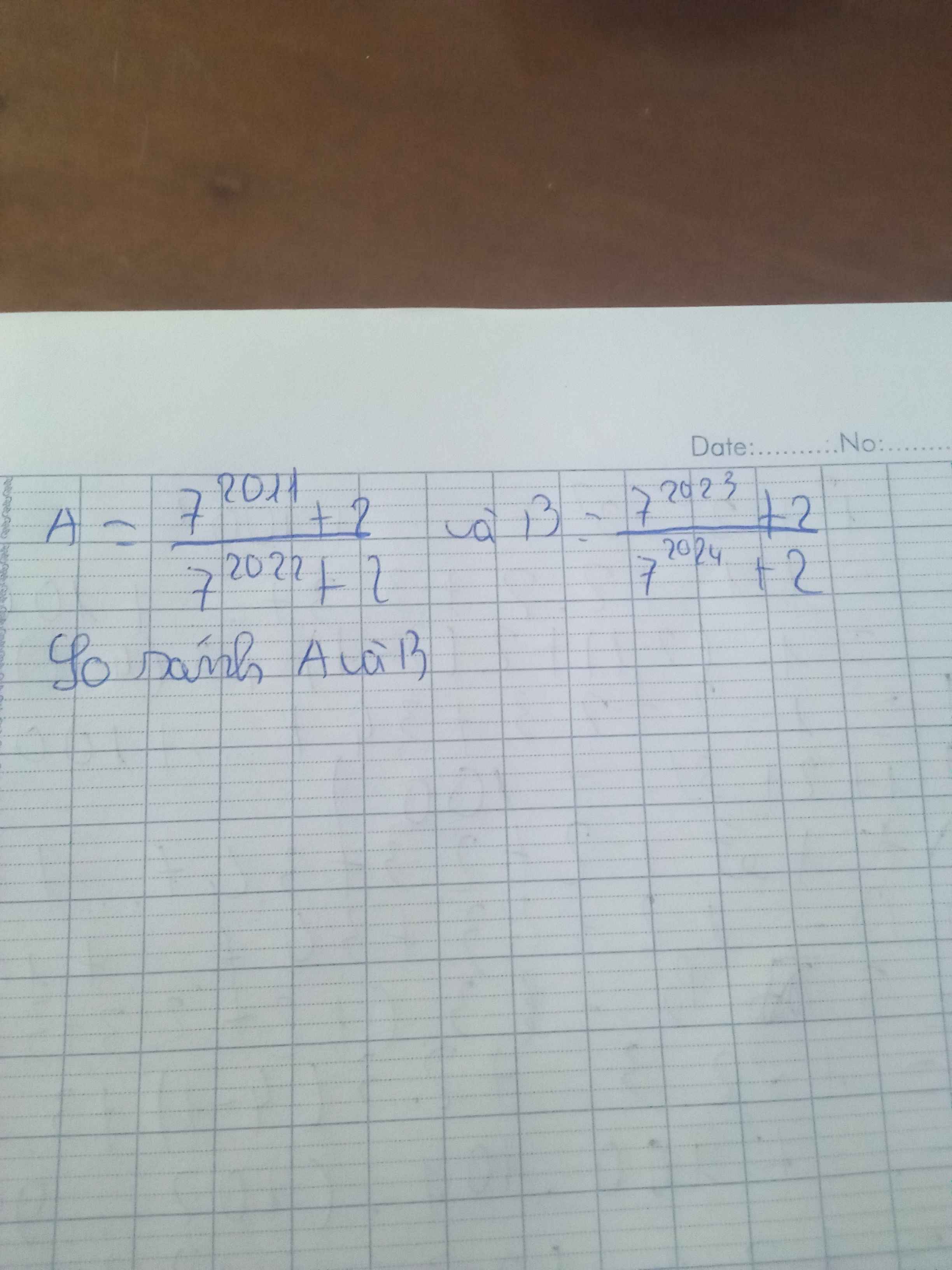
\(7A=\dfrac{7^{2022}+14}{7^{2022}+2}=1+\dfrac{12}{7^{2022}+2}\)
\(7B=\dfrac{7^{2024}+14}{7^{2024}+2}=1+\dfrac{12}{7^{2024}+2}\)
\(7^{2022}+2< 7^{2024}+2\)
=>\(\dfrac{12}{7^{2022}+2}>\dfrac{12}{7^{2024}+2}\)
=>\(\dfrac{12}{7^{2022}+2}+1>\dfrac{12}{7^{2024}+2}+1\)
=>7A>7B
=>A>B

Đặt \(P\left(x\right)=x^3+3x^2-x+3^n\)
Nếu \(P\left(x\right)\) có nghiệm hữu tỉ \(x=\dfrac{p}{q}\left(p\inℤ,q\inℕ^∗;\left(p,q\right)=1\right)\) thì \(p|3^n,q|1\Rightarrow q=1\) và \(p=3^k\left(k\le n\right)\)
Vậy \(x=3^k\) sẽ là nghiệm hữu tỉ duy nhất của \(P\left(x\right)\) hay \(P\left(3^k\right)=0\)
\(\Leftrightarrow\left(3^k\right)^3+3.\left(3^k\right)^2-3^k+3^n=0\)
\(\Leftrightarrow3^{3k}+3^{2k+1}-3^k+3^n=0\)
\(\Leftrightarrow3^{2k}+3^{k+1}-1+3^{n-k}=0\)
Ta thấy với \(n>k\) thì \(3^{2k}+3^{k+1}+3^{n-k}⋮3\) và \(0⋮3\) nên từ đây suy ra \(1⋮3\), vô lý.
Với \(n=k\) thì \(3^{2n}+3^{n+1}=0\), vô lý vì \(3^{2n}+3^{n+1}>0\) với \(n\inℕ^∗\)
Vậy \(P\left(x\right)\) không thể có nghiệm hữu tỉ. Do đó, nếu \(x^3+3x^2-x+3=0\) thì \(x\) chỉ có thể là một số vô tỉ. (đpcm)