
Cho tam giác ABC vuông tại A đường cao AH . Hãy tính AB,AC,BC,CH hoặc BH trong các trường hợp sau
AH = 12 cm ; CH =16 cm
Ai giúp mình với ạ
Hãy nhập câu hỏi của bạn vào đây, nếu là tài khoản VIP, bạn sẽ được ưu tiên trả lời.

a: Ta có: \(AM=MB=\dfrac{AB}{2}\)
\(DN=NC=\dfrac{DC}{2}\)
\(BE=EC=\dfrac{BC}{2}\)
mà AB=DC=BC
nên AM=MB=DN=NC=BE=EC
Xét tứ giác AMCN có
AM//CN
AM=CN
Do đó: AMCN là hình bình hành
b: Xét ΔMBC vuông tại B và ΔECD vuông tại C có
MB=EC
BC=CD
Do đó: ΔMBC=ΔECD
=>\(\widehat{BMC}=\widehat{CED}\)
=>\(\widehat{CED}+\widehat{ECM}=90^0\)
=>CM\(\perp\)DE
c: ΔMBC=ΔECD
=>MC=ED
a: ĐKXĐ: \(x\notin\left\{-1;0;1\right\}\)
\(\dfrac{x+3}{x+1}-\dfrac{x-1}{x}=\dfrac{3x^2+4x+1}{x\left(x-1\right)}\)
=>\(\dfrac{x\left(x+3\right)-\left(x-1\right)\left(x+1\right)}{x\left(x+1\right)}=\dfrac{3x^2+4x+1}{x\left(x-1\right)}\)
=>\(\dfrac{x^2+3x-x^2+1}{\left(x^2+x\right)}=\dfrac{3x^2+4x+1}{x\left(x-1\right)}\)
=>\(\dfrac{\left(3x+1\right)\left(x-1\right)}{x\left(x+1\right)\left(x-1\right)}=\dfrac{\left(3x^2+4x+1\right)\left(x+1\right)}{x\left(x-1\right)\left(x+1\right)}\)
=>\(\left(3x^2+4x+1\right)\left(x+1\right)=\left(3x+1\right)\left(x-1\right)\)
=>\(\left(3x+1\right)\left(x^2+2x+1\right)-\left(3x+1\right)\left(x-1\right)=0\)
=>\(\left(3x+1\right)\left(x^2+2x+1-x+1\right)=0\)
=>\(\left(3x+1\right)\left(x^2+x+2\right)=0\)
mà \(x^2+x+2=\left(x+\dfrac{1}{2}\right)^2+\dfrac{7}{4}>0\forall x\)
nên 3x+1=0
=>\(x=-\dfrac{1}{3}\left(nhận\right)\)
b: ĐKXĐ: \(x\notin\left\{-3;-1\right\}\)
\(\dfrac{x}{2\left(x+3\right)}+\dfrac{x}{2x+2}=\dfrac{-x}{\left(x+1\right)\left(x+3\right)}\)
=>\(\dfrac{x}{2\left(x+3\right)}+\dfrac{x}{2\left(x+1\right)}=\dfrac{-x}{\left(x+1\right)\left(x+3\right)}\)
=>\(\dfrac{x\left(x+1\right)+x\left(x+3\right)}{2\left(x+3\right)\left(x+1\right)}=\dfrac{-2x}{2\left(x+1\right)\left(x+3\right)}\)
=>\(x^2+x+x^2+3x=-2x\)
=>\(2x^2+6x=0\)
=>2x(x+3)=0
=>x(x+3)=0
=>\(\left[{}\begin{matrix}x=0\left(nhận\right)\\x=-3\left(nhận\right)\end{matrix}\right.\)
c: ĐKXĐ: \(x\notin\left\{0;\dfrac{3}{2}\right\}\)
\(\dfrac{1}{2x-3}=\dfrac{3}{2x^2-3x}+\dfrac{x}{5}\)
=>\(\dfrac{x-3}{x\left(2x-3\right)}=\dfrac{x}{5}\)
=>\(x^2\left(2x-3\right)=5\left(x-3\right)\)
=>\(2x^3-3x^2-5x+15=0\)
=>\(x\simeq-1,9\left(nhận\right)\)
d: ĐKXĐ: \(x\notin\left\{0;-2\right\}\)
\(\dfrac{x+2}{x}=\dfrac{x^2+5x+4}{x^2+2x}+\dfrac{x}{x+2}\)
=>\(\dfrac{\left(x+2\right)^2}{x\left(x+2\right)}=\dfrac{x^2+5x+4}{x\left(x+2\right)}+\dfrac{x^2}{x\left(x+2\right)}\)
=>\(\left(x+2\right)^2=x^2+5x+4+x^2\)
=>\(2x^2+5x+4-x^2-4x-4=0\)
=>\(x^2+x=0\)
=>x(x+1)=0
=>\(\left[{}\begin{matrix}x=0\left(loại\right)\\x=-1\left(nhận\right)\end{matrix}\right.\)
gọi v là vận tốc đi từ A đến B; s là quãng đường từ A đến B
quãng đường người đó đi từ A đến B là: s = 3v (km)
quãng đường đi từ B đến A là: s = (v - 10) x 4 (km)
theo đề ta có phương trình:
3v = (v - 10) x 4
3v = 4v - 40
4v - 3v = 40
v = 40
vậy vận tốc lúc đi là 40km/h
quãng đường AB là: s = 3v = 3 x 40 = 120 (km)
vậy quãng đường đi từ A -> B là 120 km
We are (get)getting the work (do)done by a professional decorator and she is going to talk to me about all the changes
get st V3 by sb : nhờ cái gì được làm bởi ai
1 having
2 to fix
3 get our house painted
4 have the children taught to take off their shoes before they come into the house.
5 get Jake to help us with our project.
1. They are having/ getting sb pick them up at the airport
2. I really must get sb to fix/ fix the broken window
3. We need to paint our house soon PAINTED
We must ..have/get our house painted. soon
4. You should teach the children to take off thier shoes before they come into the house HAVE
You should have the children taught to take off thier shoes before they come into the house
5. Jake đin't want to help us with our project GET
We couldn't get jack to help us with our project
4(x-2)-3(x+1)=5
=>\(4x-8-3x-3=5\)
=>\(x-11=5\)
=>x=11+5=16
\(4\left(x-2\right)-3\left(x+1\right)=5\)
\(\Leftrightarrow4x-8-3x-3=5\)
\(\Leftrightarrow\left(4x-3x\right)=5+8+3\)
\(\Leftrightarrow x=16\)
Vậy \(x=16\)
Hướng dẫn giải:
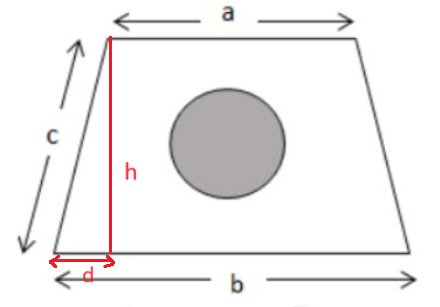
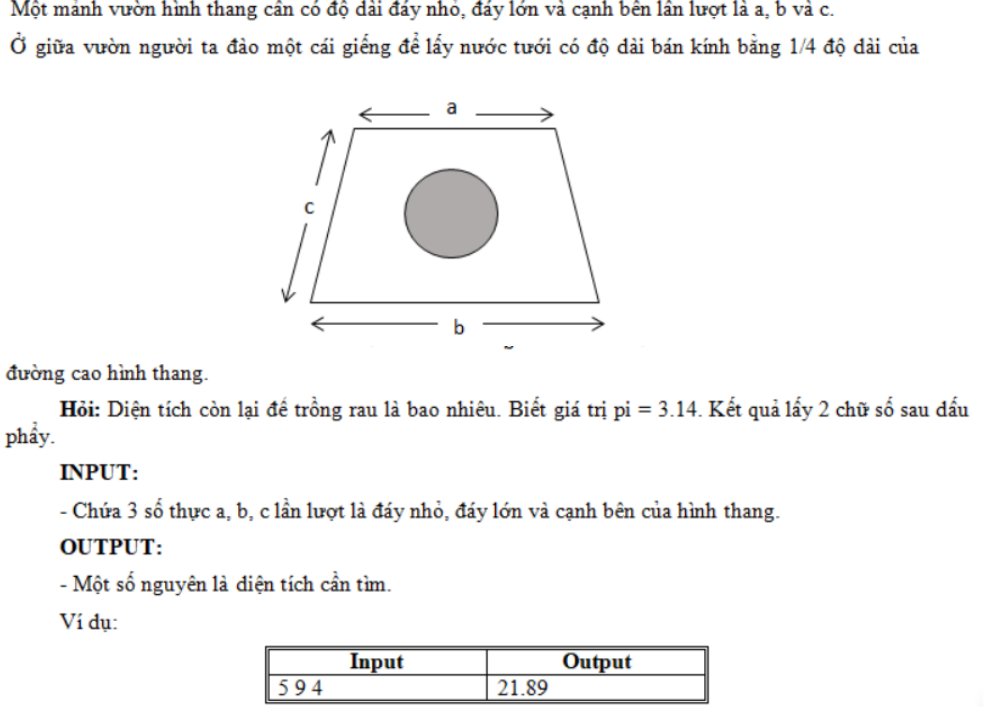
Để tìm được diện tích trồng trau đầu tiên ta phải thực hiện các bước sau:
1. Tìm chiều cao hình thang
Để tìm được h, ta sử dụng định lý Pytago để giải quyết:
- Đầu tiên dễ dàng nhận thấy 2d sẽ bằng b - a. => d = \(\dfrac{b-a}{2}\)
- Áp dụng ĐL Pytago ta có c2 = h2 + d2
=> h = \(\sqrt{c^2-d^2}\)
2. Tìm diện tích cái giếng
Bán kính bằng = 1/4 độ dài được cao => \(r=h.\dfrac{1}{4}\)
Diện tích cái giếng bằng: S1 = r x r x 3.14
3. Tìm diện tích hình thang
Sử dụng công thức hình thang bình thường để tính \(S_2=\dfrac{1}{2}\times\left(a+b\right)\times h\)
4. Diện tích trồng rau khi đó sẽ là S = S2 - S1
Code tham khảo:
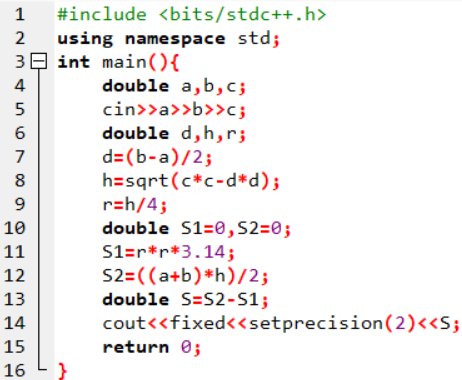


 c++
c++
Xét ΔABC vuông tại A có AH là đường cao
nên \(AH^2=HB\cdot HC\)
=>\(HB=\dfrac{12^2}{16}=9\left(cm\right)\)
BC=BH+CH=9+16=25(cm)
Xét ΔABC vuông tại A có AH là đường cao
nên \(\left\{{}\begin{matrix}AB^2=BH\cdot BC\\AC^2=CH\cdot BC\end{matrix}\right.\Leftrightarrow\left\{{}\begin{matrix}AB=\sqrt{9\cdot25}=15\left(cm\right)\\AC=\sqrt{16\cdot25}=20\left(cm\right)\end{matrix}\right.\)