
Mary said:"Life in the city is better than life in the country."
K
Khách
Hãy nhập câu hỏi của bạn vào đây, nếu là tài khoản VIP, bạn sẽ được ưu tiên trả lời.

NL
Nguyễn Lê Phước Thịnh
CTVHS
25 tháng 8 2025
a: ΔABC cân tại A
mà AH là đường trung tuyến
nên AH⊥BC tại H và AH là phân giác của góc BAC
Xét ΔAHE vuông tại E và ΔBCK vuông tại K có
\(\hat{AHE}=\hat{BCK}\left(=90^0-\hat{EHC}\right)\)
Do đó: ΔAHE~ΔBCK
b: Ta có: HE⊥AC
BK⊥AC
Do đó: HE//BK
Xét ΔCKB có
H là trung điểm của CB
HE//BK
Do đó: E là trung điểm của CK
ΔAHE~ΔBCK
=>\(\frac{HE}{CK}=\frac{AE}{BK}\)
=>\(\frac{AE}{BK}=\frac{2\cdot EO}{2\cdot EK}=\frac{EO}{EK}\)
=>\(AE\cdot EK=BK\cdot EO\)
c: Gọi M là trung điểm của EC
Xét ΔEHC có
O,M lần lượt là trung điểm của EH,EC
=>OM là đường trung bình của ΔEHC
=>OM//HC
mà HC⊥HA
nên MO⊥HA
Xét ΔAHM có
MO,HE là các đường cao
MO cắt HE tại O
Do đó: O là trực tâm của ΔAHM
=>AO⊥HM
Xét ΔBEC có
H,M lần lượt là trung điểm của CB,CE
=>HM là đường trung bình của ΔBEC
=>HM//BE
mà AO⊥HM
nên AO⊥BE
NL
Nguyễn Lê Phước Thịnh
CTVHS
21 tháng 5 2024
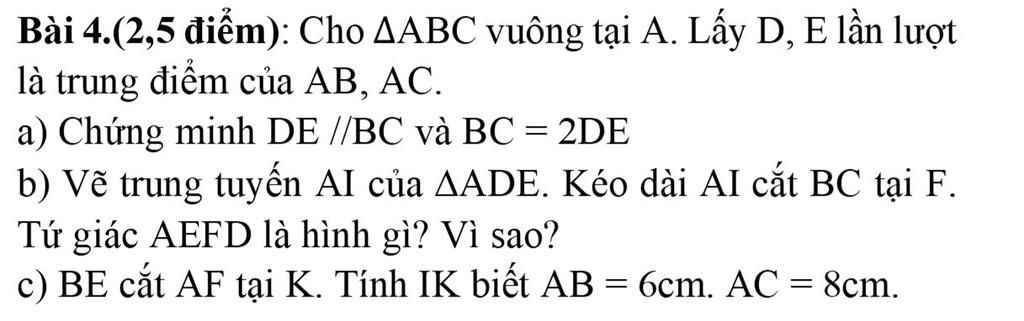
a: Xét ΔABC có
D,E lần lượt là trung điểm của AB,AC
=>DE là đường trung bình của ΔABC
=>DE//BC và BC=2DE
b: Xét ΔAFB có
D là trung điểm của AB
DI//FB
Do đó: I là trung điểm của AF
Xét ΔAFB có ID//FB
nên \(\dfrac{ID}{FB}=\dfrac{AD}{AB}=\dfrac{1}{2}\)
Xét ΔAFC có IE//FC
nên \(\dfrac{IE}{FC}=\dfrac{AE}{AC}=\dfrac{1}{2}\)
Do đó: \(\dfrac{ID}{FB}=\dfrac{IE}{FC}\)
mà ID=IE(I là trung điểm của DE)
nên FB=FC
=>F là trung điểm của BC
Xét tứ giác AEFD có
I là trung điểm chung của AF và ED
=>AEFD là hình bình hành
Hình bình hành AEFD có \(\widehat{EAD}=90^0\)
nên AEFD là hình chữ nhật
c: ΔABC vuông tại A
=>\(AB^2+AC^2=BC^2\)
=>\(BC=\sqrt{6^2+8^2}=10\left(cm\right)\)
\(DE=\dfrac{1}{2}BC=\dfrac{1}{2}\cdot10=5\left(cm\right)\)
I là trung điêm của DE
=>ID=IE=DE/2=2,5(cm)
=>AI=ED/2=2,5(cm)
ΔABC vuông tại A
mà AF là đường trung tuyến
nên AF=BC/2=5(cm)
Xét ΔABC có
BE,AF là các đường trung tuyến
BE cắt AF tại K
Do đó: K là trọng tâm của ΔABC
=>\(AK=\dfrac{2}{3}AF=\dfrac{2}{3}\cdot5=\dfrac{10}{3}\left(cm\right)\)
AI+IK=AK
=>\(IK+2,5=\dfrac{10}{3}\)
=>\(IK=\dfrac{10}{3}-\dfrac{5}{2}=\dfrac{20}{6}-\dfrac{15}{6}=\dfrac{5}{6}\left(cm\right)\)
VD
21 tháng 5 2024
Friedrich Paulus là sĩ quan cấp cao của quân đội Đức Quốc xã, chỉ huy lực lượng Đức tấn công thành phố Stalingrad của Liên Xô. Ông cũng chính là người đã chống lệnh trùm phát xít Adolf Hitler, trở thành Thống chế đầu tiên trong lịch sử Đức đầu hàng để cứu sống hàng chục nghìn binh sĩ khỏi phí mạng vô ích.
NV
Nguyễn Việt Dũng
CTVVIP
21 tháng 5 2024
Vì ông đã kháng lệnh của Hitler khi Hitler ra lệnh tử thủ, Thống chế Friedrich Paulus quyết định đầu hàng Hồng quân để khỏi phung phí sinh mạng binh sĩ thuộc quyền một cách vô ích.
MC
2
VD
21 tháng 5 2024
Người Do Thái là đại diện của những điều mà Hitler khiếp sợ hay coi thường như: ý muốn thống trị thế giới, tư tưởng hiện đại trong nghệ thuật, quan điểm chống chủ nghĩa dân tộc trong báo chí và các sản phẩm gợi dục. Hitler cũng có thể cho rằng, người Do Thái là nguyên nhân gây ra cuộc đại suy thoái kinh tế ở Đức
NV
Nguyễn Việt Dũng
CTVVIP
21 tháng 5 2024
Hitler sát hại người Do Thái vì ông ta và Đảng Quốc xã theo đuổi một hệ tư tưởng cực đoan dựa trên thuyết chủng tộc ưu việt, coi người Do Thái là mối đe dọa lớn đối với sự thuần khiết và sức mạnh của chủng tộc Aryan. Hitler đổ lỗi cho người Do Thái về nhiều vấn đề xã hội, kinh tế và chính trị mà nước Đức phải đối mặt sau Thế chiến I. Từ đó, ông ta tiến hành Holocaust, một cuộc diệt chủng hệ thống nhằm tiêu diệt toàn bộ dân tộc Do Thái.
PQ
22 tháng 5 2024
A.Complete the sentences with correct perfect modals:
1. You didn't need to buy that book about the oceans. I could have lent you my copy.
2. I don't know why Simon isn't here yet, but I suppose he must have missed the bus.
3. The city centre is no longer covered in graffiti; the city council must have cleaned it up.
4. You should have told me you were going to be late instead of making me wait so long!
5. Mark should have brought sunblock because it rained all weekend.
6. They must have eaten all that food; there was so much of it!
7. The hikers should have returned by now; I wonder where they are.
B. Rewrite the sentences using the words in brackets:
1. Lunch was provided so they didn't need to take sandwiches.
2. She studied hard so she should have passed the exam.
3. I think he's foreign so he might not have understood you.
4. John can't be in Rome - I saw him earlier.
5. You ought to have listened to my advice.
6. Why mightn't you introduce me to your friends?
C. Complete the second sentences so that they have a similar meaning to the first sentences using the words in bold:
1. Caged animals are miserable, wouldn't you agree?
2. You must pay a membership fee before you can join the animal society.
3. We are bound to get some rain today; I can feel it in my bones.
4. My Internet connection will not work; I've been trying to get online all day.
5. The documentary on whales ought to be interesting for my class.
SV
Sinh Viên NEU
CTVVIP
25 tháng 5 2024
A. Complete the sentences with correct perfect modals.
1. You didn't need to buy that book about the oceans. I ..would have lent...(lend) you my copy.
2. I don't know why Simon isn't here yet, but I suppose he…might have missed.. (miss) the bus.
3. The city centre is no longer covered in graffiti; the city council ...must have cleaned.... (clean) it up.
4. You ....should have told... (tell) me you were going to be late instead of making me wait so long!
5. Mark …should have brought.(bring) sunblock because it rained all weekend.
6. They ...couldn't have eaten... (eat) all that food; there was so much of it!
7. The hikers ..should have returned...(return) by now; I wonder where they are.
PQ
22 tháng 5 2024
A.Complete the sentences with correct perfect modals:
1. You didn't need to buy that book about the oceans. I could have lent you my copy.
2. I don't know why Simon isn't here yet, but I suppose he must have missed the bus.
3. The city centre is no longer covered in graffiti; the city council must have cleaned it up.
4. You should have told me you were going to be late instead of making me wait so long!
5. Mark should have brought sunblock because it rained all weekend.
6. They must have eaten all that food; there was so much of it!
7. The hikers should have returned by now; I wonder where they are.
B. Rewrite the sentences using the words in brackets:
1. Lunch was provided so they didn't need to take sandwiches.
2. She studied hard so she should have passed the exam.
3. I think he's foreign so he might not have understood you.
4. John can't be in Rome - I saw him earlier.
5. You ought to have listened to my advice.
6. Why mightn't you introduce me to your friends?
C. Complete the second sentences so that they have a similar meaning to the first sentences using the words in bold:
1. Caged animals are miserable, wouldn't you agree?
2. You must pay a membership fee before you can join the animal society.
3. We are bound to get some rain today; I can feel it in my bones.
4. My Internet connection will not work; I've been trying to get online all day.
5. The documentary on whales ought to be interesting for my class.
SV
Sinh Viên NEU
CTVVIP
25 tháng 5 2024
A. Complete the sentences with correct perfect modals.
1. You didn't need to buy that book about the oceans. I ..would have lent...(lend) you my copy.
2. I don't know why Simon isn't here yet, but I suppose he…might have missed.. (miss) the bus.
3. The city centre is no longer covered in graffiti; the city council ...must have cleaned.... (clean) it up.
4. You ....should have told... (tell) me you were going to be late instead of making me wait so long!
5. Mark …should have brought.(bring) sunblock because it rained all weekend.
6. They ...couldn't have eaten... (eat) all that food; there was so much of it!
7. The hikers ..should have returned...(return) by now; I wonder where they are.
PQ
22 tháng 5 2024
A.Complete the sentences with correct perfect modals:
1. You didn't need to buy that book about the oceans. I could have lent you my copy.
2. I don't know why Simon isn't here yet, but I suppose he must have missed the bus.
3. The city centre is no longer covered in graffiti; the city council must have cleaned it up.
4. You should have told me you were going to be late instead of making me wait so long!
5. Mark should have brought sunblock because it rained all weekend.
6. They must have eaten all that food; there was so much of it!
7. The hikers should have returned by now; I wonder where they are.
B. Rewrite the sentences using the words in brackets:
1. Lunch was provided so they didn't need to take sandwiches.
2. She studied hard so she should have passed the exam.
3. I think he's foreign so he might not have understood you.
4. John can't be in Rome - I saw him earlier.
5. You ought to have listened to my advice.
6. Why mightn't you introduce me to your friends?
SV
Sinh Viên NEU
CTVVIP
25 tháng 5 2024
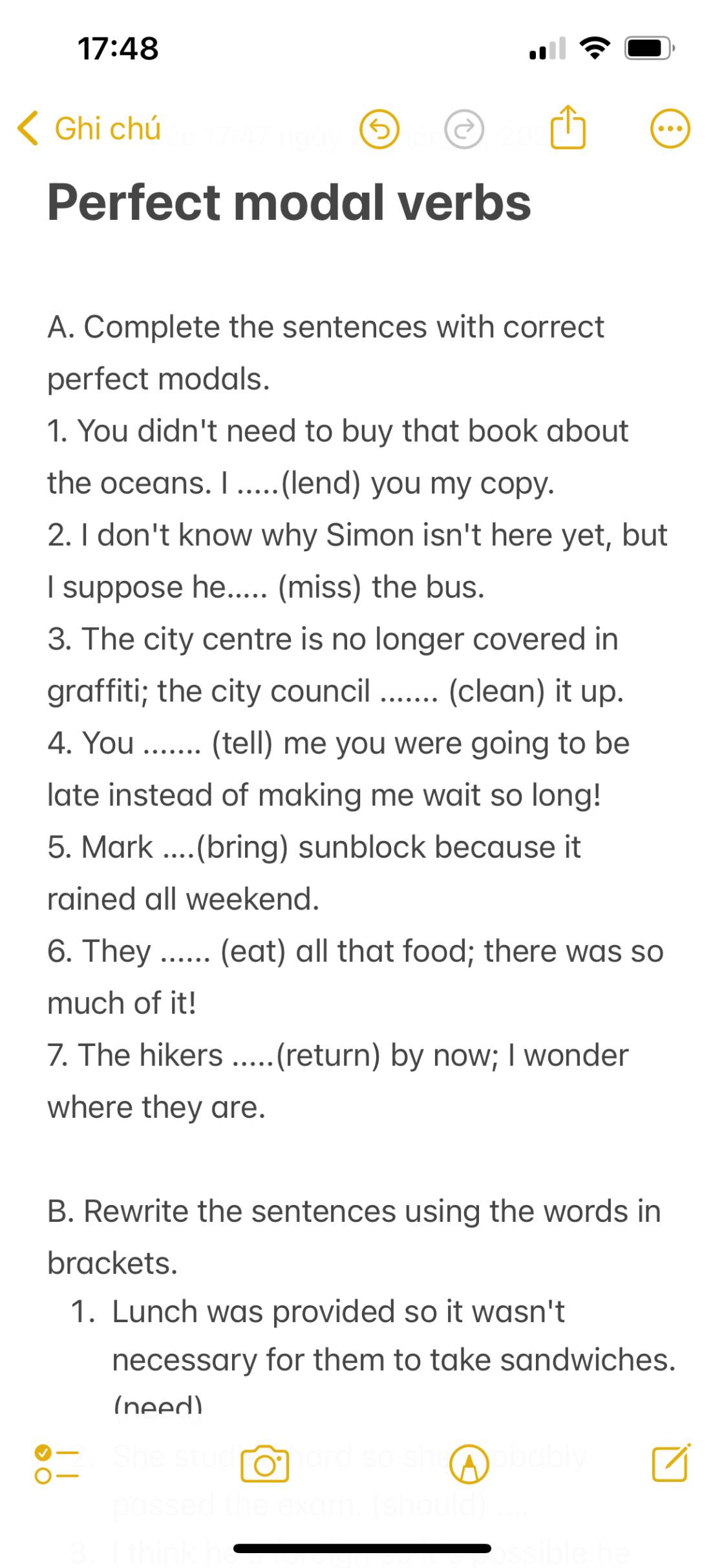
A. Complete the sentences with correct perfect modals.
1. You didn't need to buy that book about the oceans. I ..would have lent...(lend) you my copy.
2. I don't know why Simon isn't here yet, but I suppose he…might have missed.. (miss) the bus.
3. The city centre is no longer covered in graffiti; the city council ...must have cleaned.... (clean) it up.
4. You ....should have told... (tell) me you were going to be late instead of making me wait so long!
5. Mark …should have brought.(bring) sunblock because it rained all weekend.
6. They ...couldn't have eaten... (eat) all that food; there was so much of it!
7. The hikers ..should have returned...(return) by now; I wonder where they are.
PQ
22 tháng 5 2024
A.Complete the sentences with correct perfect modals:
1. You didn't need to buy that book about the oceans. I could have lent you my copy.
2. I don't know why Simon isn't here yet, but I suppose he must have missed the bus.
3. The city centre is no longer covered in graffiti; the city council must have cleaned it up.
4. You should have told me you were going to be late instead of making me wait so long!
5. Mark should have brought sunblock because it rained all weekend.
6. They must have eaten all that food; there was so much of it!
7. The hikers should have returned by now; I wonder where they are.
B. Rewrite the sentences using the words in brackets:
1. Lunch was provided so they didn't need to take sandwiches.
2. She studied hard so she should have passed the exam.
3. I think he's foreign so he might not have understood you.
4. John can't be in Rome - I saw him earlier.
5. You ought to have listened to my advice.
6. Why mightn't you introduce me to your friends?
SV
Sinh Viên NEU
CTVVIP
25 tháng 5 2024
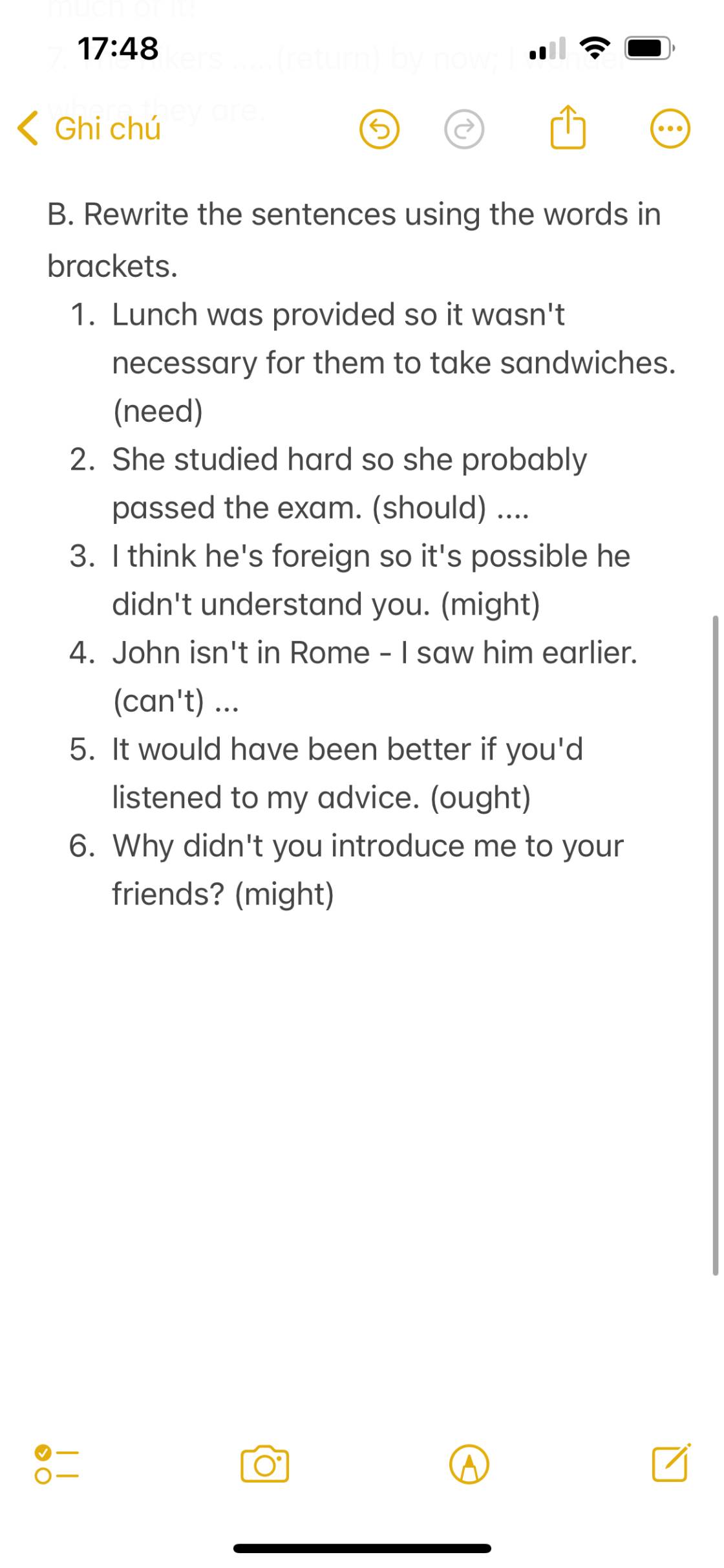
B. Rewrite the sentences using the words in brackets.
Lunch was provided so it wasn't necessary for them to take sandwiches. (need)
=> They needn't have taken sandwiches because it was provided
She studied hard so she probably passed the exam. (should) ....
=> She should have passed the exam because she studied hard
I think he's foreign so it's possible he didn't understand you. (might)
=> I think he mightn't have understood you because he's foreign
John isn't in Rome - I saw him earlier. (can't) ...
=> John can't have been in Rome because I saw him earlier
It would have been better if you'd listened to my advice. (ought)
=> You ought to have listened to my advice
Why didn't you introduce me to your friends? (might)
=> Why mightn't have you introduced me to your friends?
Marry said life in the city is better than life in the country.