
giả sử có một quần xa sv gồm cac sv sau cây xanh sâu chim mèo chột rắn châu chấu vi khuẩn , xây dựng 3 chỗi thức ăn có trong quần xa sv nêu trên
K
Khách
Hãy nhập câu hỏi của bạn vào đây, nếu là tài khoản VIP, bạn sẽ được ưu tiên trả lời.

BN
7 tháng 5 2024
Unless they knew you, they wouldn't share any valuable information.
PQ
7 tháng 5 2024
Unless they knew you, they wouldn't give you some precious information.
-> Trong câu này If...not = Unless nhé.
H
5 tháng 1 2025
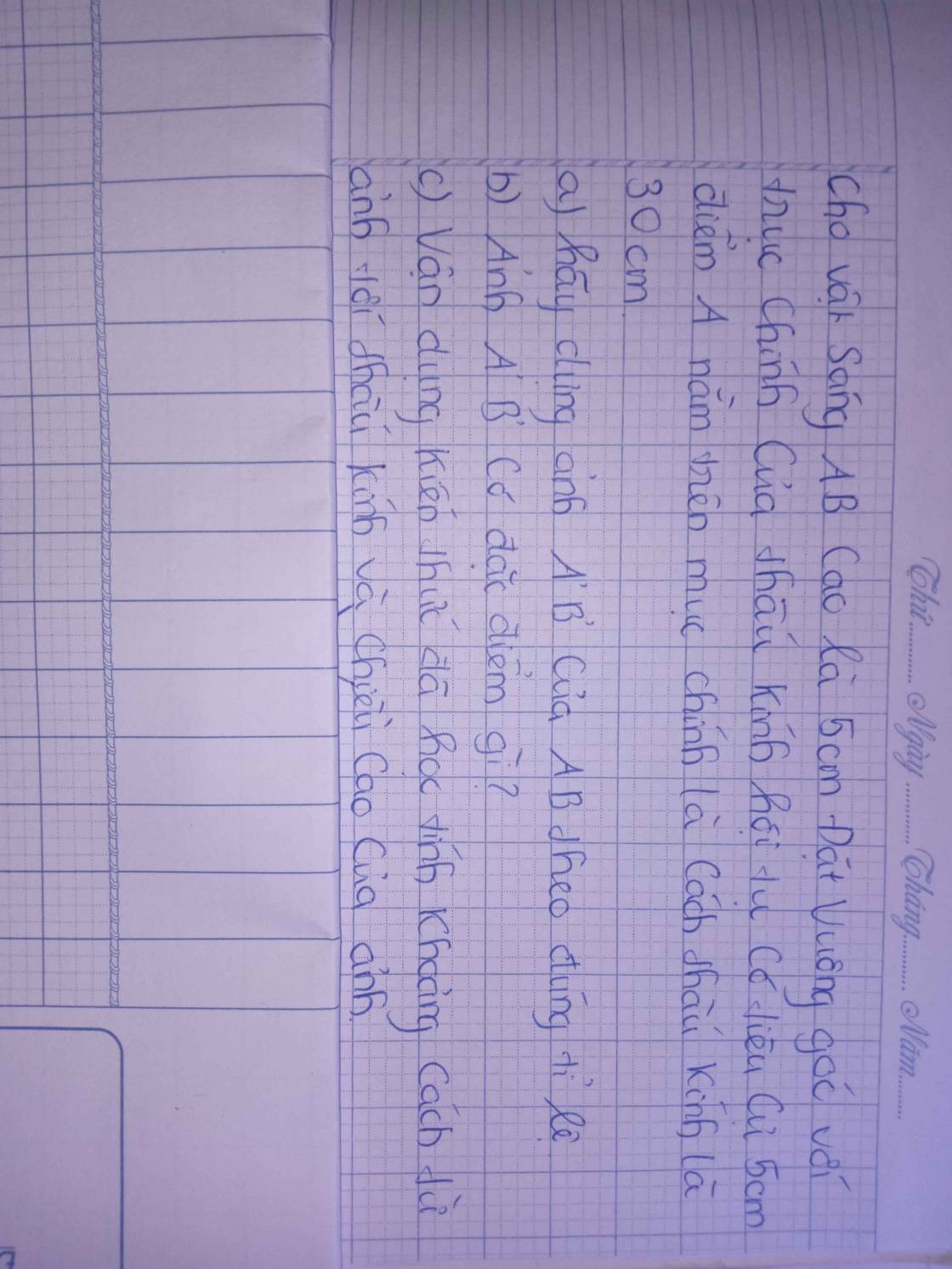
a) Dựng ảnh ↓
b) đặc điểm của ảnh : Ảnh thật, ngược chiều và nhỏ hơn vật
c)
\(tacó\Delta OAB\) ~\(\Delta O\char"0391 \text{`B`}\)
=> \(\frac{OA`}{OA}\) =\(\frac{A`B`}{AB}\) (1)
\(\Delta=FAB\) ~\(\Delta FOI\)
=>\(\frac{OF}{OA`-OF}=\frac{OI}{AB}\) (2)
Từ (1) và (2), ta có:
\(\frac{1}{OA}+\frac{1}{OA`}=\frac{1}{OF}\)
<=>\(\frac{1}{30}+\frac{1}{OA`}=\frac15\)
=> OA' = 6 cm
\(\Rightarrow A`B`=\frac{OA`}{OA}\times AB=\frac{6}{30}\times5=1\) cm
Vậy khoảng cách từ quang tâm O đến ảnh là 6 cm
chiều cao của ảnh là 1 cm
NL
Nguyễn Lê Phước Thịnh
CTVHS
7 tháng 5 2024
a: Xét tứ giác BCEF có \(\widehat{BFC}=\widehat{BEC}=90^0\)
nên BCEF là tứ giác nội tiếp
7 tháng 5 2024
Transistor gồm ba lớp bán dẫn ghép với nhau hình thành hai mỗi tiếp giáp P- N, nếu ghép theo thứ tự PNP ta được transistor thuận, nếu ghép theo thứ tự NPN ta được transistor ngược. Về cấu tạo, transistor tương đương với hai diode đấu ngược chiều nhau.
PT
1
7 tháng 5 2024
ĐKXĐ: \(x\ge2\)
\(\sqrt{4x-8}-\sqrt{x-2}=2\)
\(\Leftrightarrow\sqrt{4\left(x-2\right)}-\sqrt{x-2}=2\)
\(\Leftrightarrow2\sqrt{x-2}-\sqrt{x-2}=2\)
\(\Leftrightarrow\sqrt{x-2}=2\)
\(\Leftrightarrow x-2=4\)
\(\Leftrightarrow x=6\) (thỏa mãn)
PQ
8 tháng 5 2024
Tham khảo nha:
I strongly agree that the use of plastic shopping bags should be banned. Plastic bags pose a significant threat to the environment due to their non-biodegradable nature. They contribute to pollution in our oceans, harm wildlife, and clog up landfills. Banning plastic bags would be a crucial step towards reducing environmental damage and promoting sustainability.
Firstly, plastic bags take hundreds of years to decompose, leading to a buildup of waste in our environment. This accumulation not only affects the aesthetic appeal of our surroundings but also has serious ecological consequences. Marine animals often mistake plastic bags for food, leading to ingestion and death. By banning plastic bags, we can help mitigate these harmful effects and protect marine life.
Furthermore, banning plastic bags encourages the adoption of reusable alternatives, such as cloth or canvas bags. These alternatives are more durable and can be used multiple times, significantly reducing waste. Additionally, reusable bags can be stylish and customizable, encouraging individuals to make environmentally conscious choices.
Some argue that banning plastic bags may inconvenience consumers or businesses. However, the long-term benefits far outweigh any short-term inconveniences. Many countries and cities have successfully implemented plastic bag bans, demonstrating that viable alternatives exist and that the transition is feasible.
In conclusion, banning plastic shopping bags is a necessary and responsible action to protect our environment. By doing so, we can reduce pollution, conserve resources, and safeguard ecosystems for future generations. It is imperative that we prioritize sustainability and take proactive measures to address the pressing issue of plastic pollution.