
Cho A=4a(a+b)(a+1)(a+b+1)+`b^2 `
CMR A là số chính phương
K
Khách
Hãy nhập câu hỏi của bạn vào đây, nếu là tài khoản VIP, bạn sẽ được ưu tiên trả lời.
VD
1

16 tháng 1 2024
1. " is this your umbrella?" Linda asked.
→ Linda asked ___if this was my umbrella______________________________
2. “do you open the door,” Anne said.
→ Anne told us ___to open the door______________________________
3. “Did you come to her party?” Sam said to them.
→ Sam asked her (they chứ nhỉ) if they had come to her party__________________________
4. " have you been to the moon ?" Sunny asked her daughter.
→ Sunny asked her daughter _if she had been to the moon_____________________
5. “does your sister like this red carpet,” she said.
→ She asked me __if my sister liked this red carpet________________________________
6. Naomi said: “have they helped you ?”
→ Naomi asked me__if they had helped me_________________________________
7. " do you know that?" Kai asked me.
→ Kai wanted to know ___if I knew that_________________________
8. “Does your mother want a new jacket for her birthday,” she said.
→ She asked me ___if my mother wanted a new jacket for her birthday______________________________
9. “Have you forgotten to turn on the light.” Jimmy said.
→ Jimmy asked his brother __if he had forgotten to turn on the light_________________________
10. “Do you go home to cook a meal.” Lan said.
→ Lan told me _______if I went home to cook a meal___________________________
16 tháng 1 2024
a.
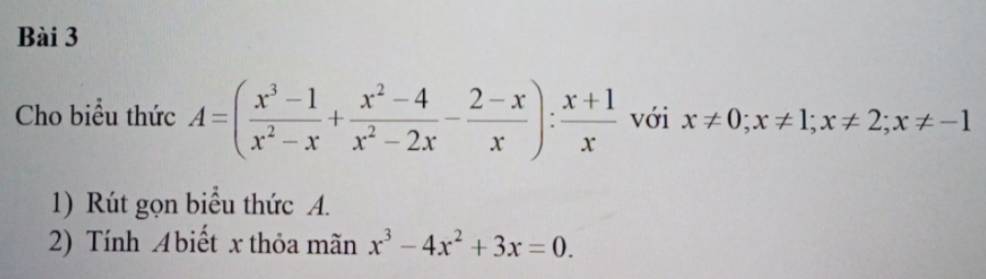
\(A=\left(\dfrac{\left(x-1\right)\left(x^2+x+1\right)}{x\left(x-1\right)}+\dfrac{\left(x-2\right)\left(x+2\right)}{x\left(x-2\right)}+\dfrac{x-2}{x}\right):\dfrac{x+1}{x}\)
\(=\left(\dfrac{x^2+x+1}{x}+\dfrac{x+2}{x}+\dfrac{x-2}{x}\right):\dfrac{x+1}{x}\)
\(=\left(\dfrac{x^2+3x+1}{x}\right).\dfrac{x}{x+1}\)
\(=\dfrac{x^2+3x+1}{x+1}\)
2.
\(x^3-4x^3+3x=0\Leftrightarrow x\left(x^2-4x+3\right)=0\)
\(\Leftrightarrow x\left(x-1\right)\left(x-3\right)=0\)
\(\Rightarrow\left[{}\begin{matrix}x=0\left(loại\right)\\x=1\left(loại\right)\\x=3\end{matrix}\right.\)
Với \(x=3\Rightarrow A=\dfrac{3^2+3.3+1}{3+1}=\dfrac{19}{4}\)
16 tháng 1 2024
\(2CuO+C\xrightarrow[]{t^0}2Cu+CO_2\\ 2Fe_2O_3+3C\xrightarrow[]{t^0}4Fe+3CO_2\\ 2Al_2O_3+3C\xrightarrow[]{t^0}4Al+3CO_2\\ CO_2+CaO\rightarrow CaCO_3\\ CaO+H_2O\rightarrow Ca\left(OH\right)_2\\ Ca\left(OH\right)_2+2Al+2H_2O\rightarrow Ca\left(AlO_2\right)_2+3H_2\\ CaCO_3+2HCl\rightarrow CaCl_2+CO_2+H_2O\\ Fe+HCl\rightarrow FeCl_2+H_2\\ 2Al+6HCl\rightarrow2AlCl_3+3H_2\\ Ca\left(OH\right)_2+2HCl\rightarrow CaCl_2+2H_2O\\ Ca\left(AlO_2\right)_2+2HCl+2H_2O\rightarrow2Al\left(OH\right)_3+CaCl_2\\ Al\left(OH\right)_3+3HCl\rightarrow AlCl_3+3H_2O\\ 2Cu+O_2\xrightarrow[t^0]{}2CuO\)
AK
1
16 tháng 1 2024
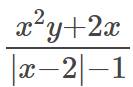
ĐKXĐ: \(\left|x-2\right|-1\ne0\)
\(\Rightarrow\left|x-2\right|\ne1\)
\(\Rightarrow\left\{{}\begin{matrix}x-2\ne1\\x-2\ne-1\end{matrix}\right.\)
\(\Rightarrow\left\{{}\begin{matrix}x\ne3\\x\ne1\end{matrix}\right.\)

P
16 tháng 1 2024
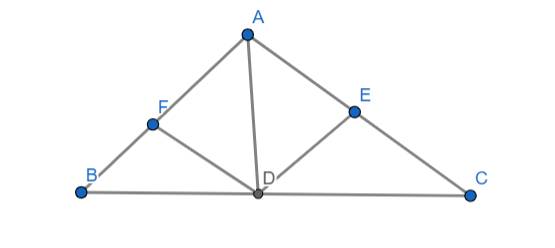
a) Ta có:
\(DF//AC\left(gt\right)\) (1)
\(DE//AB\left(gt\right)\) (2)
Từ (1) và (2) ⇒ AEDF là hình bình hành (3)
Mà AD là phân giác của góc FAE (4)
Từ (3) và (4) ⇒ AEDF là hình thoi
b) Xét hai tam giác CDE và CBA có:
\(\widehat{ACB}\) chung
\(\widehat{CED}=\widehat{CAB}\) (đồng vị vì DE//AB)
\(\Rightarrow\Delta CDE\sim\Delta CBA\left(g.g\right)\)
\(\Rightarrow\dfrac{DE}{AB}=\dfrac{CE}{AC}\Rightarrow DE\cdot AC=CE\cdot AB\)
Do: AEDF là hình thoi nên: DE = AE = AF
\(\Rightarrow AF\cdot AC=\left(AC-AE\right)\cdot AB\)
\(\Rightarrow\left(AB-BF\right)\cdot AC=AC\cdot AB-AE\cdot AB\)
\(\Rightarrow AB\cdot AC-BF\cdot AC=AC\cdot AB-AE\cdot AB\)
\(\Rightarrow BF\cdot AC=AE\cdot AB\)
\(\Rightarrow AF\cdot AB=BF\cdot AC\left(đpcm\right)\)

P
16 tháng 1 2024
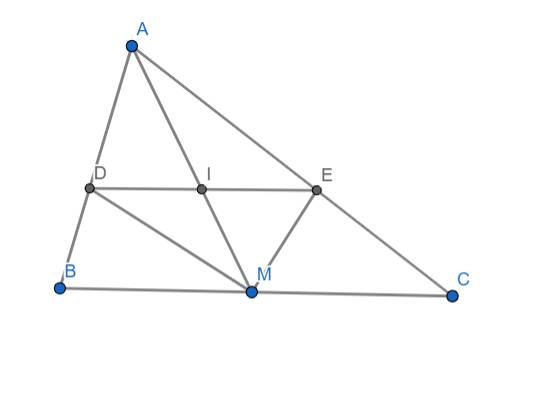
a) Ta có ME là tia phân giác của góc AMC nên:
\(\dfrac{AM}{AE}=\dfrac{MC}{CE}\Rightarrow\dfrac{AM}{MC}=\dfrac{AE}{CE}\) (1)
MD là tia phân giác của góc AMB nên:
\(\dfrac{AM}{AD}=\dfrac{BM}{BD}\Rightarrow\dfrac{AM}{BM}=\dfrac{AM}{CM}=\dfrac{AD}{BD}\) (vì M là trung điểm của BC nên BM = CM) (2)
Từ (1) và (2) ta có: \(\dfrac{AE}{CE}=\dfrac{AD}{BD}\Rightarrow DE//BC\)
b) Ta có: \(\Delta ADE\sim\Delta ABC\left(g.g\right)\) (vì có DE//BC)
\(\Rightarrow\dfrac{DE}{BC}=\dfrac{AE}{AC}\) (3)
\(\Delta AIE\sim\Delta AMC\left(g.g\right)\) (vì có IE//MC)
\(\Rightarrow\dfrac{IE}{MC}=\dfrac{AE}{AC}\) (4)
Từ (3) và (4) ta có: \(\dfrac{DE}{BC}=\dfrac{IE}{MC}\Rightarrow\dfrac{DE}{IE}=\dfrac{BC}{MC}=2\)
\(\Rightarrow DE=2IE\)
Hay I là trung điểm của DE
P
16 tháng 1 2024
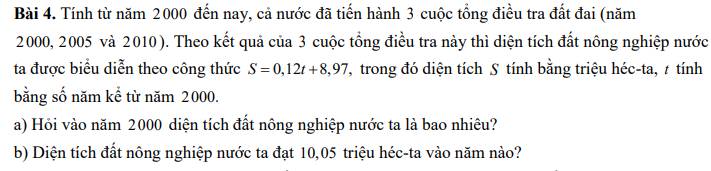
a) Vào năm 2000 diện tích đất nông nghiệp ở nước ta là:
Thay t = 0 vào \(S=0,12t+8,97\) (vì t được tính theo số năm kể từ năm 2000) ta có:
\(S=0,12\cdot0+8,97=8,97\left(tr.ha\right)\)
b) Diện tích đất nông nghiệp ở nước ra đạt 10,05 triệu hec-ta ta thay \(S=10,05\) ta có:
\(10,05=0,12t+8,97\)
\(\Leftrightarrow0,12t=10,05-8,97\)
\(\Leftrightarrow0,12t=1,08\)
\(\Leftrightarrow t=1,08:0,12\)
\(\Leftrightarrow t=9\)
Vậy năm nước ta đạt 10,05 triệu héc-ta là: \(2000+9=2009\)

P
16 tháng 1 2024
\(y=\left(m-3\right)+m^2\) có: \(\left\{{}\begin{matrix}a=m-3\\b=m^2\end{matrix}\right.\)
a) Để \(y=\left(m-3\right)x+m^2\) cắt \(y=3x+5\) thì:
\(a\ne a'\) hay:
\(m-3\ne3\)
\(\Leftrightarrow m\ne3+3\)
\(\Leftrightarrow m\ne6\)
b) Để \(y=\left(m-3\right)x+m^2\) song song với \(y=-2x+1\) thì
\(\left\{{}\begin{matrix}a=a'\\b\ne b'\end{matrix}\right.\) hay:
\(\left\{{}\begin{matrix}m-3=-2\\m^2\ne1\end{matrix}\right.\)
\(\Leftrightarrow\left\{{}\begin{matrix}m=-2+3\\m\ne\pm1\end{matrix}\right.\)
\(\Leftrightarrow\left\{{}\begin{matrix}m=1\\m\ne\pm1\end{matrix}\right.\) (ktm)
Vậy không có m thỏa mãn
c) Để \(y=\left(m-3\right)x+m^2\) trùng với \(y=-x+4\) thì
\(\left\{{}\begin{matrix}a=a'\\b=b'\end{matrix}\right.\) hay:
\(\left\{{}\begin{matrix}m-3=-1\\m^2=4\end{matrix}\right.\)
\(\Leftrightarrow\left\{{}\begin{matrix}m=-1+3\\m=\pm2\end{matrix}\right.\)
\(\Leftrightarrow\left\{{}\begin{matrix}m=2\\m=\pm2\end{matrix}\right.\Leftrightarrow m=2\)

P
16 tháng 1 2024
a) Đường thẳng \(y=ax+b\) song song với đường thẳng \(y=4x-3\)
Nên có \(a=4\) đường thẳng có dạng \(y=3x+b\left(b\ne-3\right)\)
Mà \(y=3x+b\) đi qua điểm \(I\left(\dfrac{1}{2};\dfrac{3}{4}\right)\) nên ta thay \(x=\dfrac{1}{2};y=\dfrac{3}{4}\) ta có:
\(\dfrac{3}{4}=3\cdot\dfrac{1}{2}+b\)
\(\Leftrightarrow\dfrac{3}{4}=\dfrac{3}{2}+b\)
\(\Leftrightarrow b=\dfrac{3}{4}-\dfrac{3}{2}\)
\(\Leftrightarrow b=-\dfrac{3}{4}\left(tm\right)\)
Vậy: \(y=4x-\dfrac{3}{4}\)
b) Đường thẳng \(y=ax+b\) có hệ số góc \(a=3\) nên có dạng \(y=3x+b\)
Do đường thẳng cắt trục tung tại điểm có tung độ là - 4 nên ta thay \(x=0;y=-4\)
\(-4=0\cdot3+b\)
\(\Leftrightarrow b=-4\)
Vậy: \(y=3x-4\)
\(A=4\left(a^2+a\right)\left[\left(a+b\right)^2+a+b\right]+b^2\)
\(=4a^2\left(a+b\right)^2+4a^2\left(a+b\right)+4a\left(a+b\right)^2+4a\left(a+b\right)+b^2\)
\(=4a^2\left(a+b\right)^2+4a\left(a+b\right)\left(a+b+1\right)+4a^2\left(a+b\right)+b^2\)
\(=4a^2\left(a+b\right)^2+4a^2\left(a+b+1\right)+4ab\left(a+b+1\right)+4a^2\left(a+b\right)+b^2\)
\(=4a^2\left[\left(a+b\right)^2+a+b+1+a+b\right]+4ab\left(a+b+1\right)+b^2\)
\(=4a^2\left[\left(a+b\right)^2+2\left(a+b\right)+1\right]+4ab\left(a+b+1\right)+b^2\)
\(=4a^2\left(a+b+1\right)^2+4ab\left(a+b+1\right)+b^2\)
\(=\left[2a\left(a+b+1\right)+b\right]^2\)