

K
Khách
Hãy nhập câu hỏi của bạn vào đây, nếu là tài khoản VIP, bạn sẽ được ưu tiên trả lời.

2 tháng 12 2023
I should go for a hike in the mountains if I have free time this weekend.
SV
Sinh Viên NEU
CTVVIP
3 tháng 12 2023
Should I have free time this weekend, I will go for a hike in the mountains
2 tháng 12 2023
Vietnam's ethnic diversity is a characteristic of the country's culture and society.
SV
Sinh Viên NEU
CTVVIP
3 tháng 12 2023
Ethnic diversity is a characteristic of the Vietnam's culture and society.

NL
Nguyễn Lê Phước Thịnh
CTVHS
24 tháng 9 2025
a: ΔABC vuông tại A
=>\(AB^2+AC^2=BC^2\)
=>\(BC^2=6^2+8^2=36+64=100=10^2\)
=>BC=10(cm)
ΔABC vuông tại A
mà AM là đường trung tuyến
nên \(AM=\frac{BC}{2}=\frac{10}{2}=5\left(\operatorname{cm}\right)\)
b: Xét tứ giác ADHE có \(\hat{ADH}=\hat{AEH}=\hat{DAE}=90^0\)
nên ADHE là hình chữ nhật
=>AH=DE
c: ADHE là hình chữ nhật
=>\(\hat{AED}=\hat{AHD}\)
mà \(\hat{AHD}=\hat{ABC}\left(=90^0-\hat{HAB}\right)\)
nên \(\hat{AED}=\hat{ABC}\)
Ta có: \(AM=\frac{BC}{2}\)
\(CM=\frac{BC}{2}\)
Do đó: MA=MC
=>ΔMAC cân tại M
=>\(\hat{MAC}=\hat{MCA}\)
\(\hat{MAC}+\hat{AED}=\hat{ABC}+\hat{ACB}=90^0\)
=>AM⊥DE
Ta có: ADHE là hình chữ nhật
=>HD//AE và HD=AE
HD//AE
=>HD//EF
Ta có: HD=AE
AE=EF
Do đó; HD=EF
Xét tứ giác DHFE có
DH//FE
DH=FE
Do đó: DHFE là hình bình hành
=>ED//FH
mà ED⊥AM
nên FH⊥AM
NT
Nguyễn Thị Thương Hoài
Giáo viên
VIP
2 tháng 12 2023
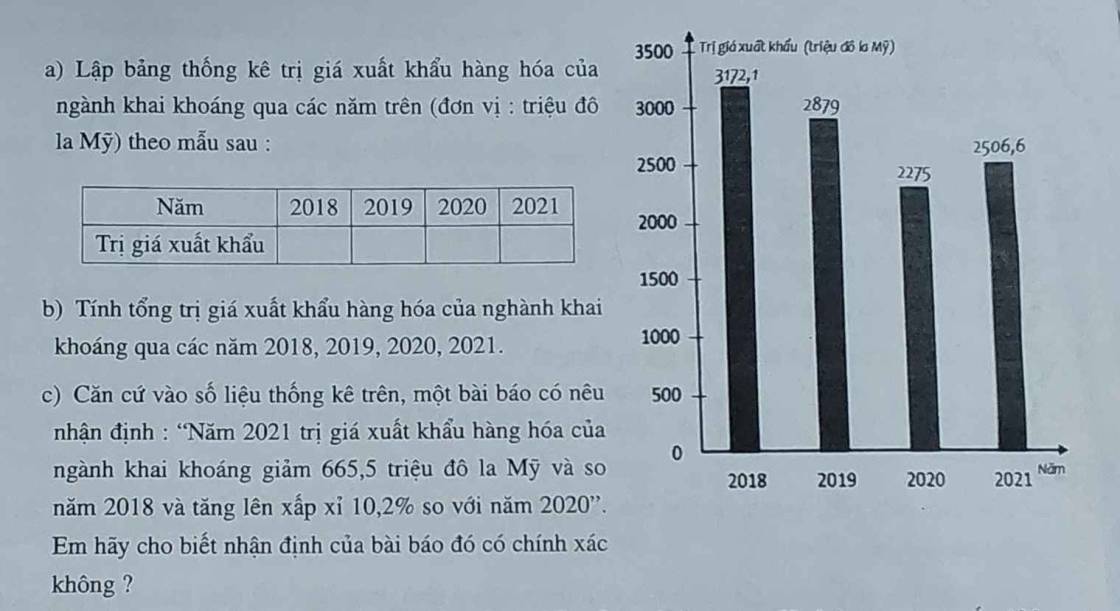
a, Trị giá xuất khẩu (triệu đô la Mỹ)
| Năm | 2018 | 2019 | 2020 | 2021 |
| Trị giá xuất khẩu | 3172,1 | 2879 | 2257 | 2506,6 |
b, Tổng giá trị xuất khẩu hàng hóa của ngành khai khoáng qua các năm 2018; 2019; 2020; 2021 là:
3172,1 + 2879 + 2275 + 2506,6 = 10832,7(đô)
c, So với năm 2018 thì năm 2021 giá trị xuất khẩu giảm:
3172,1 - 2506,6 = 665,5 (đô)
So với năm 2020 thì giá trị xuất khẩu năm 2021 tăng số phần trăm là:
(2506,6 - 2275):2257 x100 ≈ 10,2 %
Vậy nhận định của bài báo cáo là đúng

GN
GV Nguyễn Trần Thành Đạt
Giáo viên
2 tháng 12 2023
Tổng diện tích các tấm bìa của Bắc:
(43+1) : 2 x 22 = 484(cm2)
Tổng diện tích các tấm bìa của Bình:
(46+2):2 x 23= 552(cm2)
Tổng diện tích các tấm bìa của Bình lớn hơn tổng diện tích các tấm bìa của Bắc là:
552 - 484 = 68(cm2)
Đ.số: 68cm2
NL
Nguyễn Lê Phước Thịnh
CTVHS
24 tháng 9 2025
a: Sửa đề: \(A=\left(\frac{2+x}{2-x}-\frac{4x^2}{x^2-4}-\frac{2-x}{2+x}\right):\left(\frac{x^2-3x}{2x^2-x^3}\right)\)
ĐKXĐ: x∉{0;2;-2;3}
Ta có: \(A=\left(\frac{2+x}{2-x}-\frac{4x^2}{x^2-4}-\frac{2-x}{2+x}\right):\left(\frac{x^2-3x}{2x^2-x^3}\right)\)
\(=\left\lbrack\frac{-\left(x+2\right)}{x-2}-\frac{4x^2}{\left(x-2\right)\left(x+2\right)}+\frac{x-2}{x+2}\right\rbrack:\frac{x\left(x-3\right)}{x^2\cdot\left(2-x\right)}\)
\(=\frac{-\left(x+2\right)^2-4x^2+\left(x-2\right)^2}{\left(x-2\right)\left(x+2\right)}:\frac{x-3}{x\left(2-x\right)}\)
\(=\frac{-x^2-4x-4-4x^2+x^2-4x+4}{\left(x-2\right)\left(x+2\right)}\cdot\frac{-x\left(x-2\right)}{x-3}\)
\(=\frac{-4x^2-8x}{x+2}\cdot\frac{-x}{x-3}=\frac{-4x\left(x+2\right)}{x+2}\cdot\frac{-x}{x-3}=\frac{4x^2}{x-3}\)
b: Để A>0 thì \(\frac{4x^2}{x-3}>0\)
=>x-3>0
=>x>3
c: |x-7|=4
=>\(\left[\begin{array}{l}x-7=4\\ x-7=-4\end{array}\right.\Rightarrow\left[\begin{array}{l}x=11\left(nhận\right)\\ x=3\left(loại\right)\end{array}\right.\)
Thay x=11 vào A, ta được:
\(A=\frac{4\cdot11^2}{11-3}=\frac{4\cdot121}{8}=\frac{121}{2}\)
GN
GV Nguyễn Trần Thành Đạt
Giáo viên
2 tháng 12 2023
\(a,ĐKXĐ:\\ \left[{}\begin{matrix}x+1\ne0\\2x-6\ne0\end{matrix}\right.\Leftrightarrow\left[{}\begin{matrix}x\ne-1\\x\ne3\end{matrix}\right.\\ b,P=0\\ \Leftrightarrow\dfrac{3x^2+3x}{\left(x+1\right)\left(2x-6\right)}=0\\ \Leftrightarrow\dfrac{3x\left(x+1\right)}{3\left(x+1\right)\left(x-2\right)}=0\\ \Leftrightarrow\dfrac{x}{x-2}=0\\ \Leftrightarrow x=0\left(TM\right)\)
Vậy tại X=0 thì P=0
T
2 tháng 12 2023
a) Để P xác định thì: \(\left[{}\begin{matrix}x+1\ne0\\2x-6\ne0\end{matrix}\right.\Leftrightarrow\left[{}\begin{matrix}x\ne-1\\x\ne3\end{matrix}\right.\)
b) \(P=\dfrac{3x^2+3x}{\left(x+1\right)\left(2x-6\right)}=\dfrac{3x\left(x+1\right)}{\left(x+1\right)\left(2x-6\right)}=\dfrac{3x}{2x-6}\)
Để \(P=0\) thì: \(\dfrac{3x}{2x-6}=0\)
\(\Leftrightarrow3x=0\)
\(\Leftrightarrow x=0\left(tm\right)\)
T
2 tháng 12 2023
ĐKXĐ: \(x\ne0;x\ne\pm1\)
\(\dfrac{3}{2x^2+2x}+\dfrac{2x-1}{x^2-1}-\dfrac{2}{x}\)
\(=\dfrac{3}{2x\left(x+1\right)}+\dfrac{2x-1}{\left(x-1\right)\left(x+1\right)}-\dfrac{4}{2x}\)
\(=\dfrac{3\left(x-1\right)}{2x\left(x-1\right)\left(x+1\right)}+\dfrac{2x\left(2x-1\right)}{2x\left(x-1\right)\left(x+1\right)}-\dfrac{4\left(x^2-1\right)}{2x\left(x-1\right)\left(x+1\right)}\)
\(=\dfrac{3x-3+4x^2-2x-4x^2+4}{2x\left(x-1\right)\left(x+1\right)}\)
\(=\dfrac{x+1}{2x\left(x-1\right)\left(x+1\right)}\)
\(=\dfrac{1}{2x\left(x-1\right)}\)
\(=\dfrac{1}{2x^2-2x}\)
Lời giải:
a.
Áp dụng định lý Pitago:
$BC=\sqrt{AB^2+AC^2}=\sqrt{6^2+8^2}=10$ (cm)
$AM=\frac{BC}{2}=10:2=5$ (cm) - tính chất đường trung tuyến ứng với cạnh huyền thì bằng 1/2 cạnh huyền.
b.
Tứ giác $ADHE$ có 3 góc vuông $\widehat{A}=\widehat{D}=\widehat{E}$ nên $ADHE$ là hcn
$\Rightarrow AH=DE$.
c.
Do $AM=\frac{BC}{2}=BM$ nên tam giác $MAB$ cân tại $M$
$\Rightarrow \widehat{B}=\widehat{MAB}$
Gọi $T$ là giao điểm $HF$ và $AM$
Do $F$ đối xứng với $A$ qua $E$ nên $E$ là trung điểm của $AF$.
Tam giác $HAF$ có đường cao $HE$ đồng thời là trung tuyến nên $HAF$ cân tại $H$
$\Rightarrow HE$ cũng là đường phân giác.
$\Rightarrow \widehat{H_1}=\widehat{H_2}$
$\Rightarrow \widehat{AHT}=\widehat{H_1}+\widehat{H_2}=2\widehat{H_1}=2\widehat{A_2}=\widehat{A_2}+\widehat{A_2}$
$=\widehat{A_2}+90^0-\widehat{B}=\widehat{A_2}+90^0-\widehat{MAB}=\widehat{A_2}+90^0-(\widehat{A_1}+\widehat{A_2})$
$=90^0-\widehat{A_1}$
Vậy: $\widehat{AHT}+\widehat{A_1}=90^0$
$\Rightarrow \widehat{HTA}=180^0-(\widehat{AHT}+\widehat{A_1})=180^0-90^0=90^0$
$\Rightarrow AM\perp HF$
Hình vẽ: