
 Dựa vào bảng trên hãy vẽ biểu đồ thể hiện
K
Khách
Hãy nhập câu hỏi của bạn vào đây, nếu là tài khoản VIP, bạn sẽ được ưu tiên trả lời.
MT
0

S
subjects
CTVHS
27 tháng 1 2024
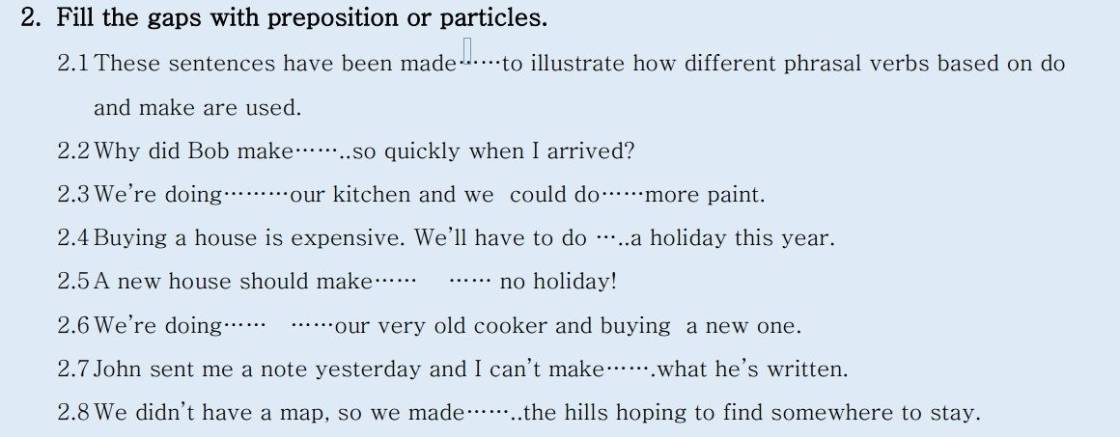
1. These sentences have been made up to illustrate how different phrasal verbs based on "do" and "make" are used.
2. Why did Bob make off so quickly when I arrived?
3. We're doing up our kitchen, and we could do with more paint.
4. Buying a house is expensive. We'll have to do without a holiday this year.
5. A new house should make for no holiday.
6. We're doing away with our very old cooker and buying a new one.
7. John sent me a note yesterday, and I can't make out what he's written.
8. We didn't have a map, so we made for the hills hoping to find somewhere to stay.
HT
0
DN
1
19 tháng 11 2023
Ta có a: 6 dư 5
=> a= 6k+5 với k ϵ N
có: a2 = (6k+5)2 = 36k2+ 60k+25
vì 36k2⋮6 ; 60k⋮6 ; 25 : 6 dư 1
=> a2 chia 6 dư 1
DN
1
AH
Akai Haruma
Giáo viên
22 tháng 11 2023
Lời giải:
Vì $a$ chia $6$ dư $5$ nên đặt $a=6k+5$ với $k$ nguyên.
Khi đó: $a^2=(6k+5)^2=36k^2+25+60k=6(6k^2+10k+4)+1$ chia $6$ dư $1$
18 tháng 11 2023
1 We've them out of run
2 If you across it come tell me
3 you should look up it
4 My friend came up with it
5 so don't throw them away
SV
Sinh Viên NEU
CTVVIP
18 tháng 11 2023
1 run our of them
2 if you come across it
3 you should look it up
4 my friend came up with it
5 so don't throw them away
T
17 tháng 11 2023
\(\dfrac{4x+2}{4x-2}+\dfrac{3-6x}{6x-6}\left(dkxd:x\ne\dfrac{1}{2};x\ne1\right)\)
\(=\dfrac{2\left(2x+1\right)}{2\left(2x-1\right)}+\dfrac{3\left(1-2x\right)}{6\left(x-1\right)}\)
\(=\dfrac{2x+1}{2x-1}+\dfrac{1-2x}{2\left(x-1\right)}\)
\(=\dfrac{2x+1}{2x-1}+\dfrac{1-2x}{2x-2}\)
\(=\dfrac{\left(2x+1\right)\left(2x-2\right)}{\left(2x-1\right)\left(2x-2\right)}+\dfrac{\left(1-2x\right)\left(2x-1\right)}{\left(2x-1\right)\left(2x-2\right)}\)
\(=\dfrac{4x^2-2x-2}{\left(2x-1\right)\left(2x-2\right)}+\dfrac{-4x^2+4x-1}{\left(2x-1\right)\left(2x-2\right)}\)
\(=\dfrac{4x^2-2x-2-4x^2+4x-1}{\left(2x-1\right)\left(2x-2\right)}\)
\(=\dfrac{2x-3}{\left(2x-1\right)\left(2x-2\right)}\)
\(=\dfrac{2x-3}{4x^2-6x+2}\)
TT
1
NT
Nguyễn Thị Thương Hoài
Giáo viên
VIP
17 tháng 11 2023
\(x\) + 2y = 8
\(2y\) = 8 - \(x\)
y = \(\dfrac{8-x}{2}\)
y = - \(\dfrac{x}{2}\) + 4
Thay y = - \(\dfrac{x}{2}\) + 4 vào biểu thức B = \(xy\) ta có:
B = \(x\).(-\(\dfrac{x}{2}\) + 4)
B = - \(\dfrac{x^2}{2}\) + 4\(x\)
B = -\(\dfrac{1}{2}\). (\(x^2\) - 8\(x\) + 16) + 8
B = - \(\dfrac{1}{2}\).(\(x\) - 4)2 + 8
Vì \(\dfrac{1}{2}\).(\(x\) - 4)2 ≥ 0 ⇒ - \(\dfrac{1}{2}\).(\(x\) - 4)2 ≤ 0 ⇒ - \(\dfrac{1}{2}\).(\(x\) - 4)2 + 8 ≤ 8
Dấu bằng xảy ra khi: \(x\) - 4 = 0 ⇒ \(x\) = 4; thay \(x\) = 4 vào biểu thức:
y = - \(\dfrac{1}{2}\) \(x\)+ 4 ta có y = - \(\dfrac{4}{2}\) + 4 = 2
Vậy giá trị lớn nhất của B là 8 xảy ra khi \(x\) = 4; y = 2