
Cho hình bình hành ABCD(AB>BC), tia phân giác của góc D cắt AB tại E và tia phân giác của góc B cắt CD tại F.
a) chứng minh 2 tam giác ADE và CBF là những tấm giác cân bằng nhau
b)tứ giác DEBF là hình j, tại sao
Hãy nhập câu hỏi của bạn vào đây, nếu là tài khoản VIP, bạn sẽ được ưu tiên trả lời.

a. 3xy( 4x + y - \(\dfrac{4}{3}\) )
b. 2x2( 3x + 1 )
c. (2x + 3 )( x - y )
d. xy( 1 - x )( x - 1 )
e. 6( 2x + 1 )( x + y )
Câu 1:
a: \(2x^2\left(x^2+3x+\frac12\right)\)
\(=2x^2\cdot x^2+2x^2\cdot3x+2x^2\cdot\frac12\)
\(=2x^4+6x^3+x^2\)
b: \(\left(x+1\right)\left(x-2\right)-\left(x+2\right)^2\)
\(=x^2-2x+x-2-\left(x^2+4x+4\right)\)
\(=x^2-x-2-x^2-4x-4=-5x-6\)
c: \(\left(3x+1\right)^2-9x\left(x+3\right)\)
\(=9x^2+6x+1-9x^2-27x\)
=-21x+1
Câu 2:
a: \(\left(x+2\right)^2-x\left(x+4\right)+10\)
\(=x^2+4x+4-x^2-4x+10\)
=4+10
=14
=>Biểu thức này không phụ thuộc vào biến
b: \(\left(x+3\right)\left(4x-1\right)-\left(2x+1\right)^2-7x+3\)
\(=4x^2-x+12x-3-4x^2-4x-1-7x+3\)
=12x-x-7x-4x-3-1+3
=x(12-1-7-4)-1
=-1
=>Biểu thức này không phụ thuộc vào biến
Câu 3:
a: \(\left(x+2\right)^2-x\left(x-1\right)=2\)
=>\(x^2+4x+4-x^2+x=2\)
=>5x+4=2
=>5x=2-4=-2
=>\(x=-\frac25\)
b: \(\left(2x+1\right)^2-\left(x+1\right)\left(4x-3\right)=-3\)
=>\(4x^2+4x+1-\left(4x^2-3x+4x-3\right)=-3\)
=>\(4x^2+4x+1-\left(4x^2+x-3\right)=-3\)
=>\(4x^2+4x+1-4x^2-x+3=-3\)
=>3x+4=-3
=>3x=-7
=>\(x=-\frac73\)
Câu 5
Xét ΔADC và ΔBCD có
AD=BC
DC chung
AC=BD
Do đó: ΔADC=ΔBCD
=>\(\hat{ACD}=\hat{BDC}\)
=>\(\hat{OCD}=\hat{ODC}\)
=>ΔOCD cân tại O
=>OC=OD
Ta có: OC+OA=AC
OD+OB=BD
mà OC=OD và AC=BD
nên OA=OB
\(x^4-4x^3-2x^2-3x+2\)
\(\Leftrightarrow x^4+x^3-5x^3+x^2-5x^2+2x^2-5x+2x+2\)
\(\Leftrightarrow x^4+x^3+x^2-5x^3-5x^2-5x+2x^2+2x+2\)
\(\Leftrightarrow x^2\left(x^2+x+1\right)-5x\left(x^2+x+1\right)+2\left(x^2+x+1\right)\)
\(\Leftrightarrow\left(x^2-5x+2\right)\left(x^2+x+1\right)\)
Xin tick ạ !!!
\(a,\dfrac{7-3x}{12}+\dfrac{3}{4}=2\left(x-2\right)+\dfrac{5\left(5-2x\right)}{6}\\ \Leftrightarrow\dfrac{7-3x+9-12.2\left(x-2\right)-2.5\left(5-2x\right)}{12}=0\\ \Leftrightarrow7-3x+9-24x+48-50+20x=0\\ \Leftrightarrow-7x=-14\\ \Leftrightarrow x=2\)
\(b,\dfrac{1}{x-1}+\dfrac{2}{x^2+x+1}=\dfrac{3x^2}{x^3-1}\left(dk:x\ne1\right)\\ \Leftrightarrow\dfrac{x^2+x+1+2\left(x-1\right)-3x^2}{x^3-1}=0\\ \Leftrightarrow x^2+x+1+2x-2-3x^2=0\\ \Leftrightarrow-2x^2+3x-1=0\\ \Leftrightarrow-2x^2+2x+x-1=0\\ \Leftrightarrow-2x\left(x-1\right)+\left(x-1\right)=0\\ \Leftrightarrow\left(-2x+1\right)\left(x-1\right)=0\)
\(\Leftrightarrow\left[{}\begin{matrix}x-1=0\\-2x+1=0\end{matrix}\right.\)
\(\Leftrightarrow\left[{}\begin{matrix}x=1\left(ktm\right)\\x=-\dfrac{1}{2}\left(tm\right)\end{matrix}\right.\)
\(c,\dfrac{7x-2}{3}-2x< 5-\dfrac{x-2}{4}\\ \Leftrightarrow\dfrac{4\left(7x-2\right)-12.2x-5.12+3\left(x-2\right)}{12}< 0\\ \Leftrightarrow28x-8-24x-60+3x-6< 0\\ \Leftrightarrow7x< 74\\ \Leftrightarrow x=\dfrac{74}{7}\)
\(c,2x-x\left(3x+1\right)< 15-3x\left(x+2\right)\\ \Leftrightarrow2x-3x^2-x-15+3x^2+6x< 0\\ \Leftrightarrow7x< 15\\ \Leftrightarrow x< \dfrac{15}{7}\)
\(a,dkxd:x\ne\dfrac{1}{3};x\ne-\dfrac{1}{3}\)
\(b,P=\left(\dfrac{3x}{1-3x}+\dfrac{2x}{3x+1}\right):\dfrac{6x^2+10x}{1-6x+9x^2}\)
\(=\dfrac{3x\left(3x+1\right)+2x\left(1-3x\right)}{\left(1-3x\right)\left(1+3x\right)}.\dfrac{\left(1-3x\right)^2}{6x^2+10x}\)
\(=\dfrac{9x^2+3x+2x-6x^2}{1+3x}.\dfrac{1-3x}{2x\left(3x+5\right)}\)
\(=\dfrac{3x^2+5x}{1+3x}.\dfrac{1-3x}{2x\left(3x+5\right)}\)
\(=\dfrac{x\left(3x+5\right)}{1+3x}.\dfrac{1-3x}{2x\left(3x+5\right)}\)
\(=\dfrac{1-3x}{2\left(1+3x\right)}\)
\(c,x=\dfrac{1}{3}\Rightarrow P=\dfrac{1-3.\dfrac{1}{3}}{2\left(1+3.\dfrac{1}{3}\right)}=\dfrac{1-1}{2.2}=0\)
x² - 6x + 9 - y²
= (x² - 6x + 9) - y²
= (x - 3)² - y²
= (x - 3 - y)(x - 3 + y)
= (x - y - 3)(x + y - 3)
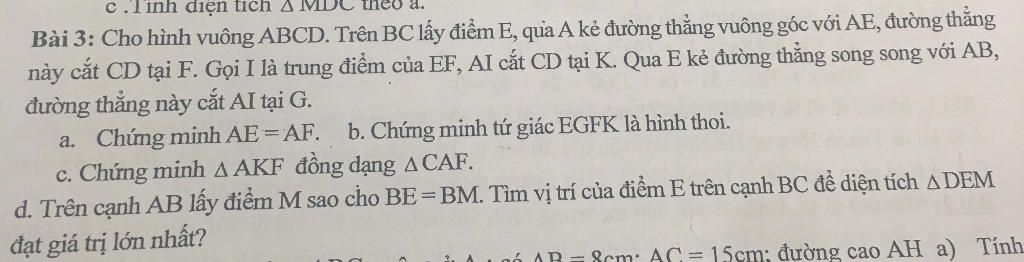
A B C D E F K I G
a/
\(\widehat{BAE}+\widehat{DAE}=\widehat{BAD}=90^o\)
\(\widehat{DAF}+\widehat{DAE}=\widehat{FAE}=90^o\)
\(\Rightarrow\widehat{BAE}=\widehat{DAF}\) (cùng phụ với \(\widehat{DAE}\) ) (1)
\(AB=AD\) (cạnh hình vuông) (2)
Xét tg vuông ABE và tg vuông ADF
Từ (1) và (2) => tg ABE = tg ADF (Hai tg vuông có cạnh góc vuông và góc nhọn tương ứng bằng nhau)
\(\Rightarrow AE=AF\) (đpcm)
b/
AE=AF (cmt) => tg AEF là tg cân tại A
I là trung điểm EF (gt)
=> AI là trung tuyến thuộc EF => \(AI\perp EF\) (tring tg cân đường trung tuyến xp từ đỉnh tg cân đồng thời là đường cao)
\(\Rightarrow GK\perp EF\) (3)
Xét tg EIG và tg FIK có
\(\widehat{EIG}=\widehat{FIK}\) (góc đối đỉnh) (4)
EG//AB; AB//CD => EG//CD => EG//FK (5)
\(\Rightarrow\widehat{GEI}=\widehat{KFI}\) (góc so le trong) (6)
\(IE=IF\) (gt) (7)
Từ (4) (6) (7) => tg EIG = tg FIK (g.c.g) => EG = FK (8)
Từ (5) và (8) => EGFK là hình bình hành (Tứ giác có cặp cạnh đối // và = nhau là hình bình hành) (9)
Từ (3) và (9) => EGFK là hình thoi (hình bình hành có hai đường chéo vuông góc với nhau là hình thoi) (đpcm)
c/
Ta có tg AEF cân tại A (cmt); AI là trung tuyến thuộc EF (cmt)
=> AI là phân giác \(\widehat{EAF}\) (trong tg cân đường trung tuyến xp từ đỉnh tg cân đồng thời là đường phân giác của góc ở đỉnh)
Mà \(\widehat{EAF}=90^o\)
\(\Rightarrow\widehat{FAK}=45^o\)
\(\widehat{ACF}=45^o\)
\(\Rightarrow\widehat{FAK}=\widehat{ACF}=45^o\)
Xét tg AKF và tg ACF có
\(\widehat{FAK}=\widehat{ACF}=45^o\)
\(\widehat{AFC}\) chung
=> tg AKF đồng dạng với tg CAF (g.g.g)
d/
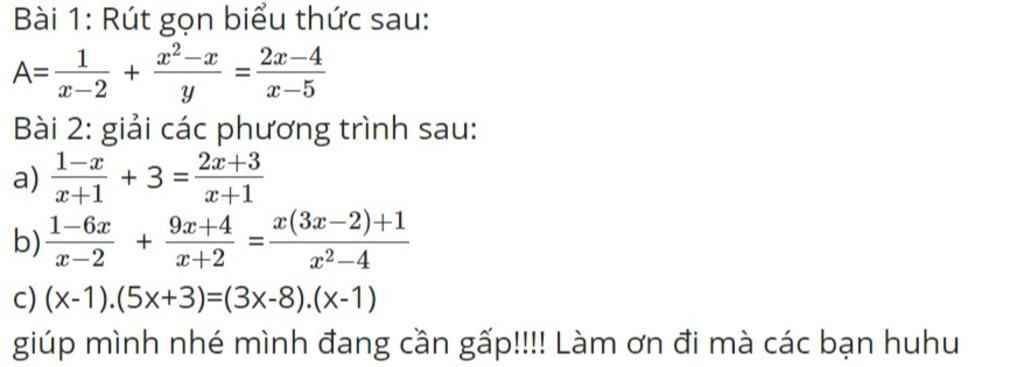
\(A=\dfrac{1}{x-2}+\dfrac{x^2-x}{x^2-7x+10}=\dfrac{2x-4}{x-5}\left(dk:x\ne2;x\ne5\right)\)
\(=\dfrac{1}{x-2}+\dfrac{x^2-x}{\left(x-2\right)\left(x-5\right)}=\dfrac{2x-4}{x-5}\)
\(=\dfrac{x-5+x^2-x-\left(2x-4\right)\left(x-2\right)}{\left(x-2\right)\left(x-5\right)}=0\)
\(\Leftrightarrow-5+x^2-2x^2+4x+4x-8=0\\ \Leftrightarrow-x^2+8x-13=0\)
\(\Leftrightarrow\left[{}\begin{matrix}x=4+\sqrt{3}\\x=4-\sqrt{3}\end{matrix}\right.\) \(\left(tmdk\right)\)
Vậy ...
Bài `2`
\(a,\dfrac{1-x}{x+1}+3=\dfrac{2x+3}{x+1}\left(\text{đ}k\text{x}\text{đ}:x\ne-1\right)\\ \Leftrightarrow\dfrac{1-x}{x+1}+\dfrac{3\left(x-1\right)}{x+1}=\dfrac{2x+3}{x+1}\\ \Rightarrow1-x+3\left(x-1\right)=2x+3\\ \Leftrightarrow1-x+3x-3-2x-3=0\\ \Leftrightarrow-5=0\left(v\text{ô}.l\text{ý}\right)\)
\(b,\dfrac{1-6x}{x-2}+\dfrac{9x+4}{x+2}=\dfrac{x\left(3x-2\right)+1}{x^2-4}\)
\(\text{đ}k\text{x}\text{đ}\left\{{}\begin{matrix}x-2\ne0\\x+2\ne0\end{matrix}\right.\Leftrightarrow\left\{{}\begin{matrix}x\ne2\\x\ne-2\end{matrix}\right.\)
\(\dfrac{1-6x}{x-2}+\dfrac{9x+4}{x+2}=\dfrac{x\left(3x-2\right)+1}{x^2-4}\)
\(\Leftrightarrow\dfrac{1-6x}{x-2}+\dfrac{9x+4}{x+2}=\dfrac{x\left(3x-2\right)+1}{\left(x-2\right)\left(x+2\right)}\\ \Leftrightarrow\dfrac{\left(1-6x\right)\left(x+2\right)}{\left(x-2\right)\left(x+2\right)}+\dfrac{\left(9x+4\right)\left(x-2\right)}{\left(x+2\right)\left(x-2\right)}=\dfrac{x\left(3x-2\right)+1}{\left(x-2\right)\left(x+2\right)}\\ \Rightarrow\left(1-6x\right)\left(x+2\right)+\left(9x+4\right)\left(x-2\right)=x\left(3x-2\right)+1\\ \Leftrightarrow x+2-6x^2-12x+9x^2-18x+4x-8-3x^2+2x-1=0\\ \Leftrightarrow-31x+1=0\\ \Leftrightarrow x=\dfrac{1}{31}\)
\(c,\left(x-1\right)\left(5x+3\right)=\left(3x-8\right)\left(x-1\right)\\ \Leftrightarrow\left(x-1\right)\left(5x+3\right)-\left(3x-8\right)\left(x-1\right)=0\\ \Leftrightarrow\left(x-1\right)\left(5x+3-3x+8\right)=0\\ \Leftrightarrow\left(x-1\right)\left(2x+11\right)=0\\ \Leftrightarrow\left[{}\begin{matrix}x-1=0\\2x+11=0\end{matrix}\right.\\ \Leftrightarrow\left[{}\begin{matrix}x=1\\2x=-11\end{matrix}\right.\\ \Leftrightarrow\left[{}\begin{matrix}x=1\\x=-\dfrac{11}{2}\end{matrix}\right.\)


a) Ta thấy \(\widehat{AED}=\widehat{EDC}=\widehat{ADE}\) nên tam giác ADE cân tại A. Hoàn toàn tương tự thì tam giác CBF cân tại C.
Mặt khác, do tứ giác ABCD là hình bình hành nên \(\widehat{A}=\widehat{C},\widehat{B}=\widehat{D}\). Do đó \(\dfrac{\widehat{B}}{2}=\dfrac{\widehat{D}}{2}\) hay \(\widehat{CBF}=\widehat{ADE}\). Kết hợp với \(\widehat{A}=\widehat{C}\) thì suy ra \(\Delta ADE~\Delta CBF\left(g.g\right)\). Lại có \(\dfrac{AD}{CB}=1\) (do tứ giác ABCD là hình bình hành), suy ra \(\Delta ADE=\Delta CBF\) (2 tam giác đồng dạng có tỉ số đồng dạng bằng 1 thì 2 tam giác đó bằng nhau), ta có đpcm.
b) Ta thấy \(\widehat{AED}=\widehat{ADE}=\widehat{CBF}=\widehat{ABF}\) nên DE//BF. Lại có BE//DF (do tứ giác ABCD là hình bình hành) nên tứ giác DEBF cũng là hình bình hành (các cặp cạnh đối song song).
A B C D E F
a/
Xét tg ADE có
\(\widehat{ADE}=\widehat{CDE}\) (gt) (1)
\(\widehat{AED}=\widehat{CDE}\) (góc so le trong) (1)
Từ (1) và (2) => \(\widehat{ADE}=\widehat{AED}\) => tg ADE là tg cân tại A
=> AD=AE (3)
Xét tg CBF có
\(\widehat{CBF}=\widehat{ABF}\) (gt) (4)
\(\widehat{CFB}=\widehat{ABF}\) (góc so le trong) (5)
Từ (4) và (5) => \(\widehat{CBF}=\widehat{CFB}\) => tg CBF cân tại C
=> CB=CF (6)
Ta có
AD=CB (cạnh đối hình bình hành) (7)
Từ (3) (6) (7) => AD=AE=CB=CF
Mà \(\widehat{DAE}=\widehat{BCF}\) (góc đối hình bình hành)
=> tg ADE = tg CBF (c.g.c)
=> tg ADE và tg CBF là những tg cân bằng nhau
b/
tg ADE = tg CBF (cmt) \(\Rightarrow\widehat{BFC}=\widehat{ADE}\)
Mà \(\widehat{EDC}=\widehat{ADE}\) (gt)
\(\Rightarrow\widehat{BFC}=\widehat{EDC}\) Hai góc này ở vị trí đồng vị => DE//BF (8)
Ta có
AB//CD (cạnh đối hình bình hành) => BE//DF (9)
Từ (8) (9) => DEBF là hình bình hành (tứ giác có các cặp cạnh đối // với nhau là hình bình hành)