
giúp mk đang cần gấp
K
Khách
Hãy nhập câu hỏi của bạn vào đây, nếu là tài khoản VIP, bạn sẽ được ưu tiên trả lời.

Những câu hỏi liên quan
NT
3 tháng 8 2021
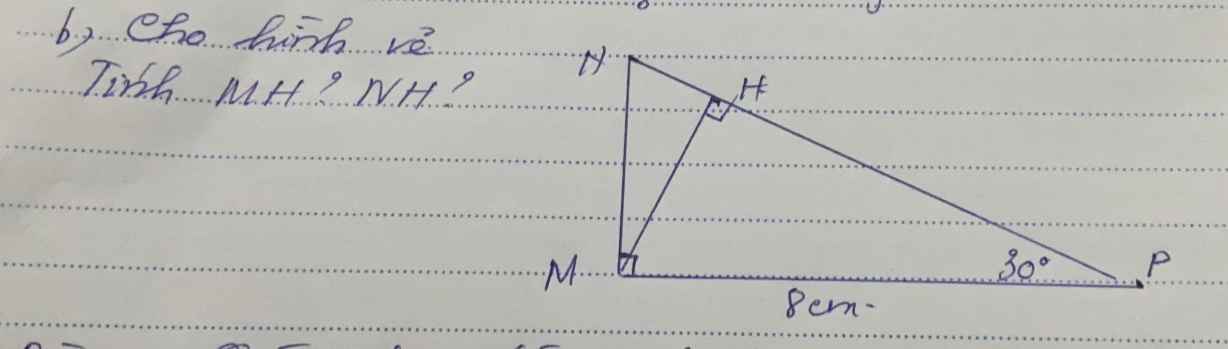
Áp dụng tỉ số lượng giác của góc nhọn vào \(\Delta MHP\), ta có:
\(\cos30\text{°}=\dfrac{MH}{8}\Rightarrow MH=8.\cos30\text{°}=4\sqrt{3}\left(cm\right)\)
Mặt khác, \(\text{∠}MNP=90\text{°}-30\text{°}=60\text{°}\)
Áp dụng tí số lượng giác của góc nhọn vào \(\Delta MHN\), ta có:
\(\tan60\text{°}=\dfrac{4\sqrt{3}}{NH}\Rightarrow NH=4\sqrt{3}.\tan60\text{°}=12\left(cm\right)\)
AH
Akai Haruma
Giáo viên
3 tháng 8 2021
Lời giải:
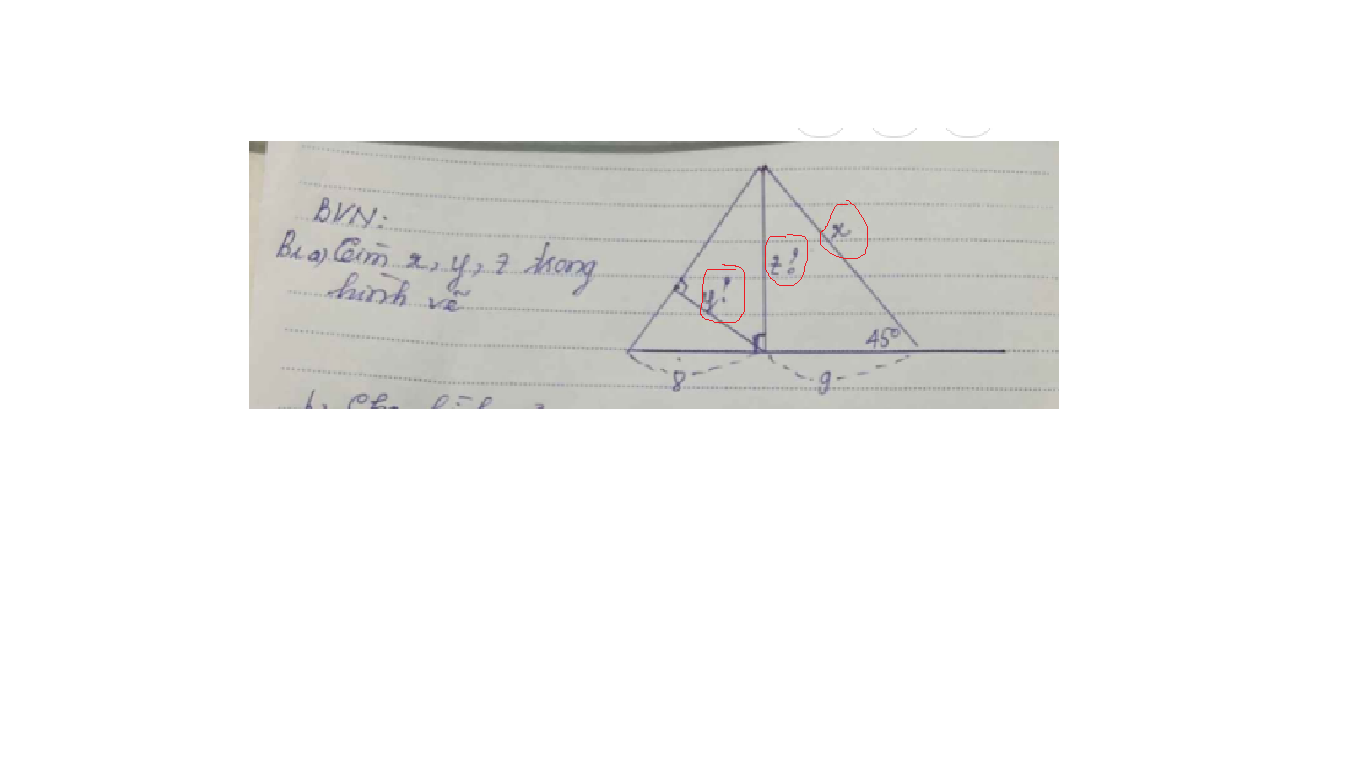
Xét tam giác $MHP$ vuông tại $H$ thì:
$\frac{MH}{MP}=\sin P=\sin 30^0=\frac{1}{2}$
$\Rightarrow MH=\frac{MP}{2}=4$ (cm)
Theo định lý Pitago:
$HP=\sqrt{MP^2-MH^2}=\sqrt{8^2-4^2}=4\sqrt{3}$
Theo hệ thức lượng trong tam giác vuông:
$MH^2=NH.HP$
$\Leftrightarrow 4^2=4\sqrt{3}.NH$
$\Leftrightarrow NH=\frac{4\sqrt{3}}{3}$ (cm)



LH
13 tháng 6 2021
1.supernatural
2.spirit
3.candles
4. theme
5.evil
6.graveyard
7.costumes
DT
Đỗ Thanh Hải
CTVVIP
13 tháng 6 2021
1 supernatural
2 spirit
3 candles
4 theme
5 evil
6 graveyard
7 costumes


PS

0

NL
Nguyễn Lê Phước Thịnh
CTVHS
17 tháng 4
Bài 2; Để hệ có nghiệm duy nhất thì \(\frac{1}{m}<>\frac{m}{1}\)
=>\(m^2<>1\)
=>m∉{1;-1}
Bài 1:
a: KHi a=2 thì hệ sẽ trở thành:
\(\begin{cases}\left(2+1\right)x-y=2+1\\ x+\left(2-1\right)y=2\end{cases}\Rightarrow\begin{cases}3x-y=3\\ x+y=2\end{cases}\)
=>3x-y+x+y=3+2
=>4x=5
=>\(x=\frac54\)
x+y=2
=>\(y=2-x=2-\frac54=\frac34\)
b: Để hệ có nghiệm duy nhất thì \(\frac{a+1}{1}<>\frac{-1}{a-1}\)
=>\(a^2-1<>-1\)
=>\(a^2<>0\)
=>a<>0
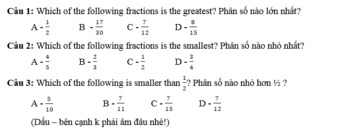
dạng 1
bài 2: đkxđ: \(x \ge 0; x \neq 1\)
a. thay x = 25 vào biểu thức A ta được:
\(A=\frac{\sqrt{25}-2}{\sqrt{25}+1}=\frac{5-2}{5+1}=\frac36=\frac12\)
b. \(B = \frac{1}{\sqrt{x}+1} - \frac{\sqrt{x}}{1-\sqrt{x}} + \frac{2}{x-1}\)
\(B = \frac{1}{\sqrt{x}+1} + \frac{\sqrt{x}}{\sqrt{x}-1} + \frac{2}{(\sqrt{x}-1)(\sqrt{x}+1)}\)
\(B = \frac{\sqrt{x}-1 + \sqrt{x}(\sqrt{x}+1) + 2}{(\sqrt{x}-1)(\sqrt{x}+1)}\)
\(B = \frac{\sqrt{x}-1 + x + \sqrt{x} + 2}{(\sqrt{x}-1)(\sqrt{x}+1)}\)
\(B = \frac{x + 2\sqrt{x} + 1}{(\sqrt{x}-1)(\sqrt{x}+1)}\)
\(B = \frac{(\sqrt{x}+1)^2}{(\sqrt{x}-1)(\sqrt{x}+1)}\)
\(B = \frac{\sqrt{x}+1}{\sqrt{x}-1} \quad (\text{đpcm})\)
\(c.P=A:B\)
\(P = \frac{\sqrt{x}-2}{\sqrt{x}+1} : \frac{\sqrt{x}+1}{\sqrt{x}-1}\)
\(P = \frac{\sqrt{x}-2}{\sqrt{x}+1} \cdot \frac{\sqrt{x}-1}{\sqrt{x}+1}\)
\(P = \frac{(\sqrt{x}-2)(\sqrt{x}-1)}{(\sqrt{x}+1)^2}\)
vì P = 5/2 nên: \(\frac{(\sqrt{x}-2)(\sqrt{x}-1)}{(\sqrt{x}+1)^2} = \frac{5}{2}\)
\(\Rightarrow2(\sqrt{x}-2)(\sqrt{x}-1)=5(\sqrt{x}+1)^2\)
\(\Rightarrow2(x-3\sqrt{x}+2)=5(x+2\sqrt{x}+1)\)
\(\Rightarrow2x-6\sqrt{x}+4=5x+10\sqrt{x}+5\)
\(\Rightarrow3x+16\sqrt{x}+1=0\)
vì \(x \ge 0 \Rightarrow \sqrt{x} \ge 0\) nên \(3x+16\sqrt{x}+1\ge1>0\quad\left(\forall x\ge0\right)\)
⇒ phương trình trên vô nghiệm
vậy không có giá trị x thoả P = 5/2
bài 3: đkxđ: \(x \ge 0; x \neq 1; x \neq 4\)
thay x = 9 vào biểu thức A ta được: \(A=\frac{4\sqrt{9}}{\sqrt{9}-1}=\frac{4 \cdot3}{3 - 1}=\frac{12}{2}=6\)
vậy khi x = 9 thì A = 6
\(B = \frac{\sqrt{x}+5}{\sqrt{x}+2} - \frac{1}{2-\sqrt{x}} + \frac{12}{x-4}\)
\(B = \frac{\sqrt{x}+5}{\sqrt{x}+2} + \frac{1}{\sqrt{x}-2} + \frac{12}{(\sqrt{x}-2)(\sqrt{x}+2)}\)
\(B = \frac{(\sqrt{x}+5)(\sqrt{x}-2) + 1 \cdot (\sqrt{x}+2) + 12}{(\sqrt{x}-2)(\sqrt{x}+2)}\)
\(B = \frac{x - 2\sqrt{x} + 5\sqrt{x} - 10 + \sqrt{x} + 2 + 12}{(\sqrt{x}-2)(\sqrt{x}+2)}\)
\(B = \frac{x + 4\sqrt{x} + 4}{(\sqrt{x}-2)(\sqrt{x}+2)}\)
\(B = \frac{(\sqrt{x}+2)^2}{(\sqrt{x}-2)(\sqrt{x}+2)}\)
\(B = \frac{\sqrt{x}+2}{\sqrt{x}-2}\)
c. ta có \(P = A \cdot B\)
\(\Rightarrow P=\frac{4\sqrt{x}}{\sqrt{x}-1}\cdot\frac{\sqrt{x}+2}{\sqrt{x}-2}\)
\(\Rightarrow P=\frac{4\sqrt{x}(\sqrt{x}+2)}{(\sqrt{x}-1)(\sqrt{x}-2)}\)
vì P = 2 nên \(\frac{4\sqrt{x}(\sqrt{x}+2)}{(\sqrt{x}-1)(\sqrt{x}-2)} = 2\)
\(\Rightarrow2\sqrt{x}(\sqrt{x}+2)=(\sqrt{x}-1)(\sqrt{x}-2)\)
\(\Rightarrow2x+4\sqrt{x}=x-3\sqrt{x}+2\)
\(\Rightarrow x+7\sqrt{x}-2=0\)
đặt \(t = \sqrt{x}\) với \(t\ge0,t\neq1,t\neq2\)
ta có: \(t^2 + 7t - 2 = 0\)
\(\Delta = 7^2 - 4 \cdot 1 \cdot (-2) = 49 + 8 = 57 > 0\)
\(\Rightarrow\begin{cases}t_1=\frac{-7 + \sqrt{57}}{2}\left(N\right)\\ t_2=\frac{-7 - \sqrt{57}}{2}<0\left(L\right)\end{cases}\)
\(x=t^2=\left(\frac{\sqrt{57}-7}{2}\right)^2=\frac{57 - 14\sqrt{57} + 49}{4}\)
\(=\frac{106 - 14\sqrt{57}}{4}=\frac{53 - 7\sqrt{57}}{2}\)
- Thay \(x = 25\) (thỏa mãn điều kiện \(x \geq 0; x \neq 1\)) vào biểu thức \(A\):
- Vì \(\sqrt{25} = 5\), ta có:
- Kết luận: Khi \(x = 25\) thì \(A = \frac{1}{2}\).
b) Chứng minh \(B = \frac{\sqrt{x}+1}{\sqrt{x}-1}\).\(A=\frac{\sqrt{25}-2}{\sqrt{25}+1}\)
\(A=\frac{5-2}{5+1}=\frac{3}{6}=\frac{1}{2}\)
- Ta có biểu thức:
- Đổi dấu ở mẫu số thứ hai để xuất hiện mẫu thức chung:
- Mẫu thức chung (MTC): \((\sqrt{x}-1)(\sqrt{x}+1)\). Quy đồng các phân thức:
- Khai triển và thu gọn tử số:
- Thay lại vào biểu thức \(B\) và rút gọn:
- Kết luận: Vậy \(B = \frac{\sqrt{x}+1}{\sqrt{x}-1}\) (Điều phải chứng minh).
c) Đặt \(P = A \cdot B\). Tìm các giá trị của \(x\) để \(P = \frac{5}{2}\).\(B=\frac{1}{\sqrt{x}+1}-\frac{\sqrt{x}}{1-\sqrt{x}}+\frac{2}{x-1}\)
\(B=\frac{1}{\sqrt{x}+1}+\frac{\sqrt{x}}{\sqrt{x}-1}+\frac{2}{(\sqrt{x}-1)(\sqrt{x}+1)}\)
\(B=\frac{\sqrt{x}-1+\sqrt{x}(\sqrt{x}+1)+2}{(\sqrt{x}-1)(\sqrt{x}+1)}\)
\(\text{T\ s}=\sqrt{x}-1+x+\sqrt{x}+2=x+2\sqrt{x}+1=(\sqrt{x}+1)^{2}\)
\(B=\frac{(\sqrt{x}+1)^{2}}{(\sqrt{x}-1)(\sqrt{x}+1)}=\frac{\sqrt{x}+1}{\sqrt{x}-1}\)
\(P=A\cdot B=\frac{\sqrt{x}-2}{\sqrt{x}+1}\cdot \frac{\sqrt{x}+1}{\sqrt{x}-1}=\frac{\sqrt{x}-2}{\sqrt{x}-1}\)
\(\frac{\sqrt{x}-2}{\sqrt{x}-1}=\frac{5}{2}\)
\(2(\sqrt{x}-2)=5(\sqrt{x}-1)\)
\(2\sqrt{x}-4=5\sqrt{x}-5\)
\(5\sqrt{x}-2\sqrt{x}=5-4\)
\(3\sqrt{x}=1\implies \sqrt{x}=\frac{1}{3}\)
\(x=\left(\frac{1}{3}\right)^{2}=\frac{1}{9}\)