
Cô cho em hỏi cách sử dụng của cấu trúc “to- infinitive” to -vo
K
Khách
Hãy nhập câu hỏi của bạn vào đây, nếu là tài khoản VIP, bạn sẽ được ưu tiên trả lời.

Những câu hỏi liên quan
TH
22 tháng 10 2021
S + be allowed + to V = s + permits Sb + to V Nêu cách sử dụng và cho vi dụ (có giải thích) cấu trúc câu tương đương ở trên.
Cách dùng: khi nói về việc cho phép làm gì.
S + be allowed + to V: S được cho phép làm gì (bị động)
S + permits Sb + to V: S cho phép ai làm gì.
VD:
I am allowed to go home late tonight by my parents: Tôi được bố mẹ cho phép về nhà muộn vào tối nay.
My parents permit me to go home late tonight: Bố mẹ cho phép tôi về nhà muộn vào tối nay.
H
8 tháng 7 2021
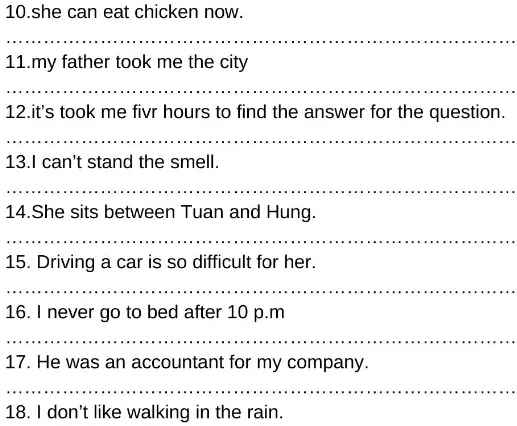
10 She is used to eating chicken now
11 My father used to take me to the city
12 It used to take me 5 hours to find the answer for the question
13 I don't get used to the smell
14 She is used to sitting between Tuan and Hung
15 She isn't used to driving a car
16 I don't get used to going to bed after 10p.m
17 He used to be an accountant....
18 I am not used to walking in the rain
NL
Nguyễn Lê Phước Thịnh
CTVHS
9 tháng 2 2023
1: vote
2: to fight
3: become
4: earn
5: to vote
6: become
QT
Quoc Tran Anh Le
CTVVIP
11 tháng 9 2023
1. Women were not allowed to vote until 1920.
(Phụ nữ không được phép bầu cử cho đến năm 1920.)
2. English women started to fight for gender equality in 1903.
(Phụ nữ Anh bắt đầu đấu tranh cho bình đẳng giới vào năm 1903.)
3. The government let women become combat soldiers in 1994.
(Chính phủ cho phép phụ nữ trở thành lính chiến vào năm 1994.)
4. Today women can earn the same pay as men.
(Ngày nay phụ nữ có thể kiếm được lương tương đương với nam giới.)
5. Victorian women campaigned for the right to vote.
(Phụ nữ Victoria vận động cho quyền bầu cử.)
6. In 1979, people in Britain saw a woman become Prime Minister for the first time.
(Năm 1979, người dân ở Anh lần đầu tiên chứng kiến một phụ nữ trở thành Thủ tướng.)
3 tháng 4 2018
Đặt 5 câu sử dụng cấu trúc Reported speech with if/whether
1.He asked if/whether he had to do it.
2.My friend asked me if/whether Caron had talked to Kevin
3.She asked him if/whether he was crazy
4.He asked her if/whether she would be at the party
5.She asked me if/whether I could meet her at the station
Đặt 5 câu sử dụng cấu trúc Wh words with V to infinitive
1.I don’t know what to do.
2.We must find out what to do next.
3.I don’t know where to turn for help.
4.Let us decide when to start.
5.We will have to find out how to reach the place.
VA
1
G
8 tháng 8 2017
1. To-infinitive / Infinitive with to
* Động từ nguyên mẫu có to được dùng làm:
- Chủ ngữ của câu:
To become a famous singer is her dream.- Bổ ngữ cho chủ ngữ:
What I like is to swim in the sea and then to lie on the warm sand.
- Tân ngữ của động từ:
It was late, so we decided to take a taxi home.
- Tân ngữ của tính từ:
I’m pleased to see you.
* Verb + to-inf
- afford: đáp ứng - agree: đồng ý - appear: hình như - arrange: sắp xếp - ask: yêu cầu- attempt: cố gắng, nỗ lực
- decide: quyết định
- expect: mong đợi- fail: thất bại, hỏng
- hope: hy vọng - intend: định - invite: mời- learn: học/ học cách
- manage: xoay sở, cố gắng
- offer: cho, tặng, đề nghị
- plan: lên kế họach
- pretend: giả vờ - promise: hứa - refuse: từ chối - seem: dường như - tell: bảo- tend: có khuynh hướng
- threaten: đe dọa - want: muốn- would like: muốn, thích -
* Trong các cấu trúc:
+ It takes / took + O + thời gian + to-inf
It takes Nam two hours to do that exercise.
+ Chỉ mục đích
I went to the post office to send a letter.
+ Bổ ngữ cho danh từ hoặc đại từ: S + V + Noun / pronoun + to-infI have some letters to write.
Is there anything to eat?
+ It + be + adj + to-inf: thật … để ..
It is interesting to study English + S + be + adj + to-inf I’m happy to receive your latter.+ S + V + too + adj / adv + to-inf
He is too short to play basket ball.
+ S + V + adj / adv + enough + to-inf
He isn’t tall enough to play basket ball.
+ S + find / think / believe + it + adj + to-inf
I find it difficult to learn English vocabulary.
+ Sau các từ nghi vấn: what, who, which, when, where, how,… (nhưng thường không dùng sau why)
I don’t know what to say.
* Note:
- allow / permit / advise / recommend + O + to-inf
Ex: She allowed me to use her pen.
- allow / permit / advise / recommend + V-ing
Ex: She didn’t allow smoking in her room
II. Bare infinitive / Infinitive without to
* V + O + bare inf
- let
- make
- had better
- would rather
Ex: He made me cry.
You had better take an aspirin.
Note
1. be + made + to-inf
Ex: I was made to cean my room.
2. Động từ help:
- help + V1 / to-inf
- help + O + V1 / to-inf
- help + O + with + N
Ex: My brother helped me do my homework.
My brother helped me to do my homework.
My brother helped me with my homework.
3. Động từ chỉ tri giác:
- Các động từ chỉ tri giác: hear, sound, smell, taste, feel, watch, notice, see, listen, find .. + O + V1 (chỉ sự hoàn tất của hành động – nghe hoặc thấy toàn bộ sự việc diễn ra)
Ex: I saw her get off the bus.- Các động từ chỉ tri giác: hear, sound, smell, taste, feel, watch, notice, see, listen, find .. + O + V-ing (chỉ sự việc đang diễn ra)
Ex: I smell something burning in the kitchen.
DT
Đỗ Thanh Hải
CTVVIP
31 tháng 8 2021
1. Viết lại những câu sau sử dụng cấu trúc "It + to be + adj + to V".
1.1. This question is easy to answer.
→This is easy to answer this question
1.2. His handwriting is difficult to read.
→It is difficult to read his handwriting
1.3. This house is convenient to live in.
→It is convenient to live in this house
1.4. That ladder is very safe to use.
→It is very safe to use that ladder
1.5. These films are very interesting to watch.
It is very interesting to watch these films
To-infinitive (to + V nguyên mẫu) thường được dùng để chỉ mục đích hoặc đi sau một số động từ, tính từ.
Ví dụ:
Công thức:
to + động từ nguyên mẫu
VD: to go, to eat, to study, to play.
đây nha bn