
tìm x biết
(x+x2+x3)x =21x
Hãy nhập câu hỏi của bạn vào đây, nếu là tài khoản VIP, bạn sẽ được ưu tiên trả lời.

a) Ta có: \(x^3+x^2+x+1=0\)
\(\Leftrightarrow x^2\left(x+1\right)+\left(x+1\right)=0\)
\(\Leftrightarrow\left(x+1\right)\left(x^2+1\right)=0\)
mà \(x^2+1>0\forall x\)
nên x+1=0
hay x=-1
Vậy: S={-1}
b) Ta có: \(x^3-6x^2+11x-6=0\)
\(\Leftrightarrow x^3-x^2-5x^2+5x+6x-6=0\)
\(\Leftrightarrow x^2\left(x-1\right)-5x\left(x-1\right)+6\left(x-1\right)=0\)
\(\Leftrightarrow\left(x-1\right)\left(x^2-5x+6\right)=0\)
\(\Leftrightarrow\left(x-1\right)\left(x-2\right)\left(x-3\right)=0\)
\(\Leftrightarrow\left[{}\begin{matrix}x-1=0\\x-2=0\\x-3=0\end{matrix}\right.\Leftrightarrow\left[{}\begin{matrix}x=1\\x=2\\x=3\end{matrix}\right.\)
Vậy: S={1;2;3}
c) Ta có: \(x^3-x^2-21x+45=0\)
\(\Leftrightarrow x^3-3x^2+2x^2-6x-15x+45=0\)
\(\Leftrightarrow x^2\left(x-3\right)+2x\left(x-3\right)-15\left(x-3\right)=0\)
\(\Leftrightarrow\left(x-3\right)\left(x^2+2x-15\right)=0\)
\(\Leftrightarrow\left(x-3\right)\left(x^2+5x-3x-15\right)=0\)
\(\Leftrightarrow\left(x-3\right)^2\cdot\left(x+5\right)=0\)
\(\Leftrightarrow\left[{}\begin{matrix}x-3=0\\x+5=0\end{matrix}\right.\Leftrightarrow\left[{}\begin{matrix}x=3\\x=-5\end{matrix}\right.\)
Vậy: S={3;-5}
d) Ta có: \(x^4+2x^3-4x^2-5x-6=0\)
\(\Leftrightarrow x^4-2x^3+4x^3-8x^2+4x^2-8x+3x-6=0\)
\(\Leftrightarrow x^3\left(x-2\right)+4x^2\cdot\left(x-2\right)+4x\left(x-2\right)+3\left(x-2\right)=0\)
\(\Leftrightarrow\left(x-2\right)\left(x^3+4x^2+4x+3\right)=0\)
\(\Leftrightarrow\left(x-2\right)\left(x^3+3x^2+x^2+4x+3\right)=0\)
\(\Leftrightarrow\left(x-2\right)\left[x^2\left(x+3\right)+\left(x+1\right)\left(x+3\right)\right]=0\)
\(\Leftrightarrow\left(x-2\right)\left(x+3\right)\left(x^2+x+1\right)=0\)
mà \(x^2+x+1>0\forall x\)
nên (x-2)(x+3)=0
\(\Leftrightarrow\left[{}\begin{matrix}x-2=0\\x+3=0\end{matrix}\right.\Leftrightarrow\left[{}\begin{matrix}x=2\\x=-3\end{matrix}\right.\)
Vậy: S={2;-3}
\(\left(x+3\right)\left(x^2-3x+9\right)=7x^3+21x\\ \Leftrightarrow x^3+27=7x^3+21x\\ \Leftrightarrow6x^3+21x-27=0\\ \Leftrightarrow\left(6x^3-6x^2\right)+\left(6x^2-6x\right)+\left(27x-27\right)=0\\ \Leftrightarrow\left(x-1\right)\left(6x^2+6x+27\right)=0\\ \Leftrightarrow\left[{}\begin{matrix}x-1=0\\6x^2+6x+27=0\end{matrix}\right.\\ \Leftrightarrow\left[{}\begin{matrix}x=1\\6\left(x^2+x+\dfrac{1}{4}\right)+\dfrac{51}{2}=0\end{matrix}\right.\\ \Leftrightarrow\left[{}\begin{matrix}x=1\\6\left(x+\dfrac{1}{2}\right)^2+\dfrac{51}{2}=0\left(vô.lí\right)\end{matrix}\right.\)
Vậy \(x=1\)
\(\Leftrightarrow x^3+27-7x^3-21x=0\)
\(\Leftrightarrow-6x^3-21x+27=0\)
\(\Leftrightarrow-6x^3+6x-27x+27=0\)
\(\Leftrightarrow-6x\left(x-1\right)\left(x+1\right)-27\left(x-1\right)=0\)
\(\Leftrightarrow\left(x-1\right)\left(6x^2+6x+27\right)=0\)
hay x=1
a: \(x^2-y^2-x-y\)
\(=\left(x-y\right)\left(x+y\right)-\left(x+y\right)\)
\(=\left(x+y\right)\left(x-y-1\right)\)
f: \(x^3-5x^2-5x+1\)
\(=\left(x+1\right)\left(x^2-x+1\right)-5x\left(x+1\right)\)
\(=\left(x+1\right)\left(x^2-6x+1\right)\)
Bài 1
a/ \(x\left(x^2+1\right)+2\left(x^2+1\right)=0\)
\(\Leftrightarrow\left(x+2\right)\left(x^2+1\right)=0\Rightarrow x=-2\)
b/
\(\Leftrightarrow x^3-6x^2+9x+5x^2-30x+45=0\)
\(\Leftrightarrow x\left(x-3\right)^2+5\left(x-3\right)^2=0\)
\(\Leftrightarrow\left(x+5\right)\left(x-3\right)^2=0\)
\(\Rightarrow\left[{}\begin{matrix}x=-5\\x=3\end{matrix}\right.\)
1.
c/ \(\Leftrightarrow x^3+2x^2+2x+x^2+2x+2=0\)
\(\Leftrightarrow x\left(x^2+2x+2\right)+x^2+2x+2=0\)
\(\Leftrightarrow\left(x+1\right)\left(x^2+2x+2\right)=0\)
\(\Leftrightarrow\left[{}\begin{matrix}x=-1\\x^2+2x+2=0\left(vn\right)\end{matrix}\right.\)
d/
\(\Leftrightarrow x^4+x^3-2x^2-x^3-x^2+2x+4x^2+4x-8=0\)
\(\Leftrightarrow x^2\left(x^2+x-2\right)-x\left(x^2+x-2\right)+4\left(x^2+x-2\right)=0\)
\(\Leftrightarrow\left(x^2-x+4\right)\left(x^2+x-2\right)=0\)
\(\Leftrightarrow\left[{}\begin{matrix}x^2-x+4=0\left(vn\right)\\x^2+x-2=0\end{matrix}\right.\)
\(\Rightarrow\left[{}\begin{matrix}x=1\\x=-2\end{matrix}\right.\)
a) x = -1. b) x = 4 hoặc x = 5.
c) x = ± 2 . d) x = 1 hoặc x = 2.
Chọn C
Ta có: P(x) + Q(x) = x3+ x2+ 2x-1
⇒ Q(x) = (x3 + x2 + 2x-1) - P(x)
= 2x3 + 4x2 - 8x - 3.
a: \(\Leftrightarrow x\left(x-5\right)\left(x+5\right)=0\)
\(\Leftrightarrow\left[{}\begin{matrix}x=0\\x=5\\x=-5\end{matrix}\right.\)
x 3 – x 2 – x + 1 = 0 ⇔ ( x 3 – x 2 ) – ( x – 1 ) = 0 ⇔ x 2 ( x – 1 ) – ( x – 1 ) = 0 ⇔ ( x 2 – 1 ) ( x – 1 ) = 0 ⇔ ( x – 1 ) ( x + 1 ) ( x – 1 ) = 0 ⇔ ( x – 1 ) 2 ( x + 1 ) = 0
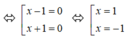
Vậy x = 1 hoặc x = -1
Đáp án cần chọn là: A
x 3 – x 2 – x + 1 = 0 ⇔ ( x 3 – x 2 ) – ( x – 1 ) = 0 ⇔ x 2 ( x – 1 ) – ( x – 1 ) = 0 ⇔ ( x 2 – 1 ) ( x – 1 ) = 0 ⇔ ( x – 1 ) ( x + 1 ) ( x – 1 ) = 0 ⇔ ( x – 1 ) 2 ( x + 1 ) = 0
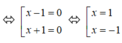
Vậy x = 1 hoặc x = -1
Đáp án cần chọn là: A
Bước 1: Chia 2 vế cho \(x\) (với \(x \neq 0\))
\(x + x^{2} + x^{3} = 21\)
Chuyển vế:
\(x^{3} + x^{2} + x - 21 = 0\)
Bước 2: Thử nghiệm nghiệm nguyên
Có thể thử nghiệm các ước của 21: ±1, ±3, ±7, ±21
→ Không có nghiệm nguyên.
Bước 3: Sử dụng phương pháp phân tích
Phương trình bậc 3:
\(x^{3} + x^{2} + x - 21 = 0\)
Không có nghiệm nguyên → dùng thử nghiệm gần đúng:
→ Nghiệm nằm giữa 2 và 3
Dùng xấp xỉ tuyến tính:
→ Nghiệm xấp xỉ \(x \approx 2.351\)
Bước 4: Không quên nghiệm đặc biệt
Chia vế cho \(x\) chỉ hợp lệ nếu \(x \neq 0\), kiểm tra \(x = 0\):
\(\left(\right. 0 + 0 + 0 \left.\right) \cdot 0 = 0 \neq 21 \cdot 0 = 0\)
Thật ra, 0 cũng là nghiệm, vì 0 = 0 → đúng. ✅
Kết luận
\(\boxed{x = 0 \&\text{nbsp};\text{ho}ặ\text{c}\&\text{nbsp};\text{x} \overset{ˊ}{\hat{\text{a}}} \text{p}\&\text{nbsp};\text{x}ỉ\&\text{nbsp}; x \approx 2.351}\)
x=6