K
Khách

Hãy nhập câu hỏi của bạn vào đây, nếu là tài khoản VIP, bạn sẽ được ưu tiên trả lời.

3 tháng 11 2025

Dịch nè :) ko bt có đúng ko ??? :B

Xin chào mọi người. Mình là Anna. Mình sống tại một thành phố lớn ở Berlin, Đức. Mình là học sinh trường Trung học Cơ sở. Mình học lớp 6A. Trường có 24 lớp với hơn 1000 học sinh. Trường có rất nhiều cây xanh cao lớn và hoa rực rỡ. Ngoài ra còn có một đài phun nước tuyệt đẹp. Vào giờ ra chơi, mình thường chơi bóng đá với bạn bè trong sân trường. Sau giờ học, mình sẽ tham gia câu lạc bộ tiếng Anh. Việc này rất dễ dàng với mình. Học tiếng Anh không khó. Mình rất yêu trường mình.

Xin chào mọi người. Mình là Anna. Mình sống ở một thành phố lớn ở Berlin, Đức. Mình là học sinh của một trường trung học cơ sở. Mình học lớp 6A. Trường có hai mươi bốn lớp với hơn một nghìn học sinh. Trong trường có rất nhiều cây xanh cao và những bông hoa đầy màu sắc. Còn có cả một đài phun nước rất đẹp nữa. Vào giờ ra chơi, mình thường chơi bóng đá với các bạn ở sân trường. Sau giờ học, mình sẽ tham gia câu lạc bộ tiếng Anh. Môn này đối với mình khá dễ. Học tiếng Anh không khó. Mình rất yêu ngôi trường của mình.

của bạn đây!!

ê ý là không ngờ nó dài mức zị luôn á

17 tháng 9 2017

bn ơi dịch ra hay làm như nào

17 tháng 9 2017

bn giới thệu lại i như mk và bằng t.a

24 tháng 11 2018

took part

24 tháng 11 2018

Linh is a good student in English at a Lower Secondary School. Three months ago,she(take part) took part in an English exam for grade 9 students and choose

12 tháng 8 2021

true / false

12 tháng 8 2021

1 F

2 F

3 T

4 T

14 tháng 3 2023

trả lời giúp mik với

14 tháng 3 2023

loading...    

Part II.Read a passage          Loan is a student at Phuoc Tan Secondary School. She  is in grade 7.  She goes to shool from Monday to Saturday. Classes always begin at seven o’clock and finish at a quarter past eleven. Today she has five classes : Literature, Math, History, Geography and Music. Loan is interested in Literature, so her favorite subject is Literature. She thinks Math is difficult, but fun. Loan’s last period is Music. In this class, she learns about a new...
Đọc tiếp

Part II.Read a passage

          Loan is a student at Phuoc Tan Secondary School. She  is in grade 7.  She goes to shool from Monday to Saturday. Classes always begin at seven o’clock and finish at a quarter past eleven. Today she has five classes : Literature, Math, History, Geography and Music. Loan is interested in Literature, so her favorite subject is Literature. She thinks Math is difficult, but fun. Loan’s last period is Music. In this class, she learns about a new song.

A.Write TRUE OR FALSE

45.Loan goes to school five day a week                                                   ……………..

46. She loves learning Literature                                                               ……………..

47. In this music, she learns about books and writes essays                  ………………..

B.Answer the questions

48. Which grade is Loan in ?

_____________________________________________________________

49. Does she think Math is different?

_____________________________________________________________

50. What subject does she have today?

____________________________________________________________________

3
12 tháng 11 2021

F

T

F

She  is in grade 7

Yes,...

Today she has five classes : Literature, Math, History, Geography and Music

A.Write TRUE OR FALSE

45. Loan goes to school five days a week                                        …FALSE…..

46. She loves learning Literature                                                     ……TRUE…..

47. In this music, she learns about books and writes essays           ……FALSE…..

B.Answer the questions

48. Which grade is Loan in?

→ She's in grade 7

49. Does she think Math is different?

→ Yes, she does

50. What subject does she have today?

→ Today she has five classes: Literature, Math, History, Geography and Music

18 tháng 1 2022

1F

2F

3T

4F

5C

6C

18 tháng 1 2022

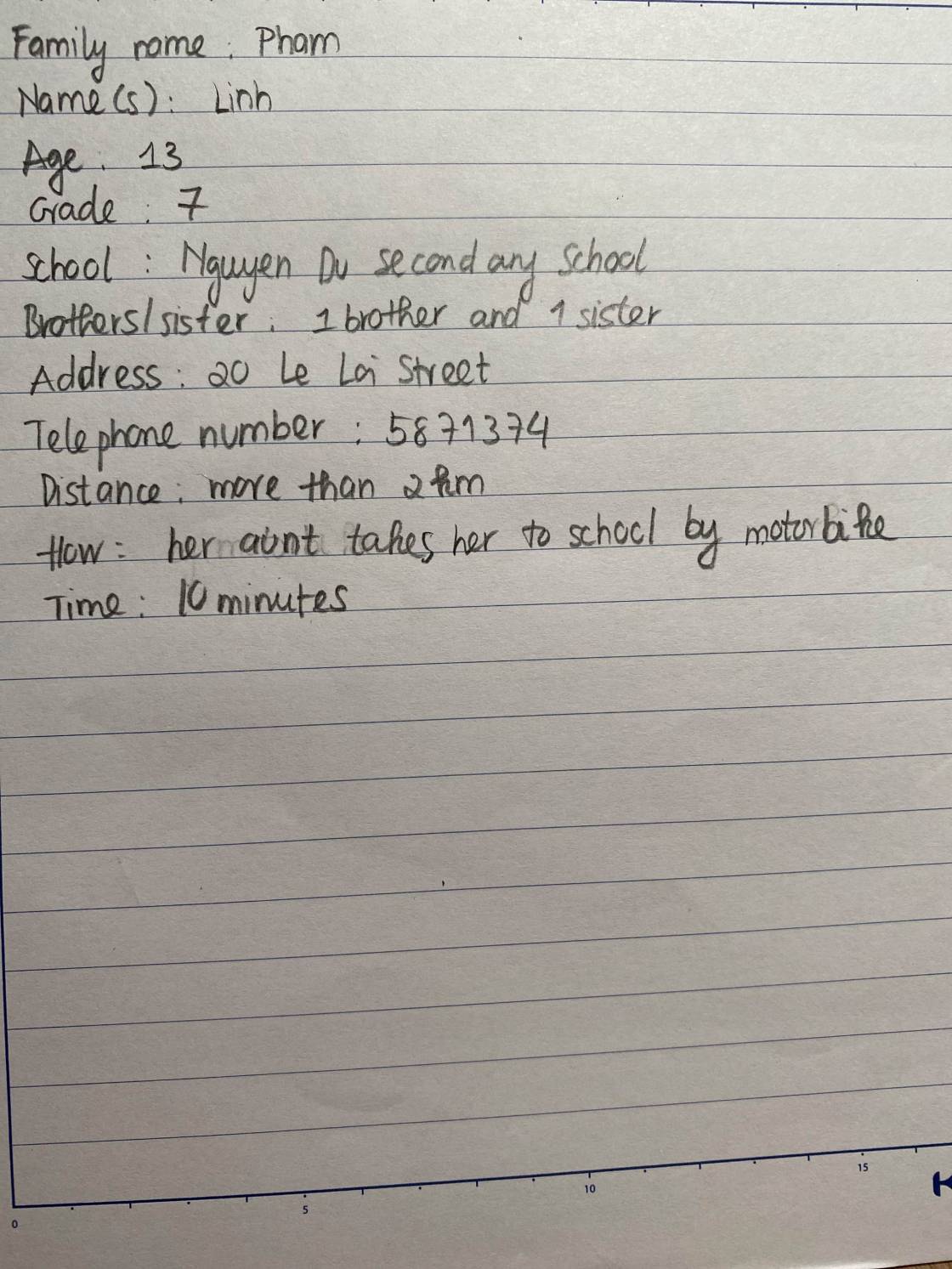
1. Linh is a new student in Nguyen Du junior high school            T

2. She studies at a small school.                F

3. She rides bike to school every day.                T

4. She needs 20 minutes to go to school.               F

5. What does the word “It” mean?
A. Linh B. her house C. her school D. her classroom
6. The passage is about …….
A. Linh’s daily life B. Linh’s family C. Linh’s school

31 tháng 10 2021

1. do

2. are

3. are

4. in learning

5. together

6. with 

7. at

8. reading

22 tháng 1 2018

Learning vocabulary is a very important part of learning a language. The more words you know, the more you will be able to understand what you hear and read; and the better you will be able to say what you want to when speaking or writing.

Which words to learn

Every day you hear or read many new English words. You also find them in your dictionary when you are translating from your own language. You can’t possibly learn all these new words, so your first problem is to decide which ones to concentrate on. Here are some suggestions:

  • learn the words that are important to the subjects you are studying
  • learn the words that you read or hear again and again
  • learn the words that you know you will often want to use yourself
  • do not learn words that are rare or not useful (your teacher can help you with this)

How to learn words

Once you have chosen which words to learn, you next have to decide how you are going to learn them. Here are a few ideas:

  • write the words in a notebook (with their translations or definitions)
  • write the words and definitions on small cards
    (advice on how to do this)
  • say the words many times (if you have an electronic dictionary you can hear how the word is pronounced)
  • put the words into different groups (you could use a graphic organiser)
  • write them in a file for use with a computer program (such as Quizlet or the one on this site)
  • make associations (in pictures or with other words)
  • ask someone to test you
  • use the words in your own speaking or writing

Some students put a tick or cross in their dictionary next to every word they look up. The next time they turn to a page with a marked word, they quickly check to see if they remember the meaning of that word.

In all of the above ways, you are doing something with the words. It’s usually not enough to just read through a list of words with their definitions or translations and try to remember them. Most students find that they memorise words better if they do something with them. Even better is to try and learn the word in a typical combination with other words. Learning that to apologizemeans to say sorry is a good start, but it's much better to learn a whole expression containing the word, e.g. He apologized for being late. Not only is this often easier to remember, but you are also learning some very important information on how the word is used.

Learning for vocabulary tests

The previous section on this page gives general advice on how to learn the words that you have chosen as important for you. Often, however, you will be given a set of words by your teacher and told to learn them for a vocabulary test. In this case you need to be sure exactly how you will be tested, because this will influence how you learn the words. There are several ways that the teacher might test your vocabulary learning, but the ways are broadly divided into two categories:

  • You will be given the word and have to:
    • write a definition
    • use it in an example sentence
    • translate it into your language
  • You will be given:
    • a definition
    • a gapped example sentence
    • the translation in your language
    and you have to write the English word.

If you do a vocabulary test from the second group above, then in most cases you will need to learn the exact spelling of the word and will lose marks if you misspell it. As with all tests, be sure to ask the teacher exactly how you will be tested and exactly how you will be graded. You will then avoid wasting time studying something that you will be not be tested on.

Learning vocabulary by reading

The way you learned very many of the words in your own language was by meeting them in the books and magazines you read. The context of a new word in a sentence or story was often enough for you to guess the meaning. Meeting the word again and again in your reading helped you learn it for use in your own speaking and writing. Doing lots of extra reading for pleasure - both fiction and non-fiction - is an excellent way to learn new English words, too. But choose books that you find quite easy to read. Difficult stories or texts that you struggle to understand will not help you to develop your vocabulary the natural way. But remember: to learn new words from reading you have to read A LOT!

More on the importance of reading.

More information about learning words

The vocabulary you know can be divided into two groups - passive vocabulary and active vocabulary. Passive vocabulary contains all the words that you understand when you read or listen, but which you do not use (or cannot remember) in your own writing and speaking. Active vocabulary is all the words you understand, plus all the words that you can use yourself. Your active vocabulary, in English and your own language, is probably much smaller than your passive vocabulary.

The more you work on learning a word, as suggested above, the more likely it is that it will become part of your active vocabulary.

Things to know about the words you learn

Usually the first things you learn about a new English word are what it means and its translation in your own language. But there are other things you need to find out before you can say that you know a word like a native speaker does. For example, you have to learn:

  • how it is spelled
  • how it is pronounced
  • how it is inflected (i.e. how it changes if it is a verb, noun or adjective)
  • other grammar information about it
  • how it collocates (i.e. what other words are often used with it)
    More on collocation
  • if it has a particular style or register
  • the context in which it is most likely to be used [ Types of Vocabulary ]

Native speakers learn these things about words by hearing them and reading them again and again. This is the best way for you to learn them, too.

Go to this site's vocabulary files

Read a Japanese translation of this page.

20 tháng 3 2019

very day you hear or read many new English words. You also find them in your dictionary when you are translating from your own language. You can’t possibly learn all these new words, so your first problem is to decide which ones to concentrate on. Here are some suggestions:

  • learn the words that are important to the subjects you are studying
  • learn the words that you read or hear again and again
  • learn the words that you know you will often want to use yourself
  • do not learn words that are rare or not useful (your teacher can help you with this)

How to learn words

Once you have chosen which words to learn, you next have to decide how you are going to learn them. Here are a few ideas:

  • write the words in a notebook (with their translations or definitions)
  • write the words and definitions on small cards 
    (advice on how to do this)
  • say the words many times (if you have an electronic dictionary you can hear how the word is pronounced)
  • put the words into different groups (you could use a graphic organiser)
  • write them in a file for use with a computer program (such as Quizlet or the one on this site)
  • make associations (in pictures or with other words)
  • ask someone to test you
  • use the words in your own speaking or writing

Some students put a k or cross in their dictionary next to every word they look up. The next time they turn to a page with a marked word, they quickly check to see if they remember the meaning of that word.

In all of the above ways, you are doing something with the words. It’s usually not enough to just read through a list of words with their definitions or translations and try to remember them. Most students find that they memorise words better if they do something with them. Even better is to try and learn the word in a typical combination with other words. Learning that to apologize means to say sorry is a good start, but it's much better to learn a whole expression containing the word, e.g. He apologized for being late. Not only is this often easier to remember, but you are also learning some very important information on how the word is used.

Learning for vocabulary tests

The previous section on this page gives general advice on how to learn the words that you have chosen as important for you. Often, however, you will be given a set of words by your teacher and told to learn them for a vocabulary test. In this case you need to be sure exactly how you will be tested, because this will influence how you learn the words. There are several ways that the teacher might test your vocabulary learning, but the ways are broadly divided into two categories:

  • You will be given the word and have to:
    • write a definition
    • use it in an example sentence
    • translate it into your language
  • You will be given:
    • a definition
    • a gapped example sentence
    • the translation in your language
    and you have to write the English word.

If you do a vocabulary test from the second group above, then in most cases you will need to learn the exact spelling of the word and will lose marks if you misspell it. As with all tests, be sure to ask the teacher exactly how you will be tested and exactly how you will be graded. You will then avoid wasting time studying something that you will be not be tested on.

Learning vocabulary by reading

The way you learned very many of the words in your own language was by meeting them in the books and magazines you read. The context of a new word in a sentence or story was often enough for you to guess the meaning. Meeting the word again and again in your reading helped you learn it for use in your own speaking and writing. Doing lots of extra reading for pleasure - both fiction and non-fiction - is an excellent way to learn new English words, too. But choose books that you find quite easy to read. Difficult stories or texts that you struggle to understand will not help you to develop your vocabulary the natural way. But remember: to learn new words from reading you have to read A LOT!

More on the importance of reading.

More information about learning words

The vocabulary you know can be divided into two groups - passive vocabulary and active vocabulary. Passive vocabulary contains all the words that you understand when you read or listen, but which you do not use (or cannot remember) in your own writing and speaking. Active vocabulary is all the words you understand, plus all the words that you can use yourself. Your active vocabulary, in English and your own language, is probably much smaller than your passive vocabulary.

The more you work on learning a word, as suggested above, the more ly it is that it will become part of your active vocabulary.

Things to know about the words you learn

Usually the first things you learn about a new English word are what it means and its translation in your own language. But there are other things you need to find out before you can say that you know a word a native speaker does. For example, you have to learn:

  • how it is spelled
  • how it is pronounced
  • how it is inflected (i.e. how it changes if it is a verb, noun or adjective)
  • other grammar information about it
  • how it collocates (i.e. what other words are often used with it)
    More on collocation
  • if it has a parular style or register
  • the context in which it is most ly to be used [ Types of Vocabulary ]

Native speakers learn these things about words by hearing them and reading them again and again. This is the best way for you to learn them, too.

Go to this site's vocabulary files

Read a Japanese translation of this page.


"Most students find that they memorise words better if they do something with them. Even better is to try and learn the word in a typical combination with other words."

12 tháng 1 2022

oeoeoeoeoe kiểm tra tiếng anh =)))

12 tháng 1 2022

1. He is a student.

2. There are four people in his family?

3. They are in their living room now.

4.His mother is talking on the phone.