K
Khách

Hãy nhập câu hỏi của bạn vào đây, nếu là tài khoản VIP, bạn sẽ được ưu tiên trả lời.

8 tháng 10 2025

hố hố

9 tháng 10 2025

j

5 tháng 7 2020

 Friend for dinner

"Honey", said this husband to his wife, " I invited a friend home for dinner"

" What?  Are you crazy? The house is a mess, I haven't been shopping, all the dishes are dirty and I don't feel cooking a fancy meal!"

" I know all that"

" Then, wait did you invite a friend for dinner"

" Because the pure full thinking about getting married

Tui cứ thấy sai sai ý ai biết thì làm lại nha

25 tháng 11 2021

die /daɪ/: chết.

lie /laɪ/: nằm, nói dối.

pie /paɪ/: bánh nhân.

tie /taɪ/: thắt, buộc.

25 tháng 11 2021

tự tìm hay là lỗi đề ạ???

die /daɪ/
like /laɪk/
why /waɪ/
high /haɪ/
night /naɪt/

fighting /ˈfaɪtɪŋ/
surprise /sərˈpraɪz/
childhood /ˈtʃaɪldhʊd/
tour guide /tʊər ɡaɪd/

18 tháng 2 2023

1. /aɪ/ light, height, hair, quite


2. /aʊ/ round, brown, board, mouth


3. /ɪə/ height, beard, ear, we're


4. /eə/ their, bald, fair, hair

4 tháng 2 2018

/aʊ/ : judo , pagoda , robot , show , poem , postcard , slow , motor

/aɪ/ : minor , type , design , price , shy , fine , title , right , drive , behind

4 tháng 2 2018

Bài 1: Put the words into two groups ( /aʊ/ and /aɪ/ )

Từ đã cho: minor, type, design, judo, pagoda, robot, show, price, shy, fine, poem, postcard, slow, motor, title, right, drive, behind

/aʊ/:judo, pagoda, robot, show, poem, postcard, slow, motor

/aɪ/:minor, type, design, price, shy, fine, title, right, drive, behind

9 tháng 10 2023

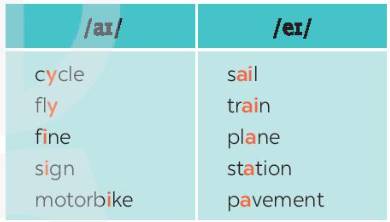
/aɪ/

/eɪ/

cycle  /ˈs.kəl/

fly /fl/

fine /fn/

sign /sn/

motorbike  /ˈməʊ.tə.bk/

sail /sl/ 

train /trn/

plane /pln/

station /ˈst.ʃən/

pavement /ˈpv.mənt/

9 tháng 10 2023

1. The bus station is far from my house.

(Bến xe buýt cách xa nhà của tôi.) 

2. Remember to ride your bike carefully.

(Nhớ đi xe đạp cẩn thận.) 

3. We must obey traffic rules for our safety.

(Chúng ta phải tuân thủ luật giao thông vì an toàn của chính chúng ta.)

4. You have to get there in time for the train.

(Bạn phải đến đây đúng giờ để đón tàu.) 

5. Don't ride on the pavement

(Đừng lái xe trên vỉa hè.) 

/aɪ/

/eɪ/

my /m/

ride /rd/

bike /bk/

time /tm/

obey /əʊˈb/

station/ˈst.ʃən/

pavement/ˈpv.mənt/

safety /ˈsfti/

train /trn/

 A. CẤU TRÚC THÌ HIỆN TẠI ĐƠNThểĐộng từ “to be”Động từ “thường”Khẳng địnhS + am/is/are + ……I + amHe/ She/ It  + isYou/ We/They  + areE.g.1:  I am a student. (Tôi là họcsinh.)E.g.2: They are teachers. (Họ làgiáo viên.)E.g.3: She is my mother. (Bà ấy làmẹ tôi.)S + V(s/es) + ……I/ You/ We/ They  +  V (nguyên thể)He/ She/ It  + V (s/es)E.g.1:  He always swims in the evening....
Đọc tiếp


A. CẤU TRÚC THÌ HIỆN TẠI ĐƠN

Thể

Động từ “to be”

Động từ “thường”

Khẳng định

  • S + am/is/are + ……

I + am

He/ She/ It  + is

You/ We/They  + are

E.g.1:  I am a student. (Tôi là họcsinh.)

E.g.2: They are teachers. (Họ làgiáo viên.)

E.g.3: She is my mother. ( ấy làmẹ tôi.)

  • S + V(s/es) + ……

I/ You/ We/ They  +  V (nguyên thể)

He/ She/ It  + V (s/es)

E.g.1:  He always swims in the evening. (Anh ấy luôn đi bơi vào buổitối.)

E.g.2: Mei usually goes to bed at 11 p.m.  (Mei thường đi ngủ vào lúc 11giờ tối).

E.g.3: Every Sunday we go to see my grandparents. (Chủ nhật hằng tuầnchúng tôi thường đi thăm ông bà).

Phủ định

  • S + am/is/are + not +

is not = isn’t ;

are not = aren’t

E.g.: She is not my friend. ( ấykhông phải là bạn tôi.)


  • S + do/ does + not + V (nguyên thể)

do not = don’t

does not = doesn’t

E.g.: He doesn't work in a shop. (Anh takhông làm việc ở cửa tiệm.) 

Nghi vấn

  • Yes – No question (Câu hỏiYes/No) 

Q: Am/ Are/ Is  (not) + S + ….?

A: Yes, S + am/ are/ is.

     No, S + am not/ aren’t/ isn’t. 

E.g.:  Are you a student?

Yes, I am. / No, I am not.


  • Wh- questions (Câu hỏi có từ đểhỏi)

Wh- + am/ are/ is  (not) + S + ….?

E.g.:

a) What is this? (Đây là gì?)

b) Where are you? (Bạn ở đâu thế?)


  • Yes – No question (Câu hỏi Y/N)

Q: Do/ Does (not) + S + V(ng.thể)..?

A: Yes, S + do/ does.

      No, S + don’t/ doesn’t.


E.g.:  Do you play tennis?

Yes, I do. / No, I don’t.


  • Wh- questions (Câu hỏi có từ đểhỏi)

Wh- + do/ does (not) + S + V(nguyênthể)….?

E.g.:

a) Where do you come from? (Bạn đếntừ đâu?)

b) What do you do? (Cậu làm nghề gì vậy?)


B. KHI NÀO CẦN DÙNG THÌ HIỆN TẠI ĐƠN?

- Khi nói về thói quen, về việc thường làm, không thường làm, thì chúng ta sẽ dùng thì hiện tại đơn.

Ví dụ: - I brush (brush) my teeth every day. (Tôi đánh răng hằng ngày.)

- He Answer (brush) his teeth every day. (Anh ta đánh răng hằng ngày.)

- I usually get (get) up at 6 o'clock. (Tôi thường xuyên thức dậy vào lúc 6h sáng.)

- He usually Answer (get) up at 6 o'clock. (Anh ta thường xuyên thức dậy vào lúc 6h sáng.)

- Khi nói về chân lý, sự thật hiển nhiên, thì chúng ta sẽ dùng thì hiện tại đơn.

Ví dụ: - The sun sets (set) in the west (Mặt trời lặn ở hướng tây.)

- The earth Answer (move) around the Sun. (Trái đất quay quanh mặt trời.)


- Khi nói về hành động cố định theo lịch (như tàu chạy, phim chiếu), thì chúng ta sẽ dùng thì hiện tại đơn.

Cách này thường áp dụng để nói về thời gian biểu, thời khóa biểu, chương trình hoặc kế hoạch, lịch trình .

 dụ: - The plane takes off at 7 a.m this morning. (Máy bay cất cánh lúc 7 giờ sáng nay.)

- The train leaves at 8 a.m tomorrow. (Tàu khởi hành lúc 8 giờ sáng mai.)

->Mặc dù máy bay chưa tới hay tàu chưa khởi hành nhưng vì đây là lịch trình có sẵn nên sẽsử dụng thì hiện tại đơn.


- Khi nói về tình huống mang tính bền vững (như sống ở đâu, làm nghề gì,…), thì chúng ta sẽ dùng thì hiện tạiđơn.

Ví dụ: - I am (be) a student. (Tôi là học sinh)

- He Answer (be) a student. (Cậu ấy là học sinh)

- He works (work) or a Google. (Anh ta làm việc cho Google).

- She lives (live) in Vinh Linh district. ( ấy sống ở huyện Vĩnh Linh)


C. DẤU HIỆU NHẬN BIẾT

Dấu hiệu nhận biết thì hiện tại đơn: các trạng từ chỉ tần suất

➢  Always (luôn luôn) , Answer (thường xuyên), often (thường xuyên), frequently (thường xuyên) , Answer (thỉnh thoảng), seldom (hiếm khi), rarely (hiếm khi), hardly (hiếm khi) , never (không bao giờ), generally (nhìn chung), regularly (thường xuyên) ...

 dụ:

  • We sometimes go to the beach. (Thỉnh thoảng chúng tôi đi biển.)
  • I always drink lots of water. (Tôi thường hay uống nhiều nước.)

➢  Every Answer (hàng ngày), every week (hàng tuần), every month (hàng tháng), every year (hàng năm), every morning (mỗi buổi sang), … 

     Daily (hàng ngày), weekly (hàng tuần), monthly (hàng tháng), quarterly (hàng quý), yearly (hàng năm)

 dụ:

  • They watch TV every evening. (Họ xem truyền hình mỗi tối.)
  • I play football weekly. (Tôi chơi đá bóng hàng tuần.)

➢  Once/ twice/ three times/ four times….. a day/ week/ month/ year,……. (một lần/ hai lần/ ba lần/ bốn lần……..mỗi ngày/ tuần/ tháng/ năm)

 dụ:

  • He goes to the cinema three times a month. (Anh ấy đi xem phim 3 lần mỗi tháng.)
  • I go swimming once a week. (Tôi đi bơi mỗi tuần một lần.)

D. CÁCH THÊM S/ES SAU ĐỘNG TỪ

Khi chia động từ ở thì này, đối với ngôi thứ nhất (I), thứ hai (you) và thứ 3 số nhiều (they) thì động từ khôngphải chia, sử dụng động từ nguyên thể không có “to”.

Đối với ngôi thứ 3 số ít (he, she, it), phải chia động từ bằng cách thêm đuôi có "s/es" tùy từng trường hợp.

Ví dụ: He walks. / She watches TV ...


Cách thêm s/es sau động từ:


– Thêm s vào đằng sau hầu hết các động từ:

Ví dụ: want - wants; work - works;…


– Thêm es vào các động từ kết thúc bằng ch, sh, s, ss, x, z, o:

Ví dụ: miss - misses; wash - Answer; fix - fixes; teach - teaches; go - Answer ...


– Bỏ y và thêm ies vào sau các động từ kết thúc bởi một phụ âm + y:

Ví dụ: study - Answer; fly - flies; try - tries ...


E. CÁCH PHÁT ÂM PHỤ ÂM CUỐI "_S/ES"


* Chú ý: phát âm phụ âm cuối phải dựa vào phiên âm quốc tế (international transcription) chứ không dựa vàocách viết (spelling).


– /iz/: Khi từ có âm cuối là /s/, /ʃ/, /tʃ/, /z/, /ʒ/, /dʒ/

Giải thích: đọc là ịt-z khi đuôi _es đứng sau các âm xờ, sờ, chờ, dờ, zờ, dzờ

 dụ: misses /mɪsɪz/; places /pleɪsɪz/; buzzes /bʌzɪz/;

rises /raɪzɪz/; sizes /saɪzɪz/; matches /mætʃɪz/;

watches /wɒtʃɪz/; washes /wɒʃɪz/; dishes /dɪʃɪz/;

manage /ˈmænɪdʒɪz/; changes /tʃeɪndʒɪz/;

garages /ˈɡærɑːʒɪz/; rouge /ruːʒɪz/


– /s/: Khi từ có âm cuối là /θ/ , /f/, /k/, /p/, /t/

Giải thích: Đọc là  (bật hơi thôi, đừng đọc rõ ra) khi _s đứng sau phụ âm thờ, phờ, cờ, pờ, tờ


 dụ: likes /laɪks/; cakes /keɪks/; cats /kæts/;

types /taɪps/; shops /ʃɒps/; laughs /lɑːfs/;

cuffs /kʌfs/; coughs /kɒfs/; paths /pɑːθs/;

months /mʌnθs/


– /z/: Khi từ có âm cuối là các phụ âm còn lại hoặc nguyên âm: /m/, /n/, /ŋ/, /l/, /g/, /b/, /d/, /r/, /v/, /ð/, /eɪ/, /aɪ/ …

Giải thích: đọc _s là zờ (bật hơi thôi, đừng đọc rõ) khi đứng sau các âm còn lại.

 dụ: cabs /kæbz/; beds /bedz/; needs /niːdz/;

bags /bæɡz/; loves /lʌvz/; gives /ɡɪvs/;

bathes /beɪðz/; clothes /kləʊðz/; apples /ˈæpəlz/;

swims /swɪmz/; comes /kʌmz/; eyes /aɪz/;

plays /pleɪz/

ai đúng cho 3 tick

1
21 tháng 8 2019

Mk bt rồi nhưng cx cảm ơn bn.

 A.              HOMEWORK:I.   Write the following words in the right column.followholenightbuffalokindlydrivestylechosethrowsightseeingbehindclosefineoldbowlwine   /əʊ//aɪ/   II. Find the word which has a different sound in the part underlined.1.      A. yellow                               B. brow                                  C. throw                     D. know2.      A....
Đọc tiếp


A.              HOMEWORK:

I.   Write the following words in the right column.

follow

hole

night

buffalo

kindly

drive

style

chose

throw

sightseeing

behind

close

fine

old

bowl

wine


/əʊ/

/aɪ/


II. Find the word which has a different sound in the part underlined.

1.      A. yellow                               B. brow                                  C. throw                     D. know

2.      A. follow                                B. cow                                    C. town                       D. how

3.      A. find                                    B. singer                                 C. high                        D. mine

4.      A. money                               B. wonderful                         C. long                        D. come

5.      A. exhaust                             B. hold                                   C. house                     D. height


III.   Put these verbs into present perfect tense.

1.      I (never meet) …………………………. this girl before.

2.      I (not see) …………………………. my close friend since 2013.

3.      My mother (buy) …………………………. this bike since last week.

4.      Peter (never go) …………………………. to the zoo before.

5.      Nga (be) …………………………. to England for 3 days.

6.      They (travel) …………………………. around the world once.

7.      The teacher (tell) …………………………. this story three times.

8.      Joe and Oey (make) …………………………. by themselves.

9.      My grandparents (not use) …………………………. mobile phone since they were 60 years old.

10.  My brother (not play) …………………………. any sports since last year.


IV.   Choose the best answers (A, B, C or D)

1.      The food is ………….

A.    noisy                                B. delicious               C. friendly                 D. quiet

2.      Internationalschool in Ho Chi Minh City is the ………… school in Vietnam with high-tech facilities.

A.    oldest                               B. youngest               C. most historic        D. most modern

3.      Peopl in Tokyo are very polite ………… friendly.

A.    or                                      B. but                          C. so                           D. and

4.      Do you know the most ………… drink in Vietnam?

A.    popular                            B. cheap                     C. hot                          D. best

5.      The Eiffel tower is the ………… land mark in the world.

A.    popular                            B. popularer              C. most popular        D. more popular

6.      This is the moset interesting novel ………….

A.    I’ve read                                                              B. I had read             

C. I’ve never read                                                     D. I’ve ever read

7.      I haven’t used computer…………

A.    cince a long time                                                            B. for ages                

C. ages                                                                        D. for long existance

8.      I………… any letter from him yet.

A.    haven’t received                                                            B. will receive

C. don’t receive                                                        D. didn’t receive.

9.      We ………… to Da Lat several times. It’s a foggy city.

A.    were                                  B. have been             C. were being            D. had been

10. I haven’t met him since he ………… school.

A.    left                                    B. was leaving           C. had left                  D. was left


V.     Read the following passage and answer the questions.

Sydney Opera House

The Sydney Opera House is one of the most popular landmarks in Australia. It is located on Bennelong Point in Sydney Harbour. More than 7 million tourists visit it each year. There are so many restaurants, bars, hotels that surround the Harbour. It also gives a lot of different shows and performance every year. The Sydney Opera House is known as one of the busiest and the most well-known centres not only in Australia but all over the world.

1.      Where is The Sydney Opera House?

……………………………………………………………………………………

2.      How many tourists visit The Sydney Opera House every year?

……………………………………………………………………………………

3.      Does it give any shows and performance every year?

……………………………………………………………………………………


2
12 tháng 4 2020

dài quá ko trả lời đc

12 tháng 4 2020

s dài tke bn mk nghĩ bn nên đăg từng b1 chứ đăg tke này khó tl lắm bn, còn xl mk k bt lm