
giải phương trình (x + 1)2(2x – 3)2 = 4x2 – 2x - 3
K
Khách
Hãy nhập câu hỏi của bạn vào đây, nếu là tài khoản VIP, bạn sẽ được ưu tiên trả lời.

Những câu hỏi liên quan
CM
10 tháng 2 2018
a) 2(x + 3)(x – 4) = (2x – 1)(x + 2) – 27
⇔ 2(x2 – 4x + 3x – 12) = 2x2 + 4x – x – 2 – 27
⇔ 2x2 – 2x – 24 = 2x2 + 3x – 29
⇔ -2x – 3x = 24 – 29
⇔ - 5x = - 5 ⇔ x = -5/-5 ⇔ x = 1
Tập nghiệm của phương trình : S = {1}
b) x2 – 4 – (x + 5)(2 – x) = 0
⇔ x2 – 4 + (x + 5)(x – 2) = 0 ⇔ (x – 2)(x + 2 + x + 5) = 0
⇔ (x – 2)(2x + 7) = 0 ⇔ x – 2 = 0 hoặc 2x + 7 = 0
⇔ x = 2 hoặc x = -7/2
Tập nghiệm của phương trình: S = {2; -7/2 }
c) ĐKXĐ : x – 2 ≠ 0 và x + 2 ≠ 0 (khi đó : x2 – 4 = (x – 2)(x + 2) ≠ 0)
⇔ x ≠ 2 và x ≠ -2
Quy đồng mẫu thức hai vế :
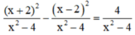
Khử mẫu, ta được : x2 + 4x + 4 – x2 + 4x – 4 = 4
⇔ 8x = 4 ⇔ x = 1/2( thỏa mãn ĐKXĐ)
Tập nghiệm của phương trình : S = {1/2}
d) ĐKXĐ : x – 1 ≠ 0 và x + 3 ≠ 0 (khi đó : x2 + 2x – 3 = (x – 1)(x + 3) ≠ 0)
⇔ x ≠ 1 và x ≠ -3
Quy đồng mẫu thức hai vế :
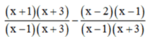

Khử mẫu, ta được : x2 + 3x + x + 3 – x2 + x – 2x + 2 + 4 = 0
⇔ 3x = -9 ⇔ x = -3 (không thỏa mãn ĐKXĐ)
Tập nghiệm của phương trình : S = ∅
PN
15 tháng 5 2021
\(2\left(x+3\right)\left(x-4\right)=\left(2x-1\right)\left(x+2\right)-27\)
\(< =>2\left(x^2-x-12\right)=2x^2+3x-2-27\)
\(< =>2x^2-2x-24=2x^2+3x-2-27\)
\(< =>5x=-24+29=5\)
\(< =>x=\frac{5}{5}=1\)
CM
31 tháng 3 2019
a) (2x – 1)(4x2 + 2x + 1) – 4x(2x2 – 3) = 23
⇔ 8x3 – 1 – 8x3 + 12x = 23
⇔ 12x = 24 ⇔ x = 2.
Tập nghiệm của phương trình: S = {2}
b) ĐKXĐ : x + 1 ≠ 0 và x – 2 ≠ 0 (vì vậy x2 – x – 2 = (x + 1)(x – 2) ≠ 0)
⇔ x ≠ -1 và x ≠ 2
Quy đồng mẫu thức hai vế :
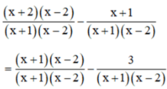
Khử mẫu, ta được : x2 – 4 – x – 1 = x2 – x – 2 – 3 ⇔ 0x = 0
Phương trình này luôn nghiệm đúng với mọi x ≠ -1 và x ≠ 2.
NL
Nguyễn Lê Phước Thịnh
CTVHS
14 tháng 2 2022
1: \(\Leftrightarrow\left(x-3\right)\left(x+3\right)-\left(x-3\right)\left(5x+2\right)=0\)
\(\Leftrightarrow\left(x-3\right)\left(-4x+1\right)=0\)
hay \(x\in\left\{3;\dfrac{1}{4}\right\}\)
2: \(\Leftrightarrow\left(x-1\right)\left(x^2+x+1\right)-\left(x-1\right)\left(x^2-2x+16\right)=0\)
\(\Leftrightarrow\left(x-1\right)\left(x^2+x+1-x^2+2x-16\right)=0\)
\(\Leftrightarrow\left(x-1\right)\left(3x-15\right)=0\)
hay \(x\in\left\{1;5\right\}\)
3: \(\Leftrightarrow\left(x-1\right)\left(4x^2-1\right)=0\)
\(\Leftrightarrow\left(x-1\right)\left(2x-1\right)\left(2x+1\right)=0\)
hay \(x\in\left\{1;\dfrac{1}{2};-\dfrac{1}{2}\right\}\)
4: \(\Leftrightarrow x^2\left(x+4\right)-9\left(x+4\right)=0\)
\(\Leftrightarrow\left(x+4\right)\left(x-3\right)\left(x+3\right)=0\)
hay \(x\in\left\{-4;3;-3\right\}\)
5: \(\Leftrightarrow\left[{}\begin{matrix}3x+5=x-1\\3x+5=1-x\end{matrix}\right.\Leftrightarrow\left[{}\begin{matrix}2x=-6\\4x=-4\end{matrix}\right.\Leftrightarrow\left[{}\begin{matrix}x=-3\\x=-1\end{matrix}\right.\)
6: \(\Leftrightarrow\left(6x+3\right)^2-\left(2x-10\right)^2=0\)
\(\Leftrightarrow\left(6x+3-2x+10\right)\left(6x+3+2x-10\right)=0\)
\(\Leftrightarrow\left(4x+13\right)\left(8x-7\right)=0\)
hay \(x\in\left\{-\dfrac{13}{4};\dfrac{7}{8}\right\}\)
14 tháng 2 2022
1.
\(\Leftrightarrow\left(x-3\right)\left(x+3\right)=\left(x-3\right)\left(5x-2\right)\)
\(\Leftrightarrow x+3=5x-2\)
\(\Leftrightarrow4x=5\Leftrightarrow x=\dfrac{5}{4}\)
2.
\(\Leftrightarrow\left(x-1\right)\left(x^2+x+1\right)=\left(x-1\right)\left(x^2-2x+16\right)\)
\(\Leftrightarrow x^2+x+1=x^2-2x+16\)
\(\Leftrightarrow3x=15\Leftrightarrow x=5\)
3.
\(\Leftrightarrow4x^2\left(x-1\right)-\left(x-1\right)=0\)
\(\Leftrightarrow\left(x-1\right)\left(4x^2-1\right)=0\)
\(\Leftrightarrow\left[{}\begin{matrix}x=1\\x=\dfrac{1}{2};x=-\dfrac{1}{2}\end{matrix}\right.\)
CM
17 tháng 10 2018
Pt ⇔ 2 x + 3 + ( x + 2 ) ( 4 x + 1 ) = 2 x + 2 + 4 x + 1 . ĐK: x ≥ − 1 4
Đặt t 2 = 8 x + 4 ( x + 2 ) ( 4 x + 1 ) + 9 ⇔ 2 x + ( x + 2 ) ( 4 x + 1 ) = t 2 − 9 4
PTTT t 2 − 4 t + 3 = 0 ⇔ t = 1 hoặc t = 3
TH1. t = 1 giải ra vô nghiệm hoặc kết hợp với ĐK t ≥ 7 bị loại
TH 2 t = 3 ⇒ 2 x + 2 + 4 x + 1 = 3. Giải pt tìm được x = − 2 9 (TM)
Vậy pt có nghiệm duy nhất x = − 2 9
AH
Akai Haruma
Giáo viên
12 tháng 5 2021
Lời giải:
a) $|4x^2-25|=0$
$\Leftrightarrow 4x^2-25=0$
$\Leftrightarrow (2x-5)(2x+5)=0$
$\Rightarrow x=\pm \frac{5}{2}$
b)
$|x-2|=3$
\(\Rightarrow \left[\begin{matrix} x-2=-3\\ x-2=3\end{matrix}\right.\Rightarrow \left[\begin{matrix} x=-1\\ x=5\end{matrix}\right.\)
c)
\(|x-3|=2x-1\Rightarrow \left\{\begin{matrix} 2x-1\geq 0\\ \left[\begin{matrix} x-3=2x-1\\ x-3=1-2x\end{matrix}\right.\end{matrix}\right.\)
\(\Leftrightarrow \left\{\begin{matrix} x\geq \frac{1}{2}\\ \left[\begin{matrix} x=-2\\ x=\frac{4}{3}\end{matrix}\right.\end{matrix}\right.\Rightarrow x=\frac{4}{3}\)
d)
$|x-5|=|3x-2|$
\(\Rightarrow \left[\begin{matrix} x-5=3x-2\\ x-5=2-3x\end{matrix}\right.\Leftrightarrow \left[\begin{matrix} x=\frac{-3}{2}\\ x=\frac{7}{4}\end{matrix}\right.\)
NL
Nguyễn Lê Phước Thịnh
CTVHS
28 tháng 7 2021
1) Ta có: \(2x\left(x-3\right)+5\left(x-3\right)=0\)
\(\Leftrightarrow\left(x-3\right)\left(2x+5\right)=0\)
\(\Leftrightarrow\left[{}\begin{matrix}x=3\\x=-\dfrac{5}{2}\end{matrix}\right.\)
2) Ta có: \(\left(x^2-4\right)-\left(x-2\right)\left(3-2x\right)=0\)
\(\Leftrightarrow\left(x-2\right)\left(x+2\right)+\left(x-2\right)\left(2x-3\right)=0\)
\(\Leftrightarrow\left(x-2\right)\left(3x-1\right)=0\)
\(\Leftrightarrow\left[{}\begin{matrix}x=2\\x=\dfrac{1}{3}\end{matrix}\right.\)
3) Ta có: \(\left(2x-1\right)^2-\left(2x+5\right)^2=11\)
\(\Leftrightarrow4x^2-4x-1-4x^2-20x-25=11\)
\(\Leftrightarrow-24x=11+1+25=37\)
hay \(x=-\dfrac{37}{24}\)
NL
Nguyễn Lê Phước Thịnh
CTVHS
28 tháng 7 2021
5) Ta có: \(3x^2-5x-8=0\)
\(\Leftrightarrow3x^2+3x-8x-8=0\)
\(\Leftrightarrow3x\left(x+1\right)-8\left(x+1\right)=0\)
\(\Leftrightarrow\left(x+1\right)\left(3x-8\right)=0\)
\(\Leftrightarrow\left[{}\begin{matrix}x=-1\\x=\dfrac{8}{3}\end{matrix}\right.\)
8) Ta có: \(\left|x-5\right|=3\)
\(\Leftrightarrow\left[{}\begin{matrix}x-5=3\\x-5=-3\end{matrix}\right.\Leftrightarrow\left[{}\begin{matrix}x=8\\x=2\end{matrix}\right.\)
10) Ta có: \(\left|2x+1\right|=\left|x-1\right|\)
\(\Leftrightarrow\left[{}\begin{matrix}2x+1=x-1\\2x+1=1-x\end{matrix}\right.\Leftrightarrow\left[{}\begin{matrix}2x-x=-1-1\\2x+x=1-1\end{matrix}\right.\)
\(\Leftrightarrow\left[{}\begin{matrix}x=-2\\x=0\end{matrix}\right.\)
5 tháng 3 2022
1.\(\left(x+2\right)\left(2x-3\right)=x^2-4\)
\(\Leftrightarrow\left(x+2\right)\left(2x-3\right)-\left(x+2\right)\left(x-2\right)=0\)
\(\Leftrightarrow\left(x+2\right)\left(2x-3-x+2\right)=0\)
\(\Leftrightarrow\left(x+2\right)\left(x-1\right)=0\)
\(\Leftrightarrow\left[{}\begin{matrix}x=-2\\x=1\end{matrix}\right.\)
2.\(x^2+3x+2=0\)
\(\Leftrightarrow x^2+x+2x+2=0\)
\(\Leftrightarrow x\left(x+1\right)+2\left(x+1\right)=0\)
\(\Leftrightarrow\left(x+1\right)\left(x+2\right)=0\)
\(\Leftrightarrow\left[{}\begin{matrix}x=-1\\x=-2\end{matrix}\right.\)
3.\(2x^2+5x+3=0\)
\(\Leftrightarrow2x^2+2x+3x+3=0\)
\(\Leftrightarrow2x\left(x+1\right)+3\left(x+1\right)=0\)
\(\Leftrightarrow\left(x+1\right)\left(2x+3\right)=0\)
\(\Leftrightarrow\left[{}\begin{matrix}x=-1\\x=-\dfrac{3}{2}\end{matrix}\right.\)
4.\(x^3+x^2-12x=0\)
\(\Leftrightarrow x\left(x^2+x-12\right)=0\)
\(\Leftrightarrow x\left(x+4\right)\left(x-3\right)=0\)
\(\Leftrightarrow\left[{}\begin{matrix}x=0\\x=-4\\x=3\end{matrix}\right.\)
NL
Nguyễn Lê Phước Thịnh
CTVHS
5 tháng 3 2022
a: \(\Leftrightarrow\left(x+2\right)\left(2x-3\right)-\left(x+2\right)\left(x-2\right)=0\)
\(\Leftrightarrow\left(x+2\right)\left(2x-3-x+2\right)=0\)
=>(x+2)(x-1)=0
=>x=-2 hoặc x=1
b: =>(x+1)(x+2)=0
=>x=-1 hoặc x=-2
c: =>(2x+3)(x+1)=0
=>x=-1 hoặc x=-3/2
d: =>x(x+4)(x-3)=0
hay \(x\in\left\{0;-4;3\right\}\)
MD
NL
Nguyễn Lê Phước Thịnh
CTVHS
12 tháng 4 2023
a:=>6x^2-8x+4x-6x^2<-4
=>-4x<-4
=>x>1
b: =>6x+8x^2-8x^2-24x>5
=>-18x>5
=>x<-5/18
12 tháng 4 2023
a)\(6x^2-8x+2x\left(2-3x\right)< -4\)
\(\Leftrightarrow6x^2-8x+4x-6x^2< -4\)
\(\Leftrightarrow-4x< -4\)
\(\Leftrightarrow-4x.\dfrac{-1}{4}>-4\cdot\dfrac{-1}{4}\)
\(\Leftrightarrow x>1\)
Vậy bất phương trình có nghiệm là \(S=\left\{xIx>1\right\}\)
b)\(2\left(3x+4x^2\right)-8x\left(x+3\right)>5\)
\(\Leftrightarrow6x+8x^2-8x^2-24x>5\)
\(\Leftrightarrow-18x>5\)
\(\Leftrightarrow-18x\cdot\dfrac{-1}{18}< 5\cdot\dfrac{-1}{18}\)
\(\Leftrightarrow x< -\dfrac{5}{18}\)
Vậy bất phương trình có nghiệm là \(S=\left\{xIx< -\dfrac{5}{18}\right\}\)
Bước 1: Khai triển vế trái
Nhân hai kết quả này:
\(\left(\right. x^{2} + 2 x + 1 \left.\right) \left(\right. 4 x^{2} - 12 x + 9 \left.\right)\)
Nhân lần lượt:
\(= x^{2} \left(\right. 4 x^{2} - 12 x + 9 \left.\right) + 2 x \left(\right. 4 x^{2} - 12 x + 9 \left.\right) + 1 \left(\right. 4 x^{2} - 12 x + 9 \left.\right)\) \(= 4 x^{4} - 12 x^{3} + 9 x^{2} + 8 x^{3} - 24 x^{2} + 18 x + 4 x^{2} - 12 x + 9\)
Gộp các hạng tử:
Vậy:
\(\text{V}\overset{}{ế}\text{ tr}\overset{}{á}\text{i}=4x^4-4x^3-11x^2+6x+9\)
Bước 2: Chuyển hết về một vế
Vế phải: \(4 x^{2} - 2 x - 3\)
Phương trình trở thành:
\(4 x^{4} - 4 x^{3} - 11 x^{2} + 6 x + 9 - \left(\right. 4 x^{2} - 2 x - 3 \left.\right) = 0\)
Rút gọn:
\(4 x^{4} - 4 x^{3} - 15 x^{2} + 8 x + 12 = 0\)
Bước 3: Chia 4 cho gọn (nếu muốn)
Không cần chia vì 4 không chia hết mọi số. Ta sẽ thử nghiệm nghiệm trước.
Bước 4: Dùng định lý Viète thử nghiệm nghiệm nguyên
Các ước của 12: ±1, ±2, ±3, ±4, ±6, ±12.
\(4 \left(\right. 16 \left.\right) - 4 \left(\right. 8 \left.\right) - 15 \left(\right. 4 \left.\right) + 8 \left(\right. 2 \left.\right) + 12 = 64 - 32 - 60 + 16 + 12 = 0\) ✅
Vậy \(x = 2\) là nghiệm.
Bước 5: Chia đa thức cho \(x - 2\)
Chia \(4 x^{4} - 4 x^{3} - 15 x^{2} + 8 x + 12\) cho \(x - 2\):
\(\text{K}ế\text{t qu}ả=4x^3+4x^2-7x-6\)
Bước 6: Tiếp tục phân tích
Thử nghiệm nghiệm của \(4 x^{3} + 4 x^{2} - 7 x - 6\):
\(4 \left(\right. - 8 \left.\right) + 4 \left(\right. 4 \left.\right) - 7 \left(\right. - 2 \left.\right) - 6 = - 32 + 16 + 14 - 6 = - 8 \neq 0\)
\(4 \left(\right. - 1 \left.\right) + 4 \left(\right. 1 \left.\right) - 7 \left(\right. - 1 \left.\right) - 6 = - 4 + 4 + 7 - 6 = 1 \neq 0\)
Thử \(x = - \frac{3}{2}\):
\(4 \left(\right. - \frac{27}{8} \left.\right) + 4 \left(\right. \frac{9}{4} \left.\right) - 7 \left(\right. - \frac{3}{2} \left.\right) - 6 = - \frac{27}{2} + 9 + \frac{21}{2} - 6 = 0\)
Vậy \(x = - \frac{3}{2}\) là nghiệm.
Bước 7: Chia tiếp
Chia \(4 x^{3} + 4 x^{2} - 7 x - 6\) cho \(x + \frac{3}{2}\):
Tốt hơn là chia cho \(2 x + 3\) để tránh phân số.
Khi chia:
\(4 x^{3} + 4 x^{2} - 7 x - 6 = \left(\right. 2 x + 3 \left.\right) \left(\right. 2 x^{2} - x - 2 \left.\right)\)
Bước 8: Phân tích tiếp \(2 x^{2} - x - 2\)
\(2 x^{2} - x - 2 = \left(\right. 2 x + 1 \left.\right) \left(\right. x - 2 \left.\right)\)
Bước 9: Kết quả phân tích hoàn toàn
\(4 x^{4} - 4 x^{3} - 15 x^{2} + 8 x + 12 = \left(\right. x - 2 \left.\right)^{2} \left(\right. 2 x + 3 \left.\right) \left(\right. 2 x + 1 \left.\right)\)
Bước 10: Giải phương trình
\(\left(\right. x - 2 \left.\right)^{2} \left(\right. 2 x + 3 \left.\right) \left(\right. 2 x + 1 \left.\right) = 0\)
Hình như bn hỏi Chatgpt thì phải!