
câu này mình cần gấp
K
Khách
Hãy nhập câu hỏi của bạn vào đây, nếu là tài khoản VIP, bạn sẽ được ưu tiên trả lời.

Những câu hỏi liên quan
IC
1
5 tháng 11 2021
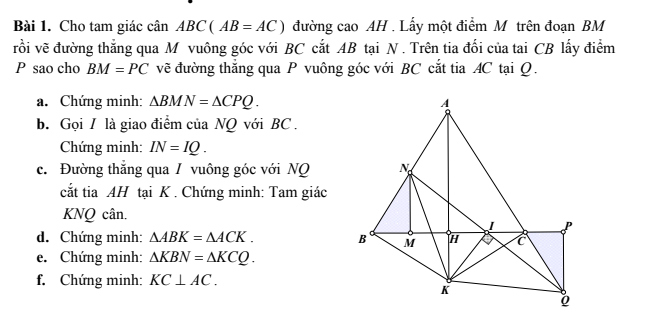
a, Vì tam giác ABC cân tại A nên \(\widehat{NBM}=\widehat{ACB}\)
Mà \(\widehat{ACB}=\widehat{PCQ}\left(đối.đỉnh\right)\Rightarrow\widehat{NBM}=\widehat{PCQ}\)
Mà \(\widehat{NMB}=\widehat{CPQ}=90^0;BM=PC\)
Do đó \(\Delta BMN=\Delta CPQ\left(g.c.g\right)\)
b, Vì \(BM//PQ\left(\perp BP\right)\) nên \(\widehat{MNI}=\widehat{IQP}\)
Mà \(\widehat{NMI}=\widehat{IPQ}=90^0;MN=PQ\left(\Delta BMN=\Delta CPQ\right)\)
Do đó \(\Delta IMN=\Delta IPQ\left(g.c.g\right)\)
\(\Rightarrow IN=IQ\)
c, Vì IK là đường cao cũng là trung tuyến tam giác KNQ nên tam giác KNQ cân tại K
P

1
NL
Nguyễn Lê Phước Thịnh
CTVHS
8 tháng 3 2022
uses crt;
var st:string;
d,i:integer;
begin
clrscr;
readln(st);
d:=length(st);
for i:=1 to d do
if (st[i] in ['0'..'9']) then write(st[i]);
readln;
end.
NV
2
NL
Nguyễn Lê Phước Thịnh
CTVHS
12 tháng 5 2023
24:
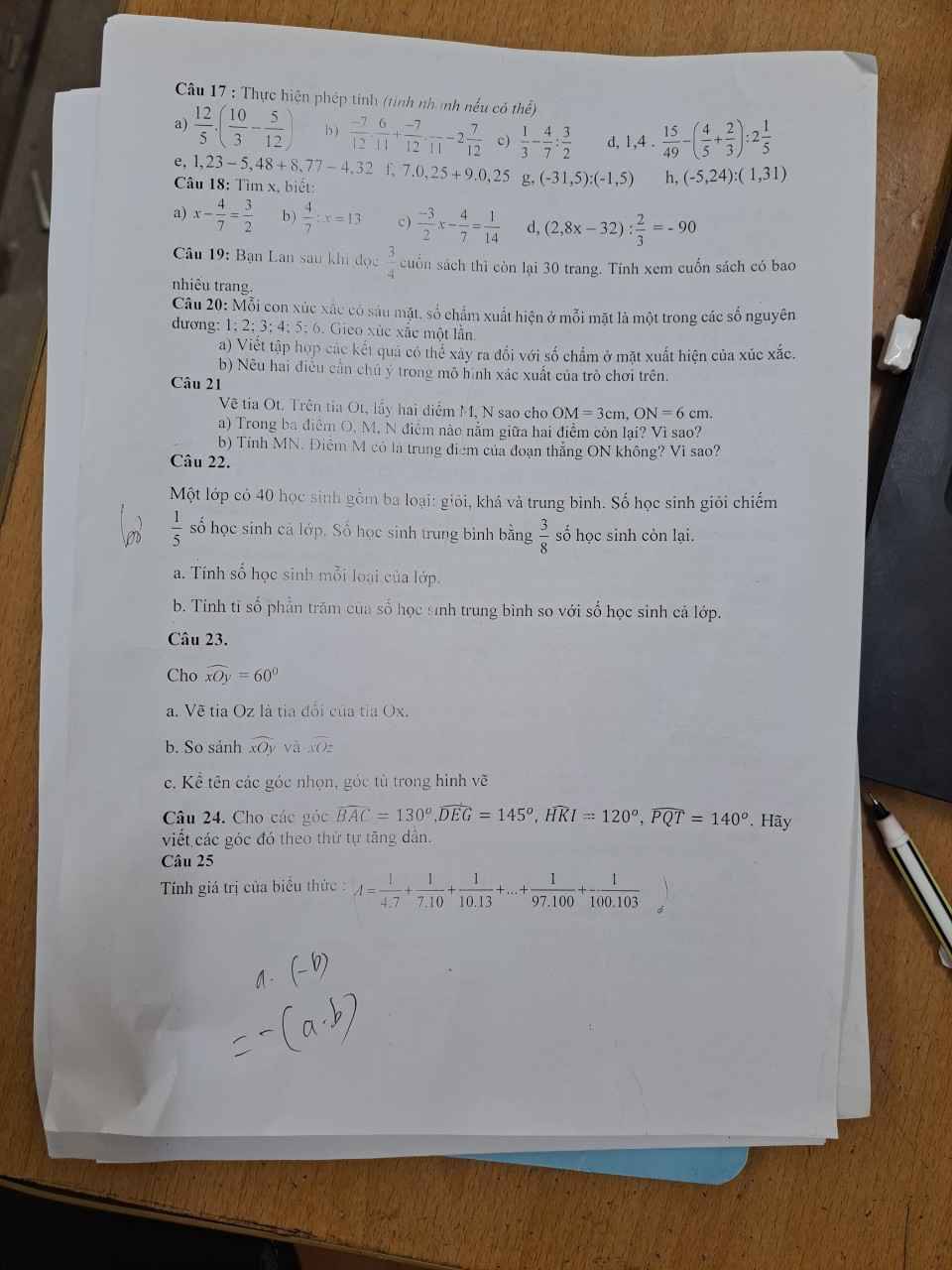
góc HKI<góc BAC<góc PQT<góc DEG
25:
A=1/3(3/4*7+3/7*10+...+3/100*103)
=1/3(1/4-1/7+1/7-1/10+...+1/100-1/103)
=1/3*99/412
=33/412
0T
2
2 tháng 5 2022
Bài 6:
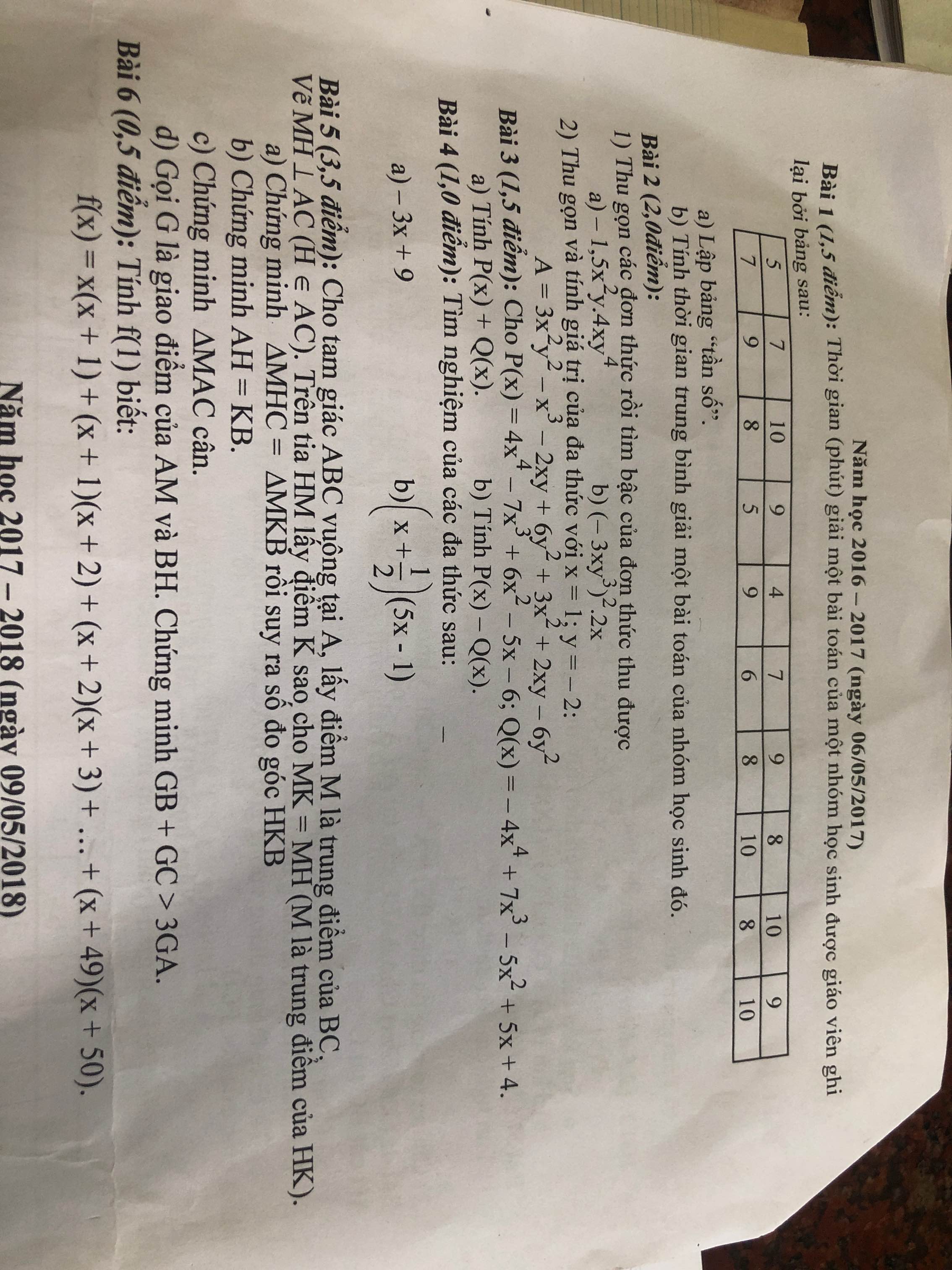
-Thay \(x=1\) vào \(f\left(x\right)=x\left(x+1\right)+\left(x+1\right)\left(x+2\right)+...+\left(x+49\right)\left(x+50\right)\), ta được:
\(f\left(1\right)=1\left(1+1\right)+\left(1+1\right)\left(1+2\right)+...+\left(1+49\right)\left(1+50\right)\)
\(=1.2+2.3+...+50.51\)
\(=\dfrac{1.2.3+2.3.3+...+50.51.3}{3}\)
\(=\dfrac{1.2.3+2.3.\left(4-1\right)+...+50.51.\left(52-49\right)}{3}\)
\(=\dfrac{1.2.3+2.3.4-1.2.3+...+50.51.52-49.50.51}{3}\)
\(=\dfrac{50.51.52}{3}=44200\)
DT

1
1 tháng 9 2021
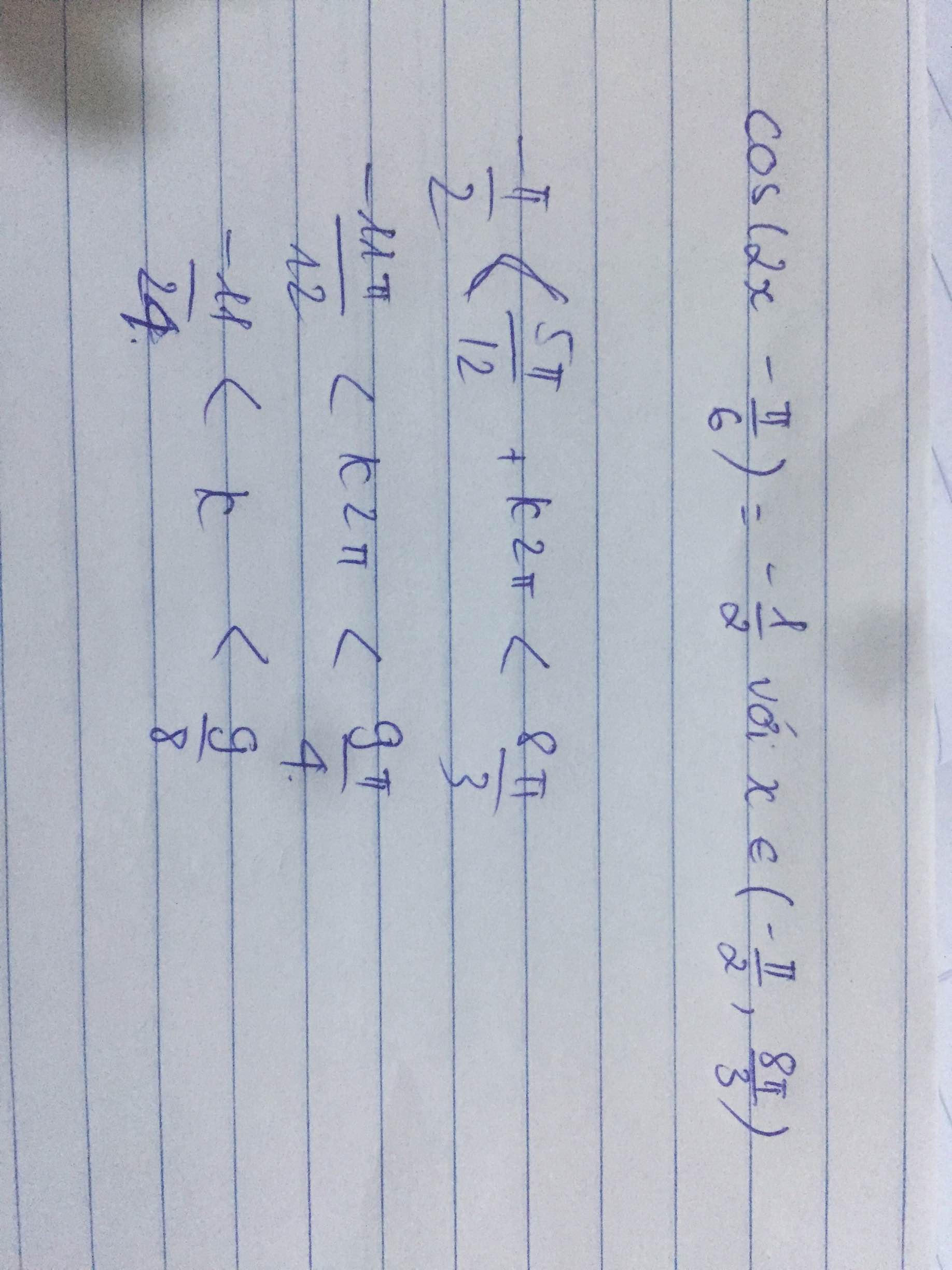
Phương trình tương đương
\(\left[{}\begin{matrix}x=\dfrac{5\pi}{12}+k\pi\\x=-\dfrac{\pi}{4}+k\pi\end{matrix}\right.,k\in Z\)
Xét họ nghiệm \(x=\dfrac{5\pi}{12}+k\pi,k\in Z\).
Do \(-\dfrac{\pi}{2}< \dfrac{5\pi}{12}+k\pi< \dfrac{8\pi}{3}\) nên \(-\dfrac{11\pi}{12}< k\pi< \dfrac{9\pi}{4}\)
⇒ \(-\dfrac{11}{12}< k< \dfrac{9}{4}\). Mà k ∈ Z nên k ∈ {0 ; 1}
Vậy các nghiệm thỏa mãn phương trình là các phần tử của tập hợp :
S1 = \(\left\{\dfrac{5\pi}{12};\dfrac{17\pi}{12}\right\}\)
Xét họ nghiệm \(x=-\dfrac{\pi}{4}+k\pi\) với k ∈ Z.
Do \(-\dfrac{\pi}{2}< \dfrac{-\pi}{4}+k\pi< \dfrac{8\pi}{3}\) nên \(-\dfrac{\pi}{4}< k\pi< \dfrac{35\pi}{12}\)
nên \(-\dfrac{1}{4}< k< \dfrac{35}{12}\). Mà k ∈ Z nên k∈ {0 ; 1 ; 2}
Vậy các nghiệm thỏa mãn phương trình là các phần tử của tập hợp
S2 = \(\left\{-\dfrac{\pi}{4};\dfrac{3\pi}{4};\dfrac{7\pi}{4}\right\}\)
Vậy các nghiệm thỏa mãn phương trình là các phần tử của tập hợp
S = S1 \(\cup\) S2 = \(\left\{\dfrac{5\pi}{12};\dfrac{17\pi}{12};-\dfrac{\pi}{4};\dfrac{3\pi}{4};\dfrac{7\pi}{4}\right\}\)
1V

1
NL
Nguyễn Lê Phước Thịnh
CTVHS
30 tháng 1 2024
a: \(\widehat{\left(SC;\left(ABCD\right)\right)}=\widehat{CS;CA}=\widehat{SCA}\)
Ta có: SA\(\perp\)(ABCD)
=>SA\(\perp\)AC
=>ΔSAC vuông tại A
Vì ABCD là hình vuông
nên \(AC=AD\cdot\sqrt{2}=a\sqrt{2}\)
Xét ΔSAC vuông tại A có \(tanSCA=\dfrac{SA}{AC}=\dfrac{a\sqrt{6}}{a\sqrt{2}}=\sqrt{3}\)
nên \(\widehat{SCA}=60^0\)
=>\(\widehat{SC;\left(ABCD\right)}=60^0\)
b: Ta có: BD\(\perp\)AC
BD\(\perp\)SA
SA,AC cùng thuộc mp(SAC)
Do đó: BD\(\perp\)(SAC)
\(\widehat{SB;\left(SAC\right)}=\widehat{SB;SD}=\widehat{BSD}\)
Vì ABCD là hình vuông
nên \(AC=BD=a\sqrt{2}\)
ΔSAD vuông tại A
=>\(SA^2+AD^2=SD^2\)
=>\(SD^2=\left(a\sqrt{6}\right)^2+a^2=7a^2\)
=>\(SD=a\sqrt{7}\)
ΔSAB vuông tại A
=>\(SA^2+AB^2=SB^2\)
=>\(SB=a\sqrt{7}\)
Xét ΔSBD có \(cosBSD=\dfrac{SB^2+SD^2-BD^2}{2\cdot SB\cdot SD}\)
\(=\dfrac{7a^2+7a^2-2a^2}{2\cdot a\sqrt{7}\cdot a\sqrt{7}}=\dfrac{6}{7}\)
=>\(sinBSD=\sqrt{1-\left(\dfrac{6}{7}\right)^2}=\dfrac{\sqrt{13}}{7}\)
=>\(\widehat{BSD}\simeq31^0\)
=>\(\widehat{SB;\left(SAC\right)}\simeq31^0\)
TN
 giúp mình câu này với mình đang cần gấp
2
NL
Nguyễn Lê Phước Thịnh
CTVHS
14 tháng 10 2021
\(\left(x-3\right)^{30}=\left(x-3\right)^{10}\)
\(\Leftrightarrow\left(x-3\right)\left(x-2\right)\left(x-4\right)=0\)
\(\Leftrightarrow\left[{}\begin{matrix}x=3\\x=2\\x=4\end{matrix}\right.\)

TV

2
NL
Nguyễn Lê Phước Thịnh
CTVHS
14 tháng 7 2023
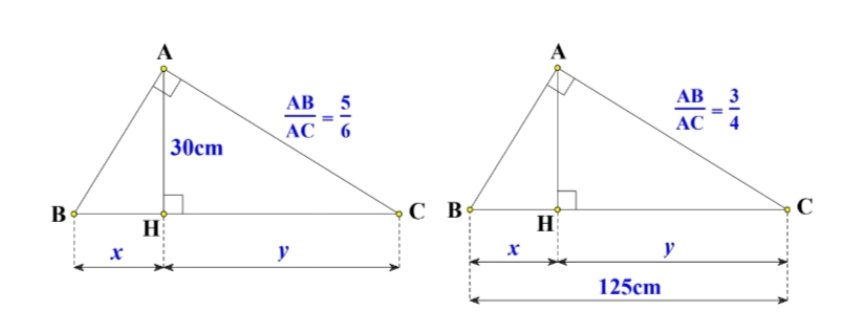
a: AB/AC=5/6
=>HB/HC=25/36
=>HB/25=HC/36=k
=>HB=25k; HC=36k
AH^2=HB*HC
=>25k*36k=30^2
=>900k^2=900
=>k=1
=>x=25cm; y=25cm
b: AB/AC=3/4
=>HB/HC=9/16
=>x/y=9/16
=>x/9=y/16=(x+y)/(9+16)=125/25=5
=>x=45cm; y=80cm
0D

2
VD
18 tháng 3 2022
\(\left(x+1\right)\left(x^2-x+1\right)-2x=x\left(x-1\right)\left(x+1\right)\\ \Leftrightarrow x^3+1-2x=x\left(x^2-1\right)\\ \Leftrightarrow x^3+1-2x=x^3-x\\ \Leftrightarrow1-x=0\\ \Leftrightarrow x=1\)
LD
18 tháng 3 2022
\(d,\left(x+1\right)\left(x^2-x+1\right)-2x=x\left(x-1\right)\left(x+1\right)\)
\(\Leftrightarrow x^3+1-2x=x\left(x^2-1\right)\)
\(\Leftrightarrow x^3+1-2x=x^3-x\)
\(\Leftrightarrow x^3-x^3-2x+x+1=0\)
\(\Leftrightarrow x+1=0\)
\(\Leftrightarrow x=-1\)
Vậy \(S=\left\{-1\right\}\)
* Áp dụng hằng thẳng thức tổng hai lập phương : \(\left(x+1\right)\left(x^2-x+1\right)=x^3+1\)
* vế phải áp dụng hằng thẳng thức hiệu hai bình phương : \(x\left(x+1\right)\left(x+1\right)=x\left(x^2-1\right)=x^3-x\)
chim to sẻ ra ăn được đấy
Câu nào