
Tìm giá trị nhỏ nhất B= -x^2+6x-2
K
Khách
Hãy nhập câu hỏi của bạn vào đây, nếu là tài khoản VIP, bạn sẽ được ưu tiên trả lời.

Những câu hỏi liên quan
NL
Nguyễn Lê Phước Thịnh
CTVHS
13 tháng 2 2023
a: Tọa độ đỉnh là:
\(\left\{{}\begin{matrix}x=\dfrac{-6}{2\cdot4}=\dfrac{-6}{8}=\dfrac{-3}{4}\\y=-\dfrac{6^2-4\cdot4\cdot\left(-5\right)}{4\cdot4}=-\dfrac{29}{4}\end{matrix}\right.\)
Bảng biến thiên là:
| x | -\(\infty\) -3/4 +\(\infty\) |
| y | -\(\infty\) -29/4 +\(\infty\) |
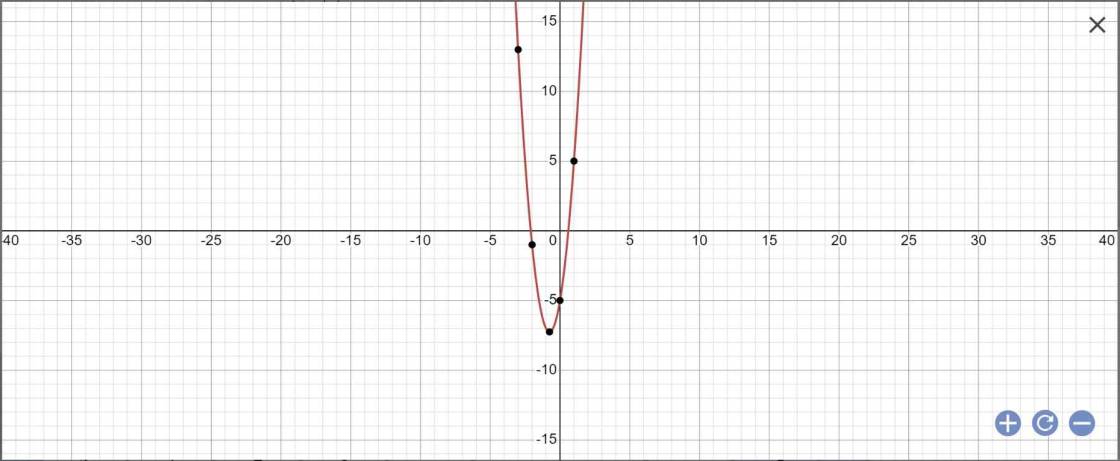
b: Hàm số đồng biến khi x>-3/4; nghịch biến khi x<-3/4
GTNN của hàm số là y=-29/4 khi x=-3/4
NL
Nguyễn Lê Phước Thịnh
CTVHS
23 tháng 5
a: \(5-2\cdot cos^2x\cdot\sin^2x\)
\(=5-2\cdot\left(\sin x\cdot cosx\right)^2\)
\(=5-2\cdot\left\lbrack\frac12\cdot2\cdot\sin x\cdot cosx\right\rbrack^2=5-2\cdot\left\lbrack\frac12\cdot\sin2x\right\rbrack^2\)
\(=5-2\cdot\frac14\cdot\sin^22x=-\frac12\cdot\sin^22x+5\)
\(0\le\sin^22x\le1\)
=>\(0\ge-\frac12\sin^22x\ge-\frac12\)
=>\(0+5\ge-\frac12\sin^22x+5\ge-\frac12+5\)
=>\(5\ge-\frac12\sin^22x+5\ge\frac92\)
=>\(\frac92\le-\frac12\sin^22x+5\le5\)
=>\(\sqrt{\frac92}\le\sqrt{-\frac12\cdot\sin^22x+5}\le\sqrt5\)
=>\(\frac{3\sqrt2}{2}\le\sqrt{-\frac12\cdot\sin^22x+5}\le\sqrt5\)
=>\(\frac{2}{3\sqrt2}\ge\frac{1}{\sqrt{-\frac12\cdot\sin^22x+5}}\ge\frac{1}{\sqrt5}\)
=>\(\frac{2\cdot4}{3\sqrt2}\ge\frac{1\cdot4}{\sqrt{-\frac12\cdot\sin^22x+5}}\ge\frac{1\cdot4}{\sqrt5}\)
=>\(\frac{4\sqrt2}{3}\ge y\ge\frac{4}{\sqrt5}\)
=>\(y_{\max}=\frac{4\sqrt2}{3}\) khi \(-\frac12\cdot\sin^22x+5=\frac92\)
=>\(-\frac12\cdot\sin^22x=-\frac12\)
=>\(\sin^22x=1\)
=>\(cos^22x=0\)
=>cos2x=0
=>\(2x=\frac{\pi}{2}+k\pi\)
=>\(x=\frac{\pi}{4}+\frac{k\pi}{2}\)
\(y_{\min}=\frac{4}{\sqrt5}\) khi \(-\frac12\cdot\sin^22x+5=5\)
=>\(\sin^22x=0\)
=>sin 2x=0
=>\(2x=k\pi\)
=>\(x=\frac{k\pi}{2}\)
b: \(f\left(x\right)=3\cdot\sin^2x+5\cdot cos^2x-4\cdot cos2x-2\)
\(=3\left(1-cos^2x\right)+5\cdot cos^2x-4\left(2\cdot cos^2x-1\right)-2\)
\(=3-3\cdot cos^2x+5\cdot cos^2x-8\cdot cos^2x+4-2=-6\cdot cos^2x+5\)
Ta có: \(0<=cos^2x\le1\)
=>\(0\ge-6\cdot cos^2x\ge-6\)
=>\(0+5\ge-6\cdot cos^2x+5\ge-6+5\)
=>5>=y>=-1
Do đó: \(y_{\min}=-1\) khi \(-6\cdot cos^2x+5=-1\)
=>\(-6\cdot cos^2x=-6\)
=>\(cos^2x=1\)
=>\(\sin^2x=0\)
=>sin x=0
=>\(x=k\pi\)
y max=5 khi \(-6\cdot cos^2x+5=5\)
=>\(-6\cdot cos^2x=0\)
=>cosx=0
=>\(x=\frac{\pi}{2}+k\pi\)
1 tháng 7 2021
a)\(-1\le sinx\le1\)
\(\Leftrightarrow1\ge-sinx\ge-1\)
\(\Leftrightarrow4\ge3-sinx\ge2\) \(\Leftrightarrow16\ge\left(3-sinx\right)^2\ge4\)\(\Leftrightarrow17\ge\left(3-sinx\right)^2+1\ge5\)
\(\Leftrightarrow17\ge y\ge5\)
\(y_{min}=5\Leftrightarrow sinx=1\)\(\Leftrightarrow\)\(x=\dfrac{\pi}{2}+k2\pi\)\(\left(k\in Z\right)\)
\(y_{max}=17\Leftrightarrow\)\(sinx=-1\Leftrightarrow x=-\dfrac{\pi}{2}+k2\pi\)\(\left(k\in Z\right)\)
b)\(y=\left(sin^2x+cos^2x\right)^2-2.sinx^2cos^2x\)\(=1-\dfrac{1}{2}.sin^22x\)
Có \(0\le sin^22x\le1\)\(\Leftrightarrow0\ge-\dfrac{1}{2}.sin^22x\ge-\dfrac{1}{2}\)
\(\Leftrightarrow1\ge1-\dfrac{1}{2}.sin^22x\ge\dfrac{1}{2}\)\(\Leftrightarrow1\ge y\ge\dfrac{1}{2}\)
\(y_{min}=\dfrac{1}{2}\Leftrightarrow sin^22x=1\)\(\Leftrightarrow\)\(\left[{}\begin{matrix}sin2x=-1\\sin2x=1\end{matrix}\right.\)\(\Leftrightarrow\left[{}\begin{matrix}x=-\dfrac{\pi}{4}+k\pi\\x=\dfrac{\pi}{4}+k\pi\end{matrix}\right.\) \(\left(k\in Z\right)\)
\(y_{max}=1\Leftrightarrow sin2x=0\Leftrightarrow x=\dfrac{k\pi}{2}\)\(\left(k\in Z\right)\)
c)\(y=\left(sin^2x+cos^2x\right)^3-3sin^2x.cos^2x\left(sin^2x+cos^2x\right)=1-3sin^2x.cos^2x=1-\dfrac{3}{4}.sin^22x\)
Có \(0\le sin^22x\le1\)\(\Leftrightarrow0\ge-\dfrac{3}{4}.sin^22x\ge-\dfrac{3}{4}\)
\(\Leftrightarrow1\ge1-\dfrac{3}{4}.sin^22x\ge\dfrac{1}{4}\)\(\Leftrightarrow1\ge y\ge\dfrac{1}{4}\)
\(y_{min}=\dfrac{1}{4}\Leftrightarrow sin^22x=1\)\(\Leftrightarrow\left[{}\begin{matrix}x=-\dfrac{\pi}{4}+k\pi\\x=-\dfrac{\pi}{4}+k\pi\end{matrix}\right.\)\(\left(k\in Z\right)\)
\(y_{max}=1\Leftrightarrow sin2x=0\Leftrightarrow x=\dfrac{k\pi}{2}\)\(\left(k\in Z\right)\)
Vậy...
HP
1 tháng 7 2021
a, Đặt \(t=sinx\left(t\in\left[-1;1\right]\right)\)
\(y=f\left(t\right)=\left(3-t\right)^2+1=t^2-6t+10\)
\(\Rightarrow min=min\left\{f\left(-1\right);f\left(1\right)\right\}=f\left(1\right)=5\)
\(\Rightarrow max=max\left\{f\left(-1\right);f\left(1\right)\right\}=f\left(-1\right)=17\)
b, \(y=sin^4x+cos^4x=1-2sin^2x.cos^2x=1-\dfrac{1}{2}sin^22x\)
Đặt \(t=sin2x\left(t\in\left[-1;1\right]\right)\)
\(y=f\left(t\right)=1-\dfrac{1}{2}t^2\)
\(\Rightarrow min=min\left\{f\left(-1\right);f\left(0\right);f\left(1\right)\right\}=\dfrac{1}{2}\)
\(\Rightarrow max=max\left\{f\left(-1\right);f\left(0\right);f\left(1\right)\right\}=1\)
c, \(y=sin^6x+cos^6x\)
\(=sin^4x+cos^4x-sin^2x.cos^2x\)
\(=1-3sin^2x.cos^2x\)
\(=1-\dfrac{3}{4}sin^22x\)
Đặt \(t=sin2x\left(t\in\left[-1;1\right]\right)\)
\(y=f\left(t\right)=1-\dfrac{3}{4}t^2\)
\(\Rightarrow min=min\left\{f\left(-1\right);f\left(0\right);f\left(1\right)\right\}=\dfrac{1}{4}\)
\(\Rightarrow max=max\left\{f\left(-1\right);f\left(0\right);f\left(1\right)\right\}=1\)
NL
Nguyễn Lê Phước Thịnh
CTVHS
26 tháng 5
a: \(5-2\cdot cos^2x\cdot\sin^2x\)
\(=5-2\cdot\left(\sin x\cdot cosx\right)^2\)
\(=5-2\cdot\left(\frac12\cdot\sin2x\right)^2=5-2\cdot\frac14\cdot\sin^22x=-\frac12\cdot\sin^22x+5\)
Ta có: \(0\le\sin^22x\le1\)
=>\(-\frac12\le-\frac12\cdot\sin^22x\le0\)
=>\(-\frac12+5\le-\frac12\cdot\sin^22x+5\le0+5\)
=>\(\frac92\le-\frac12\cdot\sin^22x+5\le5\)
=>\(\frac{3\sqrt2}{2}\le\sqrt{-\frac12\cdot\sin^22x+5}\le\sqrt5\)
=>\(4:\frac{3\sqrt2}{2}\ge\frac{4}{\sqrt{-\frac12\cdot sin^22x+5}}\ge\frac{4}{\sqrt5}\)
=>\(\frac{2\sqrt2}{3}\ge y\ge\frac{4\sqrt5}{5}\)
Do đó: \(y_{\max}=\frac{2\sqrt2}{3}\) khi \(\sin^22x=1\)
=>\(cos^22x=0\)
=>cos2x=0
=>\(2x=\frac{\pi}{2}+k\pi\)
=>\(x=\frac{\pi}{4}+\frac{k\pi}{2}\)
\(y_{\min}=\frac{4\sqrt5}{5}\) khi \(\sin^22x=0\)
=>sin 2x=0
=>\(2x=k\pi\)
=>\(x=\frac{k\pi}{2}\)
b: \(f\left(x\right)=3\cdot\sin^2x+5\cdot cos^2x-4\cdot cos2x-2\)
\(=3\cdot\sin^2x+5\cdot cos^2x-4\left(cos^2x-\sin^2x\right)-2\)
\(=3\cdot\sin^2x+5\cdot cos^2x-4\cdot cos^2x+4\cdot\sin^2x-2\)
\(=7\cdot\sin^2x+cos^2x-2=7\cdot\sin^2x+1-\sin^2x-2=6\cdot\sin^2x-1\)
Ta có: \(0\le\sin^2x\le1\)
=>\(0\le6\sin^2x\le6\)
=>\(0-1\le6\sin^2x-1\le6-1\)
=>-1<=f(x)<=5
f(x) min=-1 khi \(\sin^2x=0\)
=>sin x=0
=>\(x=k\pi\)
f(x) max=5 khi \(\sin^2x=1\)
=>\(cos^2x=0\)
=>cosx=0
=>\(x=\frac{\pi}{2}+k\pi\)
13 tháng 11 2021
\(A=\left(x^2-2x+1\right)+4=\left(x-1\right)^2+4\ge4\\ A_{min}=4\Leftrightarrow x=1\\ B=2\left(x^2-3x\right)=2\left(x^2-2\cdot\dfrac{3}{2}x+\dfrac{9}{4}\right)-\dfrac{9}{2}\\ B=2\left(x-\dfrac{3}{2}\right)^2-\dfrac{9}{2}\ge-\dfrac{9}{2}\\ B_{min}=-\dfrac{9}{2}\Leftrightarrow x=\dfrac{3}{2}\\ C=-\left(x^2-4x+4\right)+7=-\left(x-2\right)^2+7\le7\\ C_{max}=7\Leftrightarrow x=2\)
13 tháng 11 2021
a,\(A=x^2-2x+5=\left(x^2-2x+1\right)+4=\left(x-1\right)^2+4\ge4\)
Dấu "=" \(\Leftrightarrow x=-1\)
b,\(B=2\left(x^2-3x\right)=2\left(x^2-3x+\dfrac{9}{4}\right)-\dfrac{9}{2}=2\left(x-\dfrac{3}{2}\right)^2-\dfrac{9}{2}\ge-\dfrac{9}{2}\)
Dấu "=" \(\Leftrightarrow x=\dfrac{3}{2}\)
c,\(=C=-\left(x^2-4x-3\right)=-\left[\left(x^2-4x+4\right)-7\right]=-\left(x-2\right)^2+7\le7\)
Dấu "=" \(\Leftrightarrow x=2\)
11 tháng 9 2021
1. Không dịch được đề
2.
\(-1\le cos2x\le1\Rightarrow1\le y\le3\)
3.
a. \(-2\le2sinx\le2\Rightarrow-1\le y\le3\)
\(y_{min}=-1\) khi \(sinx=-1\Rightarrow x=-\dfrac{\pi}{2}+k2\pi\)
\(y_{max}=3\) khi \(sinx=1\Rightarrow x=\dfrac{\pi}{2}+k2\pi\)
b.
\(0\le cos^2x\le1\Rightarrow-1\le y\le2\)
\(y_{min}=-1\) khi \(cos^2x=1\Rightarrow x=k\pi\)
\(y_{max}=2\) khi \(cosx=0\Rightarrow x=\dfrac{\pi}{2}+k\pi\)
4.
\(y=\left(tanx-1\right)^2+2\ge2\)
\(y_{min}=2\) khi \(tanx=1\Rightarrow x=\dfrac{\pi}{4}+k\pi\)
NN
2
21 tháng 12 2020
Do ở đây tao có y=x2(1-6x)
Mà muốn tìm giá trị nhỏ nhất thì sẽ bằng: \(-\infty\)
21 tháng 12 2020
Do ở đây tao có y=x2(1-6x)
Mà muốn tìm giá trị nhỏ nhất thì sẽ bằng: \(-\infty\)
JE
1
NL
Nguyễn Lê Phước Thịnh
CTVHS
9 tháng 11 2021
\(=-\left(x^2-6x-8\right)\)
\(=-\left(x^2-6x+9\right)+17\)
\(=-\left(x-3\right)^2+17\le17\forall x\)
Dấu '=' xảy ra khi x=3
20 tháng 7 2023
Ta có:
Khi \(x\in\left[-3;0\right]\) thì \(f\left(x\right)\in\left[-4;5\right]\) (dùng BBT)
Lại có:
\(y=f\left(f\left(x\right)\right)=f^2\left(x\right)+6f\left(x\right)+5\)
Khi \(f\left(x\right)\in\left[-4;5\right]\) thì \(f\left(f\left(x\right)\right)\in\left[-4;60\right]\) (dùng BBT)
Do đó, \(m=-4\Leftrightarrow f\left(x\right)=-3\Leftrightarrow x=-2\)
và \(M=60\Leftrightarrow f\left(x\right)=5\Leftrightarrow x=0\)
\(\Rightarrow S=m+M=-4+60=56\)
`B = -x^2 + 6x - 2`
`= -x^2 + 6x - 9 + 7`
`= -(x^2 - 2.3x + 3^2) + 7`
`= -(x - 3)^2 + 7`
Do `-(x - 3)^2 <=0` với mọi x
`=> -(x - 3)^2 + 7 <= 7` với mọi x
Dấu = có khi:
`x - 3= 0 `
`<=> x = 3`
Vậy ...