
(8x-4)(-x2+2x-2)=0
K
Khách
Hãy nhập câu hỏi của bạn vào đây, nếu là tài khoản VIP, bạn sẽ được ưu tiên trả lời.

Những câu hỏi liên quan
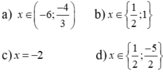
CM
9 tháng 9 2017
+ 2x2 + y2 – 8x + 2y – 1 = 0 không phải phương trình đường tròn vì hệ số của x2 khác hệ số của y2.
+ Phương trình x2 + y2 + 2x – 4y – 4 = 0 có :
a = –1; b = 2; c = –4 ⇒ a2 + b2 – c = 9 > 0
⇒ phương trình trên là phương trình đường tròn.
+ Phương trình x2 + y2 – 2x – 6y + 20 = 0 có :
a = 1; b = 3; c = 20 ⇒ a2 + b2 – c = –10 < 0
⇒ phương trình trên không là phương trình đường tròn.
+ Phương trình x2 + y2 + 6x + 2y + 10 = 0 có :
a = –3; b = –1; c = 10 ⇒ a2 + b2 – c = 0 = 0
⇒ phương trình trên không là phương trình đường tròn.
NL
Nguyễn Lê Phước Thịnh
CTVHS
25 tháng 9
1: ĐKXĐ: x<>0
\(\sqrt{x^2+x+2} + \frac{1}{x} = \frac{13-7x}{2}\)
\(\Leftrightarrow \sqrt{x^2+x+2} = \frac{13}{2} - \frac{7x}{2} - \frac{1}{x} = \frac{13x - 7x^2 - 2}{2x}\)
=>\(\left(\sqrt{x^2+x+2} - 2\right) + \left(\frac{1}{x} - 1\right) + \frac{7x - 7}{2} = 0\)
=>\(\frac{x^2+x-2}{\sqrt{x^2+x+2} + 2}+\frac{1-x}{x}+\frac{7(x-1)}{2}=0\)
=>\((x-1)\left[\frac{x+2}{\sqrt{x^2+x+2} + 2}-\frac{1}{x}+\frac{7}{2}\right]=0\)
=>x-1=0
=>x=1(nhận)
7: ĐKXĐ: \(16-x^2>0\)
=>\(x^2<16\)
=>-4<x<4
\(\frac{x^3}{\sqrt{16-x^2}} + x^2 - 16 = 0\)
\(\Leftrightarrow \frac{x^3}{\sqrt{16-x^2}} - \left(\sqrt{16-x^2}\right)^2 = 0\)
\(\Leftrightarrow x^3 - \left(\sqrt{16-x^2}\right)^3 = 0\)
\(\Leftrightarrow x^3 = \left(\sqrt{16-x^2}\right)^3\)
\(\Leftrightarrow x = \sqrt{16-x^2} \quad (x > 0)\)
\(\Leftrightarrow x^2 = 16 - x^2\) và x>0
=>\(2x^2=16\) và x>0
=>\(x^2=8\) và 0<x<4
=>\(x=2\sqrt2\)
CM
10 tháng 10 2019
a) Cách 1: Khai triển HĐT rút gọn được 3 x 2 + 6x + 7 = 0
Vì (3( x 2 + 2x + 1) + 4 < 0 với mọi x nên giải được x ∈ ∅
Cách 2. Chuyển vế đưa về ( x + 3 ) 3 = ( x - 1 ) 3 Û x + 3 = x - 1
Từ đó tìm được x ∈ ∅
b) Đặt x 2 = t với t ≥ 0 ta được t 2 + t - 2 = 0
Giải ra ta được t = 1 (TM) hoặc t = -2 (KTM)
Từ đó tìm được x = ± 1
c) Biến đổi được 
d) Biến đổi về dạng x(x - 2) (x - 4) = 0. Tìm được x ∈ {0; 2; 4}
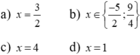
NN
2
Y
11 tháng 4 2022
\(x^2-2x+1< 9\)
\(\Leftrightarrow\left(x-1\right)^2< 9\)
\(\Leftrightarrow x-1< 3\)
\(\Leftrightarrow x< 4\)
\(\left(x-1\right)\left(4-x^2\right)\ge0\)
\(\Leftrightarrow\left(x-1\right)\left(2-x\right)\left(2+x\right)\ge0\)
\(\Leftrightarrow\left[{}\begin{matrix}x-1=0\\2-x=0\\2+x=0\end{matrix}\right.\)
\(\Leftrightarrow\left[{}\begin{matrix}x=1\\x=2\\x=-2\end{matrix}\right.\)
\(\dfrac{x+2}{x-5}< 0\)
\(\Leftrightarrow x+2< 0\)
\(\Leftrightarrow x< -2\)
11 tháng 4 2022
a)\(x^2-2x+1< 9\)
\(\Leftrightarrow\left(x-1\right)^2< 9\)
\(\Leftrightarrow\left(x-1\right)^2-9< 0\)
\(\Leftrightarrow\left(x-1-3\right)\left(x-1+3\right)< 0\)
\(\Leftrightarrow\left(x-4\right)\left(x+2\right)< 0\)
\(\Leftrightarrow\left[{}\begin{matrix}x-4< 0\\x+2>0\end{matrix}\right.hay\left[{}\begin{matrix}x-4>0\\x+2< 0\end{matrix}\right.\)
\(\Leftrightarrow\left[{}\begin{matrix}x< 4\\x>-2\end{matrix}\right.hay\left[{}\begin{matrix}x>4\\x< -2\end{matrix}\right.\)(vô lý)
-Vậy nghiệm của BĐT là \(-2< x< 4\).
b) \(\left(x-1\right)\left(4-x^2\right)\ge0\)
\(\Leftrightarrow\left(x-1\right)\left(2-x\right)\left(x+2\right)\ge0\)
\(\Leftrightarrow\left(x-1\right)\left(x-2\right)\left(x+2\right)\le0\)
\(\Leftrightarrow\left[{}\begin{matrix}x-1< 0\\x-2>0\\x+2>0\end{matrix}\right.\) hay \(\left[{}\begin{matrix}x-1>0\\x-2< 0\\x+2>0\end{matrix}\right.\) hay \(\left[{}\begin{matrix}x-1>0\\x-2 >0\\x+2< 0\end{matrix}\right.\) hay \(\left[{}\begin{matrix}x-1< 0\\x-2< 0\\x+2< 0\end{matrix}\right.\)
\(\Leftrightarrow\left[{}\begin{matrix}x< 1\\x>2\\x>-2\end{matrix}\right.\) (vô lí) hay \(\left[{}\begin{matrix}x>1\\x< 2\\x>-2\end{matrix}\right.\) (có thể xảy ra) hay
\(\left[{}\begin{matrix}x>1\\x>2\\x< -2\end{matrix}\right.\) (vô lí) hay \(\left[{}\begin{matrix}x< 1\\x< 2\\x< -2\end{matrix}\right.\) (có thể xảy ra)
-Vậy nghiệm của BĐT là \(x< -2\) hay \(1< x< 2\).
c) ĐKXĐ: \(x\ne5\)
\(\dfrac{x+2}{x-5}< 0\Leftrightarrow\left[{}\begin{matrix}x+2< 0\\x-5>0\end{matrix}\right.hay\left[{}\begin{matrix}x+2>0\\x-5< 0\end{matrix}\right.\Leftrightarrow\left[{}\begin{matrix}x< -2\\x>5\end{matrix}\right.\)(vô lí) hay
\(\left[{}\begin{matrix}x>-2\\x< 5\end{matrix}\right.\) (có thể xảy ra)
-Vậy nghiệm của BĐT là \(-2< x< 5\)
NT
0
PT
2
MN
12 tháng 2 2020
Đề bài sai ! Sửa ạ :
a) \(\left(x^2+x+1\right)\left(6-2x\right)=0\)
\(\Leftrightarrow\orbr{\begin{cases}x^2+x+1=0\\6-2x=0\end{cases}}\)
\(\Leftrightarrow\orbr{\begin{cases}\left(x+\frac{1}{2}\right)^2+\frac{3}{4}=0\left(ktm\right)\\x=3\left(tm\right)\end{cases}}\)
Vậy tập nghiệm của phương trình là \(S=\left\{3\right\}\)
b) \(\left(8x-4\right)\left(x^2+2x+2\right)=0\)
\(\Leftrightarrow\orbr{\begin{cases}8x-4=0\\x^2+2x+2=0\end{cases}}\)
\(\Leftrightarrow\orbr{\begin{cases}x=\frac{1}{2}\left(tm\right)\\\left(x+1\right)^2+1=0\left(ktm\right)\end{cases}}\)
Vậy tập nghiệm của phương trình là \(S=\left\{\frac{1}{2}\right\}\)
13 tháng 2 2020
\(\left(x^2+x+1\right)\left(6-2x\right)=0\)
Mà \(x^2+x+1=\left(x+\frac{1}{2}\right)^2+\frac{1}{4}>0\)
\(\Rightarrow6-2x=0\Rightarrow x=3\)
CM
9 tháng 3 2019
Đáp án: D

 có hai nghiệm là
 . Ta thấy
 không thỏa mãn điều kiện của phương trình
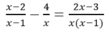 nên
 không là nghiệm của phương trình
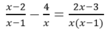 hay
 là nghiệm ngoại lai.
Ta nhận thấy
\(-x^2+2x-2=-\left[\left(x^2-2x+1\right)+1\right]\)
Ta có
\(x^2-2x+1\ge0\Rightarrow\left(x^2-2x+1\right)+1\ge1\)
\(\Rightarrow-\left[\left(x^2-2x+1\right)+1\right]\le-1\)
\(\Rightarrow PT\Leftrightarrow8x-4=0\Leftrightarrow x=\dfrac{1}{2}\)
\(\left(8x-4\right)\left(-x^2+2x-2\right)=0\Leftrightarrow\left(8x-4\right)\left(x^2-2x+2\right)=0\Leftrightarrow\left[{}\begin{matrix}8x-4=0\\x^2-2x+2=0\left(loai\right)\end{matrix}\right.\Leftrightarrow x=\dfrac{1}{4}\)
do \(x^2-2x+2=x^2-2x+1+1=\left(x-1\right)^2+1>0\)