
K
Khách
Hãy nhập câu hỏi của bạn vào đây, nếu là tài khoản VIP, bạn sẽ được ưu tiên trả lời.

Những câu hỏi liên quan
LV
1
12 tháng 6 2017
Áp dụng vi-et ta suy ra được nghiệm là:
\(\hept{\begin{cases}x=\frac{-m-\sqrt{m^2-4n}}{2}\\x=\frac{-m+\sqrt{m^2-4n}}{2}\end{cases}}\)
Ta có:
\(x_1=x_2^2+x_2+2\)
\(\Leftrightarrow x_1+x_2=\left(x_2+1\right)^2+1\)
\(\Leftrightarrow-m=\left(x_2+1\right)^2+1\)
Với \(\hept{\begin{cases}x_2=\frac{-m-\sqrt{m^2-4n}}{2}\\n=6-m\end{cases}}\)
\(\Leftrightarrow-m=\frac{\left(m-2\right)\sqrt{m^2+4m-24}+m^2-10}{2}+1\)
\(\Leftrightarrow-2m-m^2+8=\left(m-2\right)\sqrt{m^2+4m-24}\)
\(\Leftrightarrow4m^3+24m^2-144m+160=0\)
\(\Leftrightarrow\orbr{\begin{cases}m=-10\\m=2\left(l\right)\end{cases}}\)
Tương tự cho trường hợp còn lại.
PC
10 tháng 1 2019
gọi số vỏ lon bia lớp 8/1 nộp là a ( vỏ ) ( a\(\in\)N*, a< 720 )
=> số vỏ lớp 8 /2 phải nộp là 720 -a ( vỏ)
TĐB ta có (a - 40) / (720- a + 40) = 4/5
=> 5a - 200 = 3040 - 4a
a = 360
số lon của lớp 8/1 là 360 lon. số lon lớp 8/2 là 720 -360 = 360 lon
 và không có phương trình hóa học, KHÔNG CÓ PHƯƠNG TRÌNH HÓA HỌC
24 tháng 9 2016
Dùng nam châm hút sắt ra khỏi hỗn hợp . Đốt hỗn hợp còn lại lưu huỳnh cháy xanh lam còn nhôm cháy sáng chói (cái này trích mẫu thử một ít, thử xong là biết cái nào là Al cái nào là S)
PT
1
CM
21 tháng 10 2017
x 3 – 8 = 0
⇔ (x − 2)( x 2 + 2x + 4) = 0
⇔ x 1 = 2; x 2 = −1 + i 3 ; x 2 = −1 - i 3
PT
1
PT
1
CM
3 tháng 6 2017
x 3 + 8 = 0
⇔ (x + 2)( x 2 − 2x + 4) = 0
⇔ x 1 = −2; x 2 = 1 + i 3 ; x 3 = 1 - i 3
12 tháng 3 2021
đk: \(x\ge-3\)
Ta có: \(x^2-x+8=4\sqrt{x+3}\)
\(\Leftrightarrow\left(x^2-x\right)-\left(4\sqrt{x+3}-8\right)=0\)
\(\Leftrightarrow x\left(x-1\right)-\frac{16\left(x+3\right)-64}{4\sqrt{x+3}+8}=0\)
\(\Leftrightarrow x\left(x-1\right)-\frac{4\left(x-1\right)}{\sqrt{x+3}+2}=0\)
\(\Leftrightarrow\left(x-1\right)\left(x-\frac{4}{\sqrt{x+3}+2}\right)=0\)
\(\Leftrightarrow\orbr{\begin{cases}x=1\\x=\frac{4}{\sqrt{x+3}+2}\end{cases}}\)
Nếu \(x=\frac{4}{\sqrt{x+3}+2}\Leftrightarrow x\sqrt{x+3}+2x=4\)
\(\Leftrightarrow x\sqrt{x+3}=4-2x\Leftrightarrow x^2\left(x+3\right)=4x^2-16x+16\)
\(\Leftrightarrow x^3-x^2+16x-16=0\)
\(\Leftrightarrow\left(x-1\right)\left(x^2+16\right)=0\Rightarrow x-1=0\Leftrightarrow x=1\)
Vậy x = 1
CM
4 tháng 3 2019
a) * Lớp 10C:
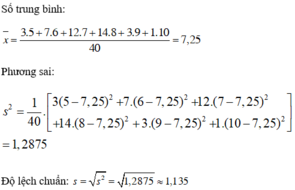
* Lớp 10D:
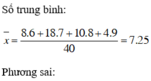

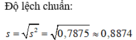
b) Kết quả lớp 10D có độ lệch chuẩn nhỏ hơn kết quả lớp 10C nên kết quả lớp 10D đồng đều hơn.
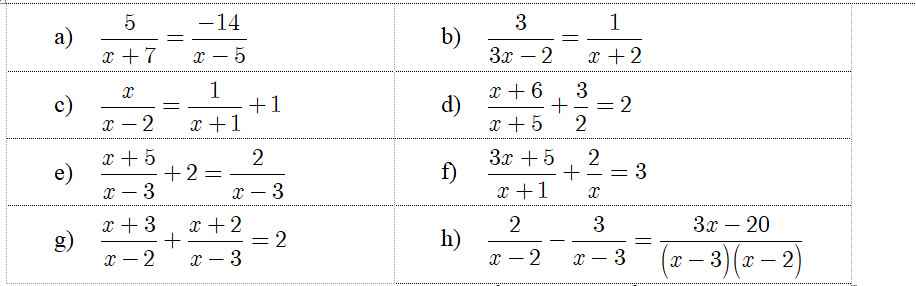
\(a)\dfrac{5}{x+7}=\dfrac{-14}{x-5}\left(x\ne-7;x\ne5\right)\\ \Leftrightarrow-14\left(x+7\right)=5\left(x-5\right)\\ \Leftrightarrow-14x-98=5x-25\\ \Leftrightarrow5x+14x=-98+25\\ \Leftrightarrow19x=-73\\ \Leftrightarrow x=-\dfrac{73}{19}\left(tm\right)\\ b)\dfrac{3}{3x-2}=\dfrac{1}{x+1}\left(x\ne\dfrac{2}{3};x\ne-1\right)\\ \Leftrightarrow3\left(x+1\right)=3x-2\\ \Leftrightarrow3x+3=3x-2\\ \Leftrightarrow3=-2\)
=> Pt vô nghiệm
\(c)\dfrac{x}{x-2}=\dfrac{1}{x+1}+1\left(x\ne2;x\ne-1\right)\\ \Leftrightarrow\dfrac{x}{x-2}=\dfrac{x+2}{x+1}\\ \Leftrightarrow x\left(x+1\right)=\left(x-2\right)\left(x+2\right)\\ \Leftrightarrow x^2+x=x^2-4\\ \Leftrightarrow x=-4\left(tm\right)\)
\(d)\dfrac{x+6}{x+5}+\dfrac{3}{2}=2\left(x\ne-5\right)\\ \Leftrightarrow\dfrac{2\left(x+6\right)}{2\left(x+5\right)}+\dfrac{3\left(x+5\right)}{2\left(x+5\right)}=2\\ \Leftrightarrow\dfrac{2\left(x+6\right)+3\left(x+5\right)}{2\left(x+5\right)}=2\\ \Leftrightarrow2x+12+3x+15=4\left(x+5\right)\\ \Leftrightarrow5x+27=4x+20\\ \Leftrightarrow5x-4x=20-27\\ \Leftrightarrow x=-7\left(tm\right)\)
e: ĐKXĐ: x<>3
\(\dfrac{x+5}{x-3}+2=\dfrac{2}{x-3}\)
=>\(\dfrac{x+5+2x-6}{x-3}=\dfrac{2}{x-3}\)
=>3x-1=2
=>3x=3
=>x=1(nhận)
f: ĐKXĐ: \(x\notin\left\{0;-1\right\}\)
\(\dfrac{3x+5}{x+1}+\dfrac{2}{x}=3\)
=>\(\dfrac{3x+3+2}{x+1}+\dfrac{2}{x}=3\)
=>\(\dfrac{2}{x+1}+\dfrac{2}{x}=0\)
=>\(\dfrac{2x+2x+2}{x\left(x+1\right)}=0\)
=>4x+2=0
=>4x=-2
=>\(x=-\dfrac{1}{2}\left(loại\right)\)
g: ĐKXĐ: \(x\notin\left\{3;2\right\}\)
\(\dfrac{x+3}{x-2}+\dfrac{x+2}{x-3}=2\)
=>\(\dfrac{\left(x+3\right)\left(x-3\right)+\left(x+2\right)\left(x-2\right)}{\left(x-2\right)\left(x-3\right)}=2\)
=>\(\dfrac{x^2-9+x^2-4}{x^2-5x+6}=2\)
=>\(2\left(x^2-5x+6\right)=2x^2-13\)
=>-10x+12=-13
=>-10x=-25
=>\(x=\dfrac{5}{2}\left(nhận\right)\)
h: ĐKXĐ: \(x\notin\left\{2;3\right\}\)
\(\dfrac{2}{x-2}-\dfrac{3}{x-3}=\dfrac{3x-20}{\left(x-3\right)\left(x-2\right)}\)
=>\(\dfrac{2\left(x-3\right)-3\left(x-2\right)}{\left(x-2\right)\left(x-3\right)}=\dfrac{3x-20}{\left(x-3\right)\left(x-2\right)}\)
=>\(2x-6-3x+6=3x-20\)
=>3x-20=-x
=>4x=20
=>x=5(nhận)