
Cho phương trình: 3x^2-2(m+1)+3m-5=0. Tìm m để x1=3x2
K
Khách
Hãy nhập câu hỏi của bạn vào đây, nếu là tài khoản VIP, bạn sẽ được ưu tiên trả lời.

Những câu hỏi liên quan
XO
12 tháng 2 2023
a) (*) m = 0 => x = \(\dfrac{7}{8}\) (loại)
(*) \(m\ne0\) Phương trình có nghiệm
\(\Delta=\left[2\left(m-4\right)\right]^2-4m\left(m+7\right)=-60m+64\ge0\Leftrightarrow m\le\dfrac{16}{15}\)
Hệ thức Viet kết hợp 4x1 + 3x2 = 1
\(\Leftrightarrow\left\{{}\begin{matrix}x_1x_2=\dfrac{m+7}{m}\\x_1+x_2=\dfrac{8-2m}{m}\\x_1=2x_2\end{matrix}\right.\)\(\Leftrightarrow\left\{{}\begin{matrix}x_1x_2=\dfrac{m+7}{m}\\x_1=\dfrac{16-4m}{3m}\\x_2=\dfrac{8-2m}{3m}\end{matrix}\right.\)
\(\Leftrightarrow\dfrac{16-4m}{3m}.\dfrac{8-2m}{3m}=\dfrac{m+7}{m}\)
\(\Leftrightarrow2\left(8-2m\right)^2=9m\left(m+7\right)\)
\(\Leftrightarrow8m^2-64m+128=9m^2+63m\)
\(\Leftrightarrow m^2+127m-128=0\Leftrightarrow\left[{}\begin{matrix}m=1\\m=128\left(\text{loại}\right)\end{matrix}\right.\)<=> m = 1
NL
Nguyễn Lê Phước Thịnh
CTVHS
16 tháng 11 2025
\(\Delta=\left(-3\right)^2-4\cdot1\cdot\left(m-3\right)\)
=9-4m+12
=-4m+21
Để phương trình có hai nghiệm thì -4m+21>=0
=>-4m>=-21
=>\(m\le\frac{21}{4}\)
Theo Vi-et, ta có: \(\begin{cases}x_1+x_2=-\frac{b}{a}=3\\ x_1x_2=\frac{c}{a}=m-3\end{cases}\)
\(x_1^2+3x_2=x_1^2\cdot x_2^2-11\)
=>\(x_1^2+x_2\left(x_1+x_2\right)=\left(x_1x_2\right)^2-11\)
=>\(\left(x_1^2+x_2^2\right)+x_1x_2=\left(x_1x_2\right)^2-11\)
=>\(\left(x_1+x_2\right)^2-x_1x_2-\left(x_1x_2\right)^2=-11\)
=>\(3^2-\left(m-3\right)-\left(m-3\right)^2=-11\)
=>\(9-m+3-m^2+6m-9=-11\)
=>\(-m^2+5m+3+11=0\)
=>\(-m^2+5m+14=0\)
=>\(m^2-5m-14=0\)
=>(m-7)(m+2)=0
=>\(\left[\begin{array}{l}m=7\left(loại\right)\\ m=-2\left(nhận\right)\end{array}\right.\)
NL
Nguyễn Lê Phước Thịnh
CTVHS
30 tháng 5 2023
=>(x1-1)[x2^2-x2(x1+x2-1)+x1x2+1]=-3
=>(x1-1)[-x1x2+x2+x1x2+1]=-3
=>(x1-1)(x2+1)=-3
=>x1x2+(x1-x2)-1=-3
=>(x1-x2)=-3+1-x1x2=-2-m+5=-m+3
=>(x1+x2)^2-4x1x2=m^2-6m+9
=>4^2-4(m-5)=m^2-6m+9
=>4m-20=16-m^2+6m-9=-m^2+6m+7
=>4m-20+m^2-6m-7=0
=>m^2-2m-27=0
=>\(m=1\pm2\sqrt{7}\)
NL
Nguyễn Lê Phước Thịnh
CTVHS
2 tháng 8 2023
b: x1=3x2 và x1+x2=2m-2
=>3x2+x2=2m-2 và x1=3x2
=>x2=0,5m-0,5 và x1=1,5m-1,5
x1*x2=-2m
=>-2m=(0,5m-0,5)(1,5m-1,5)
=>-2m=0,75(m^2-2m+1)
=>0,75m^2-1,5m+0,75+2m=0
=>\(m\in\varnothing\)
c: x1/x2=3
x1+x2=2m-2
=>x1=3x2 và x1+x2=2m-2
Cái này tương tự câu b nên kết quả vẫn là ko có m thỏa mãn
NL
Nguyễn Lê Phước Thịnh
CTVHS
9 tháng 4 2022
\(\text{Δ}=\left(-3\right)^2-4\left(m-1\right)=-4m+4+9=-4m+13\)
Để phương trình có hai nghiệm phân biệt thì -4m+13>0
hay m<13/4
Áp dụng Vi-et, ta được: \(\left\{{}\begin{matrix}x_1+x_2=3\\x_1x_2=m-1\end{matrix}\right.\)
Theo đề, ta có hệ phương trình:
\(\left\{{}\begin{matrix}x_1+x_2=3\\2x_1-3x_2=1\end{matrix}\right.\Leftrightarrow\left\{{}\begin{matrix}x_1=2\\x_2=1\end{matrix}\right.\)
Theo đề, ta có: m-1=2
hay m=3(nhận)
MH
31 tháng 1 2023
\(x^2-2\left(m+1\right)x+4m=0\)
\(\text{∆}=4\left(m+1\right)^2-16m=4\left(m-1\right)^2\)
để phương trình có 2 nghiệm phân biệt:
\(\Leftrightarrow\left(m-1\right)^2>0\Leftrightarrow m\ne1\)
\(\Rightarrow\left\{{}\begin{matrix}x_1=\dfrac{2\left(m+1\right)+2\left(m-1\right)}{2}=2m\\x_2=\dfrac{2\left(m+1\right)-2\left(m-1\right)}{2}=2\end{matrix}\right.\)
Ta có:
\(x_1=-3x_2\)
\(\Rightarrow2m=-6\Rightarrow m=-3\left(TM\right)\)
Vậy ...
AH
Akai Haruma
Giáo viên
22 tháng 5 2021
Lời giải:
Để pt có 2 nghiệm thì:
$\Delta'=(m-1)^2+2m-5\geq 0$
$\Leftrightarrow m^2-4\geq 0$
$\Leftrightarrow m\geq 2$ hoặc $m\leq -2$
Áp dụng định lý Viet: \(\left\{\begin{matrix}
x_1+x_2=2(1-m)\\
x_1x_2=-2m+5\end{matrix}\right.\)
\(2x_1+3x_2=-5\)
\(\Leftrightarrow 2(x_1+x_2)+x_2=-5\Leftrightarrow 4(1-m)+x_2=-5\)
\(\Leftrightarrow x_2=4m-9\)
\(x_1=2(1-m)-x_2=11-6m\)
$x_1x_2=-2m+5$
$\Leftrightarrow (4m-9)(11-6m)=-2m+5$
Giải pt này suy ra $m=2$ hoặc $m=\frac{13}{6}$ (đều thỏa mãn)
NL
Nguyễn Lê Phước Thịnh
CTVHS
27 tháng 3
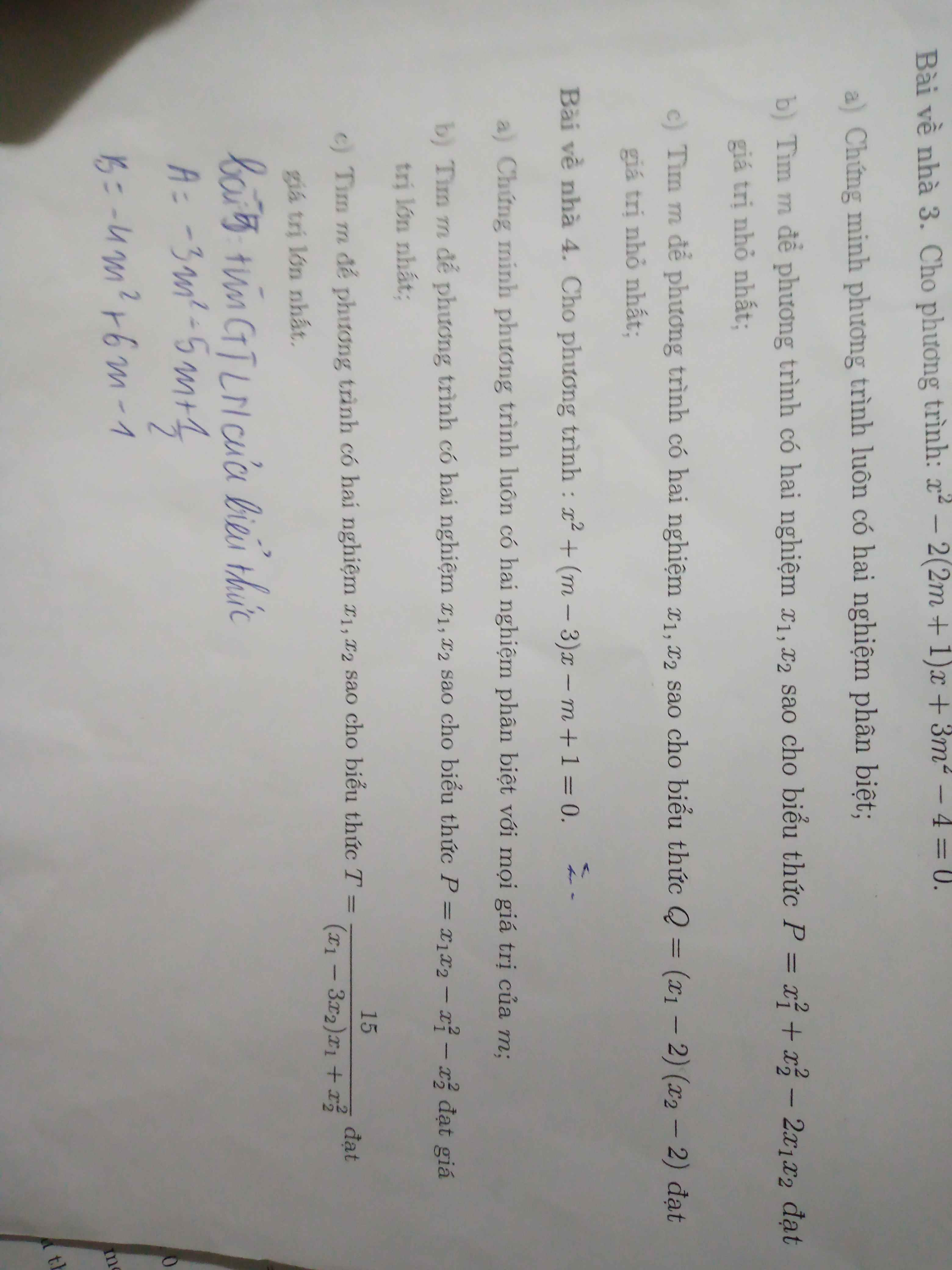
Bài 4:
a: \(\Delta=\left(m-3\right)^2-4\cdot1\cdot\left(-m+1\right)\)
\(=m^2-6m+9+4m-4=m^2-2m+5\)
\(=m^2-2m+1+4=\left(m-1\right)^2+4\ge4>0\forall m\)
=>Phương trình luôn có hai nghiệm phân biệt
b: Theo Vi-et, ta có:
\(x_1+x_2=-\frac{b}{a}=-m+3;x_1x_2=\frac{c}{a}=-m+1\)
\(P=x_1x_2-x_1^2-x_2^2\)
\(=x_1x_2-\left(x_1^2+x_2^2\right)\)
\(=x_1x_2-\left\lbrack\left(x_1+x_2\right)^2-2x_1x_2\right\rbrack=3x_1x_2-\left(x_1+x_2\right)^2\)
\(=3\left(-m+1\right)-\left(-m+3\right)^2\)
\(=-3m+3-m^2+6m-9=-m^2+3m-6\)
\(=-\left(m^2-3m+6\right)\)
\(=-\left(m^2-3m+\frac94+\frac{15}{4}\right)=-\left(m-\frac32\right)^2-\frac{15}{4}\le-\frac{15}{4}\forall m\)
Dấu '=' xảy ra khi m-3/2=0
=>m=3/2
c: \(\left(x_1-3x_2\right)\cdot x_1+x_2^2\)
\(=x_1^2+x_2^2-3x_1x_2\)
\(=\left(x_1^2+x_2^2+2x_1x_2\right)-5x_1x_2=\left(x_1+x_2\right)^2-5x_1x_2\)
\(=\left(-m+3\right)^2-5\left(-m+1\right)\)
\(=m^2-6m+9+5m-5=m^2-m+4=m^2-m+\frac14+\frac{15}{4}\)
\(=\left(m-\frac12\right)_{}^2+\frac{15}{4}\ge\frac{15}{4}\forall m\)
=>\(T\le15:\frac{15}{4}=4\forall m\)
Dấu '=' xảy ra khi \(m-\frac12=0\)
=>m=1/2
Bài 3:
a: \(\Delta=\left\lbrack-2\left(2m+1\right)\right\rbrack^2-4\left(3m^2-4\right)\)
\(=4\left(4m^2+4m+1\right)-4\left(3m^2-4\right)=4\left(4m^2+4m+1-3m^2+4\right)\)
\(=4\left(m^2+4m+5\right)=4\left(m+2\right)^2+4\ge4\forall m\)
=>Phương trình luôn có hai nghiệm phân biệt
b: \(P=x_1^2+x_2^2-2x_1x_2\)
\(=x_1^2+x_2^2+2x_1x_2-4x_1x_2\)
\(=\left(x_1+x_2\right)^2-4x_1x_2\)
\(=\left(4m+2\right)^2-4\left(3m^2-4\right)=16m^2+16m+4-12m^2+16=4m^2+16m+16+4\)
\(=\left(2m+4\right)^2+4\ge4\forall m\)
Dấu '=' xảy ra khi m+2=0
=>m=-2
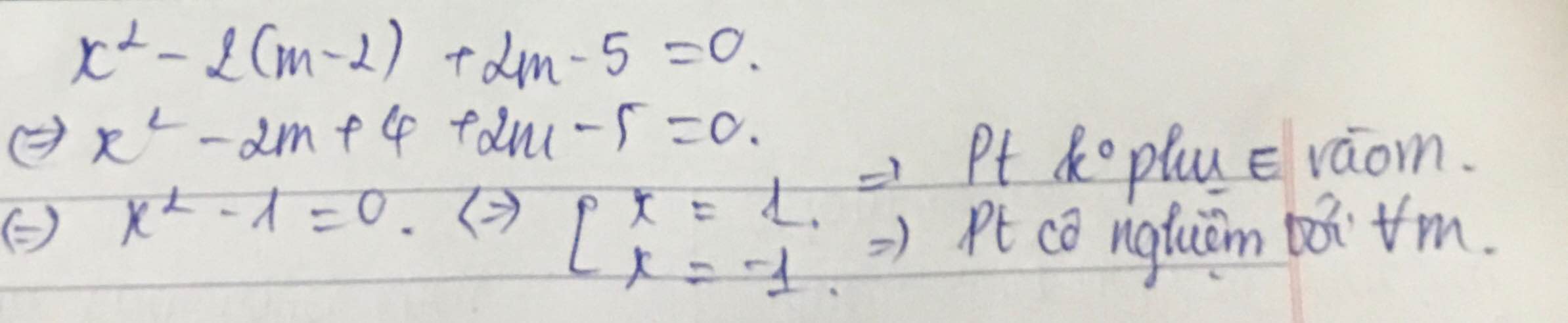
27 tháng 4 2020
Câu a )
\(2x^4+3x^2-2=0\left(1\right)\)
Đặt \(t=x^2\left(t\ge0\right)\) phương trình (1) trở thành:
\(2t^2+3t-2=0\)
\(\Leftrightarrow t\left(2t-1\right)+4t-2=0\)
\(\Leftrightarrow t\left(2t-1\right)+2\left(2t-1\right)=0\)
\(\Leftrightarrow\left(2t-1\right)\left(t+2\right)=0\)
\(\Leftrightarrow\orbr{\begin{cases}2t-1=0\\t+2=0\end{cases}}\)
\(\Leftrightarrow\orbr{\begin{cases}t=\frac{1}{2}\\1=-2\left(loại\right)\end{cases}}\)
Với \(t=\frac{1}{2}\Leftrightarrow x^2=\frac{1}{2}\Rightarrow x=\pm\frac{\sqrt{2}}{2}\)
Vậy tập nghiệm của phương trình là \(S=\left\{\pm\frac{\sqrt{2}}{2}\right\}\)
27 tháng 4 2020
Câu b )
\(\Delta=\left(m+1\right)^2-4m=m^2-2m+1=\left(m-1\right)^2\)
\(\Delta>0\Leftrightarrow\left(m-1\right)^2>0\Leftrightarrow m\ne1\)
\(\hept{\begin{cases}x_1+x_2=m+1\\x_1x_2=m\end{cases}}\)
\(x_1=3x_2\Rightarrow3x_2+x_2=m+1\Leftrightarrow4x_2=m+1\)
\(\Leftrightarrow x_2=\frac{m+1}{4}\Rightarrow x_1=\frac{3\left(m+1\right)}{4}\)
\(x_1x_2=m\Leftrightarrow\frac{3\left(m+1\right)^2}{16}=m\)
\(\Leftrightarrow3m^2+6m+3=16m\)
\(\Leftrightarrow3m^2-10m+3=0\)
\(\Leftrightarrow\left(3m-1\right)\left(m-3\right)=0\)
\(\Leftrightarrow\orbr{\begin{cases}m=\frac{1}{3}\\m=3\end{cases}\left(tm\right)}\)
pt có 2 nghiệm <=> \(\Delta=4\left(m+1\right)^2-4.3\left(3m-5\right)=4m^2+8m+4-36m+60=4m^2-28m+49+15=\left(2m-7\right)^2+15>0\)
=> pt luôn có 2 nghiệm pb với mọi m
áp dụng vi ét ta có: \(\int^{x1+x2=\frac{2m+2}{3}\left(1\right)}_{x1.x2=\frac{3m-5}{3}\left(2\right)}\)
thay: x1=3x2 vào hpt ta có:
\(\int^{3x2+x2=\frac{2m+2}{3}}_{x1.x2=\frac{3m-5}{3}}\Leftrightarrow\int^{4x2=\frac{2m+2}{3}}_{x1.x2=\frac{3m-5}{3}}\Leftrightarrow\int^{x2=\frac{m+1}{6}\Rightarrow x1=\frac{3\left(m+1\right)}{6}=\frac{m+1}{2}}_{\frac{m+1}{6}.\frac{m+1}{2}=\frac{3m-5}{3}}\Leftrightarrow\frac{\left(m+1\right)^2}{12}=\frac{3m-5}{3}\)
\(\Leftrightarrow3m^2+6m+3=36m-60\Leftrightarrow3m^2-30m+63=0\Leftrightarrow m^2-10m+21=0\Leftrightarrow\left(m-7\right)\left(m-3\right)=0\)
> m=7 hoặc m=3