
tìm số nguyên x biết:
a) 4+(-5)+(-1)+x=-10
b) (-3)+8+(-7)= -15+3
Hãy nhập câu hỏi của bạn vào đây, nếu là tài khoản VIP, bạn sẽ được ưu tiên trả lời.

a,-4/7=x/21
-12/21 = x/21
x= -12
b,(x-3)/15=1/-5
x - 3 = -1/5 * 15
x - 3 = -3
x = 0
c,.(3x+8)/-12=-5/30
=> 3x + 8 = 2
=> 3x=-6
=>x=-2
a) Ta có: 12-5x=37
\(\Leftrightarrow5x=-25\)
hay x=-5
Vậy: x=-5
b) Ta có: 7-3|x-2|=-11
\(\Leftrightarrow3\left|x-2\right|=18\)
\(\Leftrightarrow\left|x-2\right|=6\)
\(\Leftrightarrow\left[{}\begin{matrix}x-2=6\\x-2=-6\end{matrix}\right.\Leftrightarrow\left[{}\begin{matrix}x=8\\x=-4\end{matrix}\right.\)
Vậy: \(x\in\left\{8;-4\right\}\)
c) Ta có: \(x+\dfrac{2}{8}=-\dfrac{15}{4}\)
\(\Leftrightarrow x=\dfrac{-15}{4}-\dfrac{2}{8}=\dfrac{-15}{4}-\dfrac{1}{4}\)
hay x=-4
Vậy: x=-4
a, \(\Leftrightarrow5x=12-37=-25\)
\(\Leftrightarrow x=-\dfrac{25}{5}=-5\)
Vậy ...
b, \(\Leftrightarrow3\left|x-2\right|=7+11=18\)
\(\Leftrightarrow\left|x-2\right|=\dfrac{18}{3}=6\)
\(\Leftrightarrow\left[{}\begin{matrix}x-2=6\\x-2=-6\end{matrix}\right.\)
\(\Leftrightarrow\left[{}\begin{matrix}x=8\\x=-4\end{matrix}\right.\)
Vậy ...
c, \(\Leftrightarrow x=-\dfrac{15}{4}-\dfrac{2}{8}=-4\)
Vậy ..
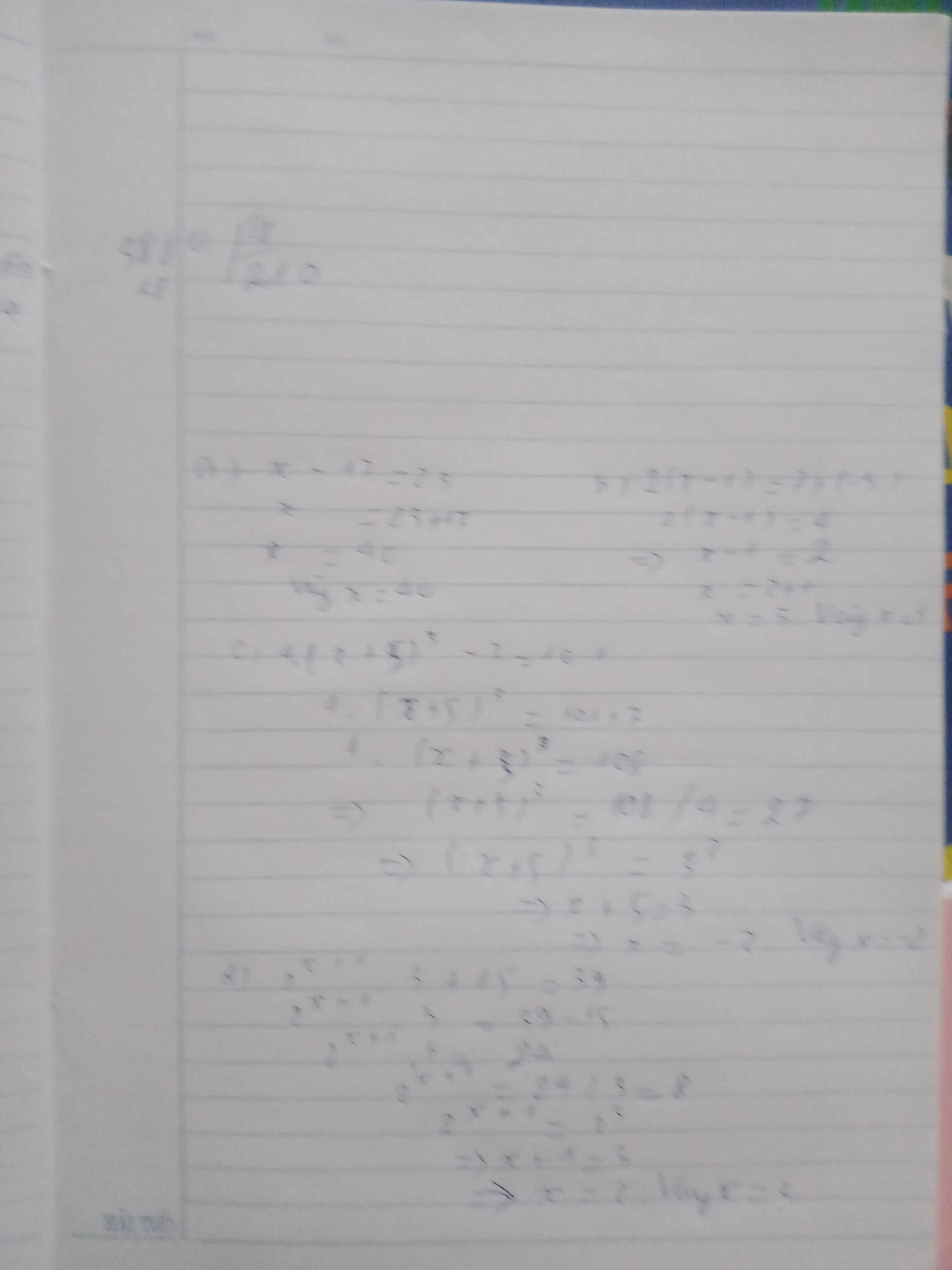
a) x - 17 = 23
x = 23 + 17
x = 40
Vậy x = 40
b) 2 ( x - 1 ) = 7 + ( - 3 )
x - 1 = 4 : 2
x = 2 + 1
x = 3
Vậy x = 3
c) 4 ( x + 3 )^3 - 7 = 101
4 ( x + 3 )^3 = ( 101 + 7 ) : 4
( x + 3 )^3 = 3^3
⇒ x + 3 = 3
⇒ x = 0
Vậy x = 0
d) 2^{ x+ 1 } . 3 + 15 = 39
2^{ x + 1 } = ( 39 - 15 ) : 3
2^{ x + 1 } = 2{ 2 + 1 }
⇒ x + 1 = 2 + 1
⇒ x = 2
Vậy x = 2
a: =>x/-3=3
hay x=-9
b: =>x/9=-1/9
hay x=-1
c: =>x+1/5=-1/3
hay x=-8/15
d: =>-7/x=-7/9
hay x=9
a, \(\dfrac{x}{-3}=3\Leftrightarrow x=-9\)
b, \(\dfrac{x}{9}=-\dfrac{1}{9}\Rightarrow x=-1\)
c, \(\dfrac{x+3}{15}=-\dfrac{6}{15}\Rightarrow x=-9\)
d, \(\dfrac{42}{-54}=-\dfrac{42}{6x}\Rightarrow6x=54\Leftrightarrow x=9\)
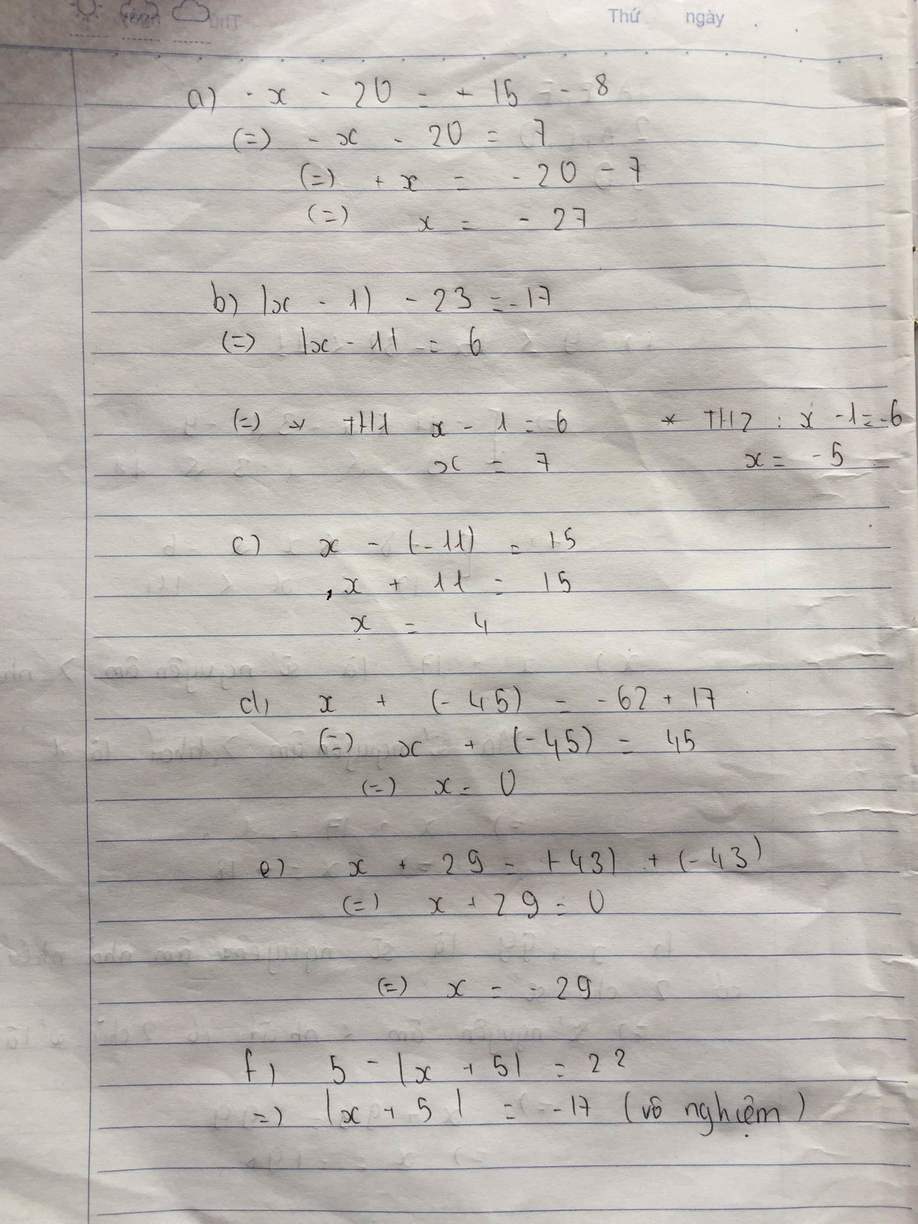
a: Sửa đề: -x+20=-(-25)-8
=>-x+20=25-8
=>20-x=17
=>x=20-17
=>x=3
b: x+(-45)=-62+17
=>x-45=-45
=>x=-45+45
=>x=0
Câu 1:
a) \(-\dfrac{3}{7}-\left(\dfrac{2}{3}-\dfrac{3}{7}\right)=\dfrac{-3}{7}-\dfrac{2}{3}+\dfrac{3}{7}=\dfrac{-2}{3}\)
Câu 2:
b) \(\dfrac{2}{15}:\left(\dfrac{1}{3}\cdot\dfrac{4}{5}-\dfrac{1}{3}\cdot\dfrac{6}{5}\right)=\dfrac{2}{15}:\left[\dfrac{1}{3}\left(\dfrac{4}{5}-\dfrac{6}{5}\right)\right]=\dfrac{2}{15}:\left(\dfrac{1}{3}\cdot\dfrac{-2}{5}\right)=\dfrac{2}{15}:\dfrac{-2}{15}=\dfrac{2}{-2}=-1\)
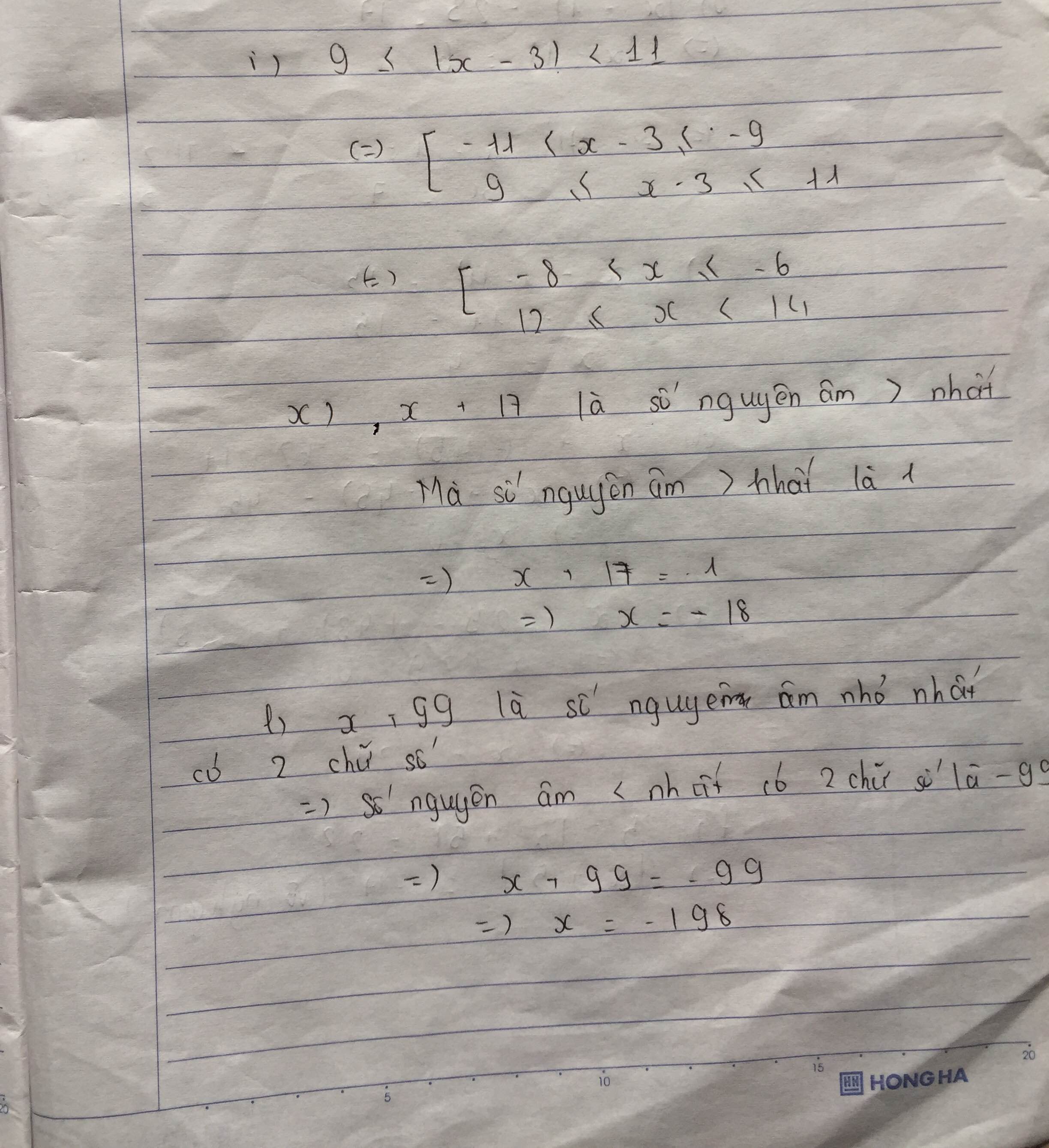
 kì thi sắp đến rồi áp lục quá

a) 4+(-5)+(-1)+x=-10
\(\Rightarrow2+x=-10\)
\(\Rightarrow x=-10-2=-12\)
a) 4+(-5)+(-1)+x=(-10)
(-1)+(-1)+x=(-10)
(-2)+x=(-10)
x=(-10)-(-2)
x=(-8)
Câu b ko có x