
1. Tìm hàm số bậc nhất f(x) biết
a. f( 2x - 1 ) + f( 2x + 1 ) - f(x) = x + 3 \(\forall x\in R\)
Hãy nhập câu hỏi của bạn vào đây, nếu là tài khoản VIP, bạn sẽ được ưu tiên trả lời.

`f'(x) = x^2 - 4x+m`
`f'(x) >=0 <=>x^2-4x+m>=0`
`<=> \Delta' >=0`
`<=> 2^2-1.m>=0`
`<=> m<=4`
Vậy....
a: \(f\left(x\right)=4x+a-\sqrt{3}\left(2x+1\right)\)
\(=4x+a-2\sqrt{3}\cdot x-\sqrt{3}\)
\(=x\left(4-2\sqrt{3}\right)-\sqrt{3}+a\)
Vì \(4-2\sqrt{3}=\left(\sqrt{3}-1\right)^2>0\)
nên hàm số \(y=f\left(x\right)=x\left(4-2\sqrt{3}\right)+a-\sqrt{3}\) luôn đồng biến trên R
b: f(x)=0
=>\(x\left(4-2\sqrt{3}\right)+a-\sqrt{3}=0\)
=>\(x\left(4-2\sqrt{3}\right)=-a+\sqrt{3}\)
=>\(x=\dfrac{-a+\sqrt{3}}{4-2\sqrt{3}}\)
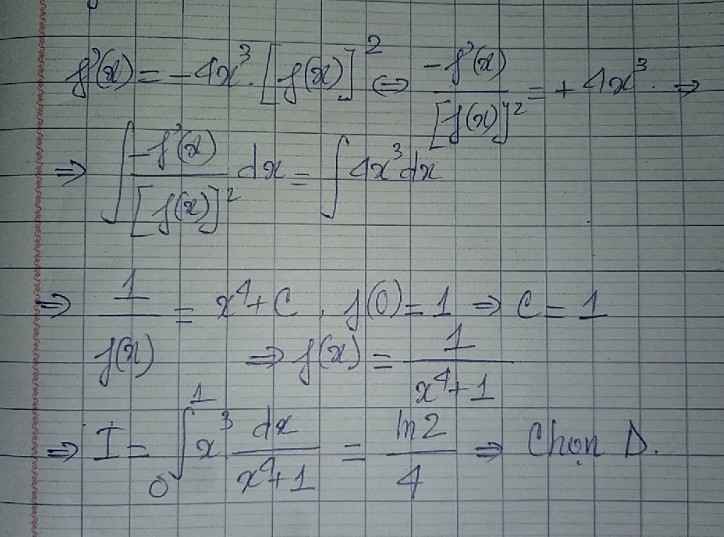
\(f'\left(x\right)=-4x^3\left(f\left(x\right)\right)^2\Leftrightarrow-\dfrac{f'\left(x\right)}{\left(f\left(x\right)\right)^2}=4x^3\)
Lấy nguyên hàm hai vế
\(\int-\dfrac{f'\left(x\right)}{\left(f\left(x\right)\right)^2}dx=\int4x^3dx\)
\(\Leftrightarrow\dfrac{1}{f\left(x\right)}=x^4+c\)
Thay x=0 vào tìm được c=1 \(\Rightarrow f\left(x\right)=\dfrac{1}{x^4+1}\)
\(I=\int\limits^1_0\dfrac{x^3}{x^4+1}dx=\dfrac{1}{4}\int\limits^1_0\dfrac{\left(x^4+1\right)'}{x^4+1}dx=\dfrac{ln2}{4}\)
Chọn D
a: TXĐ: \(D=R\backslash\left\{-\dfrac{1}{2}\right\}\)
b: TXĐ: \(D=R\backslash\left\{-3;1\right\}\)
c: TXĐ: \(D=\left[-\dfrac{1}{2};3\right]\)
a: \(5-2\cdot cos^2x\cdot\sin^2x\)
\(=5-2\cdot\left(\sin x\cdot cosx\right)^2\)
\(=5-2\cdot\left\lbrack\frac12\cdot2\cdot\sin x\cdot cosx\right\rbrack^2=5-2\cdot\left\lbrack\frac12\cdot\sin2x\right\rbrack^2\)
\(=5-2\cdot\frac14\cdot\sin^22x=-\frac12\cdot\sin^22x+5\)
\(0\le\sin^22x\le1\)
=>\(0\ge-\frac12\sin^22x\ge-\frac12\)
=>\(0+5\ge-\frac12\sin^22x+5\ge-\frac12+5\)
=>\(5\ge-\frac12\sin^22x+5\ge\frac92\)
=>\(\frac92\le-\frac12\sin^22x+5\le5\)
=>\(\sqrt{\frac92}\le\sqrt{-\frac12\cdot\sin^22x+5}\le\sqrt5\)
=>\(\frac{3\sqrt2}{2}\le\sqrt{-\frac12\cdot\sin^22x+5}\le\sqrt5\)
=>\(\frac{2}{3\sqrt2}\ge\frac{1}{\sqrt{-\frac12\cdot\sin^22x+5}}\ge\frac{1}{\sqrt5}\)
=>\(\frac{2\cdot4}{3\sqrt2}\ge\frac{1\cdot4}{\sqrt{-\frac12\cdot\sin^22x+5}}\ge\frac{1\cdot4}{\sqrt5}\)
=>\(\frac{4\sqrt2}{3}\ge y\ge\frac{4}{\sqrt5}\)
=>\(y_{\max}=\frac{4\sqrt2}{3}\) khi \(-\frac12\cdot\sin^22x+5=\frac92\)
=>\(-\frac12\cdot\sin^22x=-\frac12\)
=>\(\sin^22x=1\)
=>\(cos^22x=0\)
=>cos2x=0
=>\(2x=\frac{\pi}{2}+k\pi\)
=>\(x=\frac{\pi}{4}+\frac{k\pi}{2}\)
\(y_{\min}=\frac{4}{\sqrt5}\) khi \(-\frac12\cdot\sin^22x+5=5\)
=>\(\sin^22x=0\)
=>sin 2x=0
=>\(2x=k\pi\)
=>\(x=\frac{k\pi}{2}\)
b: \(f\left(x\right)=3\cdot\sin^2x+5\cdot cos^2x-4\cdot cos2x-2\)
\(=3\left(1-cos^2x\right)+5\cdot cos^2x-4\left(2\cdot cos^2x-1\right)-2\)
\(=3-3\cdot cos^2x+5\cdot cos^2x-8\cdot cos^2x+4-2=-6\cdot cos^2x+5\)
Ta có: \(0<=cos^2x\le1\)
=>\(0\ge-6\cdot cos^2x\ge-6\)
=>\(0+5\ge-6\cdot cos^2x+5\ge-6+5\)
=>5>=y>=-1
Do đó: \(y_{\min}=-1\) khi \(-6\cdot cos^2x+5=-1\)
=>\(-6\cdot cos^2x=-6\)
=>\(cos^2x=1\)
=>\(\sin^2x=0\)
=>sin x=0
=>\(x=k\pi\)
y max=5 khi \(-6\cdot cos^2x+5=5\)
=>\(-6\cdot cos^2x=0\)
=>cosx=0
=>\(x=\frac{\pi}{2}+k\pi\)
a: \(5-2\cdot cos^2x\cdot\sin^2x\)
\(=5-2\cdot\left(\sin x\cdot cosx\right)^2\)
\(=5-2\cdot\left(\frac12\cdot\sin2x\right)^2=5-2\cdot\frac14\cdot\sin^22x=-\frac12\cdot\sin^22x+5\)
Ta có: \(0\le\sin^22x\le1\)
=>\(-\frac12\le-\frac12\cdot\sin^22x\le0\)
=>\(-\frac12+5\le-\frac12\cdot\sin^22x+5\le0+5\)
=>\(\frac92\le-\frac12\cdot\sin^22x+5\le5\)
=>\(\frac{3\sqrt2}{2}\le\sqrt{-\frac12\cdot\sin^22x+5}\le\sqrt5\)
=>\(4:\frac{3\sqrt2}{2}\ge\frac{4}{\sqrt{-\frac12\cdot sin^22x+5}}\ge\frac{4}{\sqrt5}\)
=>\(\frac{2\sqrt2}{3}\ge y\ge\frac{4\sqrt5}{5}\)
Do đó: \(y_{\max}=\frac{2\sqrt2}{3}\) khi \(\sin^22x=1\)
=>\(cos^22x=0\)
=>cos2x=0
=>\(2x=\frac{\pi}{2}+k\pi\)
=>\(x=\frac{\pi}{4}+\frac{k\pi}{2}\)
\(y_{\min}=\frac{4\sqrt5}{5}\) khi \(\sin^22x=0\)
=>sin 2x=0
=>\(2x=k\pi\)
=>\(x=\frac{k\pi}{2}\)
b: \(f\left(x\right)=3\cdot\sin^2x+5\cdot cos^2x-4\cdot cos2x-2\)
\(=3\cdot\sin^2x+5\cdot cos^2x-4\left(cos^2x-\sin^2x\right)-2\)
\(=3\cdot\sin^2x+5\cdot cos^2x-4\cdot cos^2x+4\cdot\sin^2x-2\)
\(=7\cdot\sin^2x+cos^2x-2=7\cdot\sin^2x+1-\sin^2x-2=6\cdot\sin^2x-1\)
Ta có: \(0\le\sin^2x\le1\)
=>\(0\le6\sin^2x\le6\)
=>\(0-1\le6\sin^2x-1\le6-1\)
=>-1<=f(x)<=5
f(x) min=-1 khi \(\sin^2x=0\)
=>sin x=0
=>\(x=k\pi\)
f(x) max=5 khi \(\sin^2x=1\)
=>\(cos^2x=0\)
=>cosx=0
=>\(x=\frac{\pi}{2}+k\pi\)
Lời giải:
Từ $f(1+3x)=2x-f(1-2x)$ thay $x=0$ suy ra $f(1)=1$
$f(1+3x)=2x-f(1-2x)$
$\Rightarrow f'(1+3x)=(2x)'-f'(1-2x)$
$\Leftrightarrow 3f'(1+3x)=2+2f'(1-2x)$. Thay $x=0$ suy ra $f'(1)=2$
PTTT của $f(x)$ tại điểm $x=1$ là:
$y=f'(1)(x-1)+f(1)=2(x-1)+1=2x-1$


Đặt \(f\left(x\right)=ax+b\Rightarrow\left\{{}\begin{matrix}f\left(2x-1\right)=a\left(2x-1\right)+b=2ax-a+b\\f\left(2x+1\right)=a\left(2x+1\right)+b=2ax+a+b\end{matrix}\right.\)
\(f\left(2x-1\right)+f\left(2x+1\right)-f\left(x\right)=x+3\)
\(\Leftrightarrow2ax-a+b+2ax+a+b-ax-b=x+3\)
\(\Leftrightarrow3ax-x+b-3=0\)
\(\Leftrightarrow\left(3a-1\right)x+\left(b-3\right)=0\)
\(\Leftrightarrow\left\{{}\begin{matrix}3a-1=0\\b-3=0\end{matrix}\right.\) \(\Rightarrow\left\{{}\begin{matrix}a=\frac{1}{3}\\b=3\end{matrix}\right.\) \(\Rightarrow f\left(x\right)=\frac{1}{3}x+3\)