
tìm min, max của hàm số:
\(y=\frac{sinx+2cosx+3}{2+cosx}\)
Hãy nhập câu hỏi của bạn vào đây, nếu là tài khoản VIP, bạn sẽ được ưu tiên trả lời.

ĐKXĐ: \(sinx;cosx\ge0\)
Do \(\left\{{}\begin{matrix}0\le sinx\le1\\0\le cosx\le1\end{matrix}\right.\) \(\Rightarrow\left\{{}\begin{matrix}\sqrt{sinx}\ge sin^2x\\\sqrt{cosx}\ge cos^2x\end{matrix}\right.\)
\(\Rightarrow\sqrt{sinx}+\sqrt{cosx}\ge sin^2x+cos^2x=1\)
\(\Rightarrow y_{min}=1\) (khi \(x=\dfrac{\pi}{2}+k2\pi\) hoặc \(k2\pi\))
Mặt khác áp dụng Bunhiacopxki:
\(y\le\sqrt{2\left(sinx+cosx\right)}\le\sqrt{2\sqrt{2\left(sin^2x+cos^2x\right)}}=\sqrt[4]{8}\)
\(y_{max}=\sqrt[4]{8}\) khi \(x=\dfrac{\pi}{4}+k2\pi\)
a)\(y=\sqrt{3}sinx+cosx=2\left(\dfrac{\sqrt{3}}{2}sinx+\dfrac{1}{2}cosx\right)\)\(=2\left(sinx.cos\dfrac{\pi}{6}+cosx.sin\dfrac{\pi}{6}\right)\)\(=2sin\left(x+\dfrac{\pi}{6}\right)\)
Có \(-1\le sin\left(x+\dfrac{\pi}{6}\right)\le1\) \(\Leftrightarrow-2\le2sin\left(x+\dfrac{\pi}{6}\right)\le2\)
\(\Leftrightarrow-2\le y\le2\)
miny=-2 \(\Leftrightarrow sin\left(x+\dfrac{\pi}{6}\right)=-1\) \(\Leftrightarrow x+\dfrac{\pi}{6}=-\dfrac{\pi}{2}+2k\pi\left(k\in Z\right)\) \(\Leftrightarrow x=-\dfrac{2\pi}{3}+k2\pi\left(k\in Z\right)\)
maxy=2\(\Leftrightarrow sin\left(x+\dfrac{\pi}{6}\right)=1\) \(\Leftrightarrow x+\dfrac{\pi}{6}=\dfrac{\pi}{2}+k2\pi\left(k\in Z\right)\)\(\Leftrightarrow x=\dfrac{\pi}{3}+k2\pi\left(k\in Z\right)\)
b) \(y=sin2x-cos2x=\sqrt{2}sin\left(2x-\dfrac{\pi}{4}\right)\)
Có \(\sqrt{2}\ge\sqrt{2}sin\left(2x-\dfrac{\pi}{4}\right)\ge-\sqrt{2}\)
\(\Leftrightarrow\sqrt{2}\ge y\ge-\sqrt{2}\)
miny=\(-\sqrt{2}\) \(\Leftrightarrow sin\left(2x-\dfrac{\pi}{4}\right)=-1\)\(\Leftrightarrow2x-\dfrac{\pi}{4}=-\dfrac{\pi}{2}+k2\pi\left(k\in Z\right)\)\(\Leftrightarrow x=-\dfrac{\pi}{8}+k\pi\left(k\in Z\right)\)
maxy=\(\sqrt{2}\Leftrightarrow sin\left(2x-\dfrac{\pi}{4}\right)=1\)\(\Leftrightarrow x=\dfrac{3\pi}{8}+k\pi\left(k\in Z\right)\)
c) \(y=3sinx+4cosx=5\left(\dfrac{3}{5}sinx+\dfrac{4}{5}cosx\right)\)
Đặt \(cosa=\dfrac{3}{5}\) và \(sina=\dfrac{4}{5}\)(vì cos2a+sin2a=1)
\(y=5\left(sinx.cosa+cosx.sina\right)\)\(=5sin\left(x+a\right)\)
\(\Rightarrow-5\le y\le5\)
miny=-5 <=> \(sin\left(x+a\right)=-1\)\(\Leftrightarrow x=-\dfrac{\pi}{2}-arc.sina+k2\pi\left(k\in Z\right)\)
maxy=5 <=> \(sin\left(x+a\right)=1\)\(\Leftrightarrow x=\dfrac{\pi}{2}-arc.sina+k2\pi\left(k\in Z\right)\)
(P/s1:cái x ở câu c ấy trông nó ngu ngu??
P/s2:sau khi load lại câu hỏi ở 1 tab khác ,thấy 1 câu trả lời nhưng vẫn đăng vì cảm thấy bỏ đi hơi phí :?)
Áp dụng quy tắc sau: Nếu \(a\sin x+b\cos y=c\Leftrightarrow a^2+b^2\ge c^2\)
a/ \(3+1\ge y^2\Leftrightarrow4\ge y^2\Leftrightarrow-2\le y\le2\)
\(y_{max}=2\Leftrightarrow\sqrt{3}\sin x+\cos x=2\Leftrightarrow\dfrac{\sqrt{3}}{2}\sin x+\dfrac{1}{2}\cos x=1\Leftrightarrow\cos\dfrac{\pi}{6}.\sin x+\sin\dfrac{\pi}{6}.\cos x=1\)
\(\Rightarrow\sin\left(x+\dfrac{\pi}{6}\right)=1\Leftrightarrow x+\dfrac{\pi}{6}=\dfrac{\pi}{2}+k2\pi\Leftrightarrow x=\dfrac{\pi}{3}+k2\pi\)
\(y_{min}=-2\Leftrightarrow\sin\left(x+\dfrac{\pi}{6}\right)=-1\Leftrightarrow x+\dfrac{\pi}{6}=-\dfrac{\pi}{2}+k2\pi\Leftrightarrow x=-\dfrac{2}{3}\pi+k2\pi\)
Đáp án D
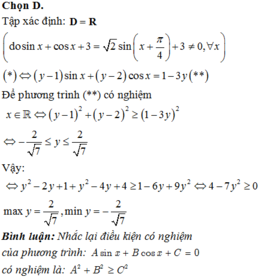
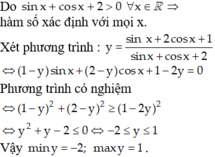
Ta có y = s inx + 2 cos x + 1 s inx + cos x + 2 ⇔ y − 1 s inx + y − 2 cos x = 1 − 2 y 1 .
PT (1) có nghiệm ⇔ y − 1 2 + y − 2 2 ≥ 1 − 2 y 2 ⇔ 2 y 2 + 2 y − 4 ≤ 0 ⇔ − 2 ≤ y ≤ 1 ⇒ M = 1.
Xét tính chẵn lẻ:
a) TXĐ: D = R \ {π/2 + kπ| k nguyên}
Với mọi x thuộc D ta có (-x) thuộc D và
\(f\left(-x\right)=\frac{3\tan^3\left(-x\right)-5\sin\left(-x\right)}{2+\cos\left(-x\right)}=-\frac{3\tan^3x-5\sin x}{2+\cos x}=-f\left(x\right)\)
Vậy hàm đã cho là hàm lẻ
b) TXĐ: D = R \ \(\left\{\pm\sqrt{2};\pm1\right\}\)
Với mọi x thuộc D ta có (-x) thuộc D và
\(f\left(-x\right)=\frac{\sin\left(-x\right)}{\left(-x\right)^4-3\left(-x\right)^2+2}=-\frac{\sin x}{x^4-3x^2+2}=-f\left(x\right)\)
Vậy hàm đã cho là hàm lẻ
Tìm GTLN, GTNN:
TXĐ: D = R
a) Ta có (\(\left(\sin x+\cos x\right)^2=1+\sin2x\)
Với mọi x thuộc D ta có\(-1\le\sin2x\le1\Leftrightarrow0\le1+\sin2x\le2\Leftrightarrow0\le\left(\sin x+\cos x\right)^2\le2\)
\(\Leftrightarrow0\le\left|\sin x+\cos x\right|\le\sqrt{2}\Leftrightarrow-\sqrt{2}\le\sin x+\cos x\le\sqrt{2}\)
Vậy \(Min_{f\left(x\right)}=-\sqrt{2}\) khi \(\sin2x=-1\Leftrightarrow2x=-\frac{\pi}{2}+k2\pi\Leftrightarrow x=-\frac{\pi}{4}+k\pi\)
\(Max_{f\left(x\right)}=\sqrt{2}\) khi\(\sin2x=1\Leftrightarrow x=\frac{\pi}{4}+k\pi\)
b) Với mọi x thuộc D ta có:
\(-1\le\cos x\le1\Leftrightarrow-2\le2\cos x\le2\Leftrightarrow1\le2\cos x+3\le5\)
\(\Leftrightarrow1\le\sqrt{2\cos x+3}\le\sqrt{5}\Leftrightarrow5\le\sqrt{2\cos x+3}+4\le\sqrt{5}+4\)
Vậy\(Min_{f\left(x\right)}=5\) khi \(\cos x=-1\Leftrightarrow x=\pi+k2\pi\)
\(Max_{f\left(x\right)}=\sqrt{5}+4\) khi \(\cos x=1\Leftrightarrow x=k2\pi\)
c) \(y=\sin^4x+\cos^4x=\left(\sin^2x+\cos^2x\right)^2-2\sin^2x\cos^2x\)\(=1-\frac{1}{2}\left(2\sin x\cos x\right)^2=1-\frac{1}{2}\sin^22x\)
Với mọi x thuộc D ta có: \(0\le\sin^22x\le1\Leftrightarrow-\frac{1}{2}\le-\frac{1}{2}\sin^22x\le0\Leftrightarrow\frac{1}{2}\le1-\frac{1}{2}\sin^22x\le1\)
Đến đây bạn tự xét dấu '=' xảy ra khi nào nha :p
Bài 1:
1: \(y=\frac{\sin x+2\cdot cosx+1}{2\cdot\sin x+cosx+3}\)
=>\(2y\cdot\sin x+y\cdot cosx+3y=\sin x+2\cdot cosx+1\)
=>\(\left(2y-1\right)\cdot\sin x+cosx\cdot\left(y-2\right)=1-3y\)
Để phương trình có nghiệm thì \(\left(2y-1\right)^2+\left(y-2\right)^2>=\left(1-3y\right)^2\)
=>\(4y^2-4y+1+y^2-4y+4\ge9y^2-6y+1\)
=>\(5y^2-8y+5-9y^2+6y-1\ge0\)
=>\(-4y^2-2y+4\ge0\)
=>\(y^2+\frac12y-1\le0\)
=>\(y^2+2\cdot y\cdot\frac14+\frac{1}{16}-\frac{17}{16}\le0\)
=>\(\left(y+\frac14\right)^2\le\frac{17}{16}\)
=>\(-\frac{\sqrt{17}}{4}\le y+\frac14\le\frac{\sqrt{17}}{4}\)
=>\(\frac{-\sqrt{17}-1}{4}\le y\le\frac{\sqrt{17}-1}{4}\)
=>\(y_{\min}=\frac{-\sqrt{17}-1}{4}\) và \(y_{\max}=\frac{\sqrt{17}-1}{4}\)
2: \(y=2\cdot\sin^2x-3\cdot\sin x\cdot cosx+cos^2x\)
\(=2\cdot\frac{1-cos2x}{2}-3\cdot\frac12\cdot\sin2x+\frac{1+cos2x}{2}\)
\(=1-cos2x-\frac32\cdot\sin2x+\frac12+\frac12\cdot cos2x\)
\(=-\frac32\cdot\sin2x-\frac12\cdot cos2x+\frac32=-\frac12\left(3\cdot\sin2x+cos2x-3\right)\)
\(=-\frac{\sqrt{10}}{2}\left(\frac{3}{\sqrt{10}}\cdot\sin2x+\frac{1}{\sqrt{10}}\cdot cos2x-\frac{3}{\sqrt{10}}\right)\)
\(=-\frac{\sqrt{10}}{2}\cdot\left\lbrack\sin\left(2x+\alpha\right)-\frac{3}{\sqrt{10}}\right\rbrack\) , với \(cosa=\frac{3}{\sqrt{10}};\sin a=\frac{1}{\sqrt{10}}\)
\(=-\frac{\sqrt{10}}{2}\cdot\sin\left(2x+\alpha\right)+\frac32\)
Ta có: \(-1\le\sin\left(2x+a\right)\le1\)
=>\(-1\cdot\frac{-\sqrt{10}}{2}\ge\frac{-\sqrt{10}}{2}\sin\left(2x+a\right)\ge1\cdot\frac{-\sqrt{10}}{2}\)
=>\(\frac{-\sqrt{10}}{2}\le\frac{-\sqrt{10}}{2}\cdot\sin\left(2x+a\right)\le\frac{\sqrt{10}}{2}\)
=>\(\frac{-\sqrt{10}}{2}+\frac32\le\frac{-\sqrt{10}}{2}\cdot\sin\left(2x+a\right)+\frac32\le\frac{\sqrt{10}}{2}+\frac32\)
=>\(y_{\min}=\frac{-\sqrt{10}+3}{2};y_{\max}=\frac{\sqrt{10}+3}{2}\)
Tham khảo: tìm GTLN - GTNN của hàm số : y=sinx cosx sinxcosx - Hoc24
Đặt sinx+cosx=t⇒−√2≤t≤√2sinx+cosx=t⇒−2≤t≤2
t2=sin2x+cos2x+2sinx.cosx=1+2sinx.cosx⇒sinx.cosx=t2−12t2=sin2x+cos2x+2sinx.cosx=1+2sinx.cosx⇒sinx.cosx=t2−12
⇒
Đặt \(sinx+cosx=\sqrt{2}sin\left(x+\dfrac{\pi}{4}\right)=t\Rightarrow t\in\left[-\sqrt{2};\sqrt{2}\right]\)
\(t^2=1+2sinx.cosx\Rightarrow sinx.cosx=\dfrac{t^2-1}{2}\)
\(\Rightarrow y=t+\dfrac{t^2-1}{2}=\dfrac{1}{2}t^2+t-\dfrac{1}{2}\)
Xét hàm \(y=f\left(t\right)=\dfrac{1}{2}t^2+t-\dfrac{1}{2}\) trên \(\left[-\sqrt{2};\sqrt{2}\right]\)
\(-\dfrac{b}{2a}=-1\in\left[-\sqrt{2};\sqrt{2}\right]\)
\(f\left(-\sqrt{2}\right)=\dfrac{1-2\sqrt{2}}{2}\) ; \(f\left(-1\right)=-1\) ; \(f\left(\sqrt{2}\right)=\dfrac{1+2\sqrt{2}}{2}\)
\(\Rightarrow y_{min}=-1\) ; \(y_{max}=\dfrac{1+2\sqrt{2}}{2}\)
\(y=\frac{sinx+2cosx+3}{2+cosx}\Leftrightarrow y\left(2+cosx\right)=sinx+2cosx+3\)
\(\Leftrightarrow sinx+cosx\left(2-y\right)=2y-3\)(1)
Điều kiện có nghiệm của phương trình (1) là
\(1^2+\left(2-y\right)^2\ge\left(2y-3\right)^2\)
\(\Leftrightarrow3y^2-8y+5\le0\)
\(\Leftrightarrow\left(3y-5\right)\left(y-1\right)\le0\)
\(\Leftrightarrow1\le y\le\frac{5}{3}\).
Vậy \(miny=1,maxy=\frac{5}{3}\).