
Cho pt 3x^2-2x-a=0
Không giải pt, tính giá trị biểu thức
A=(x1^2-5x1-2)(x2^2+5x1-2)+3(x1^2+x2^2)
Hãy nhập câu hỏi của bạn vào đây, nếu là tài khoản VIP, bạn sẽ được ưu tiên trả lời.

Theo Vi-ét, ta có:
\(\left\{{}\begin{matrix}x_1+x_2=-\dfrac{b}{a}=-\dfrac{3}{4}\\x_1x_2=\dfrac{c}{a}=-\dfrac{1}{4}\end{matrix}\right.\)
\(A=-2\left(x_1-2\right)\left(x_2-2\right)\)
\(=\left(-2x_1+4\right)\left(x_2-2\right)\)
\(=-2x_1x_2+4x_1+4x_2-8\)
\(=-2x_1x_2+4\left(x_1+x_2\right)-8\)
\(=-2.\left(-\dfrac{1}{4}\right)+4.\left(-\dfrac{3}{4}\right)-8\)
\(=\dfrac{1}{2}-3-8\)
\(=\dfrac{1}{2}-11\)
\(=-\dfrac{21}{2}\)
\(\Delta'=9-\left(2n-3\right)=12-2n>0\Rightarrow n< 6\)
Khi đó theo hệ thức Viet: \(\left\{{}\begin{matrix}x_1+x_2=6\\x_1x_2=2n-3\end{matrix}\right.\)
Do \(x_1\) là nghiệm của pt nên:
\(x_1^2-6x_1+2n-3=0\Leftrightarrow x_1^2-5x_1+2n-4=x_1-1\)
Tương tự ta có: \(x_2^2-5x_2+2n-4=x_2-1\)
Thế vào bài toán:
\(\left(x_1-1\right)\left(x_2-1\right)=-4\Leftrightarrow x_1x_2-\left(x_1+x_2\right)+1=-4\)
\(\Leftrightarrow2n-3-6+1=-4\Rightarrow n=2\)
1. Theo hệ thức Vi-ét, ta có: \(\left\{{}\begin{matrix}x_1+x_2=-\dfrac{4}{3}\\x_1.x_2=\dfrac{1}{3}\end{matrix}\right.\)
\(C=\dfrac{x_1}{x_2-1}+\dfrac{x_2}{x_1-1}=\dfrac{x_1\left(x_1-1\right)+x_2\left(x_2-1\right)}{\left(x_1-1\right)\left(x_2-1\right)}\)
\(=\dfrac{x_1^2-x_1+x_2^2-x_2}{x_1x_2-x_1-x_2+1}=\dfrac{\left(x_1+x_2\right)^2-2x_1x_2-\left(x_1+x_2\right)}{x_1x_2-\left(x_1+x_2\right)+1}\)
\(=\dfrac{\left(-\dfrac{4}{3}\right)^2-2.\dfrac{1}{3}-\left(-\dfrac{4}{3}\right)}{\dfrac{1}{3}-\left(-\dfrac{4}{3}\right)+1}=\dfrac{\dfrac{22}{9}}{\dfrac{8}{3}}=\dfrac{11}{12}\)
\(1,3x^2+4x+1=0\)
Do pt có 2 nghiệm \(x_1,x_2\) nên theo đ/l Vi-ét ta có :
\(\left\{{}\begin{matrix}S=x_1+x_2=\dfrac{-b}{a}=-\dfrac{4}{3}\\P=x_1x_2=\dfrac{c}{a}=\dfrac{1}{3}\end{matrix}\right.\)
Ta có :
\(C=\dfrac{x_1}{x_2-1}+\dfrac{x_2}{x_1-1}\)
\(=\dfrac{x_1\left(x_1-1\right)+x_2\left(x_2-1\right)}{\left(x_2-1\right)\left(x_1-1\right)}\)
\(=\dfrac{x_1^2-x_1+x_2^2-x_2}{x_1x_2-x_2-x_1+1}\)
\(=\dfrac{\left(x_1^2+x_2^2\right)-\left(x_1+x_2\right)}{x_1x_2-\left(x_1+x_2\right)+1}\)
\(=\dfrac{S^2-2P-S}{P-S+1}\)
\(=\dfrac{\left(-\dfrac{4}{3}\right)^2-2.\dfrac{1}{3}-\left(-\dfrac{4}{3}\right)}{\dfrac{1}{3}-\left(-\dfrac{4}{3}\right)+1}\)
\(=\dfrac{11}{12}\)
Vậy \(C=\dfrac{11}{12}\)
\(x^2-6x+2m-3=0\)
\(\Delta=b^2-4ac=36-4\left(2m-3\right)=36-8m+12=48-8m\)
Để phương trình có hai nghiệm phân biệt thì \(\Delta>0\)\(< =>48-8m>0< =>48>8m< =>6>m\)
Theo Vi-ét ta có :\(\hept{\begin{cases}x_1x_2=\frac{c}{a}=2m-3\\x_1+x_2=\frac{-b}{a}=6\end{cases}}\)là
\(x_1\)là nghiệm phương trình \(x_1^2-6x_1+2m-3=0\)
\(=>x_1^2=3-2m+6x_1\)
\(x_2\)là nghiệm phương trình \(x_2^2-6x_2+2m-3=0\)
\(=>x_2^2=3-2m+6x_2\)
Mà \(\left(x_1^2-5x_1+2m-4\right)\left(x_2^2-5x_2+2m-4\right)=2\)
\(\left(3-2m+6x_1-5x_1+2m-4\right)\left(3-2m+6x_2-5x_2+2m-4\right)=2\)
\(\left(3+x_1-4\right)\left(3+x_2-4\right)=2\)
\(\left(x_1-1\right)\left(x_2-1\right)=2\)
\(x_1x_2-x_1-x_2+1=2\)
\(x_1x_2-\left(x_1+x_2\right)=1\)
\(2m-3-6=1\)
\(2m-9=1\)
\(m=5\)
Vậy m=5
\(x^2 - 4x - 3 = 0\) có 1.(-3) < 0
=> Phương trình có hai nghiệm phân biệt
Áp dụng hệ thức Vi-et có \(x_1 + x_2 = 4\) \(; x_1x_2 = -3\)
Mà \(A = \dfrac{x_1^2}{x_2} + \dfrac{x_2^2}{x_1}\)
\(= \dfrac{x_1^3 + x_2^3}{x_1x_2}\)
\(= \dfrac{(x_1 + x_2)(x_1^2 - x_1x_2 + x_2^2)}{x_1x_2}\)
\(=\dfrac{(x_1+x_2)[(x_1 +x_2)^2 - 3x_1x_2]}{x_1x_2}\)
\(=\dfrac{4.[4^2 - 3.(-3)]}{-3}\)
\(= \dfrac{-100}{3}\)
a: Thay m=-5 vào phương trình, ta được:
\(x^2-2\cdot\left(-5+1\right)x+\left(-5\right)-4=0\)
=>\(x^2-2\cdot\left(-4\right)x-9=0\)
=>\(x^2+8x-9=0\)
=>(x+9)(x-1)=0
=>x=-9 hoặc x=1
b: \(\Delta=\left\lbrack-2\left(m+1\right)\right\rbrack^2-4\cdot1\left(m-4\right)\)
\(=4\left(m^2+2m+1\right)-4\left(m-4\right)=4\left(m^2+2m+1-m+4\right)\)
\(=4\left(m^2+m+5\right)=4\left(m^2+m+\frac14+\frac{19}{4}\right)=4\left(m+\frac12\right)^2+19>0\forall m\)
=>Phương trình luôn có hai nghiệm phân biệt
c: Để phương trình có hai nghiệm trái dấu thì ac<0
=>m-4<0
=>m<4
d: Theo Vi-et, ta có: \(x_1+x_2=-\frac{b}{a}=2\left(m+1\right);x_1x_2=\frac{c}{a}=m-4\)
Để phương trình có hai nghiệm dương thì \(\begin{cases}x_1+x_2>0\\ x_1x_2>0\end{cases}\)
=>m+1>0 và m-4>0
=>m>4
e: \(A=x_1\left(1-x_2\right)+x_2\left(1-x_1\right)\)
\(=\left(x_1+x_2\right)-2x_1x_2\)
=2(m+1)-2(m-4)
=2(m+1-m+4)=10
=>A không phụ thuộc vào biến m
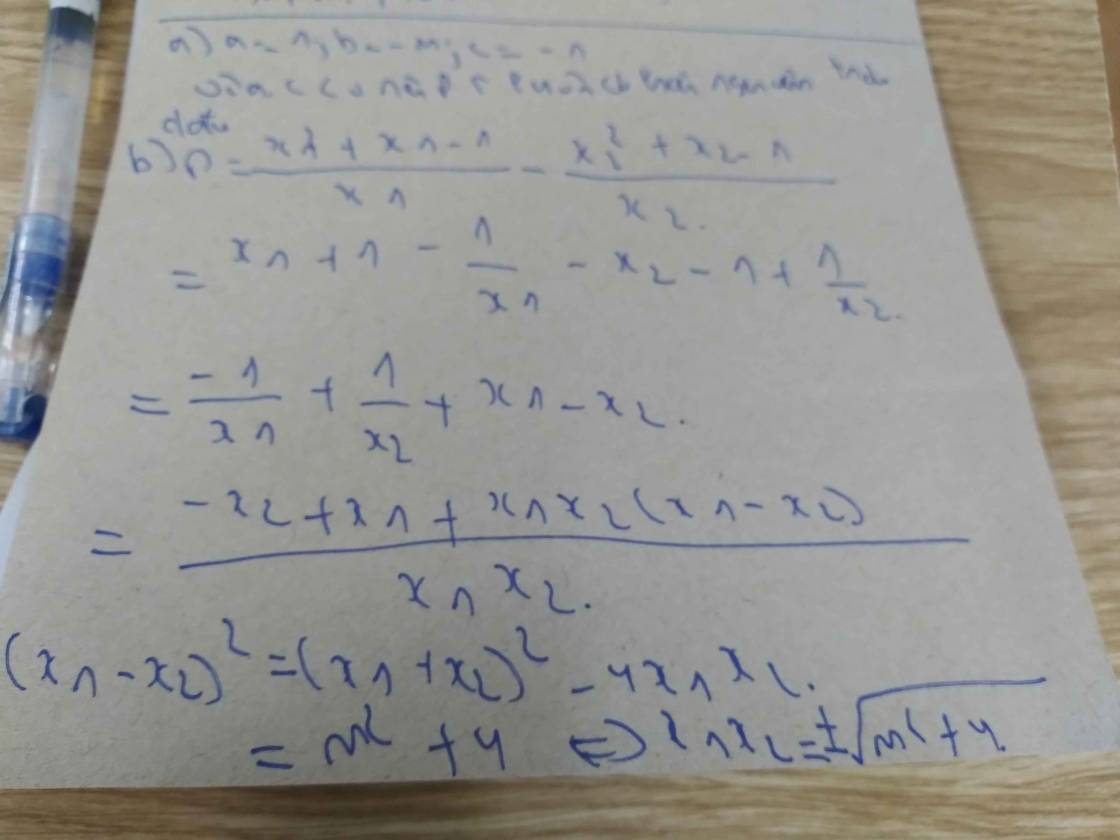
f: \(\left(x_1-x_2\right)^2=\left(x_1+x_2\right)^2-4x_1x_2\)
\(=\left(2m+2\right)^2-4\left(m-4\right)\)
\(=4m^2+8m+4-4m+16=4m^2+4m+20\)
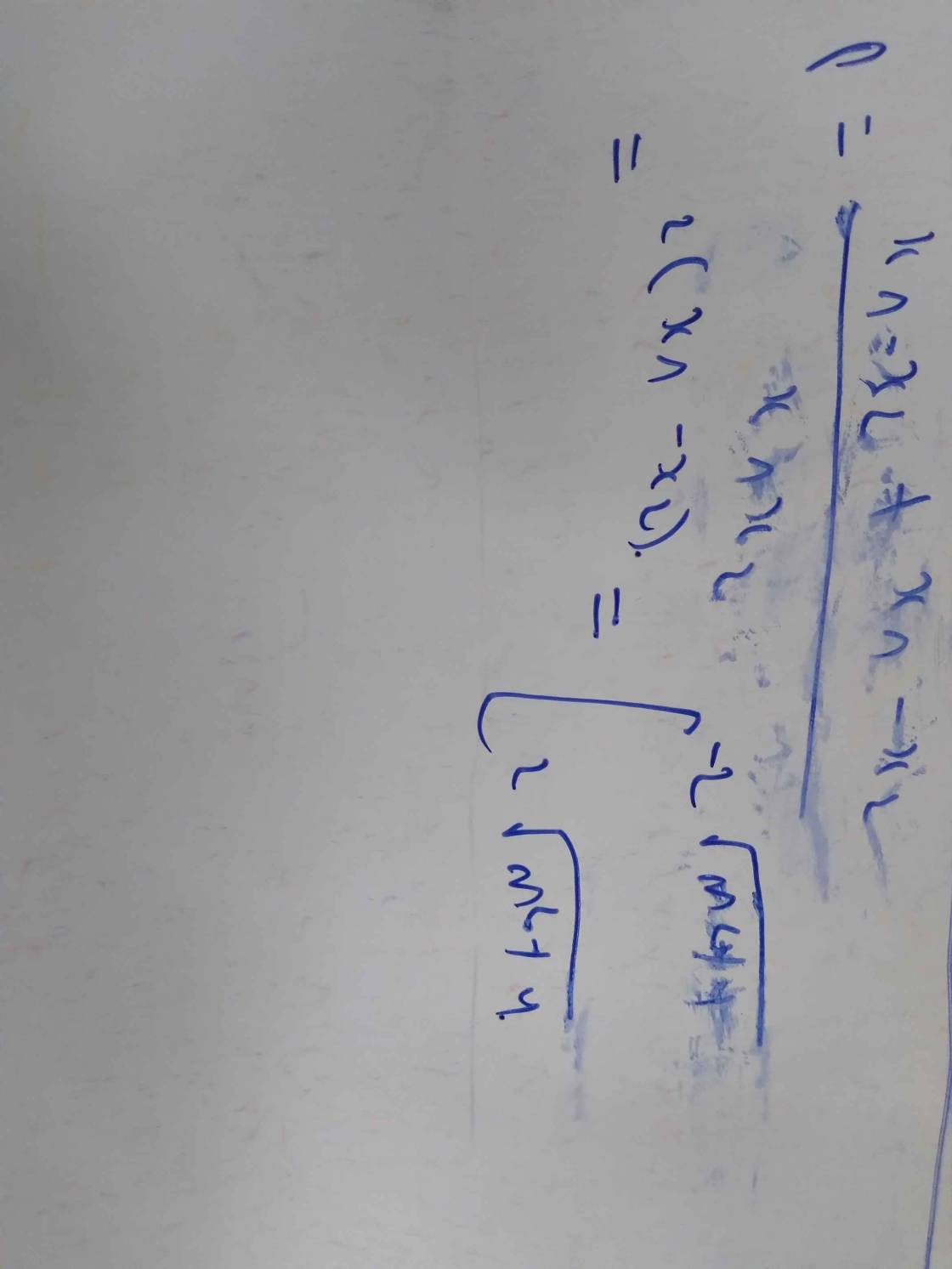
=>\(x_1-x_2=\pm\sqrt{4m^2+4m+20}=\pm2\cdot\sqrt{m^2+m+5}\)


bạn này mới tham gia hoc24