
Tìm x biết : 2x2 + 3 ( x - 1 ) ( x + 1 ) = 5x ( x + 1)
K
Khách
Hãy nhập câu hỏi của bạn vào đây, nếu là tài khoản VIP, bạn sẽ được ưu tiên trả lời.

Những câu hỏi liên quan
MH
1 tháng 11 2021
1.
a) \(2x^4-4x^3+2x^2\)
\(=2x^2\left(x^2-2x+1\right)\)
\(=2x^2\left(x-1\right)^2\)
b) \(2x^2-2xy+5x-5y\)
\(=\left(2x^2-2xy\right)+\left(5x-5y\right)\)
\(=2x\left(x-y\right)+5\left(x-y\right)\)
\(=\left(x-y\right)\cdot\left(2x+5\right)\)
KJ
1 tháng 11 2021
2 .
a,
\(4x\left(x-3\right)-x+3=0\)
⇒\(4x\left(x-3\right)-\left(x-3\right)=0\)
⇒\(\left(x-3\right)\left(4x-1\right)=0\)
⇒\(\left[{}\begin{matrix}x-3=0\\4x-1=0\end{matrix}\right.\)
⇔\(\left[{}\begin{matrix}x=3\\4x=1\end{matrix}\right.\)
⇔\(\left[{}\begin{matrix}x=3\\x=\dfrac{1}{4}\end{matrix}\right.\)
vậy \(x\in\left\{3;\dfrac{1}{4}\right\}\)
b,
\(\)\(\left(2x-3\right)^2-\left(x+1\right)^2=0\)
⇒\(\left(2x-3-x-1\right)\left(2x-3+x+1\right)\) = 0
⇒\(\left(x-4\right)\left(3x-2\right)=0\)
⇔\(\left[{}\begin{matrix}x-4=0\\3x-2=0\end{matrix}\right.\)
⇔\(\left[{}\begin{matrix}x=4\\3x=2\end{matrix}\right.\)
⇔\(\left[{}\begin{matrix}x=4\\x=\dfrac{2}{3}\end{matrix}\right.\)
vậy \(x\in\left\{4;\dfrac{2}{3}\right\}\)
2 tháng 4 2023
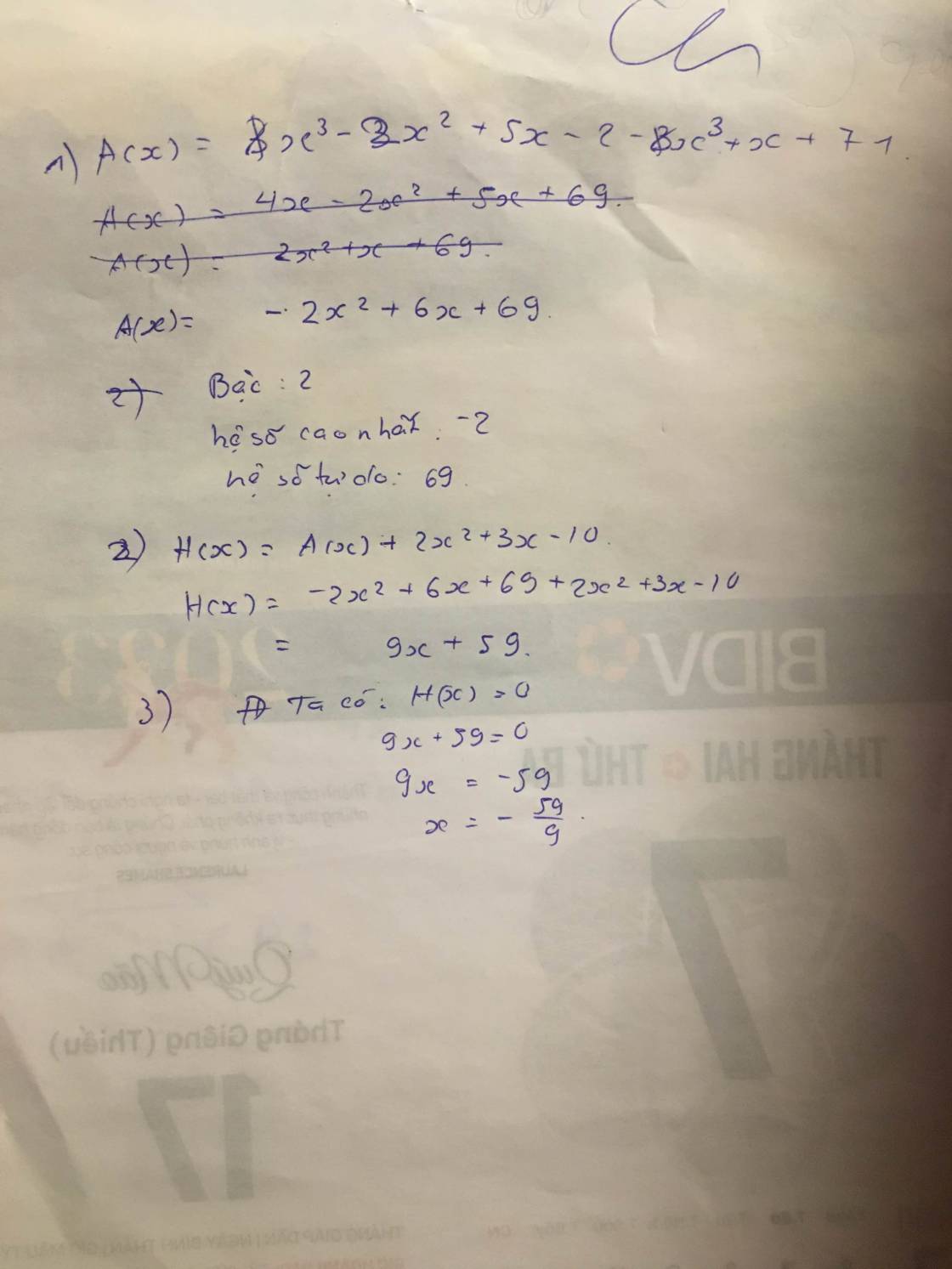
`1)`
`A(x)=x^3-2x^2+5x-2-x^3+x+7`
`A(x)=(x^3-x^3)-2x^2+(5x+x)+(-2+7)`
`A(x)=-2x^2+6x+5`
Bậc của đa thức: `2`
Hệ số cao nhất: `-2`
Hệ số tự do: `5`
`2)`
`H(x)-(2x^2 + 3x – 10) = A(x)`
`H(x)-(2x^2 + 3x – 10)=-2x^2+6x+5`
`H(x)= (-2x^2+6x+5)+(2x^2 + 3x – 10)`
`H(x)=-2x^2+6x+5+2x^2 + 3x – 10`
`H(x)=(-2x^2+2x^2)+(6x+3x)+(5-10)`
`H(x)=9x-5`
`3)`
Đặt `9x-5=0`
`9x=0+5`
`9x=5`
`-> x=5/9`
NL
Nguyễn Lê Phước Thịnh
CTVHS
11 tháng 8
Câu 1:
a: 3(x-1)-(x+1)=-1
=>3x-3-x-1=-1
=>2x-4=-1
=>2x=-1+4=3
=>\(x=\frac32\)
b: Đặt f(x)=0
=>\(2x^2-x=0\)
=>x(2x-1)=0
=>x=0 hoặc x=1/2
Bài 3:
a: Xét ΔCDA và ΔEAD có
CD=EA
\(\hat{CDA}=\hat{EAD}\) (hai góc so le trong, CD//AE)
AD chung
Do đó: ΔCDA=ΔEAD
b: Ta có: \(\hat{BAD}+\hat{CAD}=\hat{BAC}=90^0\)
\(\hat{BDA}+\hat{HAD}=90^0\) (ΔHAD vuông tại H)
mà \(\hat{CAD}=\hat{HAD}\) (AD là phân giác của góc HAC)
nên \(\hat{BAD}=\hat{BDA}\)
=>ΔBAD cân tại B
Bài 2:
a: g(x)-f(x)+h(x)
\(=-3x^3+2x^2+3x-2-2x^2+3x-x-1+2x^2+1\)
\(=-3x^3+2x^2+5x-2\)
b: f(x)=2x^2-3x-x+1=2x^2-4x+1
f(-1)=\(2\cdot\left(-1\right)^2-4\cdot\left(-1\right)+1=2+4+1=7\)
\(h\left(\frac12\right)=2\cdot\left(\frac12\right)^2+1=2\cdot\frac14+1=\frac12+1=\frac32\)
f(-1)-h(1/2)
=7-3/2
=11/2
c: f(x)=h(x)
=>\(2x^2-4x+1=2x^2+1\)
=>-4x=0
=>x=0
NL
Nguyễn Lê Phước Thịnh
CTVHS
31 tháng 3
Bài 3L
a: 2021x(x-3)+x-3=0
=>(x-3)(2021x+1)=0
=>\(\left[\begin{array}{l}x-3=0\\ 2021x+1=0\end{array}\right.\Rightarrow\left[\begin{array}{l}x=3\\ x=-\frac{1}{2021}\end{array}\right.\)
b: \(2x\left(x-2\right)+\left(x+1\right)\left(5-2x\right)=4\)
=>\(2x^2-4x+5x-2x^2+5-2x=4\)
=>-x+5=4
=>-x=-1
=>x=1
Bài 1:
a: \(2x^2+5x-2xy-5y\)
=x(2x+5)-y(2x+5)
=(2x+5)(x-y)
b: \(y\left(x-z\right)+7\left(z-x\right)\)
=y(x-z)-7(x-z)
=(x-z)(y-7)
NL
Nguyễn Lê Phước Thịnh
CTVHS
27 tháng 7 2021
Bài 1:
a) Ta có: \(P=1+\dfrac{3}{x^2+5x+6}:\left(\dfrac{8x^2}{4x^3-8x^2}-\dfrac{3x}{3x^2-12}-\dfrac{1}{x+2}\right)\)
\(=1+\dfrac{3}{\left(x+2\right)\left(x+3\right)}:\left(\dfrac{8x^2}{4x^2\left(x-2\right)}-\dfrac{3x}{3\left(x-2\right)\left(x+2\right)}-\dfrac{1}{x+2}\right)\)
\(=1+\dfrac{3}{\left(x+2\right)\left(x+3\right)}:\left(\dfrac{4}{x-2}-\dfrac{x}{\left(x-2\right)\left(x+2\right)}-\dfrac{1}{x+2}\right)\)
\(=1+\dfrac{3}{\left(x+2\right)\left(x+3\right)}:\dfrac{4\left(x+2\right)-x-\left(x-2\right)}{\left(x-2\right)\left(x+2\right)}\)
\(=1+\dfrac{3}{\left(x+2\right)\left(x+3\right)}\cdot\dfrac{\left(x-2\right)\left(x+2\right)}{4x+8-x-x+2}\)
\(=1+3\cdot\dfrac{\left(x-2\right)}{\left(x+3\right)\left(2x+10\right)}\)
\(=1+\dfrac{3\left(x-2\right)}{\left(x+3\right)\left(2x+10\right)}\)
\(=\dfrac{\left(x+3\right)\left(2x+10\right)+3\left(x-2\right)}{\left(x+3\right)\left(2x+10\right)}\)
\(=\dfrac{2x^2+10x+6x+30+3x-6}{\left(x+3\right)\left(2x+10\right)}\)
\(=\dfrac{2x^2+19x-6}{\left(x+3\right)\left(2x+10\right)}\)
19 tháng 2 2020
\(a,\left(x-1\right)\left(5x+3\right)=\left(3x-8\right)\left(x-1\right)\)
\(\left(x-1\right)\left(5x+3-3x+8\right)=0\)
\(\left(x-1\right)\left(2x+11\right)=0\)
\(\Rightarrow\orbr{\begin{cases}x-1=0\\2x+11=0\end{cases}\Rightarrow\orbr{\begin{cases}x=1\\2x=-11\end{cases}\Rightarrow}\orbr{\begin{cases}x=1\\x=-\frac{11}{2}\end{cases}}}\)
19 tháng 2 2020
\(b,3x\left(25x+15\right)-35\left(5x+3\right)=0\)
\(15x\left(5x+3\right)-35\left(5x+3\right)=0\)
\(\left(5x+3\right).5\left(3x-7\right)=0\)
\(\Rightarrow\orbr{\begin{cases}5x+3=0\\5\left(3x-7\right)=0\end{cases}\Rightarrow\orbr{\begin{cases}5x=-3\\3x-7=0\end{cases}\Rightarrow}\orbr{\begin{cases}x=-\frac{3}{5}\\3x=7\end{cases}\Rightarrow}\orbr{\begin{cases}x=-\frac{3}{5}\\x=\frac{7}{3}\end{cases}}}\)
\(2x^2+3\left(x-1\right)\left(x+1\right)=5x\left(x+1\right)\)
\(\Leftrightarrow\) \(2x^2+3\left(x^2-1\right)=5x\left(x+1\right)\)
\(\Leftrightarrow\) \(2x^2+3x^2-3=5x^2+5x\)
\(\Leftrightarrow\) \(2x^2+3x^2-5x^2-5x=3\)
\(\Leftrightarrow\) \(-5x=3\)
\(\Leftrightarrow\) \(x=\frac{-3}{5}\)
Vậy ..................................................
\(2x^2+3\left(x-1\right)\left(x+1\right)=5x\left(x+1\right)\)
\(\Leftrightarrow2x^2+3\left(x^2+1\right)-5x^2-5x=0\)
\(\Leftrightarrow5x+3=0\)
\(\Leftrightarrow x=-\frac{3}{5}\)