
tìm các giá trị của \(x\in[-\pi;2\pi]\)để cos x=0
K
Khách
Hãy nhập câu hỏi của bạn vào đây, nếu là tài khoản VIP, bạn sẽ được ưu tiên trả lời.

Những câu hỏi liên quan
HQ
Hà Quang Minh
CTVVIP
21 tháng 9 2023
a)
x | \( - \frac{\pi }{3}\) | \( - \frac{\pi }{4}\) | 0 | \(\frac{\pi }{4}\) | \(\frac{\pi }{3}\) |
\(y = \tan x\) | \( - \sqrt 3 \) | -1 | 0 | 1 | \(\sqrt 3 \) |
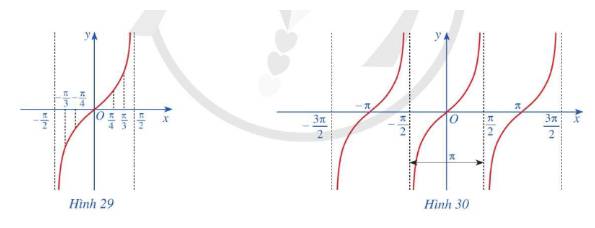
b) Trong mặt phẳng tọa độ Oxy, hãy biểu diễn các điểm (x; y) trong bảng giá trị ở câu a. Bằng cách làm tương tự, lấy nhiều điểm (x; tanx) với \(x \in \left( { - \frac{\pi }{2};\frac{\pi }{2}} \right)\) và nối lại ta được đồ thị hàm số \(y = \tan x\) trên khoảng \(\left( { - \frac{\pi }{2};\frac{\pi }{2}} \right)\) (Hình 29).
c) Làm tương tự như trên đối với các khoảng \(\left( {\frac{\pi }{2};\frac{{3\pi }}{2}} \right),\left( { - \frac{{3\pi }}{2}; - \frac{\pi }{2}} \right)\),...ta có đồ thị hàm số \(y = \tan x\)trên D được biểu diễn ở Hình 30.

KB
12 tháng 4 2022
a.Ta có : \(x\in\left(\pi;\dfrac{3}{2}\pi\right)\Rightarrow cosx< 0\)
\(cosx=-\sqrt{1-sin^2x}=-\sqrt{1-0,8^2}=-0,6\)
\(tanx=\dfrac{4}{3};cotx=\dfrac{3}{4}\)
b. cos 2x = \(cos^2x-sin^2x=0,6^2-0,8^2=-0,28\)
\(P=2.cos2x=-0,56\)
\(Q=tan\left(2x+\dfrac{\pi}{3}\right)=\dfrac{tan2x+tan\dfrac{\pi}{3}}{1-tan2x.tan\dfrac{\pi}{3}}=\dfrac{tan2x+\sqrt{3}}{1-tan2x.\sqrt{3}}\)
tan 2x = \(\dfrac{2tanx}{1-tan^2x}=\dfrac{\dfrac{2.4}{3}}{1-\left(\dfrac{4}{3}\right)^2}=\dfrac{-24}{7}\)
\(Q=\dfrac{-\dfrac{24}{7}+\sqrt{3}}{1+\dfrac{24}{7}.\sqrt{3}}\) \(=\dfrac{-24+7\sqrt{3}}{7+24\sqrt{3}}\)
HQ
Hà Quang Minh
CTVVIP
25 tháng 8 2023
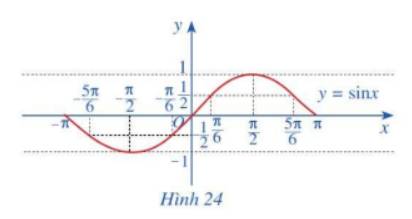
Đồ thị của hàm số \(y=sin\left(x\right)\) trên đoạn \(\left[-\pi;\pi\right]\) là:

Ta thấy đồ thị hàm số giao với đường thẳng d: \(y=\dfrac{1}{2}\) tại 2 điểm.
Do đó, phương trình \(sin\left(x\right)=\dfrac{1}{2}\) có hai giá trị \(x\in\left[-\pi;\pi\right]\) thỏa mãn
NL
Nguyễn Lê Phước Thịnh
CTVHS
23 tháng 5
a: \(5-2\cdot cos^2x\cdot\sin^2x\)
\(=5-2\cdot\left(\sin x\cdot cosx\right)^2\)
\(=5-2\cdot\left\lbrack\frac12\cdot2\cdot\sin x\cdot cosx\right\rbrack^2=5-2\cdot\left\lbrack\frac12\cdot\sin2x\right\rbrack^2\)
\(=5-2\cdot\frac14\cdot\sin^22x=-\frac12\cdot\sin^22x+5\)
\(0\le\sin^22x\le1\)
=>\(0\ge-\frac12\sin^22x\ge-\frac12\)
=>\(0+5\ge-\frac12\sin^22x+5\ge-\frac12+5\)
=>\(5\ge-\frac12\sin^22x+5\ge\frac92\)
=>\(\frac92\le-\frac12\sin^22x+5\le5\)
=>\(\sqrt{\frac92}\le\sqrt{-\frac12\cdot\sin^22x+5}\le\sqrt5\)
=>\(\frac{3\sqrt2}{2}\le\sqrt{-\frac12\cdot\sin^22x+5}\le\sqrt5\)
=>\(\frac{2}{3\sqrt2}\ge\frac{1}{\sqrt{-\frac12\cdot\sin^22x+5}}\ge\frac{1}{\sqrt5}\)
=>\(\frac{2\cdot4}{3\sqrt2}\ge\frac{1\cdot4}{\sqrt{-\frac12\cdot\sin^22x+5}}\ge\frac{1\cdot4}{\sqrt5}\)
=>\(\frac{4\sqrt2}{3}\ge y\ge\frac{4}{\sqrt5}\)
=>\(y_{\max}=\frac{4\sqrt2}{3}\) khi \(-\frac12\cdot\sin^22x+5=\frac92\)
=>\(-\frac12\cdot\sin^22x=-\frac12\)
=>\(\sin^22x=1\)
=>\(cos^22x=0\)
=>cos2x=0
=>\(2x=\frac{\pi}{2}+k\pi\)
=>\(x=\frac{\pi}{4}+\frac{k\pi}{2}\)
\(y_{\min}=\frac{4}{\sqrt5}\) khi \(-\frac12\cdot\sin^22x+5=5\)
=>\(\sin^22x=0\)
=>sin 2x=0
=>\(2x=k\pi\)
=>\(x=\frac{k\pi}{2}\)
b: \(f\left(x\right)=3\cdot\sin^2x+5\cdot cos^2x-4\cdot cos2x-2\)
\(=3\left(1-cos^2x\right)+5\cdot cos^2x-4\left(2\cdot cos^2x-1\right)-2\)
\(=3-3\cdot cos^2x+5\cdot cos^2x-8\cdot cos^2x+4-2=-6\cdot cos^2x+5\)
Ta có: \(0<=cos^2x\le1\)
=>\(0\ge-6\cdot cos^2x\ge-6\)
=>\(0+5\ge-6\cdot cos^2x+5\ge-6+5\)
=>5>=y>=-1
Do đó: \(y_{\min}=-1\) khi \(-6\cdot cos^2x+5=-1\)
=>\(-6\cdot cos^2x=-6\)
=>\(cos^2x=1\)
=>\(\sin^2x=0\)
=>sin x=0
=>\(x=k\pi\)
y max=5 khi \(-6\cdot cos^2x+5=5\)
=>\(-6\cdot cos^2x=0\)
=>cosx=0
=>\(x=\frac{\pi}{2}+k\pi\)
1 tháng 6 2021
1.
\(\Leftrightarrow1-2sin^2x+sinx+m=0\)
\(\Leftrightarrow2sin^2x-sinx-1=m\)
Đặt \(sinx=t\Rightarrow t\in\left[-\dfrac{1}{2};\dfrac{\sqrt{2}}{2}\right]\)
Xét hàm \(f\left(t\right)=2t^2-t-1\) trên \(\left[-\dfrac{1}{2};\dfrac{\sqrt{2}}{2}\right]\)
\(-\dfrac{b}{2a}=\dfrac{1}{4}\in\left[-\dfrac{1}{2};\dfrac{\sqrt{2}}{2}\right]\)
\(f\left(-\dfrac{1}{2}\right)=0\) ; \(f\left(\dfrac{1}{4}\right)=-\dfrac{9}{8}\) ; \(f\left(\dfrac{\sqrt{2}}{2}\right)=-\dfrac{\sqrt{2}}{2}\)
\(\Rightarrow-\dfrac{9}{8}\le f\left(t\right)\le0\Rightarrow-\dfrac{9}{8}\le m\le0\)
Có 2 giá trị nguyên của m (nếu đáp án là 3 thì đáp án sai)
1 tháng 6 2021
2.
ĐKXĐ: \(sin2x\ne1\Rightarrow x\ne\dfrac{\pi}{4}\) (chỉ quan tâm trong khoảng xét)
Pt tương đương:
\(\left(tan^2x+cot^2x+2\right)-\left(tanx+cotx\right)-4=0\)
\(\Leftrightarrow\left(tanx+cotx\right)^2+\left(tanx+cotx\right)-4=0\)
\(\Rightarrow\left[{}\begin{matrix}tanx+cotx=\dfrac{1+\sqrt{17}}{2}\\tanx+cotx=\dfrac{1-\sqrt{17}}{2}\left(loại\right)\end{matrix}\right.\)
Nghiệm xấu quá, kiểm tra lại đề chỗ \(-tanx+...-cotx\) có thể 1 trong 2 cái đằng trước phải là dấu "+"
HQ
Hà Quang Minh
CTVVIP
21 tháng 9 2023
a)
x | \( - \pi \) | \( - \frac{{5\pi }}{6}\) | \( - \frac{\pi }{2}\) | \( - \frac{\pi }{6}\) | 0 | \(\frac{\pi }{6}\) | \(\frac{\pi }{2}\) | \(\frac{{5\pi }}{6}\) | \(\pi \) |
\(y = \sin x\) | 0 | \( - \frac{1}{2}\) | -1 | \( - \frac{1}{2}\) | 0 | \(\frac{1}{2}\) | 1 | \(\frac{1}{2}\) | 0 |
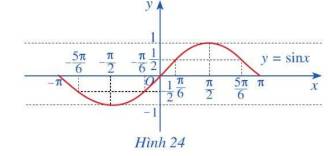
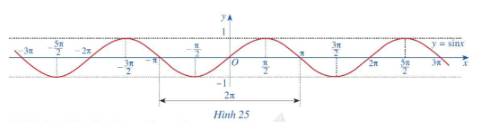
b) Trong mặt phẳng Oxy, hãy biểu diễn các điểm \(\left( {x;y} \right)\) trong bảng giá trị ở câu a. Bằng cách làm tương tự, lấy nhiều điểm \(\left( {x;\sin x} \right)\) với \(x \in \left[ { - \pi ;\pi } \right]\) với nối lại ta được đồ thị hàm số \(y = \sin x\) trên đoạn \(\left[ { - \pi ;\pi } \right]\)(Hình 24).
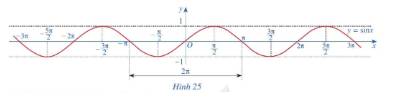
c) Làm tương tự như trên đối với các đoạn \(\left[ { - 3\pi ; - \pi } \right]\), \(\left[ {\pi ;3\pi } \right]\),...ta có đồ thị hàm số \(y = \sin x\)trên R được biểu diễn ở Hình 25.
5 tháng 5 2016
Do \(\sqrt{\pi}>1\) nên theo tính chất về lũy thừa số thực, ta có :
* Vì \(\cos x\ge1,x\in R\) nên \(A=\left(\sqrt{\pi}\right)^{\cos x}\ge\left(\sqrt{\pi}\right)^{-1}=\frac{1}{\sqrt{\pi}}\)
Giá trị nhỏ nhất của A là \(\frac{1}{\sqrt{\pi}}\) đạt được khi \(\cos x=-1\Leftrightarrow x=\pi+2k\pi,k\in Z\)
* Vì \(\cos x\le1,x\in R\) nên \(A=\left(\sqrt{\pi}\right)^{\cos x}\le\left(\sqrt{\pi}\right)^1=\sqrt{\pi}\)
Giá trị nhỏ nhất của A là \(\sqrt{\pi}\) đạt được khi \(\cos x=1\Leftrightarrow x=2k\pi,k\in Z\)
H
31 tháng 8 2023
\(a,,0< x< \dfrac{\pi}{2}\\ \Rightarrow\left\{{}\begin{matrix}sinx>0\\cosx< 0\end{matrix}\right.\\ 1+tan^2x=\dfrac{1}{cos^2x}\\ \Rightarrow cos^2x=\dfrac{1}{4}\\ \Rightarrow cosx=-\dfrac{1}{2}\)
\(sin^2x+cos^2x=1\\ \Rightarrow sin^2x=1-\left(-\dfrac{1}{2}\right)^2\\ =\dfrac{3}{4}\\ \Rightarrow sinx=\dfrac{\sqrt{3}}{2}\)
\(tanx.cotx=1\\ \Rightarrow cotx=1:\sqrt{3}\\ =\dfrac{\sqrt{3}}{3}\)
\(b,\dfrac{3\pi}{2}< x< 2\pi\\ \Rightarrow\left\{{}\begin{matrix}sinx< 0\\cosx>0\end{matrix}\right.\)
\(tanx.cotx=1\\ \Rightarrow tanx=-1\)
\(1+cot^2x=\dfrac{1}{sin^2x}\\ \Rightarrow sin^2x=\dfrac{1}{2}\\ \Rightarrow sinx=-\dfrac{\sqrt{2}}{2}\\ cos^2x+sin^2x=1\\ \Rightarrow cos^2x=\dfrac{1}{2}\\ \Rightarrow cosx=\dfrac{\sqrt{2}}{2}\)
Có \(cosx=0\)
\(\Rightarrow x=\frac{\pi}{2}+k\)
Và \(-\pi\le x\le2\pi\)
\(\Leftrightarrow-\pi\le\frac{\pi}{2}+k\le2\pi\)
\(\Leftrightarrow-2\pi\le\pi+2k\le4\pi\)
Với \(\pi,k\in Z\)
Làm đại thôi!