
Cho 𝑥𝑦 = 11 và 𝑥2𝑦 + 𝑥𝑦2 + 𝑥 + 𝑦 = 2020. Tính giá trị của biểu thức 𝑃 = 𝑥2 + 𝑦2
K
Khách
Hãy nhập câu hỏi của bạn vào đây, nếu là tài khoản VIP, bạn sẽ được ưu tiên trả lời.

NA
1
NL
Nguyễn Lê Phước Thịnh
CTVHS
16 tháng 6 2024
17:
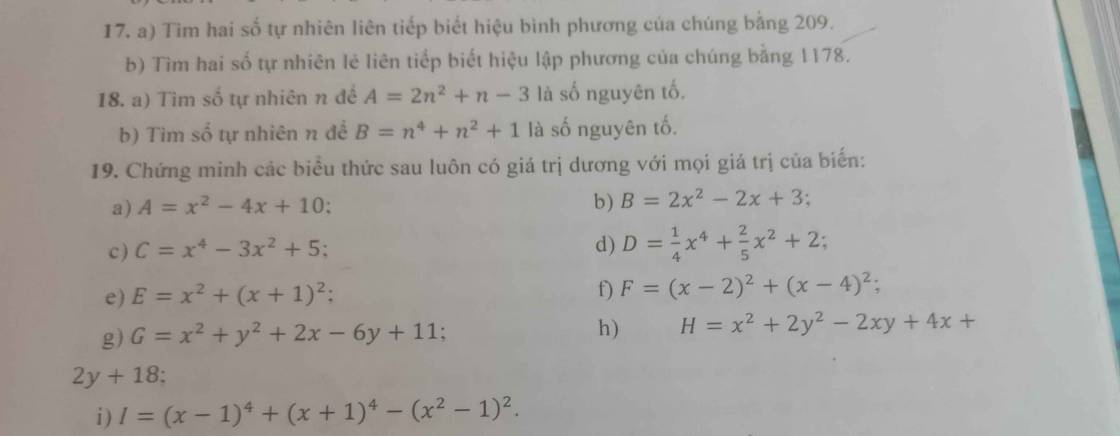
a: Gọi hai số tự nhiên liên tiếp là a;a+1
Hiệu bình phương của chúng là 209 nên ta có:
\(\left(a+1\right)^2-a^2=209\)
=>\(a^2+2a+1-a^2=209\)
=>2a+1=209
=>2a=208
=>a=104
vậy: Hai số cần tìm là 104;104+1=105
b: Gọi hai số tự nhiên lẻ liên tiếp là 2k+1;2k+3
Hiệu lập phương của chúng là 1178 nên ta có:
\(\left(2k+3\right)^3-\left(2k+1\right)^3=1178\)
=>\(8k^3+36k^2+54k+27-8k^3-12k^2-6k-1=1178\)
=>\(24k^2+48k+26-1178=0\)
=>\(24k^2+48k-1152=0\)
=>\(\left[{}\begin{matrix}k=6\left(nhận\right)\\k=-8\left(loại\right)\end{matrix}\right.\)
Vậy: Hai số cần tìm là \(2\cdot6+1=13;2\cdot6+3=15\)
19:
a: \(A=x^2-4x+10\)
\(=x^2-4x+4+6\)
\(=\left(x-2\right)^2+6>=6>0\forall x\)
=>ĐPCM
b: \(B=2x^2-2x+3\)
\(=2\left(x^2-x+\dfrac{3}{2}\right)\)
\(=2\left(x^2-x+\dfrac{1}{4}+\dfrac{5}{4}\right)\)
\(=2\left(x-\dfrac{1}{2}\right)^2+\dfrac{5}{2}>=\dfrac{5}{2}>0\forall x\)
=>ĐPCM
c: \(C=x^4-3x^2+5\)
\(=x^4-3x^2+\dfrac{9}{4}+\dfrac{11}{4}\)
\(=\left(x^2-\dfrac{3}{2}\right)^2+\dfrac{11}{4}>=\dfrac{11}{4}>0\forall x\)
=>ĐPCM
d: \(D=\dfrac{1}{4}x^4+\dfrac{2}{5}x^2+2\)
\(=x^2\left(\dfrac{1}{4}x^2+\dfrac{2}{5}\right)+2>=2>0\forall x\)
=>ĐPCM
e: \(E=x^2+\left(x+1\right)^2\)
\(=x^2+x^2+2x+1=2x^2+2x+1\)
\(=2\left(x^2+x+\dfrac{1}{2}\right)=2\left(x^2+x+\dfrac{1}{4}+\dfrac{1}{4}\right)\)
\(=2\left(x+\dfrac{1}{2}\right)^2+\dfrac{1}{2}>=\dfrac{1}{2}>0\forall x\)
=>ĐPCM
f: \(F=\left(x-2\right)^2+\left(x-4\right)^2\)
\(=x^2-4x+4+x^2-8x+16\)
\(=2x^2-12x+20=2\left(x^2-6x+10\right)\)
\(=2\left(x^2-6x+9+1\right)=2\left[\left(x-3\right)^2+1\right]>=2\cdot1=2>0\forall x\)
g: \(G=x^2+y^2+2x-6y+11\)
\(=x^2+2x+1+y^2-6y+9+1\)
\(=\left(x+1\right)^2+\left(y-3\right)^2+1>=1>0\forall x,y\)
=>ĐPCM
AH
Akai Haruma
Giáo viên
16 tháng 6 2024
Lời giải:
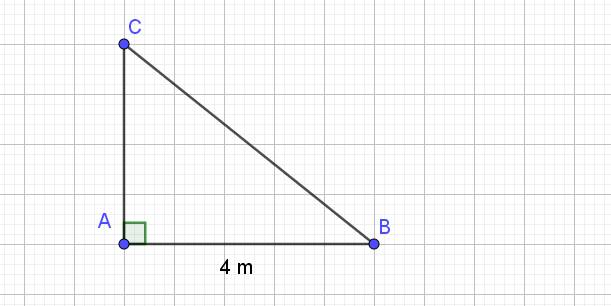
Ký hiệu gốc cây là $A$, ngọn cây bị gãy là $B$, điểm gãy là $C$. Ta có:
$AC+CB=8(1)$ (m)
$AB=4$ (m)
Áp dụng định lý Pitago:
$AC^2+AB^2=BC^2$
$\Rightarrow AC^2+4^2=BC^2$
$\Rightarrow BC^2-AC^2=16$
$\Rightarrow (BC-AC)(BC+AC)=16$
$\Rightarrow (BC-AC).8=16\Rightarrow BC-AC=2(2)$
Từ $(1); (2)\Rightarrow BC=(8+2):2=5; AC=(8-2):2=3$ (m)
Vậy độ dài từ điểm gãy tới gốc là $AC=3$ m


16 tháng 6 2024
1. Do you want - am going to go
2. Is Ann talking - is doing
3. do you go
4. are studying - want
5. are going to go - are you going to go
6. does it take
AH
Akai Haruma
Giáo viên
15 tháng 6 2024
Lời giải:
Ta có:
$P(1)=(2.1-1)^6+(1-2)^7=a_7.1^7+a_6.1^6+....+a_1.1+a_0$
$\Rightarrow 1+(-1)=a_7+a_6+a_5+....+a_1+a_0$
$\Rightarrow a_7+a_6+a_5+....+a_1+a_0=0$
TL
2
AH
Akai Haruma
Giáo viên
15 tháng 6 2024
Lời giải:
$a+b+c=0\Rightarrow a+b=-c$. khi đó:
$a^3+b^3+c^3=(a+b)^3-3ab(a+b)+c^3=(-c)^3-3ab(-c)+c^3$
$=-c^3+3abc+c^3=3abc$
Ta có đpcm.
AD
15 tháng 6 2024
ta có: a+b+c=0
=> c=-(a+b)
ta thay vào biểu thức:
=>a3+b3-(a+b)3=3ab(-a-b)
=>-3a2b-3ab2=-3a2b-3ab2

DT
16 tháng 6 2024
Chỉ ra thành phần biệt lập: Đấy, mày nghe chưa?.
Phân tích tác dụng: thể hiện chi tiết hơn tâm lý, suy nghĩ của nhân vật người chú từ đó tăng giá trị diễn đạt cảm xúc, câu văn thêm hay hơn, hấp dẫn người đọc hơn.
b. Cần ngữ liệu
TT
2
T
15 tháng 6 2024
\(\left(x+2\right)\left(x+4\right)\left(x+6\right)\left(x+8\right)-105=0\)
\(\Leftrightarrow\left[\left(x+2\right)\left(x+8\right)\right]\left[\left(x+4\right)\left(x+6\right)\right]-105=0\)
\(\Leftrightarrow\left(x^2+10x+16\right)\left(x^2+10x+24\right)-105=0\) (1)
Đặt \(x^2+10x+20=t\), khi đó (1) trở thành:
\(\left(t-4\right)\left(t+4\right)-105=0\)
\(\Leftrightarrow t^2-16-105=0\)
\(\Leftrightarrow t^2-11^2=0\)
\(\Leftrightarrow\left(t-11\right)\left(t+11\right)=0\)
\(\Rightarrow\left(x^2+10x+20-11\right)\left(x^2+10x+20+11\right)=0\)
\(\Leftrightarrow\left(x^2+10x+9\right)\left(x^2+10x+31\right)=0\)
\(\Leftrightarrow\left(x^2+9x+x+9\right)\left[\left(x+5\right)^2+6\right]=0\)
\(\Leftrightarrow x\left(x+9\right)+\left(x+9\right)=0\) (vì \(\left(x+5\right)^2+6>0;\forall x\))
\(\Leftrightarrow\left(x+9\right)\left(x+1\right)=0\)
\(\Leftrightarrow\left[{}\begin{matrix}x+9=0\\x+1=0\end{matrix}\right.\Leftrightarrow\left[{}\begin{matrix}x=-9\\x=-1\end{matrix}\right.\)
Vậy phương trình đã cho có tập nghiệm là $S=\{-9;-1\}$.
$Toru$
DT
15 tháng 6 2024
\(\left(x+2\right)\left(x+4\right)\left(x+6\right)\left(x+8\right)-105=0\\ \Leftrightarrow\left[\left(x+2\right)\left(x+8\right)\right]\left[\left(x+4\right)\left(x+6\right)\right]=105\\ \Leftrightarrow\left(x^2+10x+16\right)\left(x^2+10x+24\right)=105\\ \Leftrightarrow\left(x^2+10x+20-4\right)\left(x^2+10x+20+4\right)=105\\ \Leftrightarrow\left(x^2+10x+20\right)^2-4^2=105\\ \Leftrightarrow\left(x^2+10x+20\right)^2=121\\ \)
\(\Rightarrow\left[{}\begin{matrix}x^2+10x+20=11\left(1\right)\\x^2+10x+20=-11\left(2\right)\end{matrix}\right.\)
Giải (1):
\(x^2+10x+9=0\\ \Leftrightarrow\left(x^2+x\right)+\left(9x+9\right)=0\\ \Leftrightarrow x\left(x+1\right)+9\left(x+1\right)=0\\ \Leftrightarrow\left(x+1\right)\left(x+9\right)=0\\ \Rightarrow\left[{}\begin{matrix}x+1=0\\x+9=0\end{matrix}\right.\Leftrightarrow\left[{}\begin{matrix}x=-1\\x=-9\end{matrix}\right.\)
Giải (2):
Nhận thấy: \(x^2+10x+20=\left(x+5\right)^2-5\ge-5\forall x\inℝ\)
Vậy pt (2) vô nghiệm
Vậy tập nghiệm pt là: \(S=\left\{-1;-9\right\}\)
Ta có:
x²y + xy² + x + y = 2020
xy(x + y) + (x + y) = 2020
(x + y)(xy + 1) = 2020
(x + y).(11 + 1) = 2020
12(x + y) = 2020
x + y = 2020 : 12
x + y = 505/3
x² + y² = (x + y)² - 2xy
= (505/3)² - 2.11
= 255025/9 - 22
= 254827/9