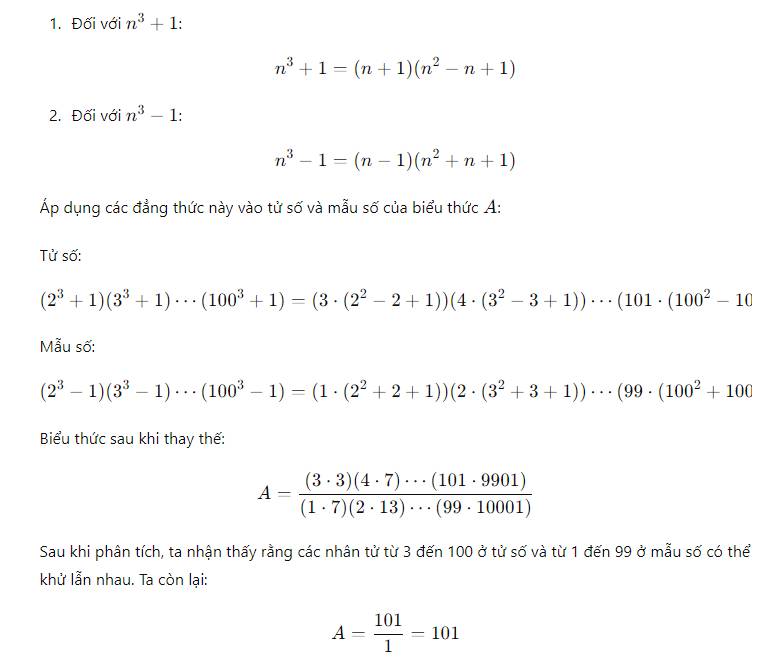
Tính \(A=\dfrac{\left(2^3+1\right)\left(3^3+1\right)...\left(100^3+1\right)}{\left(2^3-1\right)\left(3^3-1\right)...\left(100^3-1\right)}\)
Hãy nhập câu hỏi của bạn vào đây, nếu là tài khoản VIP, bạn sẽ được ưu tiên trả lời.

a: Xét ΔAEF có
AH là đường cao
AH là đường phân giác
Do đó: ΔAEF cân tại A
Xét ΔAEF có BM//EF
nên \(\dfrac{AB}{AE}=\dfrac{AM}{AF}\)
mà AE=AF
nên AB=AM
=>ΔABM cân tại A
b: Kẻ BK//AC(K\(\in\)EF)
Xét tứ giác BMFK có
BM//FK
BK//MF
DO đó: BMFK là hình bình hành
=>BK=MF
Xét ΔBDK và ΔCDF có
\(\widehat{BDK}=\widehat{CDF}\)(hai góc đối đỉnh)
DB=DC
\(\widehat{DBK}=\widehat{DCF}\)(BK//CF)
Do đó: ΔBDK=ΔCDF
=>BK=CF
Ta có: BK//FC
=>\(\widehat{BKE}=\widehat{AFE}\)
=>\(\widehat{BKE}=\widehat{BEK}\)
=>BE=BK
mà BK=FC và BK=MF
nên MF=BE=CF
ĐKXĐ: \(x\notin\left\{1;-1\right\}\)
\(\dfrac{1}{x+1}+\dfrac{2}{1-x}-\dfrac{1-5x}{x^2-1}\)
\(=\dfrac{1}{x+1}-\dfrac{2}{x-1}+\dfrac{5x-1}{\left(x-1\right)\left(x+1\right)}\)
\(=\dfrac{x-1-2\left(x+1\right)+5x-1}{\left(x-1\right)\left(x+1\right)}\)
\(=\dfrac{6x-2-2x-2}{\left(x-1\right)\left(x+1\right)}=\dfrac{4x-4}{\left(x-1\right)\left(x+1\right)}=\dfrac{4}{x+1}\)
ĐKXĐ: \(x\notin\left\{0;-2;2\right\}\)
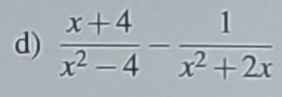
\(\dfrac{x+4}{x^2-4}-\dfrac{1}{x^2+2x}\)
\(=\dfrac{x+4}{\left(x-2\right)\left(x+2\right)}-\dfrac{1}{x\left(x+2\right)}\)
\(=\dfrac{x\left(x+4\right)-x+2}{x\left(x+2\right)\left(x-2\right)}=\dfrac{x^2+3x+2}{x\left(x+2\right)\left(x-2\right)}\)
\(=\dfrac{\left(x+2\right)\left(x+1\right)}{x\left(x+2\right)\left(x-2\right)}=\dfrac{x+1}{x\left(x-2\right)}\)
a: ĐKXĐ: x<>2
\(\dfrac{3x+1}{x-2}-\dfrac{3x}{x-2}=\dfrac{3x+1-3x}{x-2}=\dfrac{1}{x-2}\)
b: ĐKXĐ: \(x\ne0;x\ne-y\)
\(\dfrac{x+2}{x^2+xy}-\dfrac{2-y}{x^2+xy}\)
\(=\dfrac{x+2-2+y}{x\left(x+y\right)}=\dfrac{x+y}{x\left(x+y\right)}=\dfrac{1}{x}\)
Ta có:
\(A=x^6-3x^5+4x^4-3x^3+2x^2-x+1\)
\(=\left(x^6-3x^5+3x^4-1\right)+\left(x^4-2x^3+x^2\right)+\left(x^2-x\right)+1\)
\(=\left(x^2-x\right)^3+\left(x^2-x\right)^2+\left(x^2-x\right)+1\)
Thay `x^2-x=10` vào A ta có:
\(A=10^3+10^2+10+1=1111\)
A = x⁶ - 3x⁵ + 4x⁴ - 3x³ + 2x² - x + 1
= (x⁶ - x⁵) - 2x⁵ + 2x⁴ + 2x⁴ - 2x³ - x³ + x² + x² - x + 1
= x⁴(x² - x) - 2x³(x² - x) + 2x²(x² - x) - x(x² - x) + (x² - x) + 1
= (x² - x)(x⁴ - 2x³ + 2x² - x) + 1
= 10(x⁴ - x³ - x³ + x² + x² - x) + 1
= 10[x²(x² - x) - x(x² - x) + (x² - x)] + 1
= 10(x² - x)(x² - x + 1) + 1
= 10.10.(10 + 1) + 1
= 100.11 + 1
= 1100 + 1
= 1101
1. She wants to have the party on Saturday.
2. They have the party at her grandmother's house. Because her grandmother's house is bigger than her house.
3. It's thirty-one, in Regent Street.
4. They hold the party at half past four.
5. The girl asks her friends to bring cakes and some games.
6. The man asks her friends to wear jeans.
7. They can play in the garden if the weather is nice.
8. The man asks her friends parents to phone him.
\(x^4+6x^3+7x^2-6x+1\)
\(=x^4+9x^2+1+6x^3-2x^2-6x\)
\(=\left(x^2\right)^2+\left(3x\right)^2+\left(-1\right)^2+2\cdot x^2\cdot3x+2\cdot x^2\cdot\left(-1\right)+2\cdot3x\cdot\left(-1\right)\)
\(=\left(x^2+3x-1\right)^2\)
---------------------
Áp dụng hằng đẳng thức: \(\left(a+b+c\right)^2=a^2+b^2+c^2+2ab+2ac+2bc\)
Trong trường hợp này `a=x^2; b=3x; c=-1`
20.
a) \(A=4x^2-4x+m\)
\(=4x^2-4x+1-1+m\)
\(=\left(4x^2+4x+1\right)+\left(m-1\right)\)
\(=\left(2x+1\right)^2+\left(m-1\right)\)
Để biếu thức không âm thì \(A\ge0\Rightarrow\left(2x+1\right)^2+\left(m-1\right)\ge0\)
Mà: \(\left(2x+1\right)^2\ge0\)
\(\Rightarrow\) Để \(A\ge0\Rightarrow m-1\ge0\Leftrightarrow m\ge1\)
b) \(B=x^2-6x+2-m\)
\(=x^2-6x+9-9+2-m\)
\(=\left(x^2+6x+9\right)+\left(2-m-9\right)\)
\(=\left(x+3\right)^2+\left(-m-7\right)\)
Để bt không âm thì \(B\ge0\Rightarrow\left(x+3\right)^2+\left(-m-7\right)\ge0\)
Mà: \(\left(x+3\right)^2\ge0\)
⇒ Để \(B\ge0\Rightarrow-m-7\ge0\Leftrightarrow-m\ge7\Leftrightarrow m\le-7\)
Câu 16:
a) Số chính phương lẻ có dạng: \(\left(2x+1\right)^2=4x^2+4x+1=4x\left(x+1\right)+1\)
Vì \(x\in N\Rightarrow x\left(x+1\right)\) là tích của 2 số tự nhiên liên tiếp
\(\Rightarrow x\left(x+1\right)\) ⋮ 2
\(\Rightarrow4x\left(x+1\right)\) ⋮ 8
\(\Rightarrow4x\left(x+1\right)+1\) chia 8 dư 1
b) Theo câu a ta biết số chính phương lẻ chia 8 sẽ dư 1 mà `1^2;3^2;5^2;7^2;...;2023^2` đều là các số tự nhiên lẻ ⇒ Chúng đều chia 8 dư 1
Từ 1 đến 2023 có số lượng số lẻ là: \(\left(2023-1\right):2+1=1012\) (số)
Khi đó `1^2+3^2+5^2+...+2023^2` chia 8 dư `1*1012=1012`
Mà: 1012 chia 8 dư 4 ⇒ Tổng `1^2+3^2+5^2+...+2023^2` chia 8 dư 4
\(a^3+4a^2-29a+24\)
\(=a^3-a^2+5a^2-5a-24a+24\)
\(=a^2\left(a-1\right)+5a\left(a-1\right)-24\left(a-1\right)\)
\(=\left(a-1\right)\left(a^2+5a-24\right)\)
\(=\left(a-1\right)\left(a^2-3a+8a-24\right)\)
\(=\left(a-1\right)\left[a\left(a-3\right)+8\left(a-3\right)\right]\)
\(=\left(a-1\right)\left(a-3\right)\left(a+8\right)\)