
(-25).(-17).4+(-20) giúp mình với
K
Khách
Hãy nhập câu hỏi của bạn vào đây, nếu là tài khoản VIP, bạn sẽ được ưu tiên trả lời.

2 tháng 7 2024
a, nH+ = nHCl + 2nH2SO4 = 0,4.1 + 2.0,4.2 = 2 (mol)
Giả sử hh chỉ gồm Mg.
\(\Rightarrow n_{Mg}=\dfrac{12,9}{24}=0,5375\left(mol\right)\)
Xét: \(Mg+2H^+\rightarrow Mg^{2+}+H_2\)
có \(\dfrac{0,5375}{1}< \dfrac{2}{2}\) ta được H+ dư, mà nhh max → dd C còn acid dư.
b, Gọi: \(\left\{{}\begin{matrix}n_{Mg}=3x\left(mol\right)\\n_{Fe}=x\left(mol\right)\\n_{Zn}=y\left(mol\right)\end{matrix}\right.\) ⇒ 3x.24 + 56x + 65y = 21,9 (1)
Có: \(n_{H_2}=n_{Mg}+n_{Fe}+n_{Zn}=3x+x+y=\dfrac{7,437}{24,79}=0,3\left(mol\right)\left(2\right)\)
Từ (1) và (2) \(\Rightarrow\left\{{}\begin{matrix}x=0,05\\y=0,1\end{matrix}\right.\) \(\Rightarrow\left\{{}\begin{matrix}n_{Mg}=0,15\left(mol\right)\\n_{Fe}=0,05\left(mol\right)\\n_{Zn}=0,1\left(mol\right)\end{matrix}\right.\)
\(\Rightarrow\left\{{}\begin{matrix}\%m_{Mg}=\dfrac{0,15.24}{12,9}.100\%\approx27,9\%\\\%m_{Fe}=\dfrac{0,05.56}{12,9}.100\%\approx21,7\%\\\%m_{Zn}\approx50,4\%\end{matrix}\right.\)
1 tháng 7 2024
a, Giả sử hỗn hợp chỉ gồm Zn.
Ta có: \(n_{Zn}=\dfrac{21}{65}\left(mol\right)\)
PT: \(Zn+2HCl\rightarrow ZnCl_2+H_2\)
Xét tỉ lệ: \(\dfrac{\dfrac{21}{65}}{1}>\dfrac{0,6}{2}\), ta được KL dư, mà nhh min → A không tan hết.
b, Sửa đề: Cu → CuO
\(n_{H_2}=\dfrac{1}{2}n_{HCl}=0,3\left(mol\right)\)
\(n_{CuO}=\dfrac{40}{80}=0,5\left(mol\right)\)
PT: \(CuO+H_2\underrightarrow{t^o}Cu+H_2O\)
Xét tỉ lệ: \(\dfrac{0,5}{1}>\dfrac{0,3}{1}\), ta được CuO dư.
Theo PT: \(n_{Cu}=n_{CuO\left(pư\right)}=n_{H_2}=0,3\left(mol\right)\Rightarrow n_{CuO\left(dư\right)}=0,2\left(mol\right)\)
⇒ m rắn = mCu + mCuO = 0,3.64 + 0,2.80 = 35,2 (g)
NL
Nguyễn Lê Phước Thịnh
CTVHS
1 tháng 7 2024
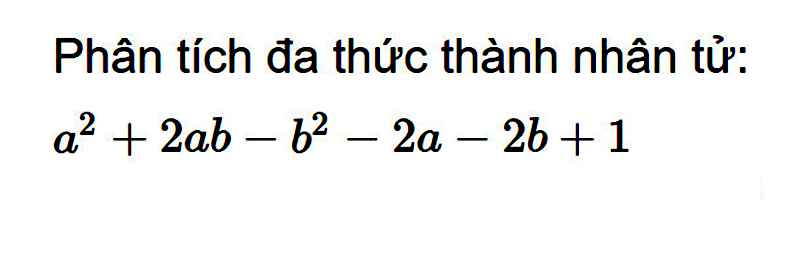
Sửa đề: \(a^2+2ab+b^2-2a-2b+1\)
\(=\left(a^2+2ab+b^2\right)-2\left(a+b\right)+1\)
\(=\left(a+b\right)^2-2\left(a+b\right)\cdot1+1^2\)
\(=\left(a+b-1\right)^2\)
NL
Nguyễn Lê Phước Thịnh
CTVHS
1 tháng 7 2024
Xét tứ giác ABCD có \(\widehat{ABC}+\widehat{ADC}=180^0\)
nên ABCD là tứ giác nội tiếp
=>\(\widehat{DAC}=\widehat{DBC};\widehat{BAC}=\widehat{BDC}\)
mà \(\widehat{CDB}=\widehat{CBD}\)(CB=CD)
nên \(\widehat{DAC}=\widehat{BAC}\)
=>AC là phân giác của góc BAD
DT
1 tháng 7 2024
\(x^2+5y^2+2y-4xy-3=0\\ \Rightarrow\left(x^2-4xy+4y^2\right)+\left(y^2+2y+1\right)-4=0\\ \Rightarrow\left(x-2y\right)^2+\left(y+1\right)^2=4\)
Mình nghĩ bạn thiếu đề nhé
Bổ sung đề: Tìm cặp x, y nguyên thỏa mãn
Với x, y nguyên hiển nhiên x-2y và y+1 nguyên
Mà: \(4=0^2+2^2=0^2+\left(-2\right)^2\)
Các trường hợp xảy ra:
TH1: y+1=0 và x-2y=2
=> y=-1 và x=0
TH2: y+1=0 và x-2y=-2
=> y=-1 và x=-4
TH3: y+1=2 và x-2y=0
=> y=1 và x=2
TH4: y+1=-2 và x-2y=0
=> y=-3 và x=-6
Vậy (x;y)=(0;-1);(-4;-1);(2;1);(-6;-3)
NL
1
DT
1 tháng 7 2024
Sửa đề: Chứng minh \(\left(a+b\right)^3=a^3+3a^2b+3ab^2+b^3\)
Bài làm:
\(VT=\left(a+b\right)^3=\left(a+b\right)\left(a+b\right)\left(a+b\right)\\ =\left(a^2+ab+ab+b^2\right)\left(a+b\right)\\ =\left(a^2+2ab+b^2\right)\left(a+b\right)\\ =a^3+2a^2b+ab^2+a^2b+2ab^2+b^3\\ =a^3+3a^2b+3ab^2+b^3=VP\left(DPCM\right)\)
P
1 tháng 7 2024
a)
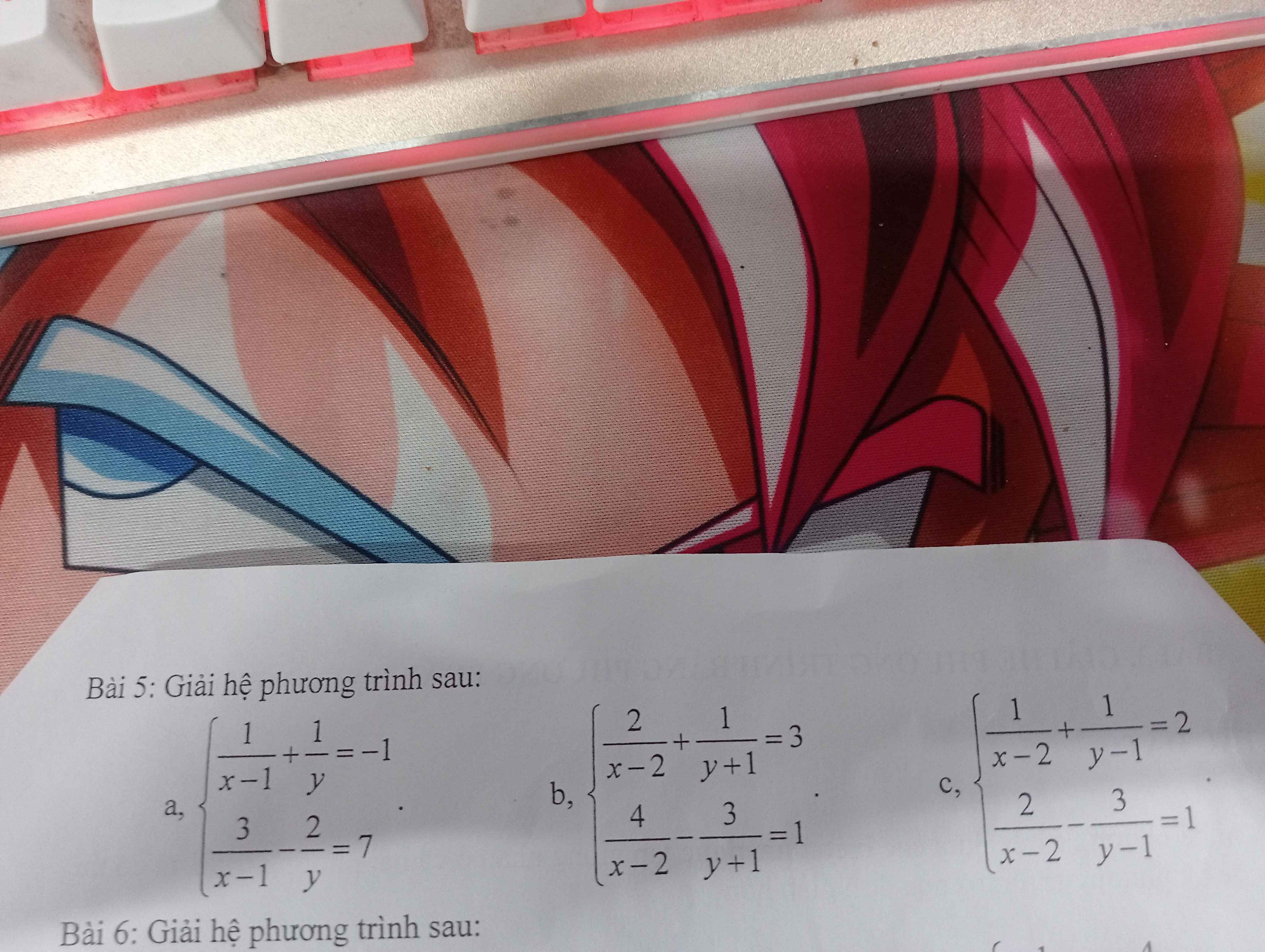
\(\left\{{}\begin{matrix}\dfrac{1}{x-1}+\dfrac{1}{y}=-1\\\dfrac{3}{x-1}-\dfrac{2}{y}=7\end{matrix}\right.\left(x\ne1;x\ne0\right)\Leftrightarrow\left\{{}\begin{matrix}\dfrac{2}{x-1}+\dfrac{2}{y}=-2\\\dfrac{3}{x-1}-\dfrac{2}{y}=7\end{matrix}\right.\\ \Leftrightarrow\left\{{}\begin{matrix}\dfrac{1}{x-1}+\dfrac{1}{y}=-1\\\dfrac{5}{x-1}=5\end{matrix}\right.\Leftrightarrow\left\{{}\begin{matrix}1+\dfrac{1}{y}=-1\\x-1=1\end{matrix}\right.\\ \Leftrightarrow\left\{{}\begin{matrix}\dfrac{1}{y}=-1-1=-2\\x=2\end{matrix}\right.\\ \Leftrightarrow\left\{{}\begin{matrix}y=-\dfrac{1}{2}\\x=2\end{matrix}\right.\left(tm\right)\)
b)
\(\left\{{}\begin{matrix}\dfrac{2}{x-2}+\dfrac{1}{y+1}=3\\\dfrac{4}{x-2}-\dfrac{3}{y+1}=1\end{matrix}\right.\left(x\ne2;y\ne-1\right)\Leftrightarrow\left\{{}\begin{matrix}\dfrac{4}{x-2}+\dfrac{2}{y+1}=6\\\dfrac{4}{x-2}-\dfrac{3}{y+1}=1\end{matrix}\right.\\ \Leftrightarrow\left\{{}\begin{matrix}\dfrac{5}{y+1}=5\\\dfrac{2}{x-2}+\dfrac{1}{y+1}=3\end{matrix}\right.\Leftrightarrow\left\{{}\begin{matrix}y+1=1\\\dfrac{2}{x-2}+1=3\end{matrix}\right.\\ \Leftrightarrow\left\{{}\begin{matrix}y=0\\\dfrac{2}{x-2}=2\end{matrix}\right.\Leftrightarrow\left\{{}\begin{matrix}y=0\\x-2=1\end{matrix}\right.\\ \Leftrightarrow\left\{{}\begin{matrix}y=0\\x=3\end{matrix}\right.\left(tm\right)\)
P
1 tháng 7 2024
c)
\(\left\{{}\begin{matrix}\dfrac{1}{x-2}+\dfrac{1}{y-1}=2\\\dfrac{2}{x-2}-\dfrac{3}{y-1}=1\end{matrix}\right.\left(x\ne2;y\ne1\right) \Leftrightarrow\left\{{}\begin{matrix}\dfrac{2}{x-2}+\dfrac{2}{y-1}=4\\\dfrac{2}{x-2}-\dfrac{3}{y-1}=1\end{matrix}\right.\\ \Leftrightarrow\left\{{}\begin{matrix}\dfrac{1}{x-2}+\dfrac{1}{y-1}=2\\\dfrac{5}{y-1}=3\end{matrix}\right.\Leftrightarrow\left\{{}\begin{matrix}\dfrac{1}{x-2}+\dfrac{3}{5}=2\\y-1=\dfrac{5}{3}\end{matrix}\right.\\ \Leftrightarrow\left\{{}\begin{matrix}\dfrac{1}{x-2}=2-\dfrac{3}{5}=\dfrac{7}{5}\\y=\dfrac{5}{3}+1=\dfrac{8}{3}\end{matrix}\right.\\ \Leftrightarrow\left\{{}\begin{matrix}x-2=\dfrac{5}{7}\Leftrightarrow x=\dfrac{5}{7}+2=\dfrac{19}{7}\\y=\dfrac{8}{3}\end{matrix}\right.\left(tm\right)\)
ND
1
P
1 tháng 7 2024
a)
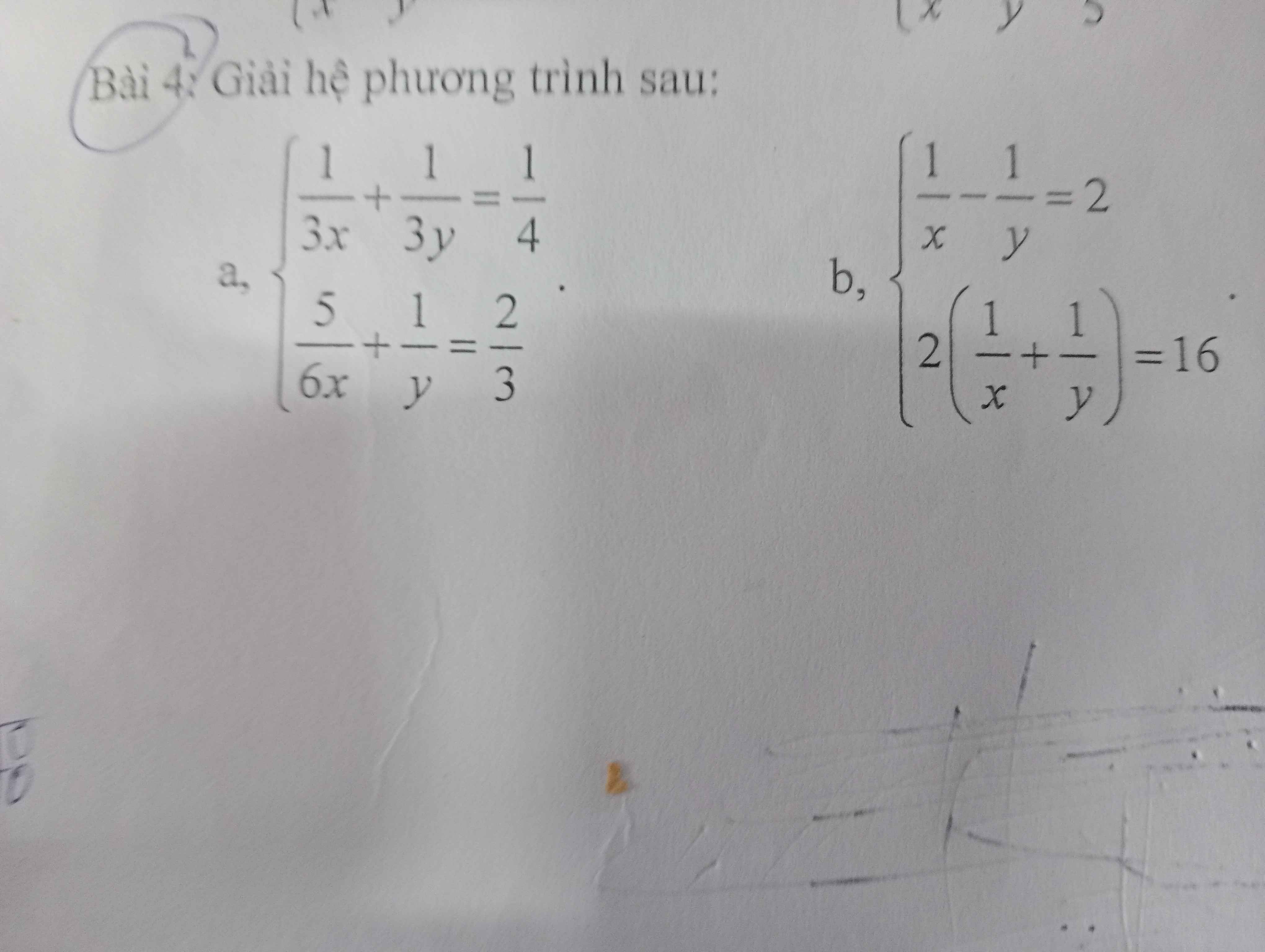
\(\left\{{}\begin{matrix}\dfrac{1}{3x}+\dfrac{1}{3y}=\dfrac{1}{4}\\\dfrac{5}{6x}+\dfrac{1}{y}=\dfrac{2}{3}\end{matrix}\right.\left(x,y\ne0\right)\Leftrightarrow\left\{{}\begin{matrix}\dfrac{1}{x}+\dfrac{1}{y}=\dfrac{3}{4}\\\dfrac{5}{6x}+\dfrac{1}{y}=\dfrac{2}{3}\end{matrix}\right.\\ \Leftrightarrow\left\{{}\begin{matrix}\dfrac{1}{x}-\dfrac{5}{6x}=\dfrac{3}{4}-\dfrac{2}{3}\\\dfrac{1}{x}+\dfrac{1}{y}=\dfrac{3}{4}\end{matrix}\right.\Leftrightarrow\left\{{}\begin{matrix}\dfrac{1}{6x}=\dfrac{1}{12}\\\dfrac{1}{x}+\dfrac{1}{y}=\dfrac{3}{4}\end{matrix}\right.\\ \Leftrightarrow\left\{{}\begin{matrix}6x=12\Leftrightarrow x=2\\\dfrac{1}{2}+\dfrac{1}{y}=\dfrac{3}{4}\end{matrix}\right.\Leftrightarrow\left\{{}\begin{matrix}x=2\\\dfrac{1}{y}=\dfrac{3}{4}-\dfrac{1}{2}=\dfrac{1}{4}\end{matrix}\right.\\ \Leftrightarrow\left\{{}\begin{matrix}x=2\\y=4\end{matrix}\right.\left(tm\right)\)
b)
\(\left\{{}\begin{matrix}\dfrac{1}{x}-\dfrac{1}{y}=2\\2\left(\dfrac{1}{x}+\dfrac{1}{y}\right)=16\end{matrix}\right.\left(x,y\ne0\right) \Leftrightarrow\left\{{}\begin{matrix}\dfrac{1}{x}-\dfrac{1}{y}=2\\\dfrac{1}{x}+\dfrac{1}{y}=8\end{matrix}\right.\\ \Leftrightarrow\left\{{}\begin{matrix}\dfrac{2}{x}=10\\\dfrac{1}{x}+\dfrac{1}{y}=8\end{matrix}\right. \Leftrightarrow\left\{{}\begin{matrix}x=\dfrac{1}{5}\\5+\dfrac{1}{y}=8\end{matrix}\right.\\ \Leftrightarrow\left\{{}\begin{matrix}x=\dfrac{1}{5}\\\dfrac{1}{y}=8-5=3\end{matrix}\right. \Leftrightarrow\left\{{}\begin{matrix}x=\dfrac{1}{5}\\y=\dfrac{1}{3}\end{matrix}\right.\left(tm\right)\)

$(-25).(-17).4+(-20)$
$=25.17.4-20$
$=(25.4).17-20$
$=100.17-20$
$=1700-20=1680$
(-25).(-17).4+(-20)
=25.17.4+(-20)
=25.4.17+(-20)
=100.17+(-20)
=1700+(-20)
=1700-20
= 1680