
Hãy nhập câu hỏi của bạn vào đây, nếu là tài khoản VIP, bạn sẽ được ưu tiên trả lời.

1. Currently I’m renting a flat on Phao Dai Lang Street. It’s not so far from my workplace, only about 2 kilometers.
2. I think most Vietnamese people want to stay at home to relax and recover from their busy schedules at work and school. I also notice that some families in the city often go on a picnic during these days.
3. Well, I’m currently living in an apartment in a condo near the heart of Hanoi, so as you can imagine, there is no space for a garden there. However, I do have a lovely garden in my parents’ house where I grow all kinds of flowers and plants.
4. Not really. I don’t think what I’m learning is practical and there is always a lot of homework and deadlines. But my friends at school are really nice. They are the main reason that I go to class.
5. Yes, I am. But I used to be a very hot-tempered kid who always got annoyed if someone kept me waiting even for 10 minutes.
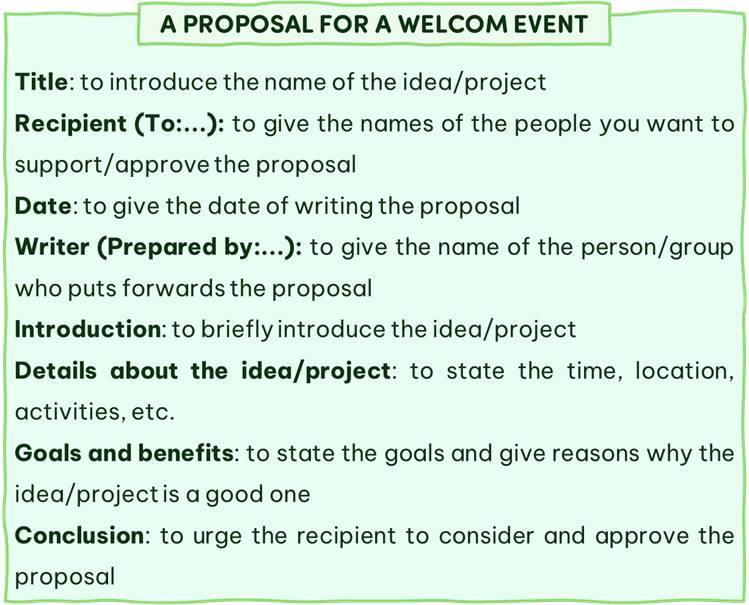
Title: Proposal for a welcome Event for New Students
To: The School Board and Teachers
Date: September 20,2025
Prepared by: Class 11B
Introduction:
This proposal aims to organize a welcome event to greet new members joining our school community
Details about the idea/project:
The event will take place in the school playgroupd on October 5,2025. It will include ice-breaking games, group activities, and short performances by students
Goals and benefits:
The event helps new members feel more comfortable, encourages teamwork, and creates a friendly school environment
Conclusion:
We kindly ask the school leaders to consider and approve this proposal so the event can be successfully organized
Question 1. Member nations/ have / reason / attend / summits / discuss /shared goals.
Member nations have a reason to attend summits to discuss shared goals
Question 2. His respiratory health /gradually / become / better / since / he quit / smoke.
His respiratory health has gradually become better since he quitted smoking
Question 3. It / forbidden / litter / public places / Vietnam / keep the environment / clean.
It is forbidden to litter in public places in Vietnam to keep the environment clean
Question 4. During / holiday season, / the city / look / festive / joyful, / decorate / with / lights and decorations.
During the holiday season, the city looks festive and joyful, decorated with lights and decorations
Question 5. My mom / charge / resolve / family argument / find / solution.
My mom takes charge to resolve family arguments and find solutions
1.Member nations have a reason for attending summits to discuss shared goals.
2.His respiratory health has gradually become better since he quit smoking.
3. It is forbidden to litter in public places in Vietnam to keep the environment clean.
4.During the holiday season, the city looks festive and joyful, decorated with lights and decorations.
5.My mom was in charge of resolving the family argument and finding a solution.
31. She said if she were me, she wouldn’t buy that coat.
Sorry mình chỉ làm đc câu 31 thôi
.png)
we should visit our grandparents once a week. My parents want us to help a close relationship with our grandparents by visiting them regularly and making sure that they are not lonely.
every member of the family has to keep his or her room tidy. My sister and I have to make our beds every morning, and clean the floor and windows twice a week.
my sister and I must be home before 10 p.m. My parents are very strict and believe that setting a curfew will help us to become responsible, and stay safe and healthy.
học tốt nha!
1 A balanced lifestyle can lead to improved health if it is adopted consistently.
2 Harry apologized to his mom for not having returned home on time.
3 It is obligatory for us to attend the mandatory training session.
4 It has been two months since he last experienced a family quarrel.
5 Susan's failure to understand the math problems made her feel frustrated.
Question 1. A balanced lifestyle can lead to improved health if we adopt it consistently. (adopted)
=> A balanced lifestyle can lead to improved health if it is adopted consistently
Question 2. “I’m sorry for not returning home on time, Mom”, Harry said. (apologized)
Harry apologized to his mom for not returning home on time
Question 3. We are obligated to attend the mandatory training session. (to)
It is obligatory for us to attend the mandatory training session
Question 4. He hasn’t experienced a family quarrel for two months. (last)
The last time he experienced a family quarrel was two months ago
Question 5. Susan failed to understand the math problems. That made her feel frustrated. (failure)
Susan's failure to understand the math problems made her feel frustrated.
OoO
g
lop 4 thui co oi
h
Tiếng anh đúng không cô
a. Phương trình phản ứng:
\(C_{5} H_{11} O H + C H_{3} C O O H \overset{H_{2} S O_{4}}{\rightarrow} C_{5} H_{11} C O O C H_{3} + H_{2} O\)
b. Tính m:
Vậy, \(m = 2 , 275 \&\text{nbsp};\text{g}\).
a, CH3COOH + (CH3) 2CHCH2CH2OH → CH3COOCH2CH2CH(CH3)2
b, 2,275
543216789
Dưới đây là lời giải chi tiết cho bài toán điều chế Isoamyl acetate: ### a. Viết phương trình phản ứng Phản ứng ester hóa giữa isoamylic alcohol và acetic acid xảy ra với xúc tác H_2SO_4 đặc và đun nóng: **Phương trình tổng quát:** **Tên gọi:** Acetic acid + Isoamylic alcohol \rightarrow Isoamyl acetate + Nước. ### b. Tính giá trị của m (khối lượng ester) **Bước 1: Tính số mol các chất tham gia** * **Acetic acid (CH_3COOH):** M = 60 \text{ g/mol} * **Isoamylic alcohol (C_5H_{12}O):** M = 88 \text{ g/mol} **Bước 2: Xác định chất hết, chất dư** Tỉ lệ phản ứng là 1:1. Ta thấy 0,025 < 0,0367, nên hiệu suất phản ứng sẽ được tính theo số mol của **isoamylic alcohol** (chất thiếu). **Bước 3: Tính khối lượng ester theo lý thuyết** * **Isoamyl acetate (C_7H_{14}O_2):** M = 130 \text{ g/mol} * Theo phương trình: n_{ester} = n_{alcohol} = 0,025 \text{ mol} * Khối lượng lý thuyết (m_{LT}): **Bước 4: Tính khối lượng ester thực tế thu được (với H = 70\%):** **Kết quả:** Giá trị của m là **2,275 gam**.
2,275
jhjj
2,275
a.CH3COOH+(CH3)2CHCH2CH2OH<=>CH3COOCH2CHCH2CH(CH3)2+H2O b.
m=2,275gam
- \(M_{ancol} (C_5H_{12}O) = 88 \text{ g/mol} \Rightarrow n_{ancol} = \frac{2,2}{88} = 0,025 \text{ mol}\)
- \(M_{acid} (C_2H_4O_2) = 60 \text{ g/mol} \Rightarrow n_{acid} = \frac{2,2}{60} \approx 0,0367 \text{ mol}\)
2. Xác định chất tính theo hiệu suất:So sánh tỉ lệ mol: \(0,025 < 0,0367 \Rightarrow\) Hiệu suất phản ứng tính theo ancol isoamylic. 3. Tính khối lượng ester (m):
- Theo phương trình: \(n_{ester\ (lý\ thuyết)} = n_{ancol} = 0,025 \text{ mol}\)
- Khối lượng mol của isoamyl acetate (\(C_7H_{14}O_2\)): \(M = 130 \text{ g/mol}\)
- Khối lượng ester thực tế thu được với hiệu suất \(70\%\):
Kết luận: Giá trị của \(m\) là 2,275 gam.\(m=0,025\times 130\times \frac{70}{100}=2,275\text{\ gam}\)
a) phương trình pư
CH3COOH+C5H11OH <=> CH3COOC5H11+H2O
b)
M=88g/mol
Số mol:
Nancol=2.2/88=0.025 mol
Acetic acid:
Mch3côh = 60g/mol
Naxit=2.2/60≈0.0367mol
=>Ancol là chất giới hạn nên :
Neste=0.025mol
Este tạo thành là isoamyl acetate:
Meste=130g/mol
Khối lượng este theo lí thuyết
Mlt=0.025x130=3.25g
Theo hiệu suất 70%
M=3.25×70%=2.275g
Vậy m≈2.28g
- \(M_{CH_3COOH} = 60 \text{ g/mol} \Rightarrow n_{acid} = \frac{2,2}{60} \approx 0,0367 \text{ mol}\)
- \(M_{isoamylic \ alcohol} = 88 \text{ g/mol} \Rightarrow n_{alcohol} = \frac{2,2}{88} = 0,025 \text{ mol}\)
2. Xác định chất hết - chất dư:Theo phương trình, tỉ lệ mol là 1:1. Vì \(0,025 < 0,0367\) nên rượu isoamylic hết, acid acetic dư. Tính toán sản phẩm sẽ dựa trên số mol của rượu. 3. Tính khối lượng ester theo lý thuyết:
- \(n_{ester \ (lý \ thuyết)} = n_{alcohol} = 0,025 \text{ mol}\)
- \(M_{ester} (C_7H_{14}O_2) = 130 \text{ g/mol}\)
- \(m_{ester \ (lý \ thuyết)} = 0,025 \times 130 = 3,25 \text{ gam}\)
4. Tính khối lượng ester thực tế thu được (với hiệu suất 70%):\(m=m_{ester\ (lý\ thuyt)}\times \frac{H\%}{100\%}=3,25\times 0,7=2,275\text{\ gam}\) Kết luận: Giá trị của \(m\) là 2,275 gam
1
B) 2,28
2,275 gam
2,275gam
- \(M_{CH_3COOH} = 60 \, g/mol\)
- \(M_{isoamylic \, alcohol} = 88 \, g/mol\) (Công thức: \(C_5H_{12}O\))
- \(n_{acid} = \frac{2,2}{60} \approx 0,0367 \, mol\)
- \(n_{alcohol} = \frac{2,2}{88} = 0,025 \, mol\)
2. Xác định chất giới hạn:So sánh tỉ lệ: \(0,0367 > 0,025\). Do đó, hiệu suất phản ứng tính theo isoamylic alcohol. 3. Tính khối lượng ester (m):
- Theo phương trình, \(n_{ester} = n_{alcohol \, phản \, ứng}\).
- Khối lượng mol isoamyl acetate (\(C_7H_{14}O_2\)): \(M = 130 \, g/mol\).
- Với hiệu suất \(H = 70\%\), khối lượng ester thu được là:
\(m=n_{alcohol}\times M_{ester}\times H=0,025\times 130\times 70\%\)\(m=2,275\,gam\)
Giá trị của m là 2,275 gam
Phương trình phản ứng este hóa:
Isoamylic alcohol (C_5H_{11}OH) phản ứng với axit axetic:
CH_3COOH + C_5H_{11}OH \xrightleftharpoons[\ ]{H_2SO_4\,đặc} CH_3COOC_5H_{11} + H_2O
(Isoamyl acetate)
b) Tính khối lượng este thu được
Số mol axit axetic:
n_{CH_3COOH}=\frac{2,2}{60}=0,0367\text{ mol}
Số mol isoamylic alcohol:
n_{C_5H_{11}OH}=\frac{2,2}{88}=0,025\text{ mol}
Tỉ lệ phản ứng 1:1, nên alcohol là chất giới hạn.
n_{\text{este lt}}=0,025\text{ mol}
Khối lượng mol isoamyl acetate:
M = 130\text{ g/mol}
Khối lượng este theo lí thuyết:
m_{lt}=0,025 \times 130 = 3,25\text{ g}
Hiệu suất 70\%:
m = 3,25 \times 70\% = 2,275\text{ g}
oo ké
- \(M_{CH_3COOH} = 60 \text{ g/mol} \Rightarrow n_{acid} = \frac{2,2}{60} \approx 0,0367 \text{ mol}\)
- \(M_{isoamylic} = 88 \text{ g/mol} \Rightarrow n_{alcohol} = \frac{2,2}{88} = 0,025 \text{ mol}\)
2. Xác định chất phản ứng hết:Vì \(n_{alcohol} (0,025) < n_{acid} (0,0367)\), nên hiệu suất phản ứng sẽ được tính theo isoamylic alcohol. 3. Tính khối lượng ester theo lý thuyết:
- Theo phương trình: \(n_{ester} = n_{alcohol} = 0,025 \text{ mol}\)
- \(M_{isoamyl \ acetate} = 130 \text{ g/mol}\)
- \(m_{\text{lý thuyết}} = 0,025 \times 130 = 3,25 \text{ gam}\)
4. Tính khối lượng ester thực tế (m) với hiệu suất 70%:\(m=m_{\text{lý\ thuyt}}\times \frac{H}{100}=3,25\times \frac{70}{100}=2,275\text{\ gam}\) Kết luận: Giá trị của \(m\) là 2,275 gam.
\(n_{acid}=\frac{2,2}{60}\approx 0,0367\,(mol)\)
\(n_{alcohol}=\frac{2,2}{88}=0,025\,(mol)\)
2,275
789
6