

 Quay lại bản cũ

Bài tập tự luận (Nâng cao)

Cho 5 điểm $A, B, C, D, E$. Chứng minh rằng:
a) $\overrightarrow{A B}+\overrightarrow{C D}+\overrightarrow{E A}=\overrightarrow{C B}+\overrightarrow{E D}$.
b) $\overrightarrow{C D}+\overrightarrow{E A}=\overrightarrow{C A}+\overrightarrow{E D}$.
 Hướng dẫn giải
a) Ta có: $\overrightarrow{AB} + \overrightarrow{CD} + \overrightarrow{EA} = \overrightarrow{CB} + \overrightarrow{ED}$
$\Leftrightarrow (\overrightarrow{AB} - \overrightarrow{CB}) + \overrightarrow{CD} + (\overrightarrow{EA} - \overrightarrow{ED}) = \overrightarrow{0}$
$\Leftrightarrow \overrightarrow{AB} + \overrightarrow{BC} + \overrightarrow{CD} + \overrightarrow{DA} = \overrightarrow{0}$
$\Leftrightarrow \overrightarrow{AA} = \overrightarrow{0}$ (luôn đúng).
Vậy $\overrightarrow{AB} + \overrightarrow{CD} + \overrightarrow{EA} = \overrightarrow{CB} + \overrightarrow{ED}$.
b) Ta có: $\overrightarrow{CD} + \overrightarrow{EA} = \overrightarrow{CA} + \overrightarrow{ED}$
$\Leftrightarrow \overrightarrow{CD} - \overrightarrow{CA} = \overrightarrow{ED} - \overrightarrow{EA}$
$\Leftrightarrow \overrightarrow{AD} = \overrightarrow{AD}$ (luôn đúng).
Vậy $\overrightarrow{CD} + \overrightarrow{EA} = \overrightarrow{CA} + \overrightarrow{ED}$.
Cho cho tứ giác lồi $A B C D$. Gọi $E, F$ lần lượt là trung điểm của $A B, C D$ và $G$ là trung điểm $E F$. Chứng minh rằng:
a) $\overrightarrow{A C}+\overrightarrow{B D}=\overrightarrow{A D}+\overrightarrow{B C}=2 \overrightarrow{E F}$.
b) $\overrightarrow{G A}+\overrightarrow{G B}+\overrightarrow{G C}+\overrightarrow{G D}=\overrightarrow{0}$
Hướng dẫn giải
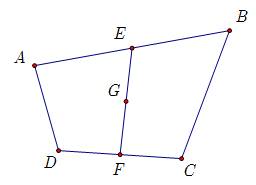
a) $\overrightarrow{A C}+\overrightarrow{B D}=\overrightarrow{A D}+\overrightarrow{B C}=2 \overrightarrow{E F}$
- $\overrightarrow{A C}+\overrightarrow{B D}=2 \overrightarrow{E F}(1)$.
Do $E$ là trung điểm $A B$ nên $2 \overrightarrow{O E}=\overrightarrow{O A}+\overrightarrow{O B}$ với $O$ là một điểm tùy ý.
Do $F$ là trung điểm $C D$ nên $2 \overrightarrow{O F}=\overrightarrow{O C}+\overrightarrow{O D}$ với $O$ là một điểm tùy ý.
(1) $\Leftrightarrow \overrightarrow{O C}-\overrightarrow{O A}+\overrightarrow{O D}-\overrightarrow{O B}=2 \overrightarrow{O F}-2 \overrightarrow{O E}$
$\begin{aligned}&\Leftrightarrow \overrightarrow{O C}-\overrightarrow{O A}+\overrightarrow{O D}-\overrightarrow{O B}=(\overrightarrow{O C}+\overrightarrow{O D})-(\overrightarrow{O A}+\overrightarrow{O B}) \\&\Leftrightarrow(\underbrace{\overrightarrow{O C}-\overrightarrow{O C}}_{\overrightarrow{0}})+(\underbrace{\overrightarrow{O D}-\overrightarrow{O D}}_{\overrightarrow{0}})-(\underbrace{\overrightarrow{O B}-\overrightarrow{O B}}_{\overrightarrow{0}})+(\underbrace{\overrightarrow{O A}-\overrightarrow{O A}}_{\overrightarrow{0}})=\overrightarrow{0} \Rightarrow \text { ĐPCM. }\end{aligned}$
$\overrightarrow{A D}+\overrightarrow{B C}=2 \overrightarrow{E F}(2)$
Do $E$ là trung điểm $A B$ nên $2 \overrightarrow{O E}=\overrightarrow{O A}+\overrightarrow{O B}$ với $O$ là một điểm tùy ý.
Do $F$ là trung điểm $C D$ nên $2 \overrightarrow{O F}=\overrightarrow{O C}+\overrightarrow{O D}$ với $O$ là một điểm tùy ý.
$(2) \Leftrightarrow \overrightarrow{O D}-\overrightarrow{O A}+\overrightarrow{O C}-\overrightarrow{O B}=2 \overrightarrow{O F}-2 \overrightarrow{O E}$
$\Leftrightarrow \overrightarrow{O D}-\overrightarrow{O A}+\overrightarrow{O C}-\overrightarrow{O B}=(\overrightarrow{O C}+\overrightarrow{O D})-(\overrightarrow{O A}+\overrightarrow{O B})$
$\Leftrightarrow(\underbrace{\overrightarrow{O C}-\overrightarrow{O C}}_{\overrightarrow{0}})+(\underbrace{\overrightarrow{O D}-\overrightarrow{O D}}_{\overrightarrow{0}})-(\underbrace{\overrightarrow{O B}-\overrightarrow{O B}}_{\overrightarrow{0}})+(\underbrace{\overrightarrow{O A}-\overrightarrow{O A}}_{\overrightarrow{0}})=\overrightarrow{0} \Rightarrow \text { ĐPCM. }$
b) $\overrightarrow{G A}+\overrightarrow{G B}+\overrightarrow{G C}+\overrightarrow{G D}=\overrightarrow{0}$ (3).
Do $E$ là trung điểm $A B$ nên $2 \overrightarrow{O E}=\overrightarrow{O A}+\overrightarrow{O B}$ với $O$ là một điểm tùy ý.
Do $F$ là trung điểm $C D$ nên $2 \overrightarrow{O F}=\overrightarrow{O C}+\overrightarrow{O D}$ với $O$ là một điểm tùy ý.
$(3) \Leftrightarrow(2 \overrightarrow{G E}-\overrightarrow{G B})+\overrightarrow{G B}+\overrightarrow{G C}+(2 \overrightarrow{G F}-\overrightarrow{G C})=\overrightarrow{0}$
$\Leftrightarrow 2 \overrightarrow{G E}+2 \overrightarrow{G F}=\overrightarrow{0} \Leftrightarrow 2(\underbrace{\overrightarrow{G E}+\overrightarrow{G F}}_{\overrightarrow{0}})=\overrightarrow{0} \Rightarrow \text { ĐPCM. }$
Cho tứ giác $A B C D$. Gọi hai điểm $M$ và $N$ theo thứ tự là trung điêm của các đoạn $A D, B C$.
a) Chứng minh rằng $\overrightarrow{M N}=\dfrac{1}{2}(\overrightarrow{A B}+\overrightarrow{D C})=\dfrac{1}{2}(\overrightarrow{A C}+\overrightarrow{D B})$.
b) Gọi $I$ là trung điểm của $M N$. Chứng minh rằng: $\overrightarrow{I A}+\overrightarrow{I B}+\overrightarrow{I C}+\overrightarrow{I D}=\overrightarrow{0}$.
Hướng dẫn giải
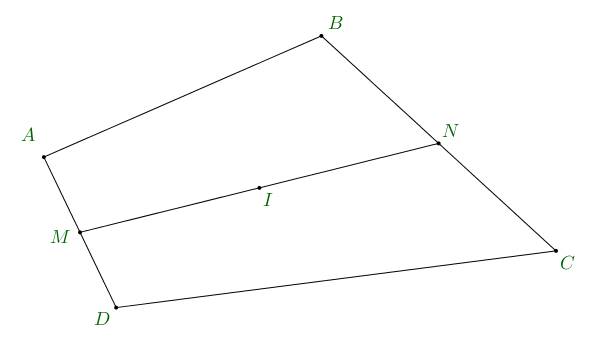
a) Chứng minh rằng $\overrightarrow{M N}=\dfrac{1}{2}(\overrightarrow{A B}+\overrightarrow{D C})=\dfrac{1}{2}(\overrightarrow{A C}+\overrightarrow{D B})$.
- Chứng minh $\overrightarrow{M N}=\dfrac{1}{2}(\overrightarrow{A B}+\overrightarrow{D C})$.
Vì $M$ là trung điểm của $A D$ nên $\overrightarrow{M A}+\overrightarrow{M D}=\overrightarrow{0}$.
Vì $N$ là trung điểm của $B C$ nên $\overrightarrow{B N}+\overrightarrow{C N}=\overrightarrow{0}$.
Áp dụng quy tắc ba điểm, ta có:
$\left\{\begin{array}{l}\overrightarrow{M N}=\overrightarrow{M A}+\overrightarrow{A B}+\overrightarrow{B N} \\ \overrightarrow{M N}=\overrightarrow{M D}+\overrightarrow{DC}+\overrightarrow{C N}\end{array}\right.$ $\Rightarrow 2 \overrightarrow{M N}=(\overrightarrow{M A}+\overrightarrow{M D})+\overrightarrow{A B}+\overrightarrow{C D}+(\overrightarrow{B N}+\overrightarrow{C N})=\overrightarrow{0}+\overrightarrow{A B}+\overrightarrow{C D}+\overrightarrow{0}=\overrightarrow{A B}+\overrightarrow{C D} .$ $\Rightarrow \overrightarrow{M N}=\dfrac{1}{2}(\overrightarrow{A B}+\overrightarrow{D C}) .$
- Chứng minh $\dfrac{1}{2}(\overrightarrow{A B}+\overrightarrow{D C})=\dfrac{1}{2}(\overrightarrow{A C}+\overrightarrow{D B}) .$ $\{\overrightarrow{A B}=\overrightarrow{A C}+\overrightarrow{C B}=\overrightarrow{D B}=\overrightarrow{C D}+\overrightarrow{B C}=\overrightarrow{A C}+\overrightarrow{D B}+\overrightarrow{C B}+\overrightarrow{B C}=\overrightarrow{A C}+\overrightarrow{D B} \Rightarrow .$
Vậy: $\overrightarrow{M N}=\dfrac{1}{2}(\overrightarrow{A B}+\overrightarrow{D C})=\dfrac{1}{2}(\overrightarrow{A C}+\overrightarrow{D B})$.
b) Gọi $I$ là trung điểm của $M N$. Chứng minh rằng: $\overrightarrow{I A}+\overrightarrow{I B}+\overrightarrow{I C}+\overrightarrow{I D}=\overrightarrow{0}$.
Áp dụng hệ thức trung điểm, ta có:
$\left\{\begin{array}{l}\overrightarrow{I A}+\overrightarrow{I D}=2 \overrightarrow{I M} \\\overrightarrow{I B}+\overrightarrow{I D}=2 \overrightarrow{I N}\end{array} \Rightarrow \overrightarrow{I A}+\overrightarrow{I D}+\overrightarrow{I B}+\overrightarrow{I D}=2(\overrightarrow{I M}+\overrightarrow{I N})= 2.\overrightarrow{0}=\overrightarrow{0} .\right.$
Cho hình lục giác đều $ABCDEF$ tâm $O$. Chứng minh rằng: $\overrightarrow{OA} + \overrightarrow{OB} + \overrightarrow{OC} + \overrightarrow{OD} + \overrightarrow{OE} + \overrightarrow{OF} = \overrightarrow{0}$.
Hướng dẫn giải
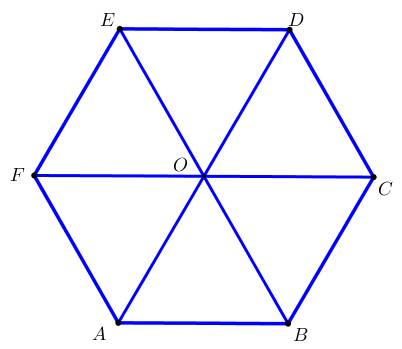
Vì $O$ là tâm của hình lục giác đều $ABCDEF$ nên $\overrightarrow{OA}$ và $\overrightarrow{OD}$; $\overrightarrow{OB}$ và $\overrightarrow{OE}$; $\overrightarrow{OC}$ và $\overrightarrow{OF}$ là các cặp vectơ đối nhau.
Do đó: $\overrightarrow{OA} + \overrightarrow{OD} = \overrightarrow{0}$, $\overrightarrow{OB} + \overrightarrow{OE} = \overrightarrow{0}$, $\overrightarrow{OC} + \overrightarrow{OF} = \overrightarrow{0}$.
Ta có:
$\begin{aligned} \overrightarrow{OA} + \overrightarrow{OB} + \overrightarrow{OC} + \overrightarrow{OD} + \overrightarrow{OE} + \overrightarrow{OF} &= (\overrightarrow{OA} + \overrightarrow{OD}) + (\overrightarrow{OB} + \overrightarrow{OE}) + (\overrightarrow{OC} + \overrightarrow{OF}) \\ &= \overrightarrow{0} + \overrightarrow{0} + \overrightarrow{0} = \overrightarrow{0}. \end{aligned}$
Cho ngũ giác đều $ABCDE$ tâm $O$.
a) Chứng minh rằng hai vectơ $\overrightarrow{OA} + \overrightarrow{OB}$ và $\overrightarrow{OC} + \overrightarrow{OE}$ đều cùng phương với $\overrightarrow{OD}$.
b) Chứng minh rằng hai vectơ $\overrightarrow{AB}$ và $\overrightarrow{EC}$ cùng phương.
c) Chứng minh rằng $\overrightarrow{OA} + \overrightarrow{OB} + \overrightarrow{OC} + \overrightarrow{OD} + \overrightarrow{OE} = \overrightarrow{0}$.
Hướng dẫn giải
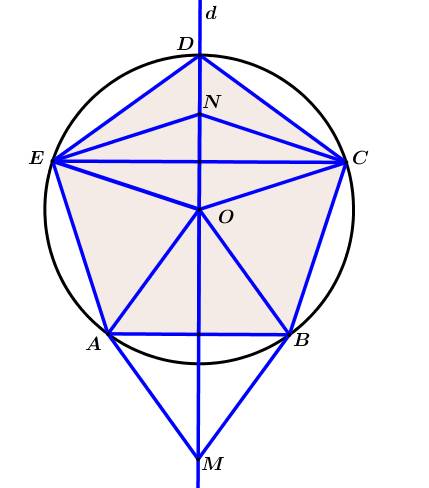
a) Vì $ABCDE$ là ngũ giác đều tâm $O$ nên đường thẳng $OD$ là trục đối xứng của ngũ giác đều $ABCDE$. Do đó $OD$ là đường trung trực của hai đoạn thẳng $AB$ và $EC$.
Gọi $M, N$ lần lượt là trung điểm của $AB$ và $EC$ thì $M, N$ đều thuộc đường thẳng $OD$.
Theo tính chất trung điểm, ta có $\overrightarrow{OA} + \overrightarrow{OB} = 2\overrightarrow{OM}$ và $\overrightarrow{OC} + \overrightarrow{OE} = 2\overrightarrow{ON}$.
Vì bốn điểm $O, M, N, D$ thẳng hàng nên hai vectơ $\overrightarrow{OM}$ và $\overrightarrow{ON}$ cùng phương với $\overrightarrow{OD}$. Suy ra hai vectơ $\overrightarrow{OA} + \overrightarrow{OB}$ và $\overrightarrow{OC} + \overrightarrow{OE}$ đều cùng phương với $\overrightarrow{OD}$.
b) Vì đường thẳng $OD$ là đường trung trực của $AB$ và $EC$ nên $OD \perp AB$ và $OD \perp EC$. Suy ra $AB \parallel EC$, do đó hai vectơ $\overrightarrow{AB}$ và $\overrightarrow{EC}$ cùng phương.
c) Đặt $\overrightarrow{v} = \overrightarrow{OA} + \overrightarrow{OB} + \overrightarrow{OC} + \overrightarrow{OD} + \overrightarrow{OE}$.
Ta có: $\overrightarrow{v} = (\overrightarrow{OA} + \overrightarrow{OB}) + (\overrightarrow{OC} + \overrightarrow{OE}) + \overrightarrow{OD}$. Theo câu a), các vectơ $\overrightarrow{OA} + \overrightarrow{OB}$ và $\overrightarrow{OC} + \overrightarrow{OE}$ đều cùng phương với $\overrightarrow{OD}$ nên $\overrightarrow{v}$ cùng phương với $\overrightarrow{OD}$.
Lập luận tương tự, nhóm $\overrightarrow{v} = (\overrightarrow{OB} + \overrightarrow{OC}) + (\overrightarrow{OD} + \overrightarrow{OA}) + \overrightarrow{OE}$, ta cũng chứng minh được $\overrightarrow{v}$ cùng phương với $\overrightarrow{OE}$.
Vì hai đường thẳng $OD$ và $OE$ cắt nhau tại $O$ nên hai vectơ $\overrightarrow{OD}$ và $\overrightarrow{OE}$ không cùng phương. Một vectơ đồng thời cùng phương với hai vectơ không cùng phương thì vectơ đó phải là vectơ-không.
Vậy $\overrightarrow{v} = \overrightarrow{0}$, hay $\overrightarrow{OA} + \overrightarrow{OB} + \overrightarrow{OC} + \overrightarrow{OD} + \overrightarrow{OE} = \overrightarrow{0}$.
Cho hình bình hành $ABCD$ tâm $O$. $M$ là một điểm bất kì trong mặt phẳng. Chứng minh rằng:
a) $\overrightarrow{BA} + \overrightarrow{DA} + \overrightarrow{AC} = \overrightarrow{0}$.
b) $\overrightarrow{OA} + \overrightarrow{OB} + \overrightarrow{OC} + \overrightarrow{OD} = \overrightarrow{0}$.
c) $\overrightarrow{MA} + \overrightarrow{MC} = \overrightarrow{MB} + \overrightarrow{MD}$.
Hướng dẫn giải
a) Vì $ABCD$ là hình bình hành nên theo quy tắc hình bình hành, ta có: $\overrightarrow{AB} + \overrightarrow{AD} = \overrightarrow{AC}$.
Ta có: $\overrightarrow{BA} + \overrightarrow{DA} + \overrightarrow{AC} = -(\overrightarrow{AB} + \overrightarrow{AD}) + \overrightarrow{AC} = -\overrightarrow{AC} + \overrightarrow{AC} = \overrightarrow{0}$.
b) Vì $O$ là tâm của hình bình hành $ABCD$ nên $O$ là trung điểm của hai đường chéo $AC$ và $BD$. Do đó $\overrightarrow{OA} + \overrightarrow{OC} = \overrightarrow{0}$ và $\overrightarrow{OB} + \overrightarrow{OD} = \overrightarrow{0}$.
Ta có: $\overrightarrow{OA} + \overrightarrow{OB} + \overrightarrow{OC} + \overrightarrow{OD} = (\overrightarrow{OA} + \overrightarrow{OC}) + (\overrightarrow{OB} + \overrightarrow{OD}) = \overrightarrow{0} + \overrightarrow{0} = \overrightarrow{0}$.
c) Với điểm $M$ bất kì, theo quy tắc ba điểm, ta có:
$\begin{aligned} \overrightarrow{MA} + \overrightarrow{MC} &= (\overrightarrow{MO} + \overrightarrow{OA}) + (\overrightarrow{MO} + \overrightarrow{OC}) = 2\overrightarrow{MO} + (\overrightarrow{OA} + \overrightarrow{OC}) = 2\overrightarrow{MO} + \overrightarrow{0} = 2\overrightarrow{MO}, \\ \overrightarrow{MB} + \overrightarrow{MD} &= (\overrightarrow{MO} + \overrightarrow{OB}) + (\overrightarrow{MO} + \overrightarrow{OD}) = 2\overrightarrow{MO} + (\overrightarrow{OB} + \overrightarrow{OD}) = 2\overrightarrow{MO} + \overrightarrow{0} = 2\overrightarrow{MO}. \end{aligned}$
Vậy $\overrightarrow{MA} + \overrightarrow{MC} = \overrightarrow{MB} + \overrightarrow{MD}$.
Cho tam giác $ABC$. Gọi $M, N, P$ lần lượt là trung điểm của $BC, CA, AB$. Chứng minh rằng:
a) $\overrightarrow{BM} + \overrightarrow{CN} + \overrightarrow{AP} = \overrightarrow{0}$.
b) $\overrightarrow{AP} + \overrightarrow{AN} - \overrightarrow{AC} + \overrightarrow{BM} = \overrightarrow{0}$.
c) $\overrightarrow{OA} + \overrightarrow{OB} + \overrightarrow{OC} = \overrightarrow{OM} + \overrightarrow{ON} + \overrightarrow{OP}$ với $O$ là điểm bất kì.
Hướng dẫn giải
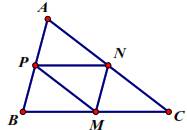
a) Vì $M, N, P$ lần lượt là trung điểm của $BC, CA, AB$ nên $\overrightarrow{BM} = \dfrac{1}{2}\overrightarrow{BC}$, $\overrightarrow{CN} = \dfrac{1}{2}\overrightarrow{CA}$ và $\overrightarrow{AP} = \dfrac{1}{2}\overrightarrow{AB}$.
Ta có: $\overrightarrow{BM} + \overrightarrow{CN} + \overrightarrow{AP} = \dfrac{1}{2}(\overrightarrow{BC} + \overrightarrow{CA} + \overrightarrow{AB}) = \dfrac{1}{2}(\overrightarrow{BA} + \overrightarrow{AB}) = \dfrac{1}{2}\overrightarrow{0} = \overrightarrow{0}$.
b) Theo quy tắc hiệu, ta có $\overrightarrow{AN} - \overrightarrow{AC} = \overrightarrow{CN}$.
Do đó: $\overrightarrow{AP} + \overrightarrow{AN} - \overrightarrow{AC} + \overrightarrow{BM} = \overrightarrow{AP} + \overrightarrow{CN} + \overrightarrow{BM} = \overrightarrow{0}$ (theo câu a).
c) Với điểm $O$ bất kì, theo quy tắc ba điểm, ta có:
$\begin{aligned} \overrightarrow{OM} + \overrightarrow{ON} + \overrightarrow{OP} &= (\overrightarrow{OB} + \overrightarrow{BM}) + (\overrightarrow{OC} + \overrightarrow{CN}) + (\overrightarrow{OA} + \overrightarrow{AP}) \\ &= (\overrightarrow{OA} + \overrightarrow{OB} + \overrightarrow{OC}) + (\overrightarrow{BM} + \overrightarrow{CN} + \overrightarrow{AP}). \end{aligned}$
Theo câu a), $\overrightarrow{BM} + \overrightarrow{CN} + \overrightarrow{AP} = \overrightarrow{0}$. Vậy $\overrightarrow{OA} + \overrightarrow{OB} + \overrightarrow{OC} = \overrightarrow{OM} + \overrightarrow{ON} + \overrightarrow{OP}$.
Chứng minh các khẳng định sau:
a) Nếu $\vec{a}$ và $\vec{b}$ cùng hướng thì $|\vec{a}+\vec{b}|=|\vec{a}|+|\vec{b}|$.
b) Nếu $\vec{a}$ và $\vec{b}$ ngược hướng và $|\vec{b}| \geq|\vec{a}|$ thì $|\vec{a}+\vec{b}|=|\vec{b}|-|\vec{a}|$.
c) $|\vec{a}+\vec{b}| \leq|\vec{a}|+|\vec{b}|$. Khi nào xảy ra dấu đẳng thức?
Hướng dẫn giải
Giả sử $\overrightarrow{a} = \overrightarrow{AB}$ và $\overrightarrow{b} = \overrightarrow{BC}$, khi đó $\overrightarrow{a} + \overrightarrow{b} = \overrightarrow{AB} + \overrightarrow{BC} = \overrightarrow{AC}$.
a) Nếu $\overrightarrow{a}$ và $\overrightarrow{b}$ cùng hướng thì $|\overrightarrow{a} + \overrightarrow{b}| = |\overrightarrow{a}| + |\overrightarrow{b}|$.
Nếu $\overrightarrow{a} = \overrightarrow{0}$ hoặc $\overrightarrow{b} = \overrightarrow{0}$ thì đẳng thức hiển nhiên đúng. Nếu $\overrightarrow{a} \neq \overrightarrow{0}$ và $\overrightarrow{b} \neq \overrightarrow{0}$ cùng hướng thì ba điểm $A, B, C$ cùng thuộc một đường thẳng và $B$ nằm giữa $A, C$.
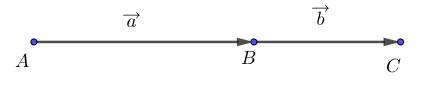
Do đó $|\overrightarrow{a} + \overrightarrow{b}| = |\overrightarrow{AB} + \overrightarrow{BC}| = |\overrightarrow{AC}| = AC = AB + BC = |\overrightarrow{a}| + |\overrightarrow{b}|$.
Vậy $|\overrightarrow{a} + \overrightarrow{b}| = |\overrightarrow{a}| + |\overrightarrow{b}|$.
b) Nếu $\overrightarrow{a}$ và $\overrightarrow{b}$ ngược hướng và $|\overrightarrow{b}| \geq |\overrightarrow{a}|$ thì $|\overrightarrow{a} + \overrightarrow{b}| = |\overrightarrow{b}| - |\overrightarrow{a}|$.
Nếu $\overrightarrow{a} = \overrightarrow{0}$ thì $|\overrightarrow{0} + \overrightarrow{b}| = |\overrightarrow{b}| = |\overrightarrow{b}| - |\overrightarrow{0}|$, đẳng thức đúng. Nếu $\overrightarrow{a} \neq \overrightarrow{0}$ (khi đó $|\overrightarrow{b}| \geq |\overrightarrow{a}| > 0$ nên $\overrightarrow{b} \neq \overrightarrow{0}$), vì $\overrightarrow{a}$ và $\overrightarrow{b}$ ngược hướng và $|\overrightarrow{b}| \geq |\overrightarrow{a}|$ nên ba điểm $A, B, C$ cùng thuộc một đường thẳng và $A$ nằm giữa $B, C$ (hoặc $A \equiv C$ khi $|\overrightarrow{b}| = |\overrightarrow{a}|$).

Do đó $|\overrightarrow{a} + \overrightarrow{b}| = |\overrightarrow{AB} + \overrightarrow{BC}| = |\overrightarrow{AC}| = AC = BC - AB = |\overrightarrow{b}| - |\overrightarrow{a}|$.
Vậy $|\overrightarrow{a} + \overrightarrow{b}| = |\overrightarrow{b}| - |\overrightarrow{a}|$.
c) $|\overrightarrow{a} + \overrightarrow{b}| \leq |\overrightarrow{a}| + |\overrightarrow{b}|$. Khi nào xảy ra dấu đẳng thức?
Từ chứng minh ở câu a) và câu b), xét hai trường hợp:
- Nếu $\overrightarrow{a}$ và $\overrightarrow{b}$ cùng phương:
+ Khi $\overrightarrow{a}$ và $\overrightarrow{b}$ cùng hướng (bao gồm cả trường hợp $\overrightarrow{a} = \overrightarrow{0}$ hoặc $\overrightarrow{b} = \overrightarrow{0}$) thì $|\overrightarrow{a} + \overrightarrow{b}| = |\overrightarrow{a}| + |\overrightarrow{b}|$.
+ Khi $\overrightarrow{a}$ và $\overrightarrow{b}$ ngược hướng (với $\overrightarrow{a} \neq \overrightarrow{0}$ và $\overrightarrow{b} \neq \overrightarrow{0}$), theo câu b) và tính đối xứng giữa $\overrightarrow{a}, \overrightarrow{b}$ thì $|\overrightarrow{a} + \overrightarrow{b}| = \big||\overrightarrow{b}| - |\overrightarrow{a}|\big| < |\overrightarrow{a}| + |\overrightarrow{b}|$ (do $|\overrightarrow{a}| > 0$ và $|\overrightarrow{b}| > 0$).
- Nếu $\overrightarrow{a}$ và $\overrightarrow{b}$ không cùng phương thì ba điểm $A, B, C$ không thẳng hàng.
Xét $\triangle ABC$ có bất đẳng thức tam giác $AC < AB + BC$. Do đó $|\overrightarrow{a} + \overrightarrow{b}| < |\overrightarrow{a}| + |\overrightarrow{b}|$.
Vậy trong mọi trường hợp ta luôn có $|\overrightarrow{a} + \overrightarrow{b}| \leq |\overrightarrow{a}| + |\overrightarrow{b}|$. Dấu đẳng thức xảy ra khi và chỉ khi $\overrightarrow{a}$ và $\overrightarrow{b}$ cùng hướng (quy ước vectơ $\overrightarrow{0}$ cùng hướng với mọi vectơ).
Cho tam giác $ABC$ vuông tại $A$ có $\widehat{ABC} = 30^{\circ}$ và $BC = a\sqrt{5}$ ($a > 0$).
Tính độ dài của các vectơ $\overrightarrow{AB} + \overrightarrow{BC}$, $\overrightarrow{AC} - \overrightarrow{BC}$ và $\overrightarrow{AB} + \overrightarrow{AC}$.
Hướng dẫn giải
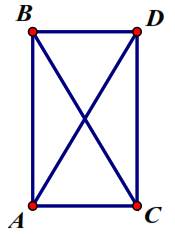
Xét tam giác $ABC$ vuông tại $A$ có $\widehat{ABC} = 30^{\circ}$ và $BC = a\sqrt{5}$ ($a > 0$), ta có:
$AC = BC \cdot \sin 30^{\circ} = a\sqrt{5} \cdot \dfrac{1}{2} = \dfrac{a\sqrt{5}}{2}$,
$AB = BC \cdot \cos 30^{\circ} = a\sqrt{5} \cdot \dfrac{\sqrt{3}}{2} = \dfrac{a\sqrt{15}}{2}$.
Ta tính độ dài các vectơ như sau:
$|\overrightarrow{AB} + \overrightarrow{BC}| = |\overrightarrow{AC}| = AC = \dfrac{a\sqrt{5}}{2}$.
$|\overrightarrow{AC} - \overrightarrow{BC}| = |\overrightarrow{AC} + \overrightarrow{CB}| = |\overrightarrow{AB}| = AB = \dfrac{a\sqrt{15}}{2}$.
Dựng hình chữ nhật $ABDC$ (do $\widehat{BAC} = 90^{\circ}$). Theo quy tắc hình bình hành, ta có $\overrightarrow{AB} + \overrightarrow{AC} = \overrightarrow{AD}$.
Vì hai đường chéo của hình chữ nhật bằng nhau nên $AD = BC = a\sqrt{5}$. Vậy $|\overrightarrow{AB} + \overrightarrow{AC}| = |\overrightarrow{AD}| = AD = a\sqrt{5}$.
Cho hình vuông $ABCD$ có tâm là $O$ và cạnh $a$ ($a > 0$). $M$ là một điểm bất kì.
a) Tính $|\overrightarrow{AB} + \overrightarrow{AD}|$, $|\overrightarrow{OA} - \overrightarrow{CB}|$, $|\overrightarrow{CD} - \overrightarrow{DA}|$.
b) Chứng minh rằng $\overrightarrow{u} = \overrightarrow{MA} + \overrightarrow{MB} - \overrightarrow{MC} - \overrightarrow{MD}$ không phụ thuộc vị trí điểm $M$. Tính độ dài vectơ $\overrightarrow{u}$.
Hướng dẫn giải
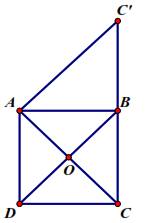
a) Vì $ABCD$ là hình vuông cạnh $a$ ($a > 0$) nên $AC = BD = a\sqrt{2}$ và $OD = \dfrac{1}{2}BD = \dfrac{a\sqrt{2}}{2}$.
- Theo quy tắc hình bình hành, ta có $\overrightarrow{AB} + \overrightarrow{AD} = \overrightarrow{AC}$, suy ra $|\overrightarrow{AB} + \overrightarrow{AD}| = |\overrightarrow{AC}| = AC = a\sqrt{2}$.
- Vì $ABCD$ là hình vuông nên $\overrightarrow{CB} = \overrightarrow{DA}$, suy ra $\overrightarrow{OA} - \overrightarrow{CB} = \overrightarrow{OA} - \overrightarrow{DA} = \overrightarrow{OA} + \overrightarrow{AD} = \overrightarrow{OD}$.
Do đó $|\overrightarrow{OA} - \overrightarrow{CB}| = |\overrightarrow{OD}| = OD = \dfrac{a\sqrt{2}}{2}$.
- Vì $ABCD$ là hình vuông nên $\overrightarrow{CD} = \overrightarrow{BA}$, suy ra $\overrightarrow{CD} - \overrightarrow{DA} = \overrightarrow{BA} + \overrightarrow{AD} = \overrightarrow{BD}$.
Do đó $|\overrightarrow{CD} - \overrightarrow{DA}| = |\overrightarrow{BD}| = BD = a\sqrt{2}$.
b) Ta có: $\overrightarrow{u} = \overrightarrow{MA} + \overrightarrow{MB} - \overrightarrow{MC} - \overrightarrow{MD} = (\overrightarrow{MA} - \overrightarrow{MC}) + (\overrightarrow{MB} - \overrightarrow{MD}) = \overrightarrow{CA} + \overrightarrow{DB}$.
Vì $\overrightarrow{CA} + \overrightarrow{DB}$ là tổng của hai vectơ cố định nên vectơ $\overrightarrow{u}$ không phụ thuộc vào vị trí điểm $M$.
Dựng điểm $E$ sao cho $\overrightarrow{AE} = \overrightarrow{DB}$, khi đó $ADBE$ là hình bình hành nên $AE \parallel BD$ và $AE = BD = a\sqrt{2}$.
Ta có $\overrightarrow{u} = \overrightarrow{CA} + \overrightarrow{AE} = \overrightarrow{CE}$.
Vì hai đường chéo $AC$ và $BD$ của hình vuông $ABCD$ vuông góc với nhau nên $CA \perp AE$. Xét tam giác $CAE$ vuông tại $A$, theo định lí Pythagore ta có:
$CE = \sqrt{CA^2 + AE^2} = \sqrt{(a\sqrt{2})^2 + (a\sqrt{2})^2} = \sqrt{4a^2} = 2a$.
Vậy $|\overrightarrow{u}| = |\overrightarrow{CE}| = CE = 2a$.