

K
Khách
Hãy nhập câu hỏi của bạn vào đây, nếu là tài khoản VIP, bạn sẽ được ưu tiên trả lời.
Các câu hỏi dưới đây có thể giống với câu hỏi trên

12 tháng 10 2017
Bài 1
1.(x-3)(x+2)-x(x-7)=15
\(\Leftrightarrow x^2+2x-3x-6-x^2+7x=15\)
\(\Leftrightarrow-6+6x=15\)
\(\Leftrightarrow6x=15+6\) =21
\(\Rightarrow x=\dfrac{21}{6}=3,5\)
2.(x-5)(x+5)+x(3-x)=20
\(\Leftrightarrow x^2-25+3x-x^2=20\)
\(\Leftrightarrow-25+3x=20\)
\(\Leftrightarrow3x=20+25=45\)
\(\Rightarrow x=\dfrac{45}{3}=15\)
3.(x-7)2-x(2+x)=-7
\(\Leftrightarrow x^2-14x+49-2x-x^2=-7\)
\(\Leftrightarrow-16x+49=-7\)
\(\Leftrightarrow-16x=-7-49=-56\)
\(\Rightarrow x=\dfrac{-56}{-16}=\dfrac{7}{2}=3,5\)
12 tháng 10 2017
Tiếp bài 1
4.(x-4)2-(x+4)(x-4)=-16
\(\Leftrightarrow x^2-8x+16-x^2-16=-16\)
\(\Leftrightarrow-8x=-16\)
\(\Rightarrow x=\dfrac{-16}{-8}=2\)
5.(x-5)(x+5)-x(2-3x)=4x2-7
\(\Leftrightarrow x^2-25-2x+3x^2=4x^2-7\)
\(\Leftrightarrow4x^2-25-2x+3x^2=4x^2-7\)
\(\Leftrightarrow4x^2-4x^2-2x=-7+25\)
\(\Leftrightarrow-2x=18\)
\(\Rightarrow x=\dfrac{18}{-2}=-9\)
13 tháng 7 2017
\(\left(x+4\right)\left(x^2-4x+16\right)-x\left(x-4\right)^2=8\left(x-3\right)\left(x+3\right)\)3)
\(\Leftrightarrow x^3+4^3-x\left(x-4\right)^2=8\left(x^2-3^2\right)\)
\(\Leftrightarrow x^3+64-x\left(x^2-8x+16\right)=8x^2-72\)
\(\Leftrightarrow x^3+64-x^3+8x^2-16x-8x^2-72=0\)
\(\Leftrightarrow-16x-8=0\)
\(\Leftrightarrow-8\left(2x-1\right)=0 \)
\(\Rightarrow2x-1=0\)
\(\Leftrightarrow2x=1\)
\(\Leftrightarrow x=\frac{1}{2}\)
Vậy \(x=\frac{1}{2}\)
NQ
Nguyễn Quốc Đạt
CTVVIP
24 tháng 7
$\textbf{1)}$
$(4x-1)^2-2(4x-1)(3x-7)+(7-3x)^2$
$=(4x-1)^2-2(4x-1)(3x-7)+(3x-7)^2$
$=\left[(4x-1)-(3x-7)\right]^2$
$=(x+6)^2.$
Tại $x=44$: $(44+6)^2=50^2=2500.$
NQ
Nguyễn Quốc Đạt
CTVVIP
24 tháng 7
$\textbf{2)}$
$(2x-5)^2-2(2x-5)(3x-4)+(4-3x)^2$
$=(2x-5)^2-2(2x-5)(3x-4)+(3x-4)^2$
$=\left[(2x-5)-(3x-4)\right]^2$
$=(x+1)^2.$
Tại $x=24$: $(24+1)^2=625.$
LV
18 tháng 1 2022
một đòn bẫy dài một mét .đặt ở đâu để có thể dùng 3600n có thể nâng tảng đá nặng 120kg?
NQ
Nguyễn Quốc Đạt
CTVVIP
24 tháng 7
$\textbf{5)}$
$(4x-5)(x+2)-(x+5)(x-3)-3x^2-x$
$=(4x^2+3x-10)-(x^2+2x-15)-3x^2-x$
$=4x^2+3x-10-x^2-2x+15-3x^2-x$
$=5.$
NL
Nguyễn Lê Phước Thịnh
CTVHS
3 tháng 7 2022
a: \(\dfrac{1}{x-2}+3=\dfrac{3-x}{x-2}\)
=>1+3x-6=3-x
=>3x-5=3-x
=>4x=8
hay x=2(loại)
b: \(\Leftrightarrow8-x-8\left(x-7\right)=-26\)
=>8-x-8x+56=-26
=>-9x+64=-26
=>-9x=-90
hay x=10(nhận)
c: \(\dfrac{1}{x-2}+\dfrac{1}{x-3}=\dfrac{2}{x-1}\)
\(\Leftrightarrow\dfrac{x-3+x-2}{\left(x-2\right)\left(x-3\right)}=\dfrac{2}{x-1}\)
\(\Leftrightarrow\left(x-1\right)\left(2x-5\right)=2\left(x^2-5x+6\right)\)
\(\Leftrightarrow2x^2-5x-2x+5=2x^2-10x+12\)
=>-7x+10x=12-5
=>3x=7
hay x=7/3(nhận)
NL
Nguyễn Lê Phước Thịnh
CTVHS
23 tháng 5 2022
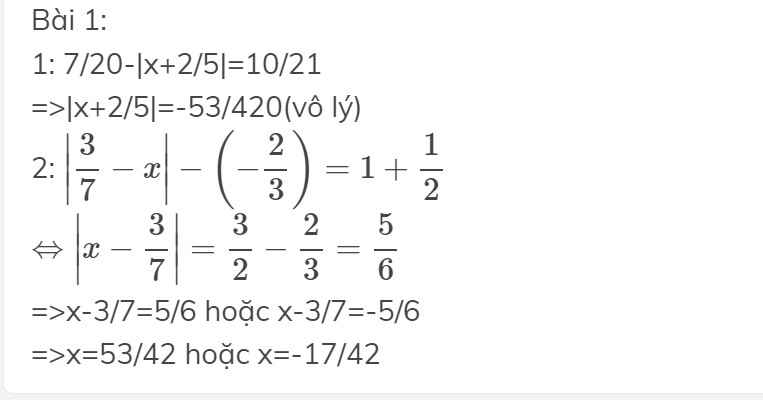
3: \(-\dfrac{1}{2}+\left|\dfrac{1}{3}x+\dfrac{2}{5}\right|=\dfrac{5}{7}\cdot\dfrac{3}{11}+\dfrac{8}{11}\cdot\dfrac{5}{7}=\dfrac{5}{7}\)
=>|1/3x+2/5|=5/7+1/2=17/14
=>1/3x+2/5=17/14 hoặc 1/3x+2/5=-17/14
=>x=171/70 hoặc x=-339/70
Ko chép lại đề!
\(\Leftrightarrow x^2-7^2+x^2-2=2x^2+10\)
\(\Leftrightarrow x^2-49+x^2-2=2x^2+10\)
\(\Leftrightarrow2x^2-51=2x^2+10\)
<=> -51 = 10 ( vô lý )
=> \(x\in\varnothing\)
\(\left(x+7\right)\left(x-7\right)+x^2-2=2\left(x^2+5\right)\)
\(\Leftrightarrow x^2-49+x^2-2=2x^2+10\)
\(\Leftrightarrow x^2+x^2-2x^2=10+2+49\)
\(\Leftrightarrow0x=61\)(vô nghiệm)
\(\Leftrightarrow x\in\varnothing\)
\(\left(x+7\right)\left(x-7\right)+x^2-2=2\left(x^2+5\right)\)
\(x^2-7^2+x^2-2=2x^2+10\)
\(x^2-49+x^2-2=2x^2+10\)
\(2x^2-51=2x^2+10\)
\(\Rightarrow-51=10\)(vô lí vl)
\(\Rightarrow x\in\varnothing\)