
Hãy nhập câu hỏi của bạn vào đây, nếu là tài khoản VIP, bạn sẽ được ưu tiên trả lời.


1. General information about the festival
(Thông tin chung về lễ hội)
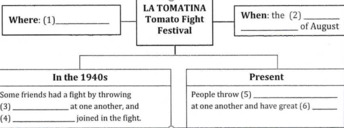
La Tomatina is an unusual festival. It's a fun fight with tomatoes. People hold it in Buñol, Spain on the last Wednesday of every August.
(La Tomatina là một lễ hội lạ thường. Đó là một cuộc chiến thú vị với cà chua. Mọi người tổ chức nó ở Buñol, Tây Ban Nha vào thứ Tư cuối cùng của tháng Tám hàng năm.)
Giải thích:The paragraph mentions many information related to the festival such as name, place, and time to celebrate the festival => B. General information about the festival.
(Đoạn văn đề cập đến nhiều thông tin liên quan đến lễ hội như tên, địa điểm, thời gian tổ chức lễ hội=> B. Thông tin chung về lễ hội.)
2. Activities at the festival
(Các hoạt động tại lễ hội)
In the town square, there is a high pole with a ham on top of it. People climb the pole and get the ham. At 11 a.m., a jet of water shoots from the water cannons, and people start throwing tomatoes. People throw bags of tomatoes at the crowd. They then throw tomatoes at one another. After one hour, there is another jet of water, and people stop throwing. The whole square now is red with rivers of tomato juice.
(Trong quảng trường của thị trấn, có một cái cột cao với một cái giăm bông trên đầu nó. Mọi người trèo lên cột và lấy cái giăm bông đó. Lúc 11 giờ sáng, một dòng nước bắn ra từ vòi rồng, và mọi người bắt đầu ném cà chua. Mọi người ném những túi cà chua vào đám đông. Sau đó, họ ném cà chua vào nhau. Sau một giờ, có một dòng nước nữa được bắn ra, mọi người ngừng ném. Cả quảng trường bây giờ đỏ rực như dòng sông nước ép cà chua.)
Giải thích: The paragraph mentions some activities at the festival like climbing the pole and getting the ham, throwing tomatoes at the crowd, and one another, …=> C. Activities at the festival
(Đoạn văn đề cập đến một số hoạt động tại lễ hội như leo cột và lấy giăm bông, ném cà chua vào đám đông và vào nhau, …=> C. Các hoạt động tại lễ hội)
3. Food after the festival
(Món ăn sau lễ hội)
After the fight, many people go to restaurants to try paella. It is a traditional Spanish rice dish. It has rice, chicken, seafood, and herbs.
(Sau cuộc chiến, nhiều người đến các nhà hàng để ăn thử món paella. Nó là một món cơm truyền thống của Tây Ban Nha. Nó có cơm, gà, hải sản và rau thơm.)
Giải thích: The paragraph mentions a food called paella. People enjoy this food after the fight =>A. Food after the festival
(Đoạn văn đề cập đến một món ăn có tên là “paella”. Mọi người thưởng thức món ăn này sau cuộc chiến=> A. Món ăn sau lễ hội)
V. Choose the word (A, B, C, or D) that best fits each of the blank spaces.
Yesterday, Carlos went (1)…to……..La Tomatina. The festival is held on the last Wednesday of August every year in Bunol, Spain. (2)……There…….were thousand of people there. In the morning, many people tried (3)…to climb……..up the pole to get the ham. At 1 a.m, they (4)……saw….a jet from the water cannons and the chaos began. Bags of tomatoes from trucks were (5)…thrown………..to the crowds, and they began throwing tomatoes at one another. They all had to wear goggles (6)…to protect……..their eyes.
After one hour, they saw another jet and stopped (7)……throwing….. the whole town square (8)……was…….red with rivers of tomato juice. Finally, they tried tomato Paella, a (9)……best…….Spanish dish.
V. Choose the word (A, B, C, or D) that best fits each of the blank spaces.
Yesterday, Carlos went (1)………to…..La Tomatina. The festival is held on the last Wednesday of August every year in Bunol, Spain. (2)………there….were thousand of people there. In the morning, many people tried (3)……to climb…..up the pole to get the ham. At 1 a.m, they (4)…saw…….a jet from the water cannons and the chaos began. Bags of tomatoes from trucks were (5)……thrown……..to the crowds, and they began throwing tomatoes at one another. They all had to wear goggles (6)………to protect..their eyes.
After one hour, they saw another jet and stopped (7)……throwing….. the whole town square (8)………was….red with rivers of tomato juice. Finally, they tried tomato Paella, a (9)……best…….Spanish dish.
Many countries all over the world celebrate the New Year holiday. In China, it is a very happy time. Chinese people think it is the most important time of the year. There are parades in the streets, and families gather for big dinners. At these dinners, children get lucky money in red envelopes as their good grade and achievements during the last year. Before the New Year, the Chinese people always clean their houses to clean out bad luck. Everything must be fresh and clean as they think that they will have a happy new year. People also make sure that they have paid all their bills. It is important to start a New Year without owning anyone’s money. Different from Chinese, in Thailand, people hold Water Festival. The festival takes place everywhere in the country but especially popular in the north. Water Festival takes place in the middle of April every year. It is a part of the Thai New Year. People throw buckets of water on each other. There are even parades where people throw water. It is especially important to throw water on older people. It shows respect to them.
56. What happen in the streets in China on New Year holiday?
There are parades in the streets.
57. Why do Chinese people clean their houses before the New Year?
They clean their houses to clean out bad luck.
58. What do they try to avoid when they start the New Year?
They try to avoid owing money.
59. When is the Water Festival held in Thailand?
It is held in the middle of April.
60. Why is it important to throw water on older people?
Because it shows respect to them.
 10C
Read the following passage, and then tick the correct answers: true (T), or false (F).
Songkran is Thailand's most famous festival. An Important event on the Buddhist calendar, this water festival marks the beginning of the traditional Thai New Year. Water is an important element of Songkran, especially in more recent times when the throwing of water has become a huge part of the annual celebrations. If you're visiting Thailand during this period, don't be surprised if you get splashed. Crowds of people roam around throwing buckets of water, using water pistols and just generally soaking anyone in the vicinity. Appreciation of family is another important aspect of the festival, with many Thai people making their way to their hometowns to spend time with older relatives. Buddhists also visit temples throughout Songkran where water is poured on Buddha images and on the hands of Buddhist monks as a mark of respect. Without a doubt, Songkran is a hugely important festival to the Thai people but it's also very popular with visitors and many tourists specifically arrange their holidays around rhis unique event. Anyone and everyone can and will get involved in the celebrations. If you're out and about during Songkran, you're almost guaranteed to end up soaked but you'll have lost of fun in the process!
38. Songkran is considered the festival of the traditional Thai New Year. ---> T
39. Water has been used during the festival recently but not in the past. ---> F
40. People have many ways to makes each other wet with water. ---> T
41. Songkran is also an occasion for people to go to back to the hometown to spend time with their relatives. ---> T
42. It is certainly not a religious festival. ---> F
43. Everyone visits temples to pour water on Buddha images to show their respect. ---> T
44. The Thai do not let foreigners participate in the festival. ---> F
45. Songkran is actually a very important festival in Thailand. ---> T
46. Nearly everyone gets wet after talking part in the festival. ---> T
47. The festival only has the religious meaning but it is not enjoyable. ---> F
Complete the summary of the passage above with the correct words.
one another joined and had fun gather at
clean up tomato fight in the 1940s
La Tomatina is an exciting (1)_____tomato fight__________ festival in Brunol, Spain. It is held on the last Wednesday of August every year. (2)_____In 1940s_________, some friends fought with fruit and passers-by (3) ____joined and had fun______.
It became a festival called La Tomanita. On the festval, people (4) _____gather at_________ the main plaza. At 11 o’clock, the tomatoes arrive and people begin to throw them at (5) ___one other_________. They have great fun. Two hours later, people help to (6) ___clean up_________ the street.