

K
Khách
Hãy nhập câu hỏi của bạn vào đây, nếu là tài khoản VIP, bạn sẽ được ưu tiên trả lời.
Các câu hỏi dưới đây có thể giống với câu hỏi trên
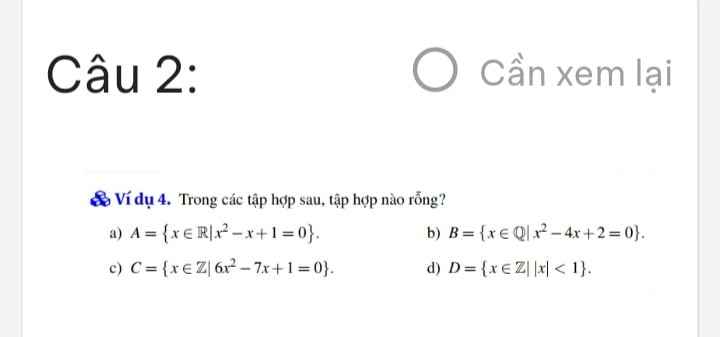
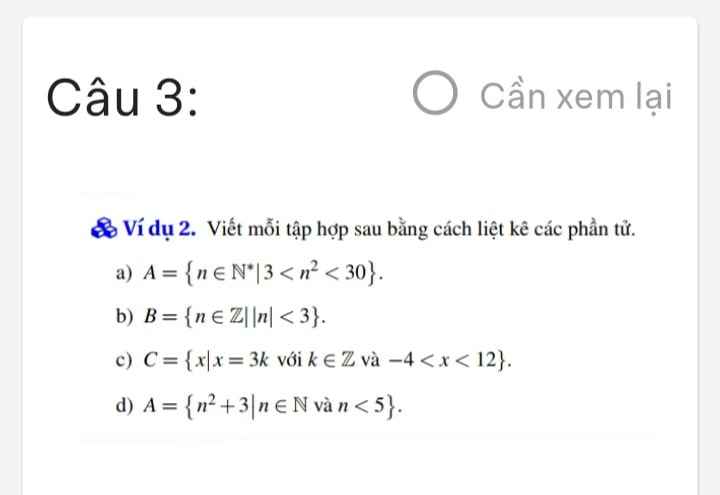
16 tháng 9 2021
a)\(A=\left\{2,3,4,5\right\}\)
b)\(B=\left\{-2,-1,0,1,2\right\}\)
c)\(C=\left\{-3;0;3;6;9\right\}\)
d)\(A=\left\{3;4;7;12;19\right\}\)


AM
20 tháng 2 2022
Câu 13:
Ta có: \(f\left(x\right)>0\Leftrightarrow3x-m>0\Leftrightarrow3x>m\)
Mà x>1 hay 3x>3
Vậy \(m\le3\)
Đáp án C
AM
20 tháng 2 2022
Câu 14:
(d): x-2y+1=0 hay \(\dfrac{1}{2}x+\dfrac{1}{2}=y\)
Gọi phương trình đường thẳng cần tìm là: y=ax+b
Phương trình cần tìm đi qua A nên ta có: 2=-2a+b
Để phương trình cần tìm vuông góc với (d) thì: \(a.\dfrac{1}{2}=-1\Rightarrow a=-2\)\(\Rightarrow b=-2\)
Vậy phương trình cần tìm là: \(y=-2x-2\)
Đáp án C
NT
1
NL
Nguyễn Lê Phước Thịnh
CTVHS
31 tháng 12 2021
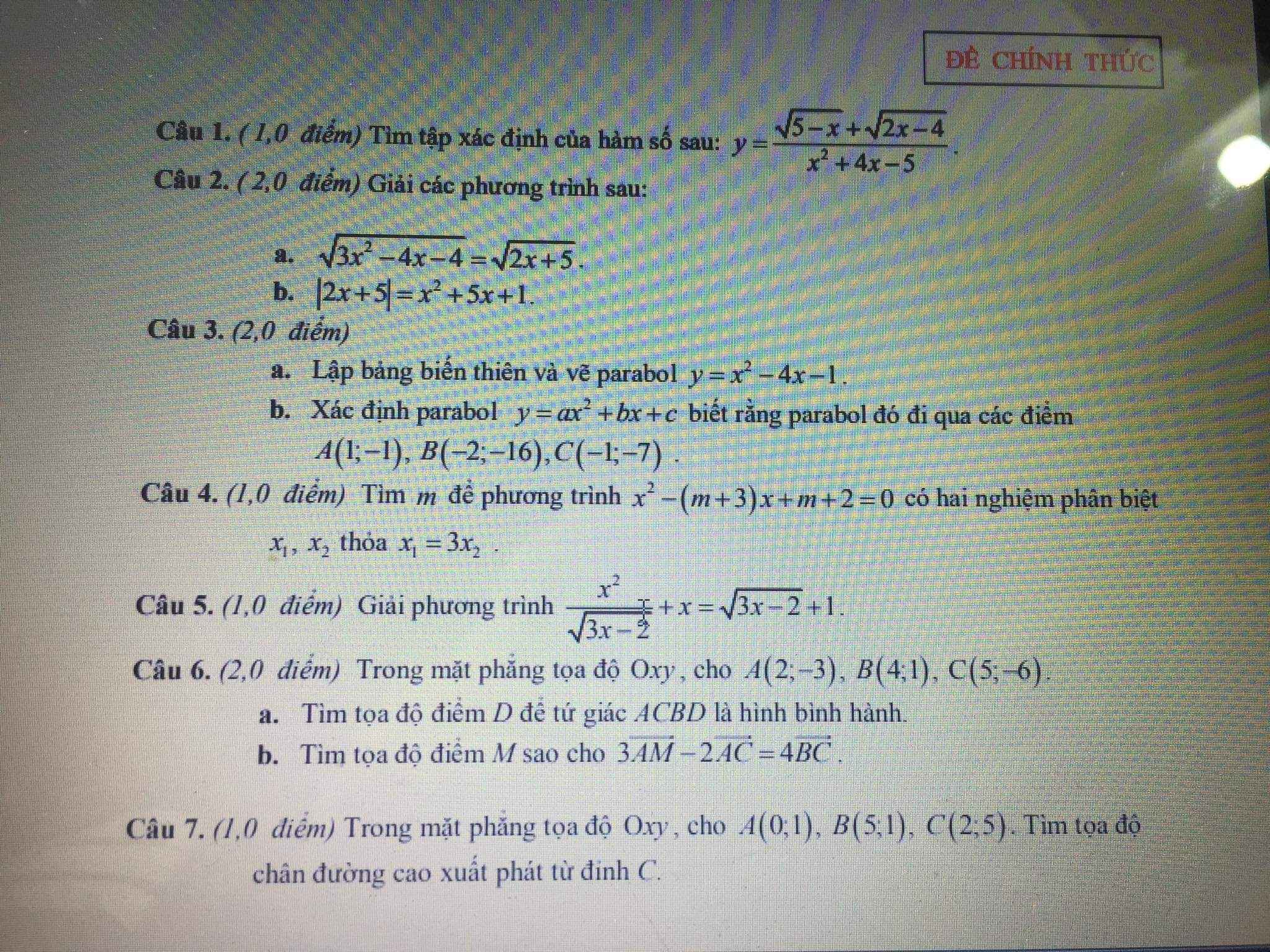
Câu 6:
a: \(\overrightarrow{AC}=\left(3;-3\right)\)
\(\overrightarrow{DB}=\left(4-x_D;1-y_D\right)\)
Để ACBD là hình bình hành thì \(\left\{{}\begin{matrix}4-x_D=3\\1-y_D=-3\end{matrix}\right.\Leftrightarrow D\left(1;4\right)\)
HT

1
4 tháng 10 2021
a.
Do (P) qua M và N nên:
\(\left\{{}\begin{matrix}a-b+4=7\\16a-4b+4=4\end{matrix}\right.\) \(\Rightarrow\left\{{}\begin{matrix}a=-1\\b=-4\end{matrix}\right.\)
b.
Do (P) có trục đối xứng x=2 và qua A nên:
\(\left\{{}\begin{matrix}-\dfrac{b}{2a}=2\\4a+2b+4=-4\end{matrix}\right.\)
\(\Leftrightarrow\left\{{}\begin{matrix}4a+b=0\\4a+2b=-8\end{matrix}\right.\) \(\Rightarrow\left\{{}\begin{matrix}a=2\\b=-8\end{matrix}\right.\)
HT

1
NL
Nguyễn Lê Phước Thịnh
CTVHS
17 tháng 3
Câu 1:
\(\Delta=\left(-2m\right)^2-4\cdot1\cdot\left(m^2+m-3\right)\)
\(=4m^2-4m^2-4m+12=-4m+12\)
Để phương trình vô nghiệm thì -4m+12<0
=>-4m<-12
=>m>3
=>Chọn C
Câu 2: Theo Vi-et, ta có: \(x_1+x_2=-\frac{b}{a}=3;x_1x_2=\frac{c}{a}=-1\)
\(x_1^2+x_2^2=\left(x_1+x_2\right)^2-2x_1x_2\)
\(=3_{}^2-2\cdot\left(-1\right)=9+2=11\)
=>Chọn A
Câu 3: D
Câu 4: D
Câu 5: B
Câu 6: C
Câu 7: |x-2|=|3x-5|
=>3x-5=x-2 hoặc 3x-5=-x+2
=>2x=3 hoặc 4x=7
=>x=3/2 hoặc x=7/4
=>Chọn C
Câu 8: A
Câu 9: C
Câu 10: D

14 tháng 12 2021
Câu 2:
\(a,\Leftrightarrow\Delta'=\left(1-m\right)^2-\left(m^2-m\right)>0\\ \Leftrightarrow m^2-2m+1-m^2+m>0\\ \Leftrightarrow1-m>0\Leftrightarrow m< 1\\ b,\text{Áp dụng Viét: }\left\{{}\begin{matrix}x_1+x_2=2\left(1-m\right)\\x_1x_2=m^2-m\end{matrix}\right.\\ \left(2x_1-1\right)\left(2x_2-1\right)-x_1x_2=1\\ \Leftrightarrow2x_1x_2-2\left(x_1+x_2\right)+1-x_1x_2=1\\ \Leftrightarrow x_1x_2-2\left(x_1+x_2\right)=0\\ \Leftrightarrow m^2-m-4\left(1-m\right)=0\\ \Leftrightarrow m^2+3m-4=0\\ \Leftrightarrow\left(m-1\right)\left(m+4\right)=0\\ \Leftrightarrow\left[{}\begin{matrix}m=1\left(ktm\right)\\m=-4\left(tm\right)\end{matrix}\right.\)
Vậy m=-4
14 tháng 12 2021
Câu 1:
\(1,\Leftrightarrow2x-2=3\Leftrightarrow x=\dfrac{5}{2}\\ 2,ĐK:x\ne\pm1\\ PT\Leftrightarrow\dfrac{2x^2+2x-1}{x^2-1}=2\\ \Leftrightarrow2x^2+2x-1=2x^2-2\\ \Leftrightarrow2x=-1\Leftrightarrow x=-\dfrac{1}{2}\left(tm\right)\\ 3,\Leftrightarrow\left[{}\begin{matrix}3x-2=2x-1\\3x-2=1-2x\end{matrix}\right.\Leftrightarrow\left[{}\begin{matrix}x=1\\x=\dfrac{3}{5}\end{matrix}\right.\)
\(4,\Leftrightarrow\left[{}\begin{matrix}3x-1=2-x\left(x\ge\dfrac{1}{3}\right)\\3x-1=x-2\left(x< \dfrac{1}{3}\right)\end{matrix}\right.\Leftrightarrow\left[{}\begin{matrix}x=\dfrac{3}{4}\left(tm\right)\\x=-\dfrac{1}{2}\left(tm\right)\end{matrix}\right.\\ 5,\Leftrightarrow4x^2-2x+10=9x^2-6x+1\left(x\le\dfrac{1}{3}\right)\\ \Leftrightarrow5x^2-4x-9=0\\ \Leftrightarrow\left[{}\begin{matrix}x=\dfrac{9}{5}\left(ktm\right)\\x=-1\left(tm\right)\end{matrix}\right.\)
\(6,\Leftrightarrow3x^2-9x+1=x^2-4x+4\left(x\ge2\right)\\ \Leftrightarrow2x^2-5x-3=0\\ \Leftrightarrow\left[{}\begin{matrix}x=3\left(tm\right)\\x=-\dfrac{1}{2}\left(ktm\right)\end{matrix}\right.\\ 7,\Leftrightarrow2x^2+3x-4=7x+2\left(x\ge-\dfrac{2}{7}\right)\\ \Leftrightarrow x^2-2x-3=0\\ \Leftrightarrow\left[{}\begin{matrix}x=3\left(tm\right)\\x=-1\left(ktm\right)\end{matrix}\right.\)
Nội dung câu hỏi đâu em ha?